Most orchids grown indoors don't fail because of watering mistakes. They fail because the light is wrong. Too dim and you get lush, dark green leaves with no flowers. Too intense and you see bleached patches and crispy tips. The right grow light, dialed in properly, is genuinely the single biggest variable you can control. This guide covers what orchids actually need from a light source, how specific models perform in real home setups, and how to get the timing and height right so your plants flower reliably.
Grow Lights for Orchids Reviews: Best Picks by Type

Marcus Caldwell
21 Apr 2026
What orchids actually need from a grow light
Orchids are not a monolith. Phalaenopsis, the moth orchid you see everywhere, is genuinely a low-light plant. The American Orchid Society puts its maximum light tolerance at around 1,500 foot-candles, which converts to roughly 16,000–17,000 lux or, in PPFD terms, somewhere in the 150–250 µmol/m²/s range for comfortable vegetative growth. Research on Phalaenopsis and Doritaenopsis vegetative growth suggests that 200–400 µmol/m²/s PPFD covers most productive growth scenarios, with the lower end being safer for acclimation. Cattleyas want more, around 3,000 fc. Cymbidiums, Oncidiums, and Dendrobiums can handle up to 5,000 fc. Miltoniopsis and Zygopetalum sit in the middle at about 2,500 fc. So before you buy anything, know your genus.
Spectrum matters too, and blue light deserves more credit than it usually gets. Research on Phalaenopsis specifically shows that blue-light acclimation helps reduce photoinhibition, meaning blue wavelengths actively support how these plants cope with their light environment, even at the lower intensities they prefer. A full-spectrum LED with a meaningful blue component (roughly 450–470 nm) and strong red output (630–660 nm) is what you want. Warm-white LEDs alone, or grow bulbs with a heavy pink bias and almost no green or blue, tend to underperform for long-term plant health.
Photoperiod is the third leg of the stool. The American Orchid Society recommends 12–14 hours of light daily for most orchids to flower successfully, but also notes that many orchids need at least 10–12 hours of uninterrupted darkness per night. Some orchids are short-day plants that only bloom if they receive fewer than 12 hours of light, so running your lights indefinitely actually prevents flowering. Even ambient room lighting during the dark period can disrupt the cycle. A programmable timer is not optional; it is part of the light system.
How we compare grow lights for orchids
Every light reviewed or referenced here gets evaluated on the same set of criteria. This is how we cut through marketing specs and find what actually matters on a shelf or in a tent.
- PPFD and coverage: We look at measured PPFD (µmol/m²/s) at realistic hanging heights (typically 12–24 inches), not just peak center readings. For orchids, a usable PPFD of 150–300 µmol/m²/s across the coverage footprint is the target for Phalaenopsis; 300–500+ for Cattleyas and high-light types.
- Wattage and efficiency: True watt draw from the wall, not 'equivalent' watts. Efficiency matters for running costs and heat output. Anything above 2.0 µmol/J is solid; above 2.5 µmol/J is excellent for 2026 standards.
- Build quality and heat: Heat near the canopy stresses orchids and can prevent flowering in Phalaenopsis if temperatures exceed 82°F (28°C). Lights that run cool at the canopy level are a real advantage.
- Controls and dimming: Dimming capability lets you dial in the right PPFD without repositioning the fixture, which is especially useful on a shelf. Timers, daisy-chain ports, and app control are bonuses.
- Form factor: Bar lights spread light more evenly over a shelf than a single panel. Circular or square panels work better in a tent. Clip-on or gooseneck bulbs suit single-plant setups.
- Value: Cost per µmol/J delivered at the coverage area, not just sticker price. A $40 light that covers one plant well is better value for that use case than a $200 panel covering four plants you don't have.
Best grow lights for orchids: top picks by setup
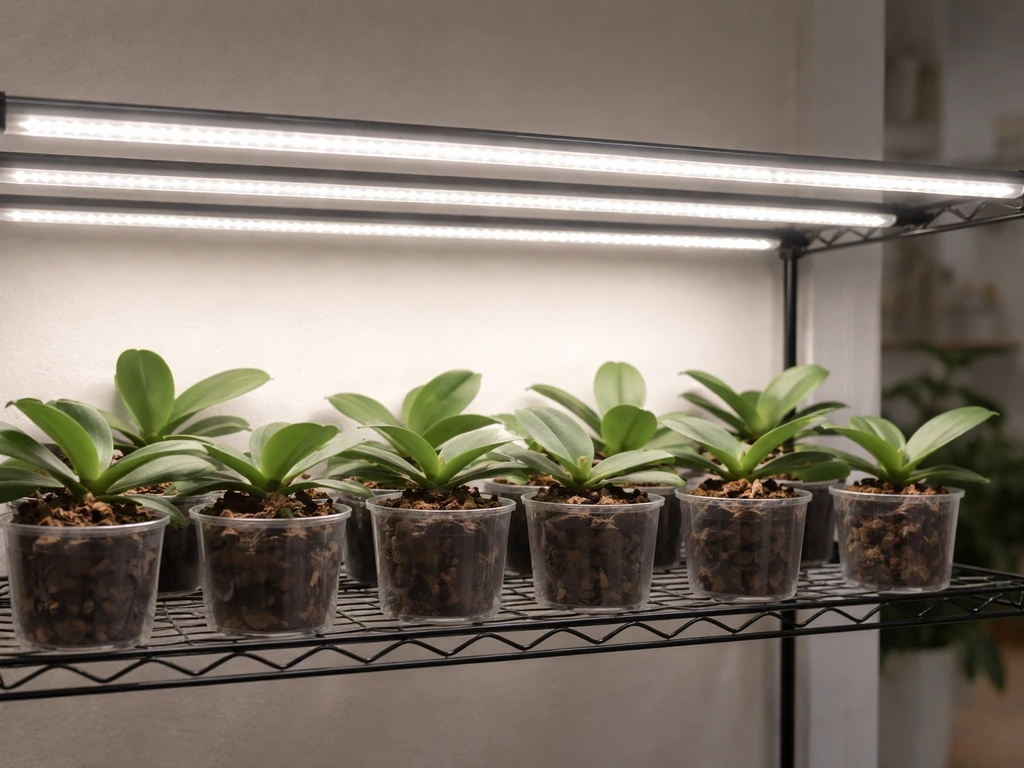
These are the configurations that consistently deliver for orchid growers in real home environments. I've organized them by setup type because the right light for a four-shelf baker's rack is completely different from what works in a 2x2 grow tent or on a windowsill.
Best for shelves: full-spectrum LED bar lights
For shelves, bar-style LED lights are the clear winner. They spread light evenly across the width of a shelf instead of hot-spotting the center, which matters when you have six to ten pots side by side. The Spider Farmer SF series bar lights (the SF600 and SF1000 in strip configurations) are strong performers here. The SF1000 draws about 100W true from the wall, covers a 2x4 ft footprint reasonably well, and delivers 200–280 µmol/m²/s at 18–24 inches in the center zone, which is right in the Phalaenopsis sweet spot. The dimmer is smooth and goes down to around 10%, which lets you reduce intensity for newly acquired plants. Build is solid aluminum with passive cooling, so there's no fan noise and the canopy stays cool.
Mars Hydro's TS and FC-E series are popular alternatives. The TS600 (around 100W true draw) is slightly warmer in spectrum, which some growers prefer for triggering blooms, but it covers a smaller sweet-spot footprint than the Spider Farmer bar arrangement. If you're stacking shelves, the Barrina T5-style full-spectrum LED strips are a budget-friendly option. They don't have dimmers, but at 8W per tube running 4–6 tubes per shelf, you get even coverage and easy mounting. PPFD is modest, sitting around 80–150 µmol/m²/s at 8–10 inches, which is sufficient for Phalaenopsis on a tight shelf but may fall short for Cattleyas without more tubes.
Best for grow tents: dimmable quantum board panels
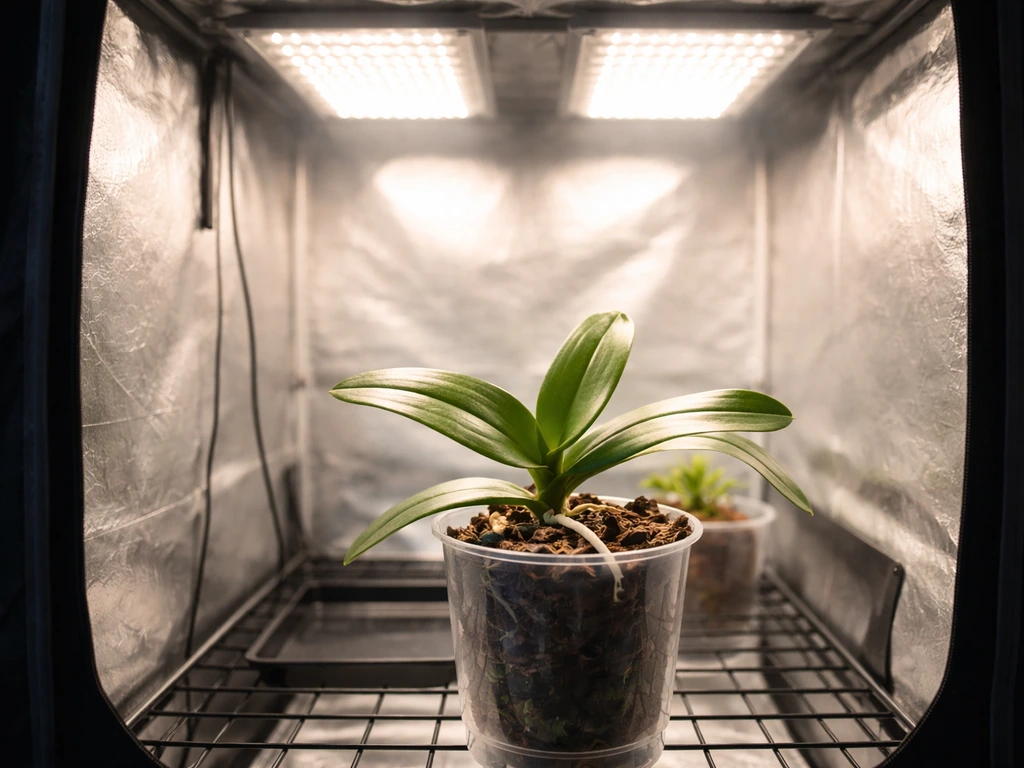
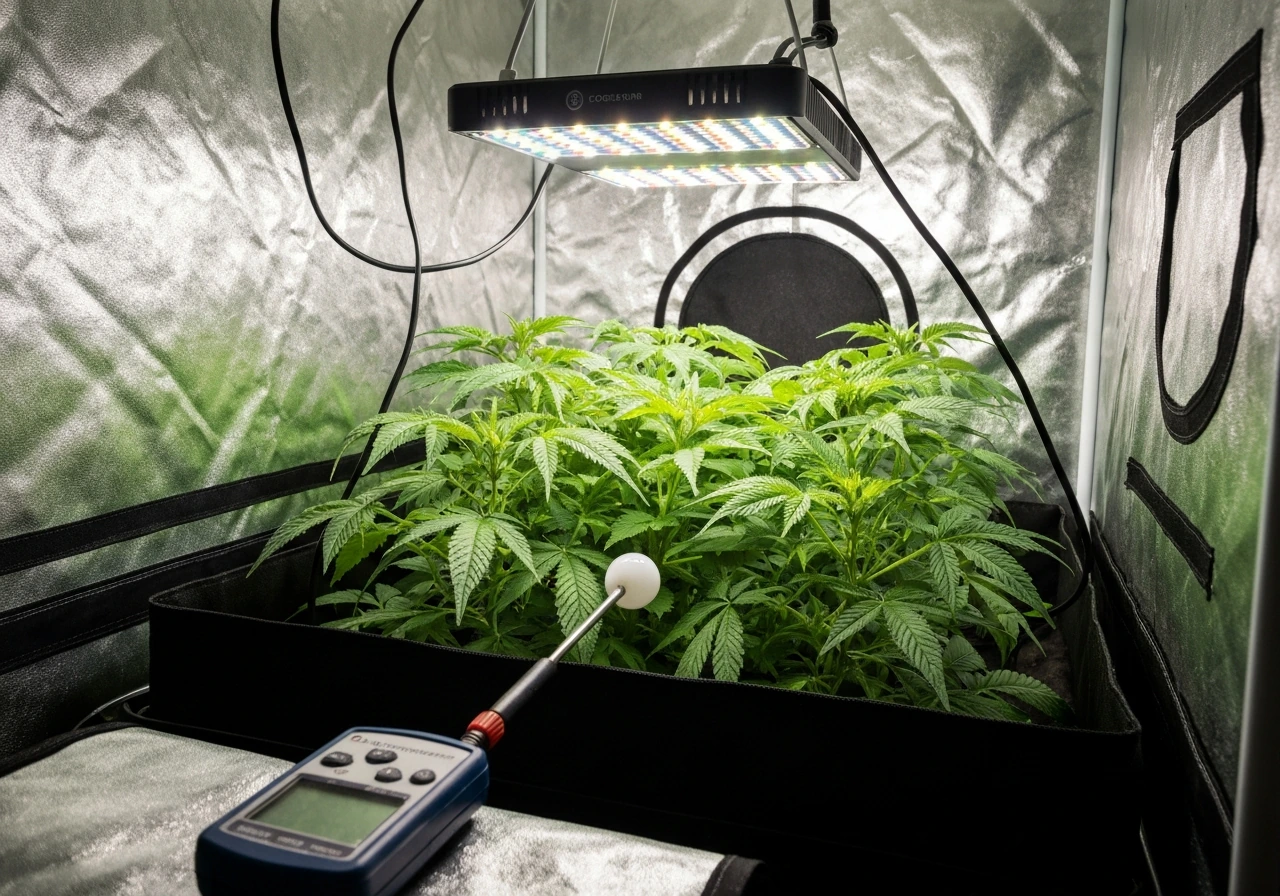
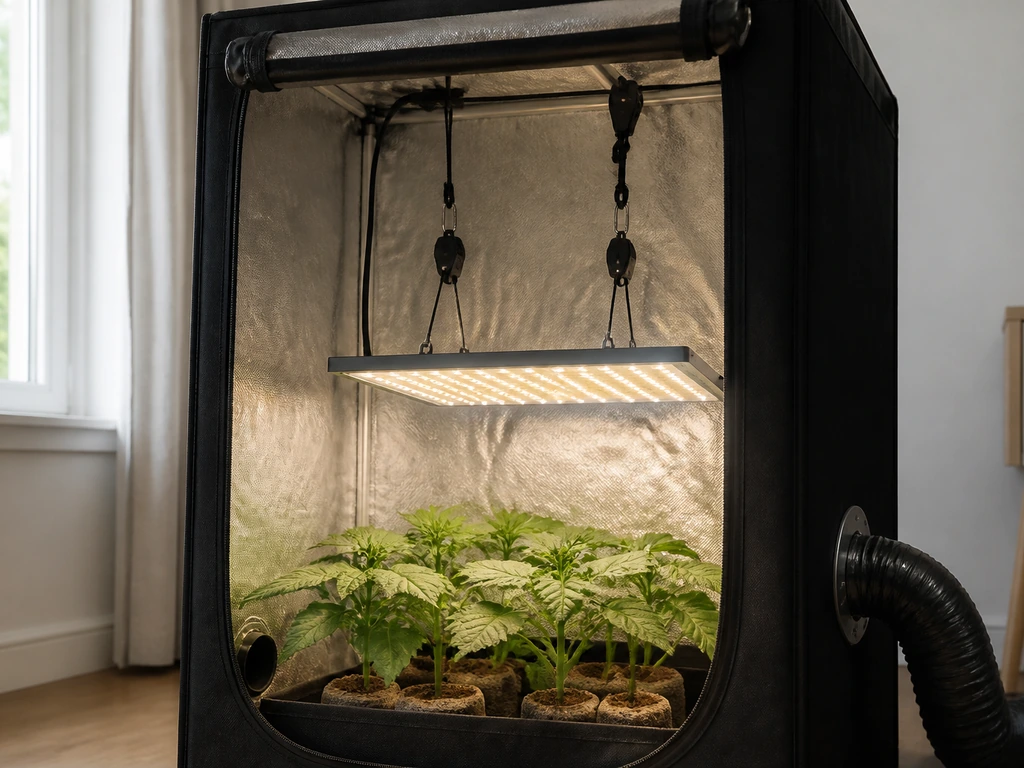
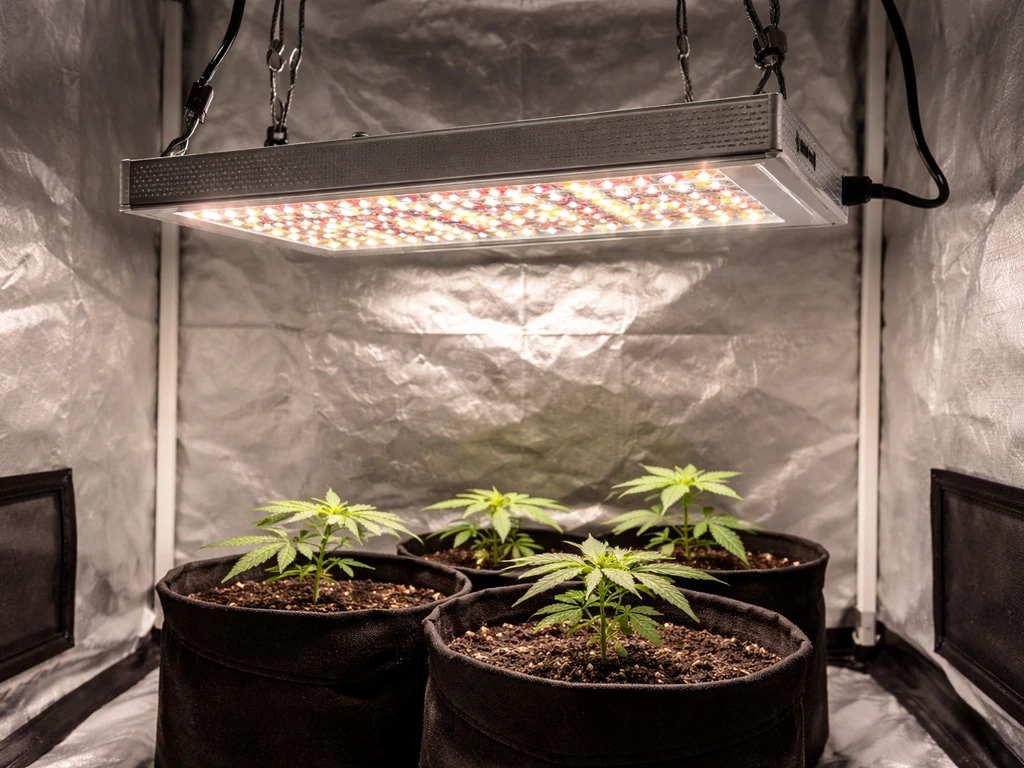
Inside a 2x2 or 2x4 ft tent, a quantum board panel is ideal. The reflective walls boost effective PPFD significantly (often 20–30% more than the same light in open air), so you can dim down more than you'd expect. The HLG 65 V2 (65W true draw) is a well-regarded option for a 2x2 tent with orchids. It runs cool, has a reliable driver, and at 18–24 inches delivers a comfortable 200–350 µmol/m²/s across most of the footprint. For a 2x4 tent housing a mixed collection, the HLG 200 Rspec or the Spider Farmer SF-2000 (around 200W true draw) give you enough headroom to serve both low-light Phalaenopsis on the edges and higher-light Oncidiums closer to center, which matches exactly the bench-positioning logic the Illinois Orchid Society recommends. If you want a closer look at how the 200W class performs, the Grow Light Science Grow 200 review is a helpful read before you buy. The Grow Light Science Grow 300 review breaks down how that specific model performs for orchid height, coverage, and real-world PPFD Grow Light Science Grow 200 review.
Best for single plants: clip-on LED grow lights
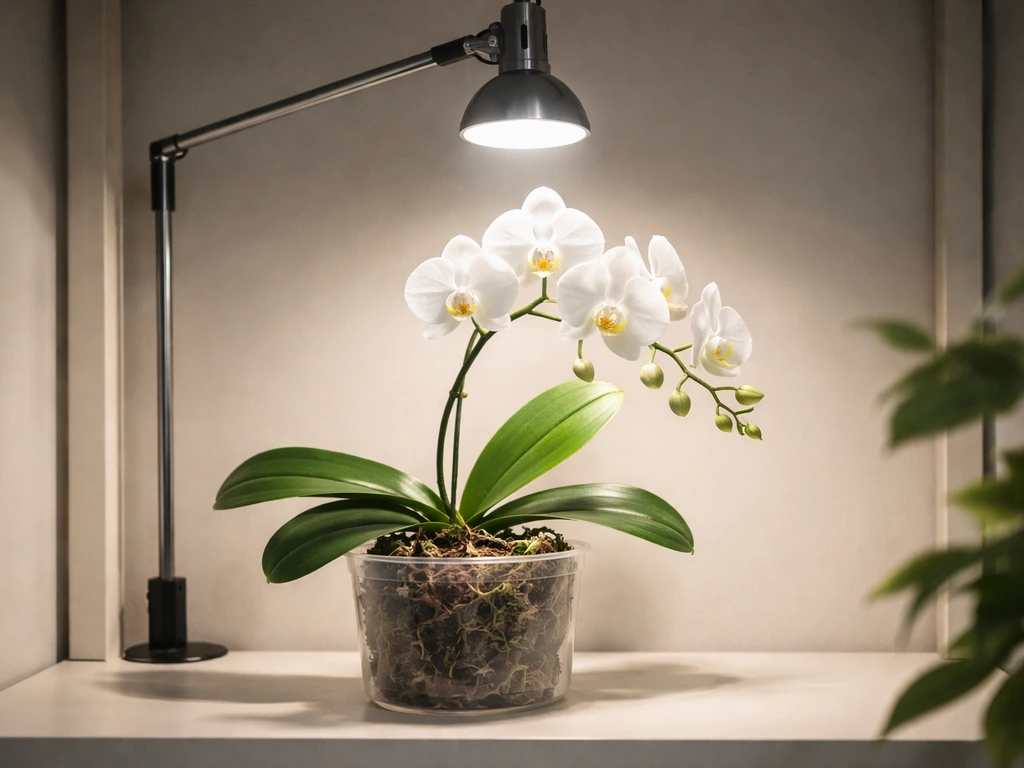
For one or two plants on a desk or windowsill, a clip-on or gooseneck LED is the practical solution. The Soltech Solutions Aspect is a standout here. It's designed specifically for houseplants, delivers a warm full-spectrum output, and looks good in a living space without the industrial-warehouse aesthetic of a quantum board. At the recommended 12–24 inch distance, it delivers enough PPFD for a Phalaenopsis to stay healthy and rebloom without scorching. The KOLLER Products PanamaX and the iGrowtek clip-on are more affordable alternatives that work adequately, though their coverage area is smaller and they lack dimming. For anyone who wants something that doubles as a desk lamp, these are the honest picks.
Best for multi-plant collections: commercial-grade LED bars
If you're running 20 or more plants across multiple shelves or a dedicated grow space, per-fixture cost and running efficiency become real factors. The Fluence RAZR and similar commercial-tier LED bar systems are what serious collectors and hobbyist growers scale up to. They're more expensive upfront, but the efficiency (often 2.7–3.0+ µmol/J) means lower monthly electricity cost per plant. For a more accessible middle-ground option, the Spider Farmer SE series bars are designed for larger coverage and link together cleanly. If budget is the main constraint, the budget grow light category offers serviceable options, though you'll typically trade off uniform PPFD distribution and dimming flexibility. If you are working with a tight budget, check our budget grow lights review to compare the most practical options and what tradeoffs to expect. If you want more options, read our grow light heaven reviews to see how popular models stack up for orchids grow light category.
LED spectrum and what it actually does for your orchids
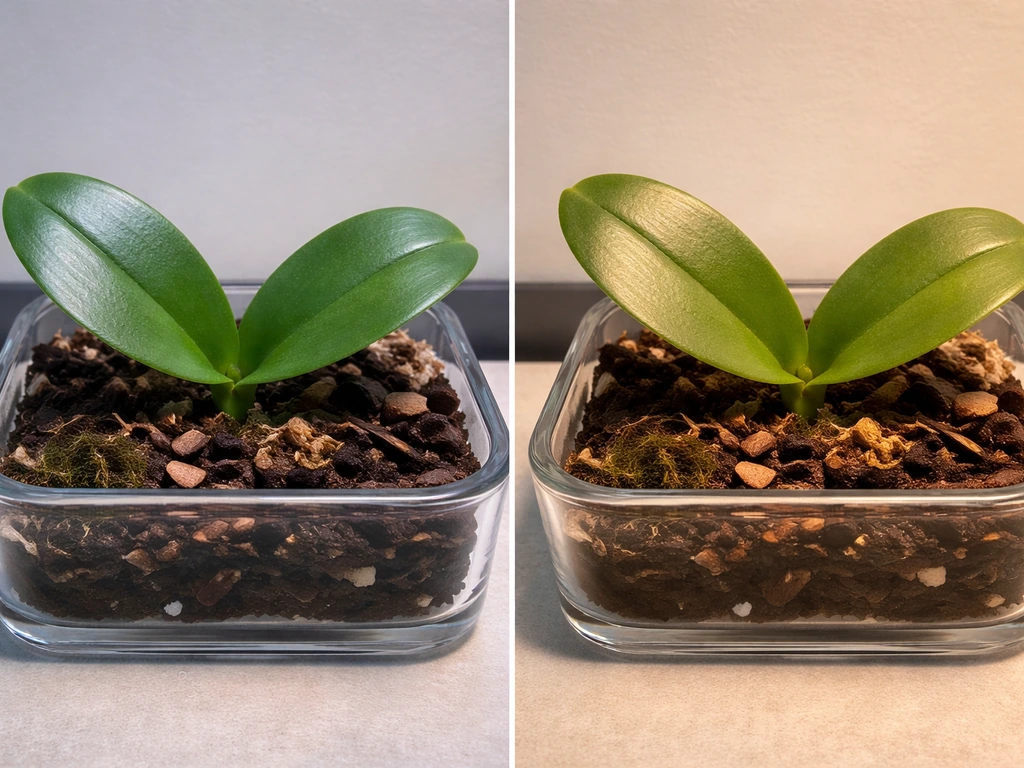
The spectrum question gets overcomplicated. Here's the straightforward version: full-spectrum white LEDs with a color temperature of 3500K–5000K cover the wavelengths orchids use for both vegetative growth and flowering. You don't need to obsess over a specific red:blue ratio if you're buying a reputable full-spectrum fixture. What you should pay attention to is whether a light leans warm (lower K, more red-orange) or cool (higher K, more blue).
For pure vegetative health and leaf development, a cooler spectrum (4000–6500K with strong blue output around 450 nm) supports photosynthetic efficiency. Blue light helps Phalaenopsis manage its light environment and reduces photoinhibition, which is useful when you're pushing the intensity higher than the plant is accustomed to. For triggering and sustaining flowering, a warmer spectrum with stronger red output (660 nm in particular) is what most grow light brands target with their 'bloom' or 'full cycle' LEDs. The Rspec and similar 660nm-boosted quantum boards are designed around this principle.
In practice, for most home orchid growers, a single full-spectrum light running year-round is sufficient. The photoperiod (hours of light vs. dark) is likely a bigger lever for triggering blooming than fine-tuning the spectrum, especially for Phalaenopsis. Where spectrum matters more is when you're growing high-light genera like Cymbidium or Cattleya under artificial light exclusively, as they need both more intensity and a spectrum that supports heavier photosynthetic throughput.
How to set up your orchid lighting correctly
Height and distance
The single most common setup mistake is hanging the light too far away. Most home growers, worried about burning their plants, position LED panels 30–36 inches above the canopy and then wonder why nothing blooms. For Phalaenopsis, start at 18–24 inches from the top of the leaves with a mid-range LED (100–200W true draw). For Cattleyas and Oncidiums, 12–18 inches from a comparable fixture is more appropriate. Use a PAR meter app (like Photone on a smartphone) to get a rough PPFD reading at the canopy and adjust accordingly. It won't be laboratory-accurate, but it will tell you if you're at 80 µmol/m²/s (too dim) versus 200+ (workable).
Timer schedule
Run a 12–14 hour light period for most orchids, with 12 hours being a safe default that satisfies both the minimum needed for flowering and the minimum dark period needed for short-day bloomers. The American Orchid Society also cautions that continuous lighting can cause undesirable responses, recommending at least a six-hour dark period each day 12–14 hour light period. Set the timer so the dark period is genuinely dark. If your grow space is in a room with evening ambient light, either move the setup or cover it. Even low-level room lighting during the dark window can interrupt the photoperiod cue. A mechanical or digital outlet timer costs under $15 and eliminates any daily guesswork.
Acclimation
When you first put a plant under a new grow light, especially one that's brighter than what the plant was previously getting, don't go straight to full intensity. Start at 50–60% output if you have a dimmable fixture, or hang the light 6–8 inches higher than your target height, and move it down (or increase intensity) over 2–3 weeks. Orchid leaves that darken noticeably within a week are telling you they're getting less light than before. Leaves that develop pale or yellowed patches within the first few days are telling you the intensity is too high for an unacclimated plant.
Spacing multiple plants
If you're mixing low-light and high-light orchids under the same fixture (say, Phalaenopsis and Cattleya on the same shelf), put the Phalaenopsis at the ends where PPFD drops off and Cattleyas in the center directly under the light. This is exactly the approach the Illinois Orchid Society recommends, and it works well because most bar lights and panels have a natural PPFD gradient that's 20–40% lower at the edges than at the center.
Diagnosing common light problems
| Symptom | Likely cause | Fix |
|---|---|---|
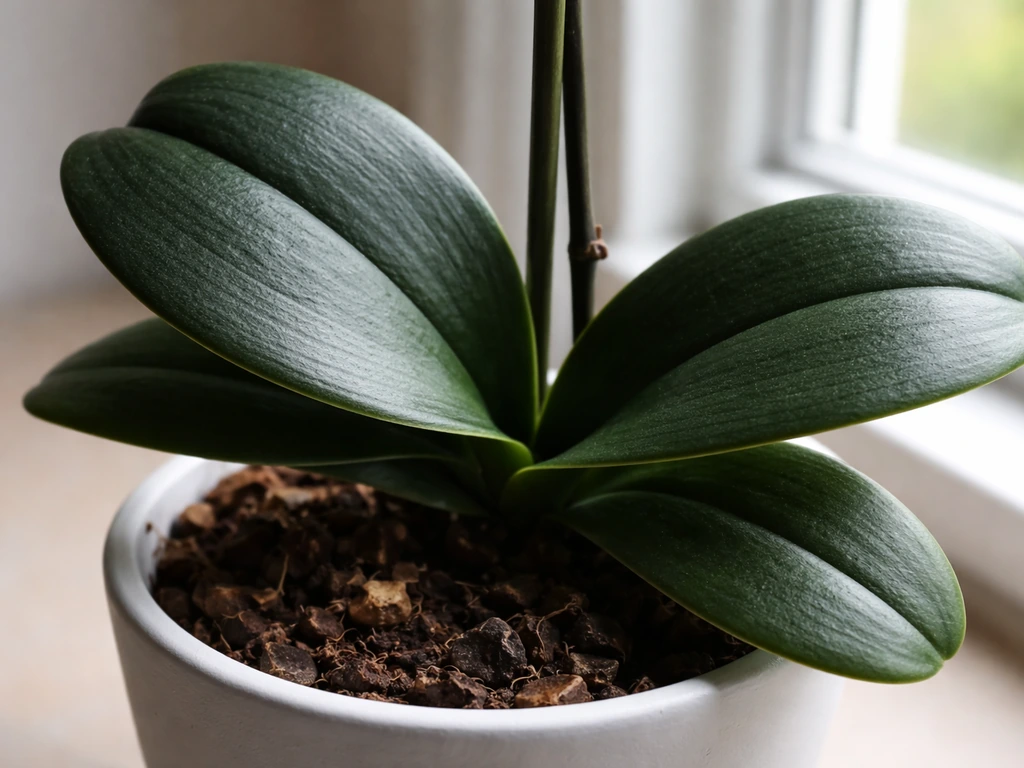
| Leaves turn very dark green, almost olive | Light is too dim; plant producing extra chlorophyll to compensate | Move light closer or increase dimmer; target 150–250 µmol/m²/s for Phalaenopsis |
| Pale yellow or bleached patches on upper leaves | Light intensity too high or too sudden for acclimation stage | Raise light or reduce dimmer; acclimate over 2–3 weeks |
| Leaves healthy but no flower spike after 12+ months | Insufficient photoperiod, wrong dark period, or temperatures too high | Set timer to 12 hrs on/12 hrs off; ensure room temp drops below 82°F at night; check that dark period is truly dark |
| Tips of leaves turning brown and crispy | Heat stress from light being too close, or low humidity combined with high intensity | Raise the light, check canopy temperature, increase humidity to 50–70% |
| Weak, elongated new growth (etiolation) | Plant is stretching toward insufficient light | Reduce light height or increase intensity; reorient plant so new growth points toward light source |
| Roots healthy, leaves fine, but buds drop before opening | Temperature fluctuation or light period disruption during bud development | Stabilize temperature; don't change timer schedule while buds are forming |
Your buying checklist before you order anything
Before you add a light to your cart, answer these questions. They'll save you from buying the wrong fixture or discovering a setup problem after delivery.
- What genus are you primarily growing? Phalaenopsis needs 150–250 µmol/m²/s. Cattleya needs 300–500+. Cymbidium and Oncidium need even more. Your answer determines minimum PPFD target.
- What is your grow space: open shelf, enclosed tent, or individual plant spot? Bar lights for shelves, quantum boards for tents, clip-ons for single plants.
- What are the shelf or space dimensions? Measure the footprint you need to cover. A light covering 2x2 ft is not the same as one covering 2x4 ft, even at the same wattage.
- Do you have a timer? If not, add one to your order. A light without a timer is not a complete orchid lighting system.
- What is the ambient temperature in your grow space? If it regularly exceeds 80°F (26°C), choose a fixture that runs cool and consider how to manage airflow, because Phalaenopsis won't spike reliably above 82°F.
- Do you need dimming? If your setup will change (more plants, different genera, different seasons), a dimmable fixture is worth the extra cost. Fixed-output lights force you to adjust height instead, which is less precise.
- What is your realistic budget for electricity? A 100W true-draw light running 12 hours per day costs roughly $5–7/month at average US electricity rates. A 200W fixture doubles that. Factor this into your decision, especially for multiple fixtures.
- Have you measured your current light level? Even a rough reading from a PAR meter app tells you whether your plants are currently light-starved or within range, which helps you know how big a change you actually need.
The bottom line: for most home growers with Phalaenopsis, a dimmable full-spectrum LED bar light in the 50–100W true-draw range, hung 18–24 inches above the canopy and running on a 12-hour timer, covers the basics well. If you're growing a mixed collection with higher-light genera, step up to a 150–200W quantum board or a linked bar system and position your plants by their light tolerance across the coverage footprint. The lights in the Spider Farmer SF and HLG V2 lines are consistent, well-documented performers with genuine dimming and solid build quality, which is why they keep appearing on shortlists for orchid growers. Other fixture types, including the induction grow lights reviewed elsewhere on this site, can work for orchids but require more careful PPFD verification at realistic mounting heights before committing. If you want the induction grow lights angle, the review elsewhere on this site covers how they perform for real orchid setups induction grow lights reviewed elsewhere.
FAQ
Do orchids need a grow light year-round, or can I rely on seasons and window light?
For most indoor setups, you will get more reliable rebloom by running the grow light through the dark season rather than switching fully back to window light. If you do pause the lights, keep the night truly dark, because “off hours” that still get indoor lighting can disrupt bloom triggers. Also note that window light intensity drops fast with curtains, distance from the glass, and cloudy days, so you may need a shorter but still consistent photoperiod under artificial light to avoid a sudden light shock.
What light readings should I trust, PPFD numbers from the seller, lux from an app, or foot-candles?
Seller specs and app lux/foot-candle estimates are useful for direction, but for orchids the actionable metric is PPFD at the canopy. If your tool only gives lux, use it as a rough check, not the decision-maker, because conversion depends on spectrum. Even a smartphone PAR app can be enough to catch the biggest errors, like being below about 80 µmol/m²/s for Phalaenopsis or missing the higher range needed for Cattleya.
Can I use one grow light for an entire shelf that has both Phalaenopsis and Cattleya?
Yes, but you need to use the fixture’s natural PPFD gradient. Place Phalaenopsis at the ends or farther from the centerline where intensity drops, and place higher-light genera closer to the brightest area. If your orchids are all the same height, still account for micro-variations by rotating pots weekly, so the “edge” plants are not always the ones underexposed.
How do I know if my orchid is getting too much light versus too much fertilizer or wrong watering?
Light stress shows up on leaves faster in form of bleaching patches, crispy tips, or leaf color shifting lighter than normal. Overfertilizing often presents as leaf burn with accompanying residue or salt issues and usually does not align neatly with the light beam pattern. A practical test is to reduce the light by dimmer (or raise the fixture) for 10 to 14 days and see if new growth returns to normal color.
Is blue light or red light more important for flowering?
Blue light is especially helpful for how orchids handle the overall light environment, it can reduce photoinhibition when you increase intensity. For flowering, warm-spectrum bias with stronger red output (for many growers, around the 660 nm range) is commonly used to support bloom cycling, but photoperiod and the plant’s light tolerance usually dominate results. In other words, do the timing and correct PPFD first, then refine spectrum if blooming still stalls.
Should I run the lights continuously, like 18 hours on?
For most orchids, continuously long photoperiods can prevent proper blooming, especially for short-day types that need fewer than 12 hours of light to trigger flowering. Use 12 to 14 hours on as a starting point, then protect an uninterrupted dark window of at least 10 to 12 hours. If you want to experiment, change one variable at a time, usually photoperiod, not spectrum and height at the same time.
My room lights turn on at night, will that affect blooming?
Yes. Even relatively low ambient light during the “dark” period can interfere with the light-cycle cue, particularly for species that require short-day conditions. If you cannot guarantee darkness, move the setup to a darker room, use blackout curtains around the grow zone, or run the lights so the dark window happens when the rest of the room is truly off.
What’s the best way to place the light height if I can’t measure PPFD?
Use a conservative starting distance and adjust gradually. For Phalaenopsis, start around 18 to 24 inches above the canopy, then move closer only after 2 to 3 weeks if growth looks sluggish or color stays very dark. If you see paler leaves or bleaching early, back off by raising the light 2 to 4 inches or lowering intensity by about 20 to 30 percent. This “slow change” approach matters because orchids acclimate more slowly than most herbs or leafy vegetables.
Do I need a dimmer, or is a fixed-output light fine?
Dimming is highly valuable because orchid needs change over time (acclimation, seasonal light shifts, and different genera). If the fixture has no dimming, you can still control intensity by adjusting height, but it is less precise and can create uneven coverage. If you are buying for a mixed collection, dimming reduces the chance that the low-light orchids get stressed while the high-light ones still need more.
How close can I mount a clip-on light without scorching?
Clip-on and gooseneck fixtures often have narrower coverage, so overheating risk is more about having the plant directly under a hot spot than the general mounting height. Start at the manufacturer-recommended distance for houseplants, then verify by observing new growth after 7 to 10 days. If you notice leaf tip crisping or white patches, increase the distance slightly and rotate the pot so light exposure is even.
What happens if I buy the right wattage but the coverage area is wrong?
Wattage alone does not guarantee correct canopy PPFD across multiple pots. A narrow beam can leave edge plants underlit while center plants get overstressed, which is why uniformity matters for multi-pot shelves and benches. If you cannot measure PPFD, choose fixtures that match your footprint (bar lights for wide rows, quantum boards for tents), and use placement rules such as keeping low-light orchids at the dimmer edges.
Can I reuse the same lighting schedule for different orchids species year after year?
You can use a baseline schedule, but you should still adjust for changes in the plant’s state and the species. A nursery-shipped orchid may need a lower starting intensity than an established specimen under lights for months. Also, spikes in temperature, changes in leaf count, and shifts in spacing can alter how much light the canopy effectively receives, so re-check height and timing when you see new growth stop or color change.