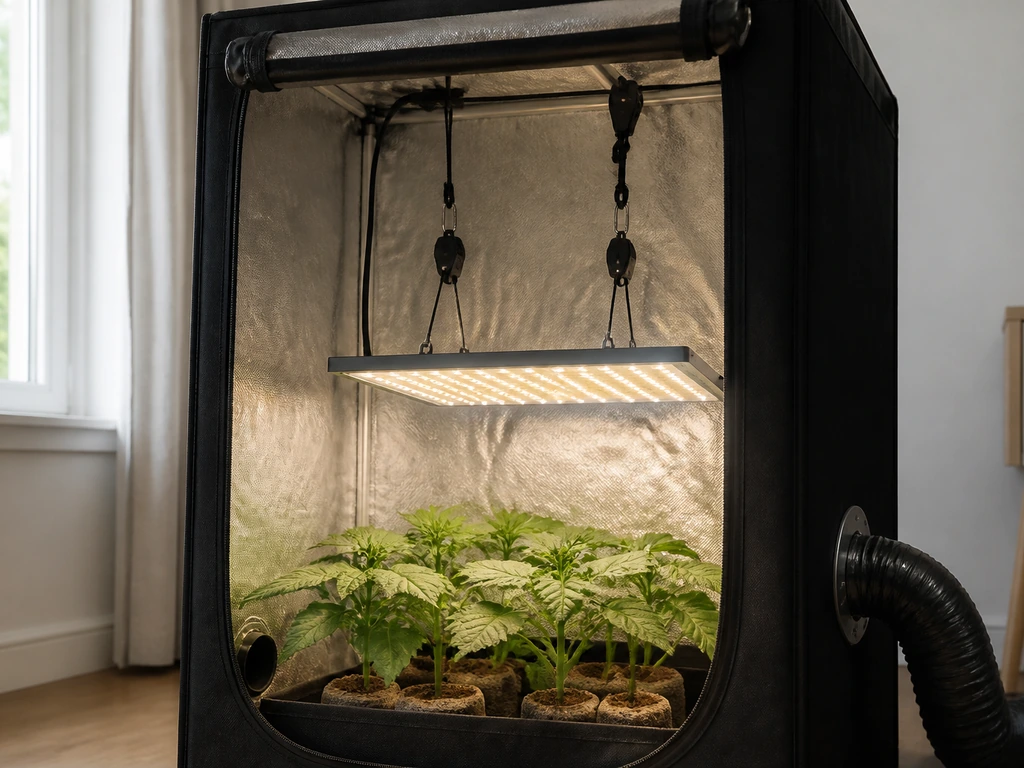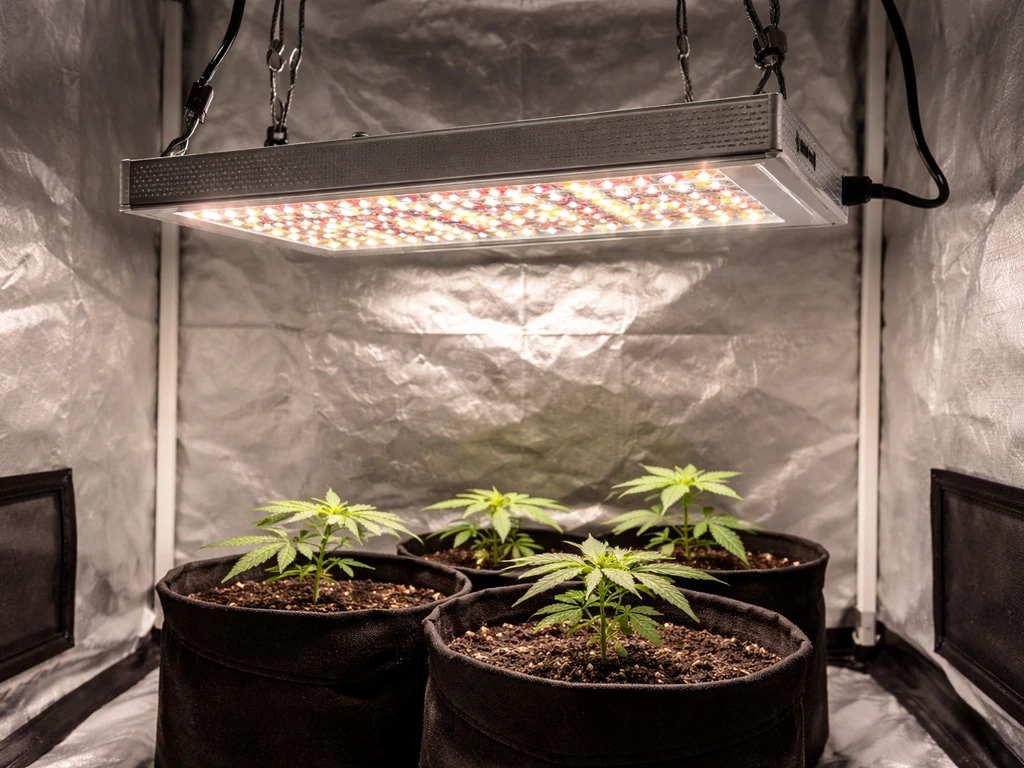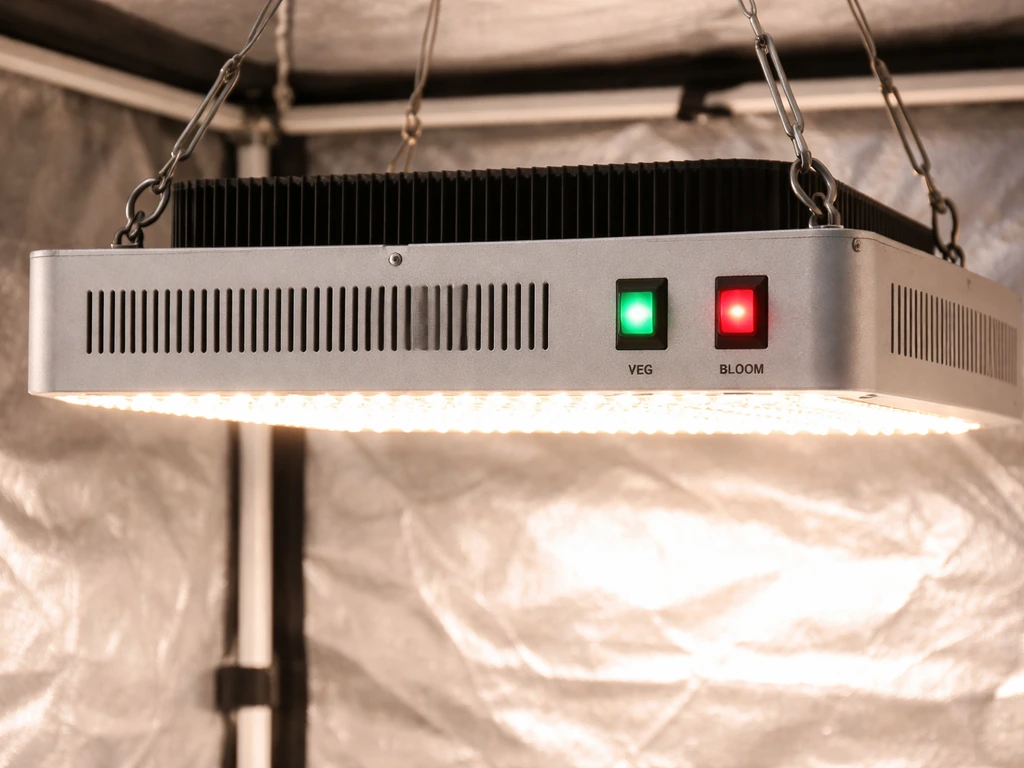
Grow Light Heaven is an online retailer based in Monsey, NY that sells grow lights and related cultivation equipment from multiple brands. When people search 'Grow Light Heaven reviews,' they're usually trying to figure out two things: whether the store itself is trustworthy, and whether the lights they carry actually perform well enough for real plant growth. This guide covers both. If you still want a quick sanity check before applying the metrics below, read induction grow lights reviews for another angle on performance expectations. You'll get a clear picture of what the shop offers, how to evaluate the lights on practical metrics, how different models map to plant types and growth stages, and whether this is the right place to buy your next fixture.
Grow Light Heaven Reviews: Honest Buyer Guide and Tests

What Grow Light Heaven is and what you're actually reviewing
Grow Light Heaven is a multi-brand retailer, not a grow light manufacturer. That distinction matters a lot. When you buy from them, you're typically buying a light made by a third-party brand, with Grow Light Heaven acting as the storefront and middleman. The company lists a phone/text number at (914) 219-6983, an email at [email protected], and operates Monday through Friday, 9AM to 5PM EST. Their physical business address is listed as 8 Beckett Ct., Monsey, NY 10952. So this isn't a fly-by-night operation without a traceable address, but it's also not a manufacturer with proprietary R&D behind its products.
The product catalog skews toward LED grow lights across a range of wattages, including quantum board (QB)-style panels, bar-style fixtures, and full-spectrum white LED units aimed at hobbyist and small commercial growers. They carry options across the 100W to 700W range, making them relevant for tent growers running 2x2 through 4x8 setups. Some products in their store are also available directly from the brands themselves or through Amazon, so price-matching is worth doing before you commit.
Red flags and trust check: is the store legit?
The store has a traceable address, a working phone number, and business hours, which already puts it ahead of a lot of sketchy drop-shipping operations. That said, there are a few policy details you need to understand before placing an order.
Shipping is not guaranteed fast. Grow Light Heaven states that orders 'usually ship within 48 hours if your order is in stock,' but if their warehouse is backed up, it can take up to five business days to ship. They also acknowledge drop-shipping directly from manufacturers in some cases, which means your package could arrive with a different brand's name on the box and delivery timelines you didn't expect. If you're on a tight grow schedule, factor that in.
The returns policy is where you need to read carefully. Most brands they carry have a seven-day return window from the time of delivery, which is short. And most returns are subject to a 25% restocking fee. Some items, like Sasquash and EZ Trim products, are listed as final sale with no returns at all. That's a meaningful financial exposure if a light arrives damaged or underperforms. Before buying, confirm the specific return policy for the exact brand and model you're purchasing, and get any exceptions in writing via email.
On review quality: treat aggregate star ratings from any single storefront with skepticism. Look for reviews that mention actual PPFD readings, coverage uniformity, heat output, or specific growth outcomes rather than vague praise like 'plants look happy.' Reviews that describe mounting height, photoperiod settings, and yield comparisons are far more useful than generic five-star endorsements. If you're seeing lots of short, undifferentiated reviews without technical detail, that's a signal to dig deeper before buying.
How to actually evaluate a grow light: the metrics that matter
Whether you're buying from Grow Light Heaven or anywhere else, the performance criteria are the same. Here's the framework I use when testing any fixture.
PPFD and coverage uniformity
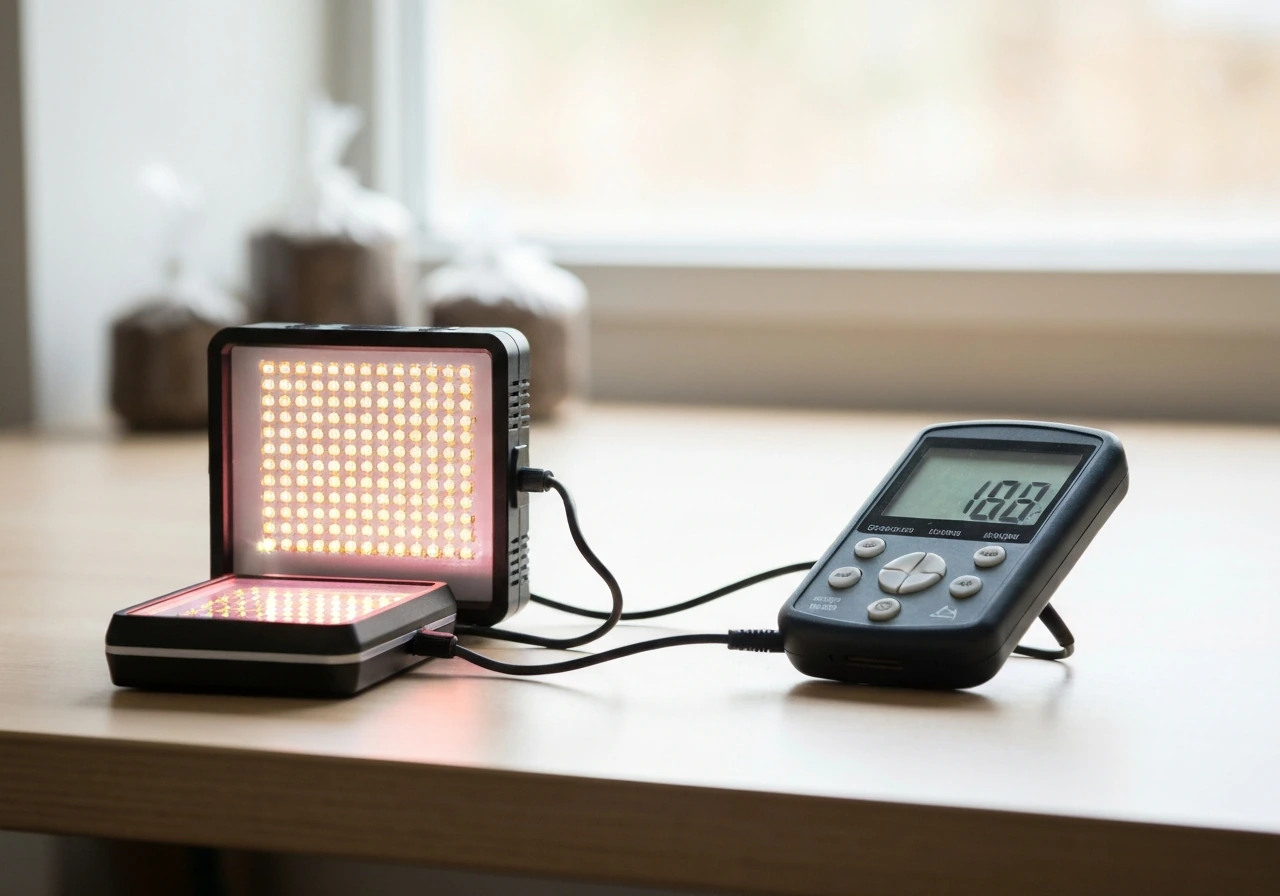
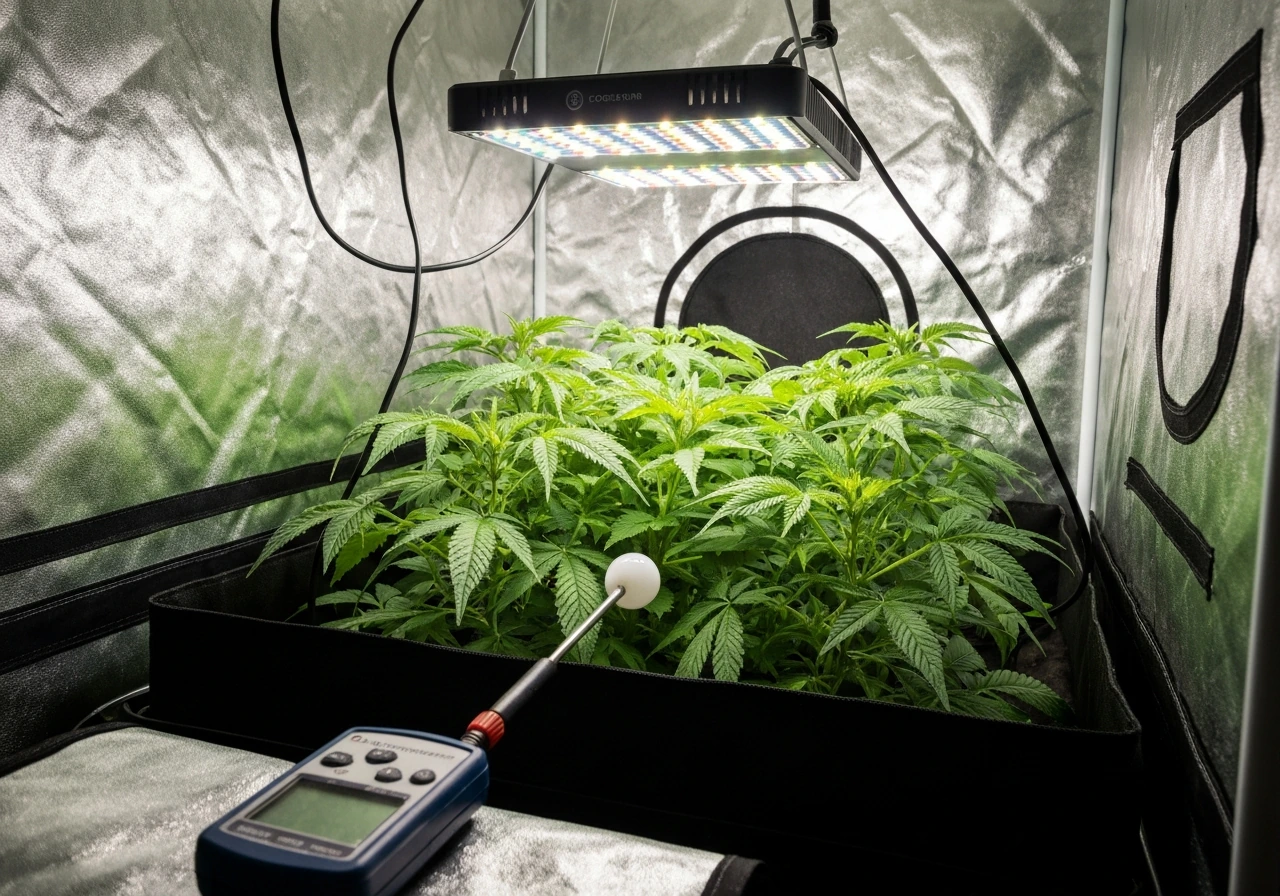
PPFD (photosynthetic photon flux density) measured in micromoles per square meter per second (µmol/m²/s) is the single most important number for plant performance. Seedlings want roughly 100 to 300 µmol/m²/s. Vegetative growth performs well between 400 and 600 µmol/m²/s. Flowering and fruiting plants typically want 600 to 900 µmol/m²/s, with some crops pushing higher. The number you care about isn't the peak PPFD at the center of the light's footprint, it's the average usable PPFD across your full canopy. A light that reads 900 µmol/m²/s dead center but drops to 300 µmol/m²/s at the corners is significantly less useful than one delivering 650 µmol/m²/s uniformly across a 4x4 area.
Efficiency: µmol/J is the number to watch
Efficiency is expressed as µmol per joule (µmol/J), and it tells you how much light you're getting per watt of electricity consumed. Anything below 2.0 µmol/J is mediocre by current standards. Solid mid-range LEDs hit 2.3 to 2.7 µmol/J. Top-tier fixtures using Samsung LM301H or similar high-efficiency diodes push 2.8 to 3.0+ µmol/J. Higher efficiency means lower heat output and lower electricity costs over a grow cycle, both of which matter in a sealed tent.
Spectrum quality
Full-spectrum white LED fixtures (typically 3000K to 4000K with red supplementation) outperform blurple lights for most hobbyist applications. Blurple (blue + red diode arrays) can produce growth, but they don't allow you to visually assess plant health accurately, and they're increasingly outcompeted on efficiency. The lights carried by Grow Light Heaven appear to lean toward full-spectrum and quantum board-style products, which is the right direction. Look specifically for lights that include far-red (730nm) diodes if you're running flowering crops, as far-red has measurable effects on flowering speed and yield through the Emerson enhancement effect.
Thermal management and build quality
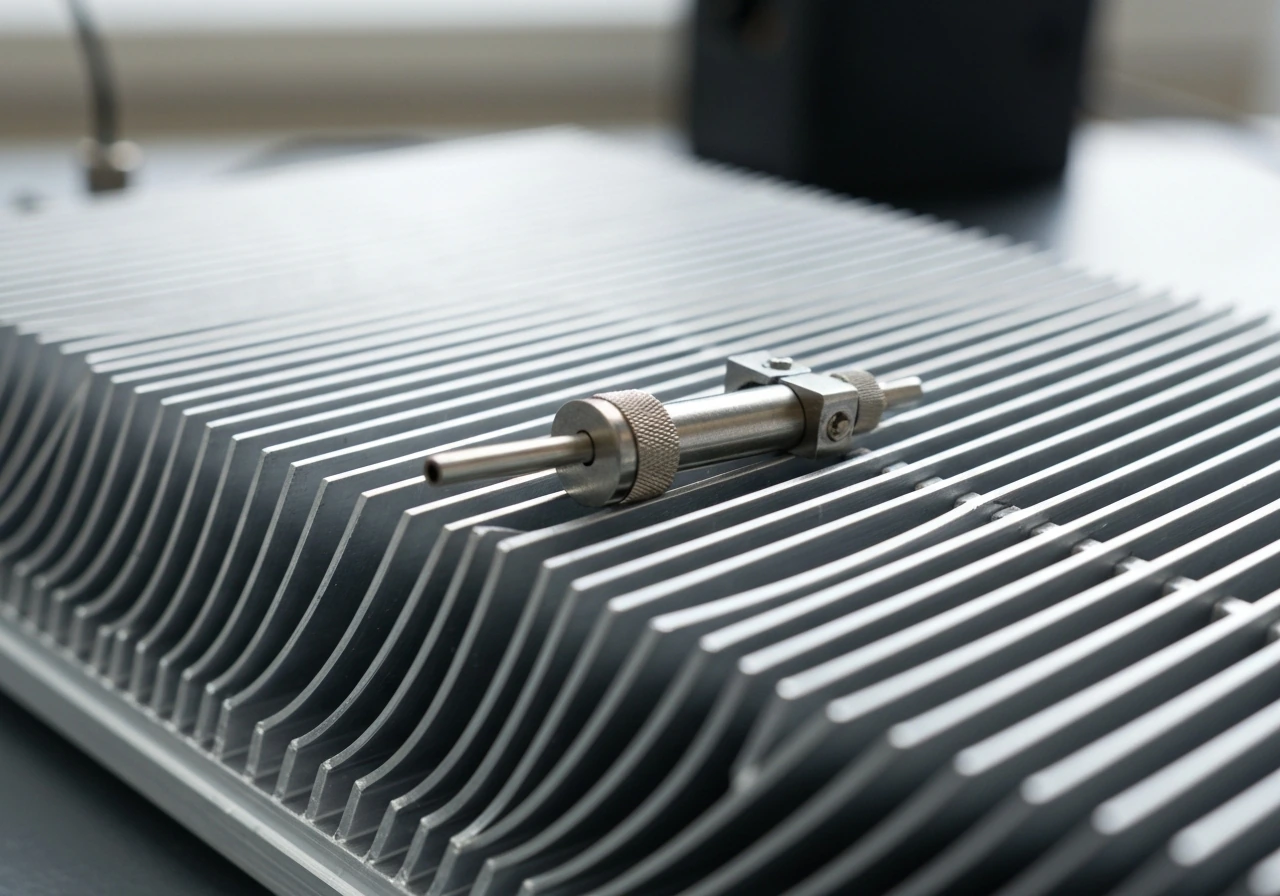
Heat is the enemy of LED longevity. A fixture with passive aluminum heat sinks and adequate surface area can last 50,000+ hours if diodes stay under 85°C junction temperature. Cheap lights cut corners on the heatsink extrusion thickness or use undersized drivers. When evaluating any light from this retailer, check whether the driver is brand-name (Meanwell is the standard) or generic, and whether the heatsink feels substantial relative to the light's wattage. Bar-style fixtures tend to manage heat better than single-panel designs at equivalent wattages because the diode density is distributed across a larger surface area.
Controls: dimming and timer compatibility
Dimming is a genuine quality-of-life feature, not just a marketing checkbox. Being able to dial a 400W fixture down to 50% during seedling stage protects young plants and saves electricity. Check whether dimming is stepless (smooth dial) or stepped (preset percentages), and whether the light is compatible with 0-10V external controllers if you're running a multi-light setup. Timer compatibility with standard 120V outlet timers is basic and expected, but verify that dimming and timer functions work simultaneously on any model you're considering.
Real-world results by plant type and growth stage
Seedlings and clones
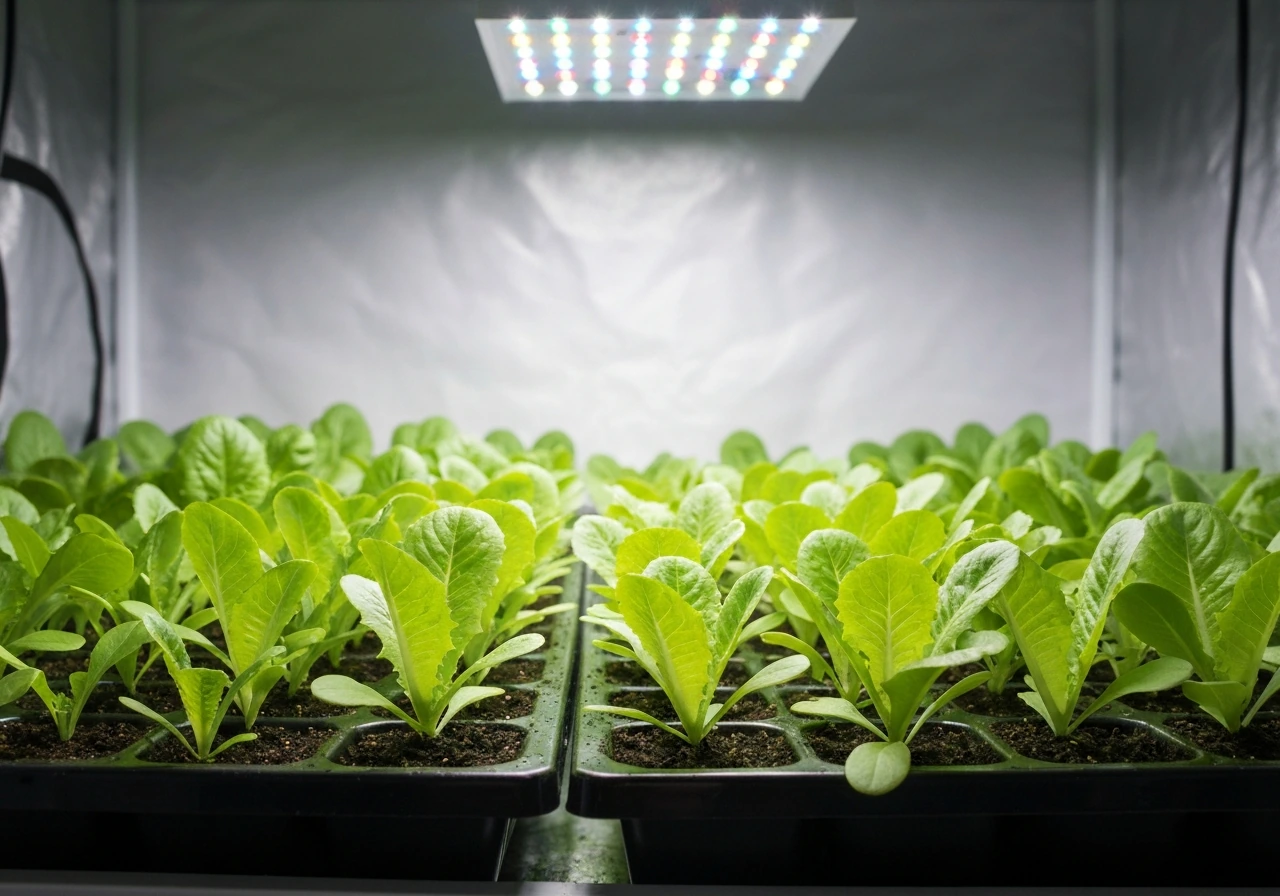
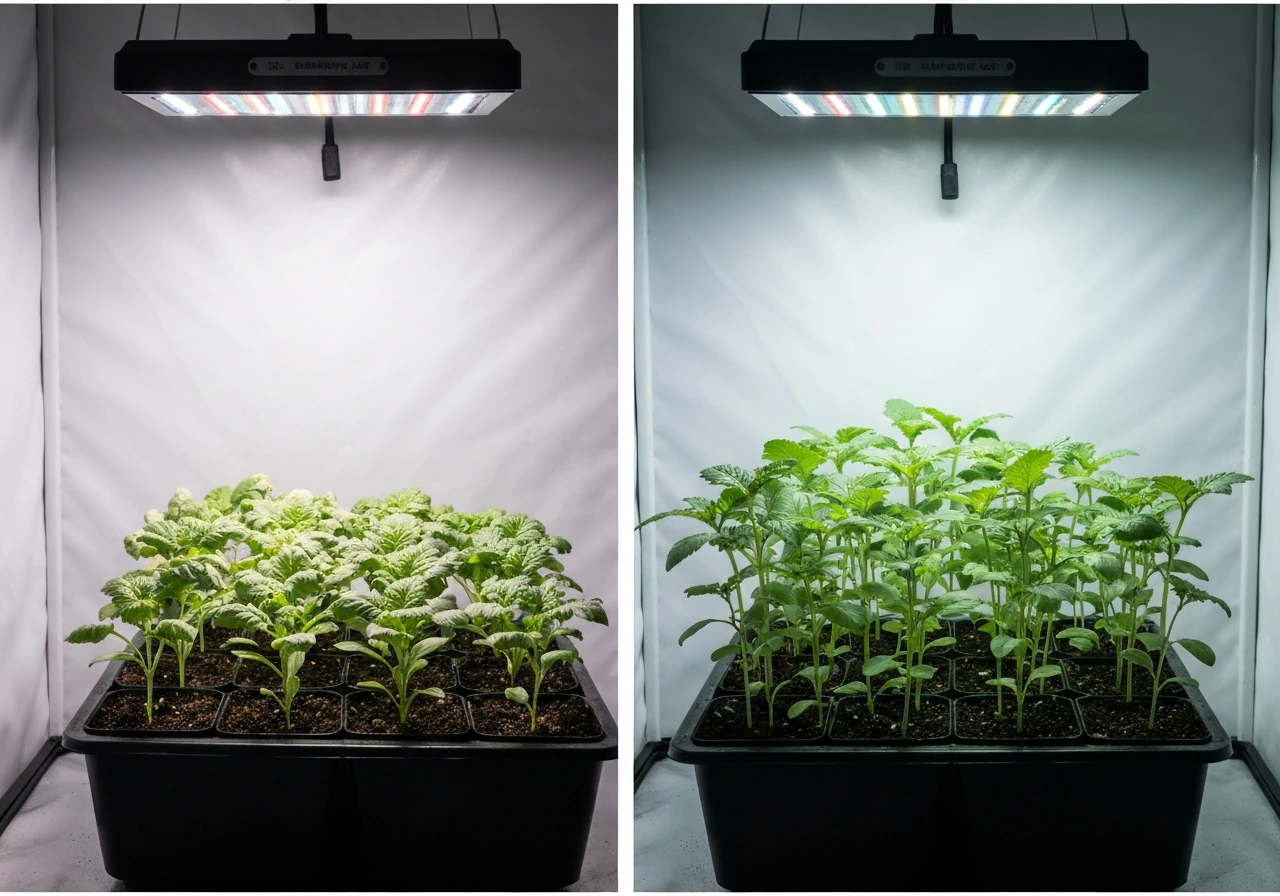
At this stage, less is more. You want 100 to 250 µmol/m²/s at canopy level, which means mounting a 200W+ fixture high (24 to 36 inches above the tray) or running it at 20 to 30% power. Full-spectrum white LEDs are ideal here because they don't stress tender root systems with high intensity, and you can monitor leaf color accurately. Blurple lights at this stage make it very hard to catch early deficiencies because everything looks pink under the light. If you're buying a larger fixture for later stages, make sure it dims low enough to be safe for seedlings without adding a separate seedling light.
Vegetative growth and leafy greens
Leafy greens like lettuce, spinach, and herbs are among the easiest crops to grow under LED, and almost any decent full-spectrum fixture will produce good results at 400 to 500 µmol/m²/s with an 16/8 photoperiod. For vegetative growth of fruiting plants (tomatoes, peppers, cannabis), you want to push PPFD toward 500 to 700 µmol/m²/s and run 18/6. The lights in the Grow Light Heaven catalog should handle this range without issue if you're matching wattage to tent size correctly (more on that below). Compact, bushy growth with short internodal spacing is your indicator that light intensity and spectrum are well-matched. Stretchy, pale growth with long internodes means either the light is too far away, too low in intensity, or spectrum is off.
Flowering and fruiting
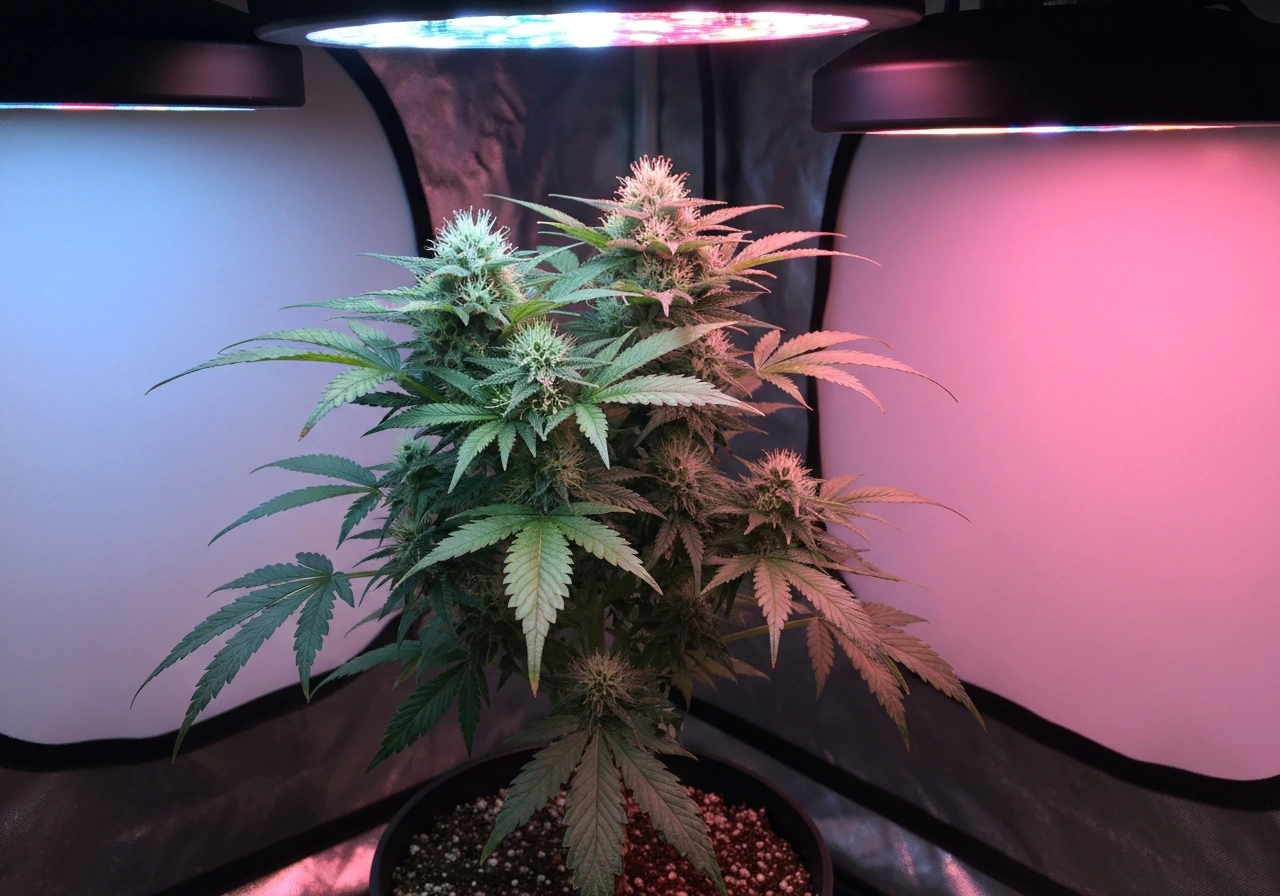
This is where light quality separates the budget fixtures from the performers. If you're specifically hunting for a budget grow lights review, focus on PPFD, efficiency, and coverage uniformity rather than marketing specs budget fixtures. At 600 to 900+ µmol/m²/s, you need consistent canopy coverage, good red-to-blue ratio (typically spectrum-weighted toward 3000K or with added 660nm red), and ideally far-red supplementation for Emerson effect activation. Heat management also becomes critical at higher power settings. If user reviews for a specific Grow Light Heaven fixture mention inconsistent bud development from center to edges of the canopy, that's a uniformity problem, often solved by adjusting mounting height or adding a second fixture to the periphery. Expect flowering performance limitations from underpowered or low-efficiency fixtures; a 200W unit claiming to replace a 1000W HPS will not deliver flowering results equivalent to a well-driven 600W HPS or a genuine 600W LED.
Spectrum, wattage, and coverage explained plainly
The single most common mistake hobbyists make is confusing 'equivalent wattage' claims with actual power draw. A light advertised as '1000W equivalent' might draw 200W from the wall. What matters is the actual wattage consumed and the efficiency at which that wattage is converted to usable light. As a practical sizing guide, plan for 30 to 50 true watts per square foot for flowering crops, and 20 to 30 true watts per square foot for vegetative-only or leafy green grows. That means a 2x4 tent (8 sq ft) needs 240 to 400 true watts for flowering, and a 4x4 tent (16 sq ft) needs 480 to 800 true watts.
| Tent Size | True Watts Needed (Veg) | True Watts Needed (Flower) | Target Avg PPFD |
|---|---|---|---|
| 2x2 (4 sq ft) | 80–120W | 120–200W | 400–600 µmol/m²/s |
| 2x4 (8 sq ft) | 160–240W | 240–400W | 500–700 µmol/m²/s |
| 3x3 (9 sq ft) | 180–270W | 270–450W | 500–750 µmol/m²/s |
| 4x4 (16 sq ft) | 320–480W | 480–800W | 600–900 µmol/m²/s |
| 4x8 (32 sq ft) | 640–960W | 960–1600W | 700–1000 µmol/m²/s |
On spectrum: a 4000K white LED with red supplementation works well across all growth stages, making it the most versatile single-spectrum option for hobbyists who grow a variety of plants. Purpose-built flowering spectrums (3000K heavy, with 660nm red and 730nm far-red) will edge out 4000K lights for fruiting crops but are less ideal for seedlings and leafy greens. If you're growing one type of crop from seed to harvest, match the spectrum to that crop's peak demand. If you're growing multiple things simultaneously, a full-spectrum 3500K to 4000K light is the safer bet.
Grow Light Heaven vs major brands: where it fits in the market
Since Grow Light Heaven is a retailer rather than a manufacturer, the real comparison is between the brands they carry and the alternatives you'd find at other retailers or direct-to-consumer brands. Here's how the fixture categories stack up.
| Category | Typical Efficiency | Coverage Quality | Price Point | Best For |
|---|---|---|---|---|
| Blurple LED (older style) | 1.5–2.0 µmol/J | Poor uniformity | Low | Budget seedling/veg, not recommended for flower |
| Full-spectrum white LED (QB-style) | 2.3–2.8 µmol/J | Good to excellent | Mid | All-around hobbyist use, versatile |
| Bar/strip LED fixtures | 2.5–3.0 µmol/J | Excellent uniformity | Mid to high | Flower/fruiting, professional hobbyist |
| Branded direct-to-consumer (e.g., Spider Farmer, Mars Hydro, HLG) | 2.5–3.1 µmol/J | Good to excellent | Mid to high | Performance-focused buyers who want verified specs |
| Induction grow lights | 1.8–2.2 µmol/J | Moderate | High upfront | Long-life applications, specialty use |
Grow Light Heaven's value proposition depends entirely on which brands they're stocking and at what price. If they're selling fixtures from well-regarded manufacturers at competitive prices, they can be a legitimate option. If pricing is similar to buying direct or from Amazon, the short return window and 25% restocking fee make buying direct or through a platform with stronger consumer protections the smarter move. Brands like Spider Farmer, Mars Hydro, and Horticultural Lighting Group (HLG) all have established return and warranty programs that are typically more favorable than what Grow Light Heaven's blanket policy describes. Grow Light Science fixtures (their Grow 200 and Grow 300 models, for example) are another category worth cross-referencing if you're evaluating smaller, targeted wattage fixtures for compact spaces. Grow Light Science fixtures, including a Grow Light Science Grow 300 review, are worth cross-referencing if you're evaluating smaller, targeted wattage options for compact spaces. If you're specifically looking at a Grow Light Science Grow 200 review, compare its stated wattage, real PPFD coverage, and efficiency against what your tent size and crop need Grow Light Science fixtures.
For budget-focused buyers, it's worth noting that the broader budget grow light market has improved significantly, and many mid-range fixtures now deliver performance that used to require premium pricing. If cost is a primary constraint, comparing against the broader budget grow light options on the market will give you a clearer baseline before settling on any specific retailer.
How to size your setup, use the light correctly, and decide if it's worth it
Sizing and mounting
Start with your tent size and work backwards. Use the wattage-per-square-foot guidelines above to establish the minimum true wattage you need. Then verify the manufacturer's PPFD map at your intended mounting height, which should be included in the product documentation. For QB-style panels, a typical starting height for vegetative growth is 18 to 24 inches above canopy; for seedlings, 24 to 36 inches or significantly dimmed. For flowering, 12 to 18 inches above canopy is common with high-efficiency fixtures, but always confirm with the PPFD map rather than guessing.
Photoperiod settings
Standard photoperiod guidelines apply regardless of where you buy the light. Leafy greens and most vegetables do well at 16 hours on, 8 hours off. Photoperiod-sensitive flowering plants (like cannabis or chrysanthemums) need 12/12 to trigger and maintain flowering. Autoflowering strains can run 18/6 to 20/4 through their entire lifecycle. Using a mechanical or smart outlet timer is the most reliable way to maintain consistency; don't rely on manual switching.
Common mistakes to avoid
- Trusting 'equivalent wattage' claims instead of actual wall-draw wattage and PPFD maps
- Hanging the light too close to seedlings or young transplants without dimming, causing light stress or bleaching
- Ignoring canopy uniformity and only measuring light at the center of the tent
- Skipping the return policy fine print before purchase, especially the 7-day window and 25% restocking fee
- Assuming all full-spectrum LEDs are equivalent without checking efficiency ratings and diode quality
- Not accounting for heat load in a sealed tent, especially at high wattages in summer grows
Questions to ask before buying from Grow Light Heaven
- What is the actual brand and model of the fixture, and can I find independent reviews of that specific product?
- What is the true wall-draw wattage and what PPFD does the manufacturer claim at my intended mounting height?
- Is this item in stock, or will it be drop-shipped from the manufacturer with a longer lead time?
- What is the exact return window and restocking fee for this specific brand through Grow Light Heaven?
- Is the driver brand-name (Meanwell preferred), and what is the warranty period on the fixture?
- Can I buy this same product at the same or better price directly from the manufacturer or through a platform with stronger buyer protections?
Buy if / skip if
Buy from Grow Light Heaven if: they're carrying a specific brand or model you've already researched and validated, the price is genuinely competitive, and you've confirmed the return policy for that exact product. If you're specifically shopping for orchids, it can also help to read grow lights for orchids reviews to see whether the spectrum and intensity match orchid growth habits. They appear to be a legitimate small-business retailer, and if you know what you want and the deal makes sense, there's no strong reason to avoid them.
Skip or look elsewhere if: you're still figuring out which fixture to buy and want flexible returns for comparison purposes, you're uncomfortable with a 25% restocking fee if something doesn't work out, or the light you're considering is available at similar pricing directly from the manufacturer with a better warranty and return program. The short return window is the biggest practical risk here, especially for first-time buyers who may not know exactly what to look for when a fixture arrives.
FAQ
Do grow light heaven reviews mean the store makes the lights, or just sells them?
Grow Light Heaven is a multi-brand retailer, not the manufacturer. “Grow Light Heaven reviews” usually reflect buying and customer service, while performance depends on the third-party brand and model you choose, so you should verify the specific fixture’s PPFD map, efficiency (µmol/J), and warranty terms for that brand.
How can I tell if a review is actually measuring performance, not just describing results?
Look for reviewer details like canopy measurements, mounting height, and reported PPFD at center and edges, plus notes about uniformity. Vague comments such as “plants are thriving” without any intensity, coverage, or heat information are weaker evidence than a review that explains how far the light was from the canopy and what growth stage was used.
What if the return window starts when I order instead of when it arrives?
The article notes a short return window from delivery, but in practice you should confirm the exact clock for the specific brand and item. Before ordering, email support and ask whether the seven days is counted from delivery date, shipping date, or “delivered and confirmed,” and whether restocking applies to exchanges or only refunds.
Are damaged items covered if they arrive broken or not as advertised?
Given the restocking fee and some final-sale items, you should ask what happens for damaged-in-transit or clearly defective units. Request written guidance on whether you can return for a full refund (or replacement) without the 25% fee, and what documentation they require (photos of the box, packaging, and the fixture).
Should I worry that some orders ship with a different brand name on the box?
Yes, if you are counting on a specific warranty card, manual, or branding. The retailer may drop-ship in some cases, so confirm the exact manufacturer and model number you will receive, and ask whether the warranty is handled by the manufacturer directly or only through the retailer.
How do I use PPFD maps if the mounting height in the listing differs from my setup?
Treat the PPFD map like a calculator. Match your intended mounting height and then check average PPFD across the coverage area, not just the peak. If your tent forces a higher or lower mount than the map assumes, you may need dimming or a different fixture to avoid overshooting seedlings or undersupplying flowering.
What’s a safe way to start with seedlings if I’m unsure the fixture output is correct?
Start with dimming (if available) and a conservative canopy distance, then fine-tune after you confirm intensity behavior. The article suggests lower intensity for early growth, and the practical step is to measure your actual PPFD at canopy level if possible, or at least observe leaf response after a few days before increasing power.
Do I have to run far-red (730nm) for flowering?
Not strictly for every situation, but far-red can improve measurable flowering outcomes in many systems. If you are comparing lights for bloom, verify the fixture actually includes far-red diodes (not only “full spectrum” marketing) and consider whether the effect matters for your crop and timeline, especially if you are staying with one spectrum for all stages.
Is 0-10V dimming required, or is basic dimming enough?
Basic dimming is usually sufficient for a single light. If you run multiple fixtures and want synchronized control, 0-10V compatibility matters so you can keep all lights at the same intensity. Ask whether dimming is truly stepless and whether the driver accepts external control, not just that the light “can dim.”
How do I avoid the common “equivalent wattage” trap when comparing listings?
Compare actual draw (watts from the wall) and the reported efficiency (µmol/J), then ignore any HPS “equivalent” claim unless the reviewer or documentation includes PPFD and coverage. Two lights that both say “1000W equivalent” can have very different real PPFD, especially at the corners of a tent.
What if my tent is 2x4 or 4x4, but the fixture’s PPFD map coverage is smaller?
Use the PPFD map to verify that average PPFD across your full canopy matches your target range. If the map shows strong PPFD only in the center, you may need a second fixture or adjust spacing to reduce edge drop-off, because center-only performance often leads to uneven development and smaller yields.
Does better efficiency always mean I should buy the most efficient model?
Efficiency helps with electricity cost and heat, but you still need the right PPFD and uniformity for your canopy area. A high-efficiency light that is underpowered for your tent will underperform at flowering, while an efficient light with poor uniformity can still cause edge issues.
Are full-spectrum white LEDs always better than blurple for first-time growers?
For most hobbyists, full-spectrum white LEDs are easier to evaluate because you can visually assess leaf condition and deficiencies more reliably. Blurple can work, but the practical challenge is that the color changes under blurple make early issues harder to detect, so first-time growers often benefit from white spectrum for monitoring.
If Grow Light Heaven price-matches Amazon or brand-direct, should I still compare warranties?
Yes. Even if the price is similar, warranties and returns can differ significantly by manufacturer. Before buying, compare the brand’s warranty length, what it covers (driver, diodes, power supply), and whether you must process claims through the retailer or directly with the manufacturer.