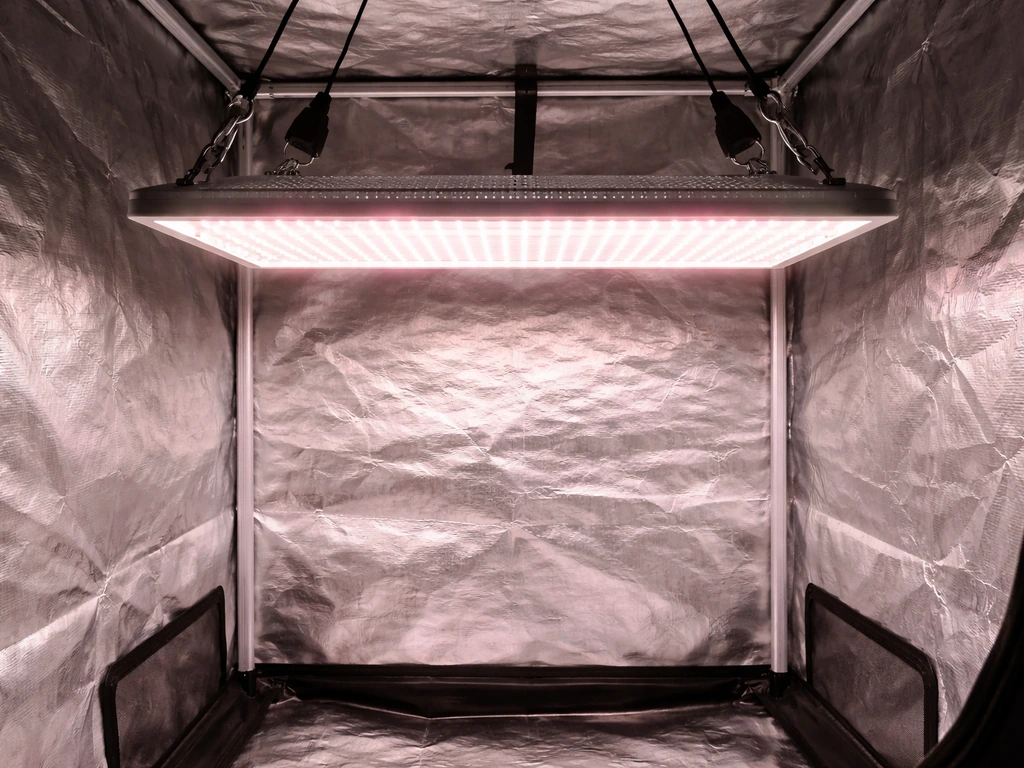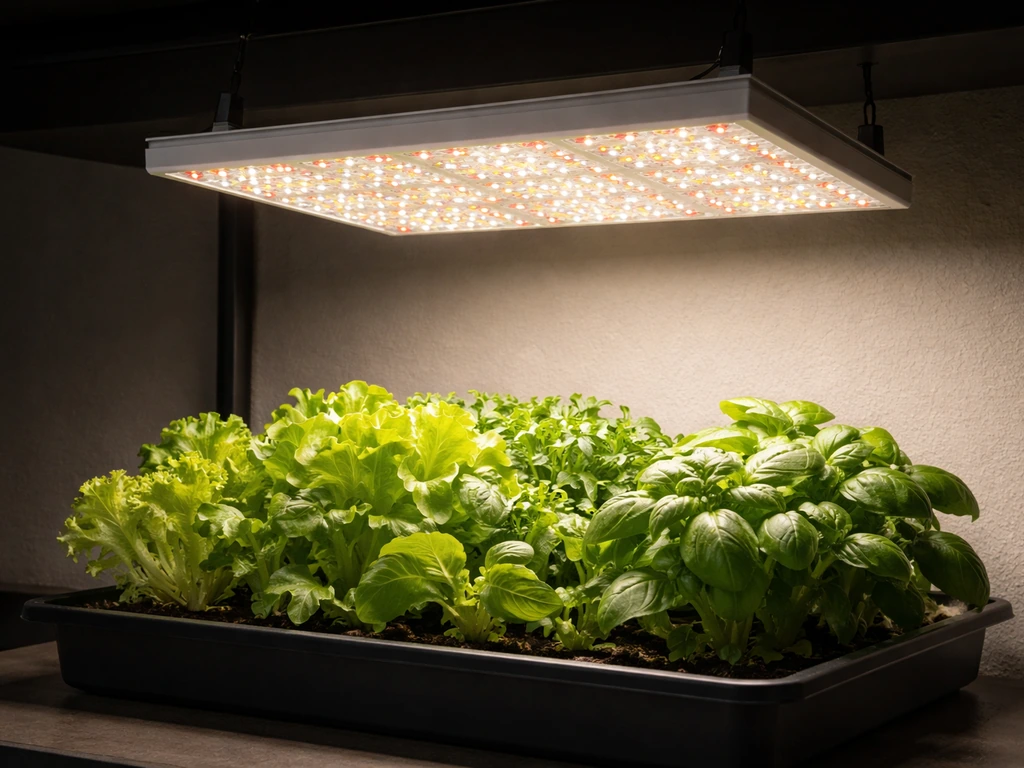
If you're looking at VOLT Grow lights, you're essentially choosing between two models: the 440W VL-1 and the 720W FL-1. Both use Samsung and OSRAM LEDs, both hit 2.8 µmol/J efficacy, and both carry IP65 and UL certifications with a 5-year warranty. The VL-1 fits a 4'x4' veg space or a 3'x3' flower tent well. The FL-1 is the one to grab if you're working a 4'x4' to 5'x5' canopy and want enough PPFD to push plants through flower without compromise. Neither is a bargain-bin light, but the FL-1 at around $650 is genuinely competitive against similarly-specced fixtures from brands like Spider Farmer or Mars Hydro.
Volt King Grow Light Review: Performance, Coverage, Value

Marcus Caldwell
23 Apr 2026
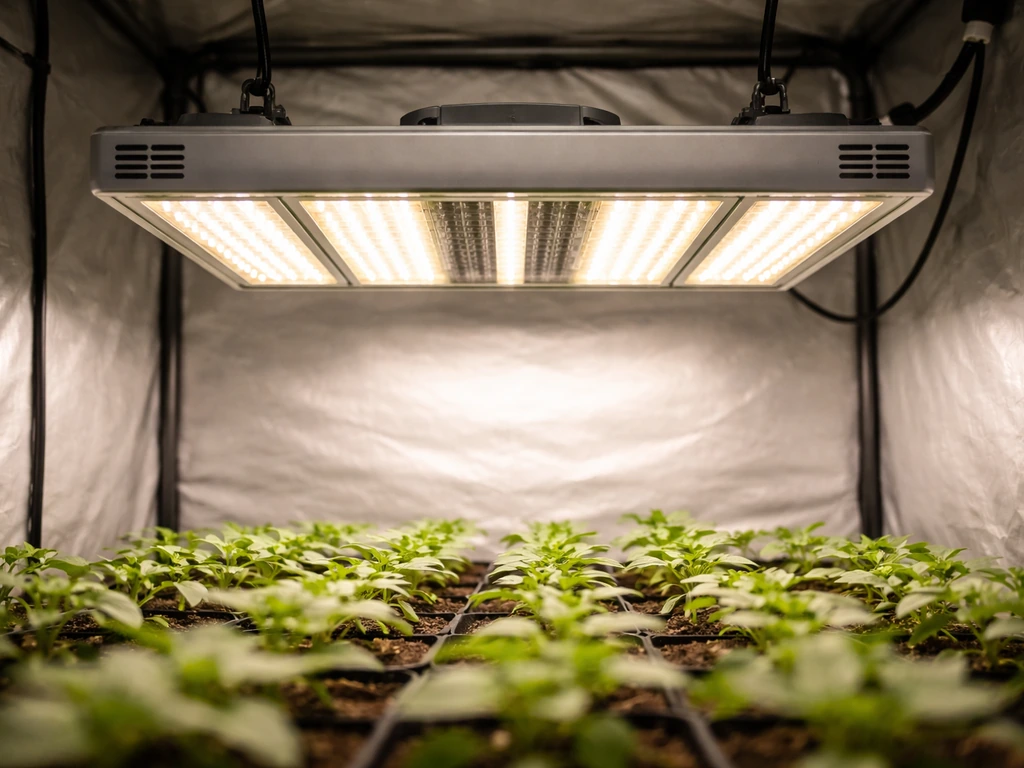
What the VOLT Grow Lineup Actually Is
VOLT Lighting is primarily known as an outdoor and commercial LED brand, but their VOLT Grow line is purpose-built for indoor cultivation. The two current models are the VL-1 (440W) and the FL-1 (720W). Both are marketed as "full-cycle" lights, meaning they're designed to take plants from seedling through harvest on a single fixture with no bulb or board swaps. The spectrum is full-spectrum white light, not the old-school blurple configuration, which means the light looks natural in your grow space and the spectrum is broadly useful across all plant stages.
Both models share the same core feature set: built-in 0-10V dimming with a remote, adjustable from 0 to 100% in 1% increments (so you can dial it all the way off), a minimum mounting height of 6 inches (15.2cm) above the canopy, and IP65 weatherproofing. The VL-1 puts out a stated PPF of 1,220 µmol/s, and the FL-1 claims 2,000 µmol/s, both rated at ±5%. These are manufacturer numbers, so treat them as benchmarks rather than gospel, but the 2.8 µmol/J efficacy figure on both models is competitive with the better fixtures in this price bracket.
| Spec | VL-1 | FL-1 |
|---|---|---|
| Wattage | 440W | 720W |
| PPF Output | 1,220 ±5% µmol/s | 2,000 ±5% µmol/s |
| Efficacy | 2.8 µmol/J | 2.8 µmol/J |
| Heat Output | 1,350 BTU | 2,450 BTU |
| Dimming | 0-100% (0-10V, remote) | 0-100% (0-10V, remote) |
| Min. Mounting Height | ≥6 in (15.2cm) | ≥6 in (15.2cm) |
| Certifications | IP65 & UL Listed | IP65 & UL Listed |
| Warranty | 5 Years | 5 Years |
| Approximate Price | ~$350 | ~$650 |
Real-World Performance: Coverage and PPFD Numbers

VOLT publishes PPFD maps for both models, and the numbers tell a clear story about where each light works and where it starts to stretch thin. Here's how to read those maps practically: the average PPFD across a footprint is what matters for plant health, not the hot-spot reading directly under the center of the fixture.
FL-1 (720W) Coverage
At 6 inches above the canopy, the FL-1 averages 1,027 µmol/m²/s across a 4'x4' area. That's solidly in flowering range, exceeding VOLT's own recommended 900-1,000+ µmol/m²/s target for flower. Stretch it to a 5'x5' footprint and you're at 939 µmol/m²/s average, still above that flowering threshold. Push it to 6'x6' and the average drops to 744 µmol/m²/s, which is fine for veg but won't push a heavy-feeding flower crop hard enough. The practical takeaway: the FL-1 is a genuine 5'x5' flowering light and a 6'x6' vegetative light. For anyone running a 4'x4' tent, this fixture gives you headroom to dim it back during veg and open it up in flower.
VL-1 (440W) Coverage
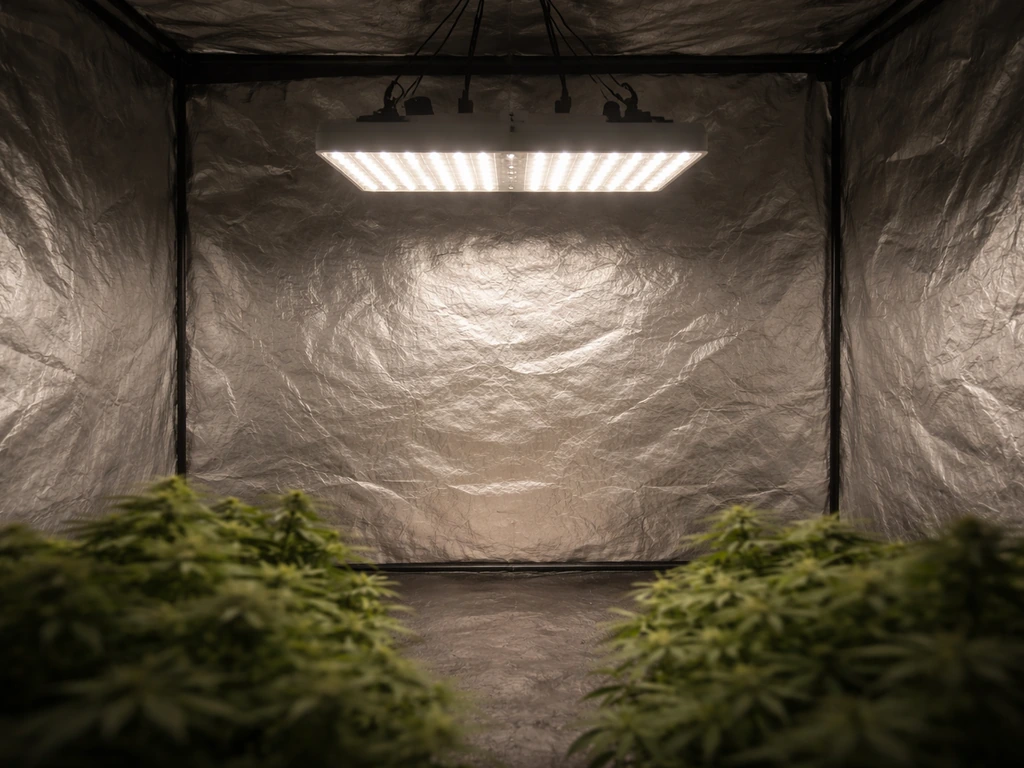
The VL-1's PPFD map at 6 inches shows 1,080 µmol/m²/s average over a 3'x3' area, which is excellent for flowering in a small tent. Over a 4'x4' area, it averages 865 µmol/m²/s, which sits comfortably in veg range and is usable for flower on plants that don't need maximum intensity. The drop-off is steep from there: a 5'x5' footprint yields only 459 µmol/m²/s, and at 18 inches mounting height over a 6'x6' area, the average falls to 379 µmol/m²/s. That lower end is fine for seedlings or light-loving greens, but it's not a number you'd chase for tomatoes or cannabis in late flower. VOLT's own buying guide flags the VL-1 as a 4'x4' veg solution, and that holds up.
One useful habit worth picking up from community growers: if you want to verify these numbers against your actual setup, an app like Photone or a dedicated PAR meter will tell you quickly whether your canopy is hitting the 700+ µmol/m²/s floor that most flowering crops need. Manufacturer maps are measured under ideal conditions, and real rooms with walls, canopy variations, and fixtures that may have slight unit-to-unit variation can shift readings.
Build Quality, Heat, Noise, and Efficiency
Both models use Samsung and OSRAM LEDs, which are among the more respected LED chips in commercial horticulture. That's not marketing fluff; those chips have documented consistency in output and longevity compared to generic alternatives. The IP65 rating means the fixtures are dust-tight and protected against water jets, which matters in a humid grow environment where condensation and misting are common. The UL listing adds another layer of confidence on the electrical safety side.
Heat is always a conversation with high-wattage LEDs. The FL-1 generates 2,450 BTU, which is meaningful in a sealed or small tent. You'll need active airflow and ventilation to manage that, especially in a 4'x4' or 5'x5' space during long photoperiods. The VL-1's 1,350 BTU is easier to manage. Neither model uses internal fans, which keeps them quiet. The passive heat dissipation design means noise is essentially zero, a genuine practical advantage over older blurple boards with small, loud cooling fans.
The dimming controller on both units is one of the more practical features here. The FL-1's control panel includes stepped power settings (720W, 576W, 432W, 28W are referenced in the installation guide), and the 0-10V remote lets you fine-tune anywhere in between. This isn't just a convenience feature. Being able to run a 720W fixture at 432W during early veg saves electricity and reduces heat load without swapping hardware. On the operating cost side, VOLT's catalog estimates annual costs based on 12-hour daily runtime, and at 440W or 720W, these aren't cheap-to-run fixtures. They're efficient for their output class, but plan your electricity budget accordingly.
Best Plants, Grow Stages, and Mounting Heights
Both the VL-1 and FL-1 are full-spectrum white light fixtures, which makes them genuinely versatile across plant types. Leafy greens, herbs, tomatoes, peppers, and cannabis all work here. The spectrum doesn't shift between veg and flower, which means you're managing intensity (via dimming and mounting height) rather than swapping out a different spectrum. That's how modern full-spectrum LEDs are designed to work, and it simplifies the grow process considerably.
| Stage | Target PPFD | VL-1 Best Fit | FL-1 Best Fit |
|---|---|---|---|
| Seedling | 100–300 µmol/m²/s | Dimmed, high mount, 4'x4'–5'x5' | Dimmed heavily, high mount |
| Veg | 400–600 µmol/m²/s | 4'x4' at 6–12 in, moderate dim | 5'x5'–6'x6' at 6–12 in |
| Flower | 900–1,000+ µmol/m²/s | 3'x3' at 6 in, full power | 4'x4'–5'x5' at 6 in, full or near-full power |
The minimum mounting height of 6 inches applies to both models, but in practice, most growers hang these higher during early stages to reduce intensity and spread light more evenly. For seedlings, starting at 24–30 inches above the tray and gradually lowering as plants develop is a sensible approach. For late flower at full power, getting down to 12–18 inches over the canopy (while staying above the 6-inch minimum) is where you maximize the output the fixture is designed to deliver.
Setup Tips and Common Mistakes
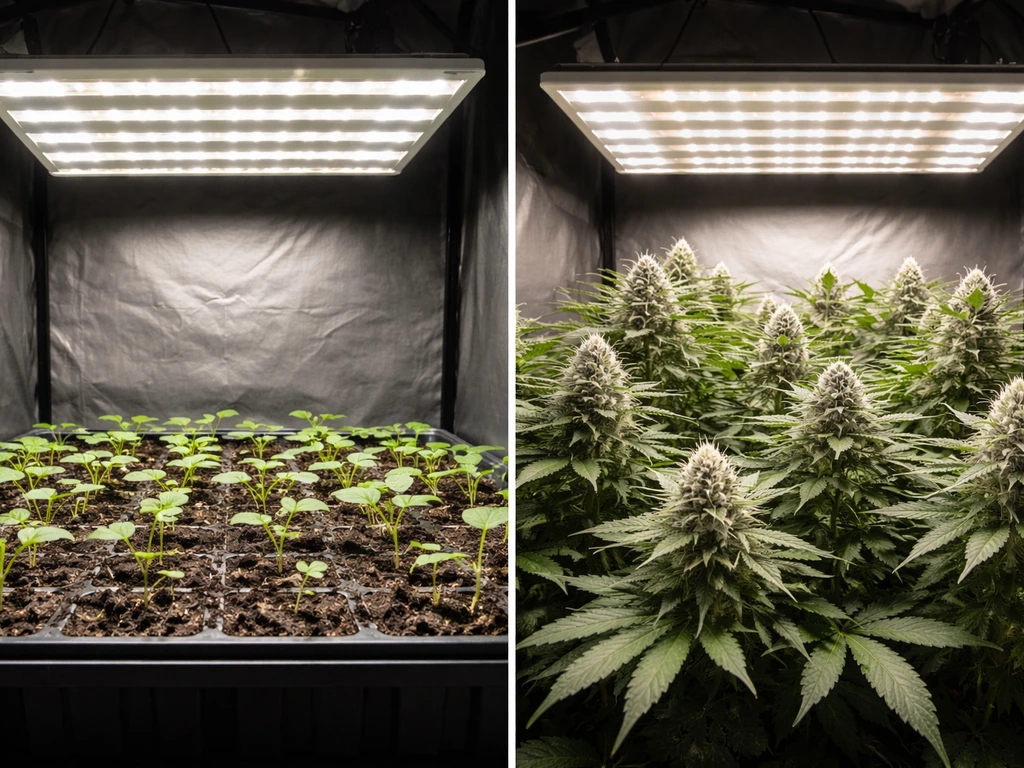
VOLT provides installation guidance through their learning center, and it's worth reading before you hang the fixture. A few practical notes from working with fixtures like these:
- Don't run the FL-1 at full power during seedling or early veg. Use the dimmer remote to start at 30–40% output and ramp up as plants develop. Skipping this step is the most common way to cause light stress early.
- Verify your hanging height with a tape measure, not eyeballing. An inch or two matters at close mounting distances where PPFD gradients are steep.
- Check canopy PPFD with a meter or Photone app when you first set up, especially if your grow space has unusual geometry, reflective walls, or multiple fixtures. Manufacturer maps assume clean, controlled conditions.
- Make sure your ventilation can handle the BTU load before running long photoperiods. The FL-1's 2,450 BTU will noticeably raise tent temperature if exhaust airflow isn't adequate.
- Use the 0-10V dimming feature actively through the grow cycle, not just at setup. Dialing down during the dark period ramp-up or adjusting for heat management in summer months is exactly what the feature is for.
- Don't assume a 5'x5' PPFD average means uniform coverage across all 25 square feet. Edges and corners will be lower than center readings. Rotating plants periodically helps even out exposure.
- The IP65 rating makes the fixture splash-resistant, but don't position it directly over open water reservoirs or in paths of strong misting spray as a routine practice.
How VOLT Grow Compares to the Competition
At 2.8 µmol/J, both the VL-1 and FL-1 sit at the upper end of the efficiency range for commercial-grade LED grow lights. If you are also weighing efficiency and performance numbers against other brands, this vander grow light review can give you a useful comparison point. Budget fixtures from brands like Vogek, <a data-article-id="0404A589-1033-4A32-A4FC-22BAECB34C02"><a data-article-id="7F23916A-66A0-40F4-A3CA-F4C4FDA14894">Vander</a>, or Excelvan typically clock in lower on efficacy</a> and don't carry UL or IP65 certifications. The PPFD maps from those brands also tend to be less detailed or harder to verify independently. If you've been comparing VOLT against those entry-level options, the difference in quality and documentation is real, and the price difference reflects it.
Against mid-tier competitors like Spider Farmer, Mars Hydro, or AC Infinity, the comparison tightens. If you're also hunting for a high-watt comparison, this vander 2000w led grow light review is a helpful related option. Spider Farmer's SF-7000 (at roughly 650W and comparable street pricing) and Mars Hydro's TSW-2000 line compete directly with the VL-1 on footprint and wattage. Where VOLT differentiates itself is the UL listing, the IP65 weatherproofing, and the five-year warranty, which is longer than most competitors in this price range. VEVOR's grow lights, for instance, offer lower prices but come with less comprehensive certifications and shorter warranty terms. If you want a quick decision, you can also check a VEVOR grow light review to see how their price-focused fixtures stack up on real performance. If you're also considering Excelvan fixtures, this <a data-article-id="ACBD8F70-7B20-4DDE-BABE-631497EC2C8E">excelvan grow light review</a> can help you compare pricing and real-world performance. If you're also considering the Excelvan line, this excelvan 1200w led grow light review is a useful related option for comparing output, coverage, and value against the VOLT VL-1 and FL-1. For growers who want that added reliability assurance, VOLT's credentials carry weight.
| Brand / Model | Wattage | Efficacy | Warranty | UL Listed | Approx. Price |
|---|---|---|---|---|---|
| VOLT FL-1 | 720W | 2.8 µmol/J | 5 Years | Yes | ~$650 |
| VOLT VL-1 | 440W | 2.8 µmol/J | 5 Years | Yes | ~$350 |
| Spider Farmer SF-7000 | ~650W | ~2.7 µmol/J | 3 Years | No | ~$600–700 |
| Mars Hydro TSW-2000 | ~300W | ~2.7 µmol/J | 3 Years | No | ~$200–250 |
| AC Infinity IONBOARD S44 | ~400W | ~2.6 µmol/J | 3 Years | No | ~$350–400 |
| Budget brands (Vogek, Vander, Excelvan) | Varies | Typically <2.4 µmol/J | 1–2 Years | Rarely | $50–$150 |
The FL-1 at $650 is priced fairly for its output class. The 720W draw and 2,000 µmol/s PPF at 2.8 µmol/J puts it alongside fixtures from respected brands, but with better certification credentials than most. The VL-1 at $350 is competitive in the 400–450W category, though growers on a tight budget will find comparable performance from AC Infinity or Mars Hydro at similar or lower price points. VOLT's stronger warranty and IP65 protection are what push the value case over the line.
Who Should Buy a VOLT Grow Light (and Who Shouldn't)
Buy the FL-1 if:
- You're growing in a 4'x4' to 5'x5' space and want enough PPFD to properly flower high-light crops like cannabis, tomatoes, or peppers.
- You want a fixture with UL listing and IP65 protection for a more controlled or humid environment.
- A 5-year warranty matters to you and you plan to use the light for multiple grow cycles.
- You want a single full-cycle fixture that handles seedling through harvest without buying additional hardware.
- You're comfortable with a higher upfront cost in exchange for verified build quality and efficiency.
Buy the VL-1 if:
- Your grow space is a 3'x3' tent for flower or a 4'x4' tent for veg.
- You want the same VOLT build quality and warranty on a lower wattage and lower price.
- Your electricity cost or heat management is a consideration and the FL-1's 2,450 BTU is too much to handle comfortably.
Skip VOLT Grow lights if:
- You're on a tight budget and growing herbs or leafy greens that don't need 800+ µmol/m²/s. Budget fixtures from other brands will serve you adequately at much lower cost.
- You're growing in a space larger than 5'x5' and want to flower the whole canopy intensively. You'd need multiple units, and costs add up fast.
- You want a fixture with onboard app control or smart home integration. VOLT's dimming is remote-based, not app-connected.
Your Next Steps Before You Buy
Before committing to either model, run through this quick checklist to confirm the fit for your setup:
- Measure your grow space precisely. A 4'x4' tent and a 5'x5' tent are very different scenarios for the VL-1 vs FL-1 decision.
- Decide what you're growing and at what stage you need peak performance. Flower-focused growers in a 4'x4' or 5'x5' should default to the FL-1. Veg-only or small-tent flower growers can consider the VL-1.
- Check your electrical circuit. The FL-1 at 720W is a significant draw. Make sure your circuit can handle it alongside fans, timers, and other equipment.
- Calculate your heat management capacity. The FL-1's 2,450 BTU requires active exhaust. If your tent ventilation is minimal, factor in the upgrade cost.
- Compare current pricing on VOLT's site against competitors in the same wattage class. Prices shift, and the value case can change depending on promotions.
- If you already own a PAR meter or plan to use the Photone app, plan to verify canopy PPFD in the first week. Adjust mounting height or dimmer setting based on actual readings, not just manufacturer maps.
- Review VOLT's warranty terms before purchasing. The 5-year coverage includes replacement with the current version or comparable value if a model is discontinued.
The VOLT Grow lineup earns its price tag through build quality, certification credentials, and a warranty that's genuinely longer than most competitors. The FL-1 is the standout if you're serious about flowering in a 4'x4' to 5'x5' space, and the VL-1 is a solid smaller-footprint option that carries the same quality standards. Neither is the cheapest path to adequate grow light coverage, but for growers who want to invest in a fixture they won't need to replace in two seasons, VOLT makes a strong case.
FAQ
Do I really need a PAR meter or Photone if VOLT provides PPFD maps?
Not strictly, but it helps. Use a meter if your room conditions differ (reflective walls, hot spots, mixed canopy heights, or multiple fixtures). Treat VOLT maps as a baseline, then confirm your canopy reaches your target PPFD at your planned mounting height and dim level.
What dimming percentage should I use in veg versus flower?
Start with intensity targets rather than a fixed dim setting. If your canopy is not reaching VOLT’s flowering range average at full power, use dimming to avoid excess heat and leaf stress, especially in small tents. Many growers land in the mid dim range for veg and open up for late flower, but verify with PPFD to avoid underfeeding light.
Is the 6-inch minimum mounting height ever too low in practice?
Yes, depending on plant stage and your dimming/thermal conditions. Even though the minimum is 6 inches, seedlings are usually safer at much higher starts (for example, 24 to 30 inches) and then lowered gradually, because young plants are more sensitive to localized intensity and heat.
How close can I place the fixture to plant tops without causing light burn?
If you drop below the typical safe range (often 12 to 18 inches for late flower on high power), the central hot spot can exceed what your canopy can use efficiently. Monitor leaf tip curl, bleaching, or tacoing, and use PPFD checks to ensure you are not chasing the highest center reading instead of the canopy average.
Are the listed wattage settings (like 720W and 432W) accurate for power use?
They are useful reference points, but real draw can vary slightly by voltage, dimming behavior, and device tolerances. If electricity cost matters, measure actual input with a plug-in watt meter at the dim level you plan to run, especially if you will dim frequently.
Does IP65 mean I can directly spray water on the fixture?
IP65 means dust-tight and protected against water jets, but it does not mean the driver and connection areas should be treated like an underwater device. Avoid direct high-pressure spray on cable glands and hanging hardware, and keep condensation from forming on electrical components.
Will the lack of internal fans make cooling harder in my tent?
It means you rely on room ventilation and airflow patterns rather than a built-in fan to move heat away from the LEDs. In small tents or during long photoperiods, you will likely need stronger exhaust and circulation, and you should keep air moving across the heatsink area.
What happens if my canopy is uneven across the tent?
PPFD will vary by height, and uneven canopies often cause “overlit” tops and “underlit” lower areas. Solutions include leveling plants, using gentle training to bring heights closer, and adjusting mounting height or dimming to target the lower canopy without cooking the tallest points.
Can I run this light for both seedlings and late flower without changing spectrum?
Yes, because the fixtures are full-spectrum white and you mainly manage stage changes by intensity (dimming and mounting height). The key caveat is that spectrum staying constant does not remove the need to adjust PPFD, photoperiod, and plant nutrient practices as plants transition to flower.
Is the FL-1 truly a 5x5 flowering light, or will edge plants be underpowered?
VOLTs map averages support 4x4 to 5x5 flowering performance, but edges will still read lower than the center. If your plants are similar height and you can accept a little variability, 5x5 works well. For more demanding high-density flower, consider keeping plants uniform, or plan for slightly lower yields at the far edges.
Are there electrical or safety considerations because it is UL listed and dimmable?
UL helps with electrical safety expectations, but dimming still depends on correct wiring and using the provided controller. Ensure the 0-10V remote wiring is installed properly, and do not mix dimming controllers or power supplies that are not specified for the fixture.
Which model should I choose if my tent is 4x4 but I sometimes grow larger plants?
For most 4x4 grows, the VL-1 is the tighter fit if you want strong efficiency within that footprint, while the FL-1 gives headroom if you plan more aggressive late-flower intensity or want better coverage when plants spread. If you choose the FL-1 in a 4x4, diming and careful mounting help prevent excessive central intensity.