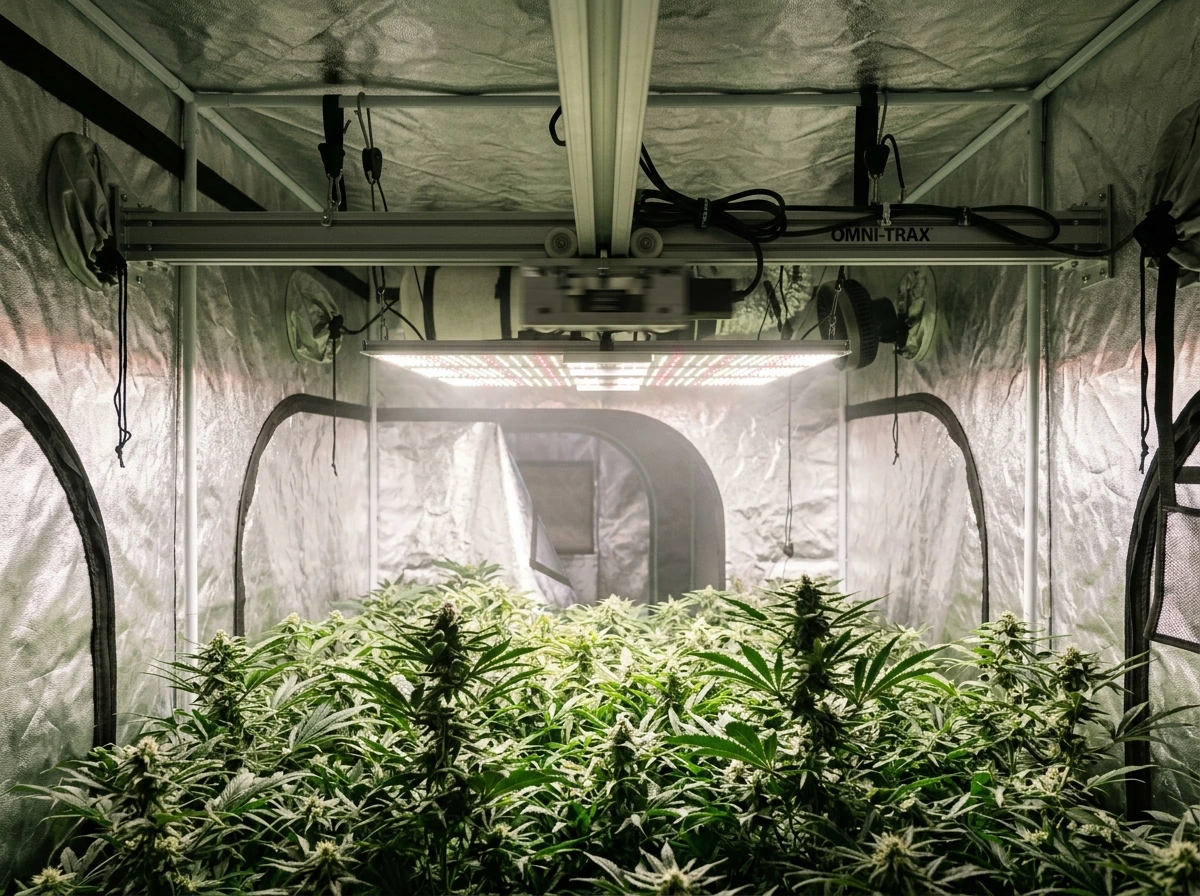
The short answer: the best grow light for you depends on your space size, what you're growing, and your budget, but in 2026 the strongest value is almost always found in full-spectrum LED bar or quantum board fixtures in the 200W to 600W range. The US EPA notes that UV exposure increases skin cancer risk and highlights the need for proper protective eyewear because UV can be harmful to eyes.
Grow Lights Reviews: How to Choose the Right System Today

Marcus Caldwell
24 Mar 2026
That said, the spec sheet on a product page tells you very little on its own. What actually matters is how independent reviewers measured that light, and whether those measurements translate to your specific setup. This guide walks through how to read grow light reviews critically, what to buy for common setups, and what changes if you're shopping in Canada. grow light reviews 2024
How to interpret grow light reviews (metrics that actually matter)
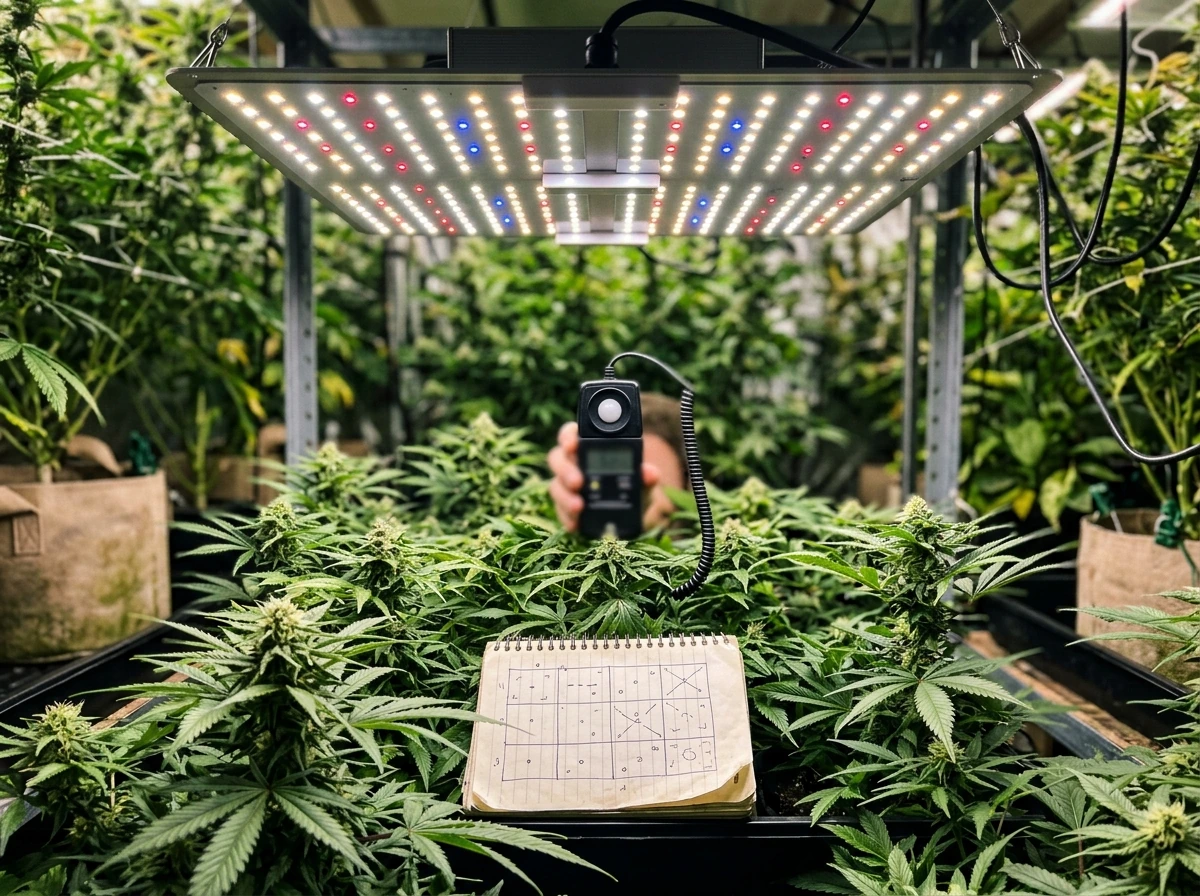
Most grow light marketing leads with wattage and coverage area claims. Neither of those numbers means much on their own. Wattage tells you how much electricity the light draws, not how much useful light it produces. Coverage area claims are almost always optimistic and rarely tied to a specific PPFD target. The metrics you actually want to see in a review are PPFD, PPF, efficacy, and spectrum, and here's what each one means in practice.
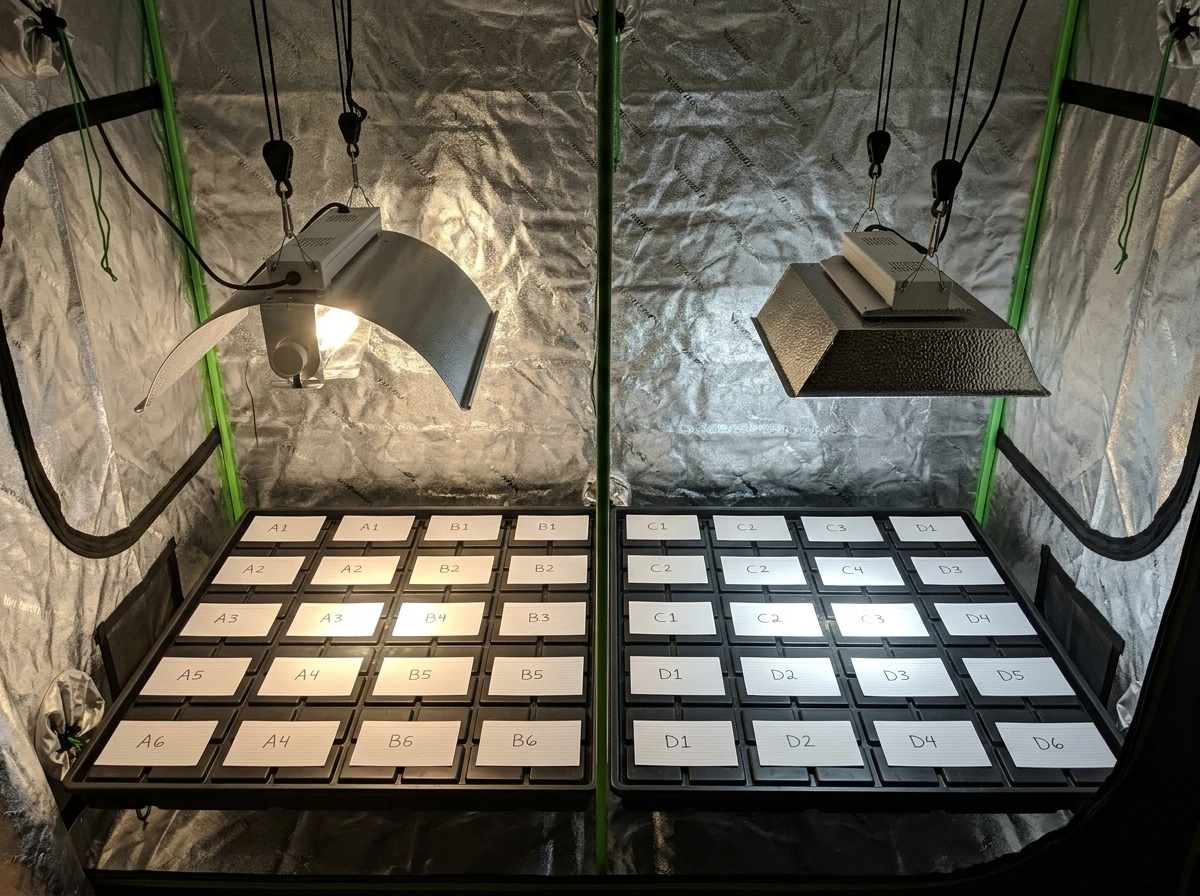
PPFD (Photosynthetic Photon Flux Density), measured in µmol/m²/s, tells you how many photons are hitting a square meter of canopy per second at a specific point. A single PPFD reading is almost useless. What you want is a PPFD map, a grid of readings across the full footprint at a stated hanging height. Good reviewers publish this map so you can see whether the light is evenly distributed or has a hot spot in the center with dead edges. MIGRO's own testing methodology, for example, translates raw PPFD readings into a PAR intensity map specifically to show how well a fixture covers a target grow area.
PPF (Photosynthetic Photon Flux), measured in µmol/s, tells you the total photon output of the fixture regardless of where those photons land. Some reviewers, including Coco for Cannabis, report a more useful variation called Usable PPF, which represents the photons actually arriving at the canopy in a reflective-walled grow space when the fixture is hung at a height where the maximum PPFD sits between 950 and 1000 µmol/m²/s.
If you are also weighing reflective options, reading the best grow light reflector reviews can help you choose one that improves light spread without sacrificing PPFD reflective-walled grow space. In their test of the Migro Aray 4 240W, for example, they reported an average PPFD of 713. 7 µmol/m²/s and a Usable PPF of 513. 8 µmol.
That distinction matters because real grow tents have reflective walls, and a light that spreads photons wide can score better under real-world conditions than a tightly focused fixture with a high peak reading.
Efficacy is expressed in µmol/J and tells you how efficiently a fixture converts electricity into useful photons. In 2026, a good LED grow light should be hitting 2.5 to 3.0+ µmol/J. Anything below 2.0 µmol/J is either outdated technology or a budget fixture that will cost you more in electricity over time. Spectrum matters too, but less than marketers suggest. A full-spectrum white LED with a moderate red-to-blue ratio works well for most plants across all growth stages. You only need to go deep on spectrum if you're dialing in flowering response or supplementing specific wavelengths.
One detail worth noting about published test data: testing conditions matter a lot. Coco for Cannabis uses reflective mylar panels on four sides of their test area during PAR testing, which mimics a real grow tent environment. Reviews that test lights in open air with no reflective surfaces will report lower numbers than you'd see in actual use. When comparing reviews across sources, check whether tests were done in a reflective enclosure or open air, since those two setups are not directly comparable.
Best grow light types for common indoor setups
Before getting into specific products, it helps to match light type to setup. The indoor grow light market has largely settled into a few dominant categories, and each suits different growers differently.
LED quantum boards and bar lights
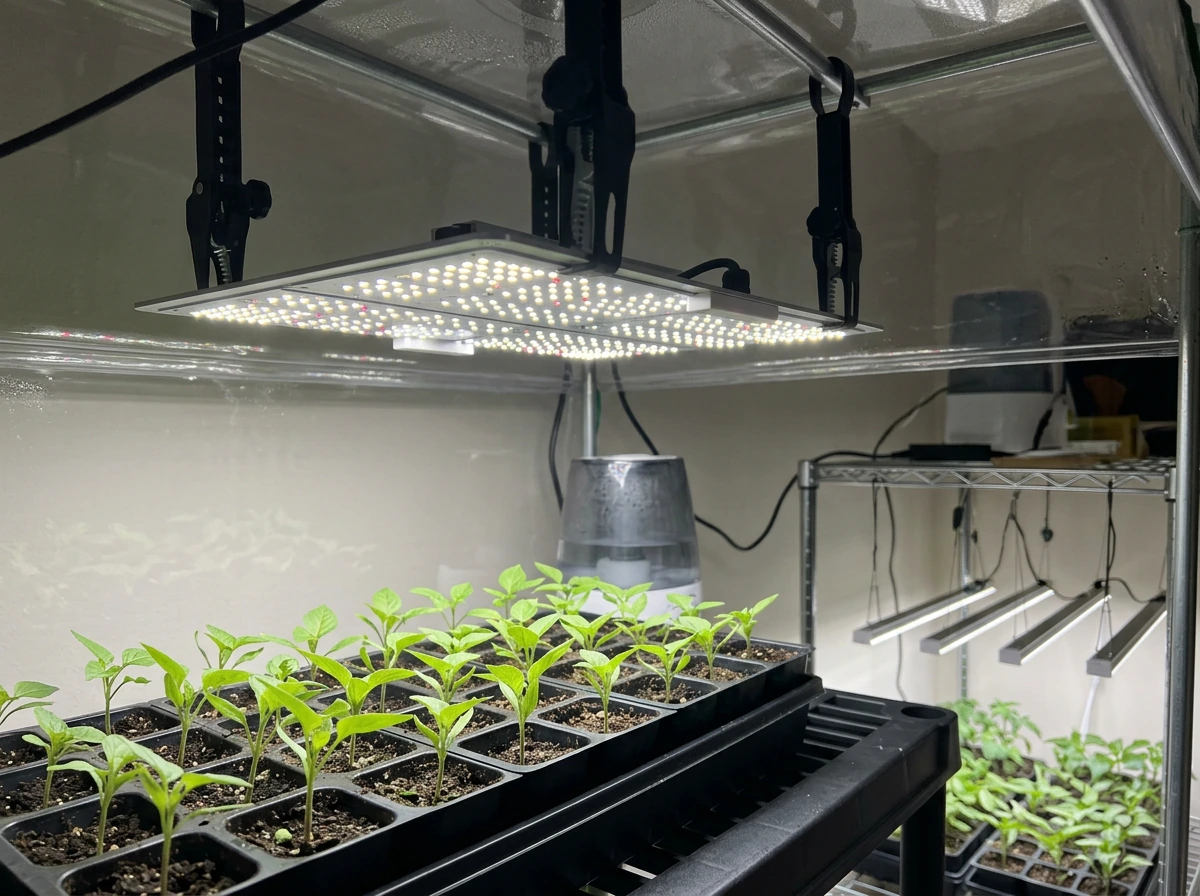
These are the current standard for good reason. Quantum board designs spread light more evenly across a footprint than older blurple LED panels, and modern bar-style fixtures with blank" rel="noopener noreferrer">Samsung LM301H or similar diodes consistently hit efficacy ratings above 2.7 µmol/J. For a 2x4 foot tent, a quality 200W to 250W LED bar light is the right range. For a 4x4, look at 400W to 480W. These fixtures run cooler than HID, have low heat output relative to light output, and long lifespans (50,000 hours is typical).
HID (HPS and CMH/LEC)
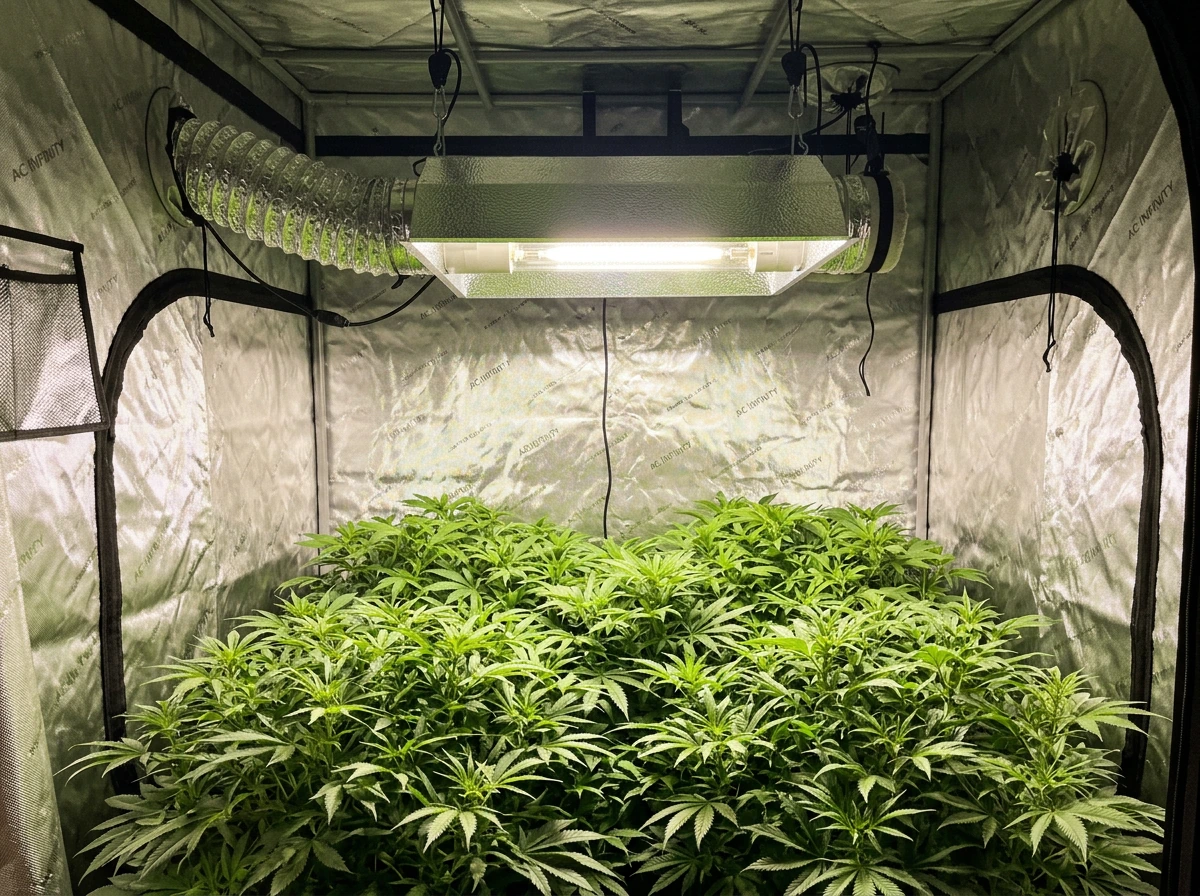
High-pressure sodium and ceramic metal halide lights still have a place, particularly for growers who already own the infrastructure or who are running larger spaces where the economics of LEDs don't yet close as cleanly. HPS produces a lot of heat and requires ventilation management, but the light output per dollar upfront is still competitive for spaces above 6x6 feet. CMH/LEC lights produce a more balanced spectrum and are more efficient than HPS, but still fall behind top-tier LEDs in efficacy.
Fluorescent T5 and CFL
T5 fluorescent fixtures are still a practical choice for seedling stages and cloning, where lower intensity and even coverage matter more than peak PPFD. They're inexpensive, easy to use, and produce enough light for propagation without risk of bleaching young plants. For full-cycle growing or flowering, they don't produce enough photon output to be competitive. CFLs have largely been superseded by LED equivalents that cost the same and perform better.
| Light Type | Efficacy (µmol/J) | Best Use Case | Heat Output | Upfront Cost |
|---|---|---|---|---|
| LED Quantum Board/Bar | 2.5 to 3.2+ | Full cycle, all space sizes | Low | Medium to High |
| HPS | 1.5 to 1.9 | Large spaces, flowering | High | Low to Medium |
| CMH/LEC | 1.9 to 2.2 | Full cycle, medium spaces | Medium | Medium |
| T5 Fluorescent | 0.9 to 1.3 | Seedlings, clones, herbs | Low | Low |
| CFL | 0.7 to 1.1 | Seedlings only | Low to Medium | Low |
For most readers in 2026, the recommendation is straightforward: buy a quality full-spectrum LED bar or quantum board for your primary grow space. The efficacy advantage over HID means lower electricity bills within the first year, and the heat management difference is significant if you're growing in a tent without dedicated HVAC.
Grow lamp vs grow light vs grow light system: what you're really buying
These terms get used interchangeably in reviews and on product pages, but they refer to meaningfully different things, and buying the wrong one wastes money.
A grow lamp or grow bulb is just the light source itself, designed to fit into an existing fixture or socket. If you already have a reflector hood, ballast, or standard socket, you're buying a lamp. Examples include HPS bulbs, CMH bulbs, and screw-in LED grow bulbs. Reviews of grow lamps should focus on spectrum output, PPF, and compatibility with your existing driver or ballast.
A grow light (or grow light fixture) is the complete, ready-to-hang unit: driver, diodes or bulb, housing, and hanging hardware all included. This is what most hobbyists are buying. Reviews should evaluate the full fixture as a system including PPFD maps, efficacy, heat management, and build quality.
A grow light system is a fuller package that may include the fixture plus a controller, reflective tent or hood, timer, and sometimes a grow medium starter kit. System reviews need to evaluate each component on its own merits because a strong light paired with a weak controller can underperform a well-matched mid-range system. If you're buying a system, check whether the controller is proprietary or whether it works with third-party lights, since that affects your upgrade path significantly.
Seedlings and indoor plants: picking the right wattage and setup
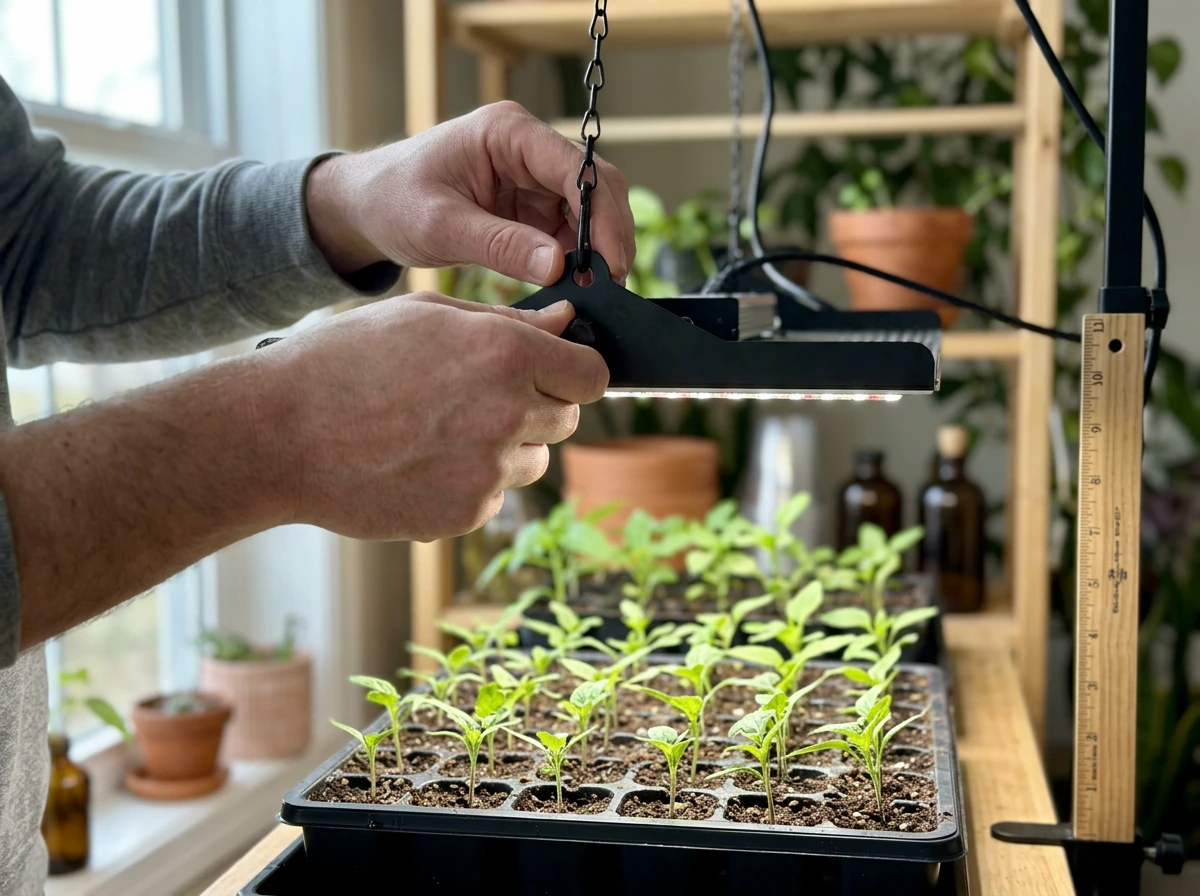
Getting the wattage right for seedlings is honestly where most first-time growers make mistakes, and the mistake usually goes in the direction of too much intensity rather than too little. Young seedlings need PPFD in the range of 100 to 300 µmol/m²/s. Most full-size grow lights are capable of delivering 800 to 1000 µmol/m²/s at the canopy, which means you either need to hang the light much higher than usual, dim it significantly, or use a dedicated low-intensity fixture for the seedling stage.
For a small seedling tray, a T5 fixture or a dimmable LED panel hung at 24 to 36 inches is the practical choice. If you're using the same light that will take plants through vegetative growth and flowering, make sure it has a dimmer. Running a 480W light at full power over a seed tray is not only unnecessary, it can stunt or bleach young plants.
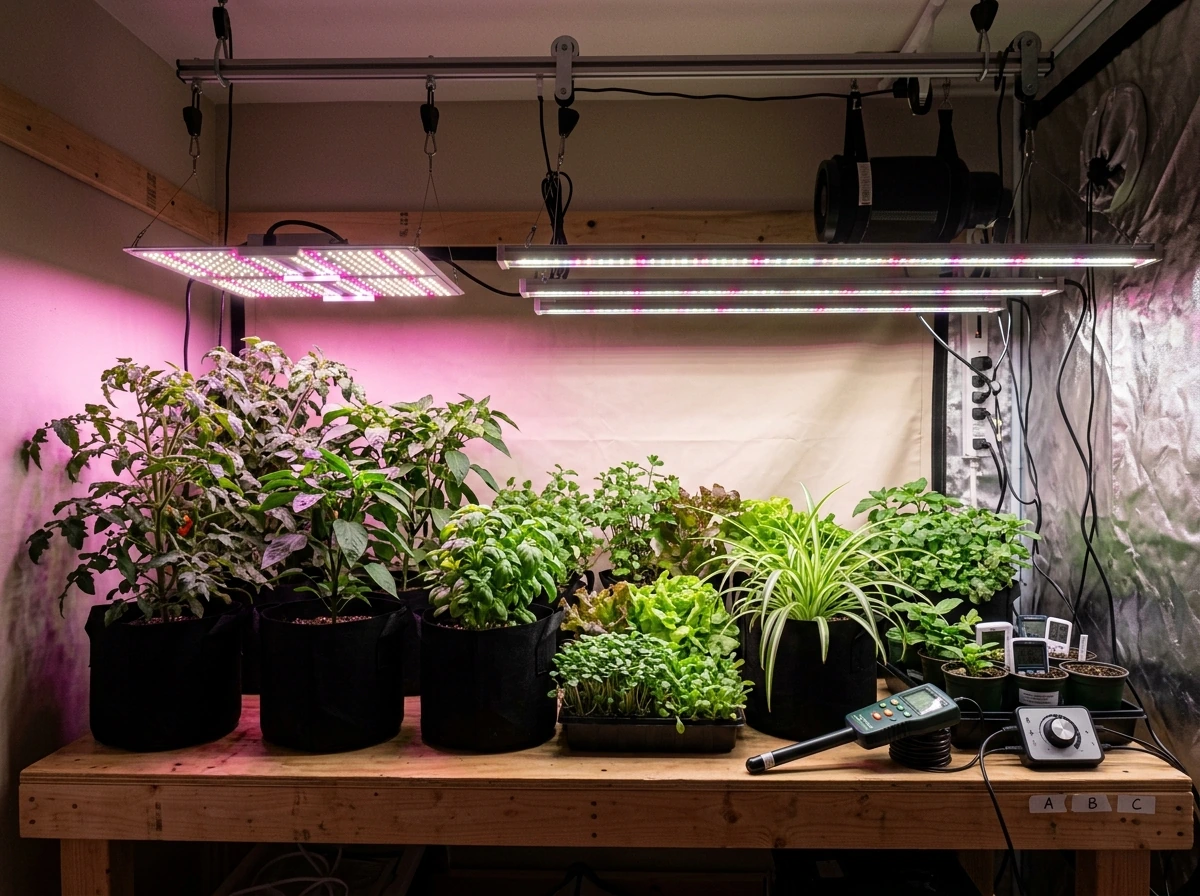
For established indoor plants like houseplants, herbs, and vegetables, the target PPFD range varies by plant type. Low-light houseplants (pothos, snake plants) are fine at 50 to 150 µmol/m²/s. Herbs and leafy greens want 150 to 400 µmol/m²/s. Fruiting plants like tomatoes and peppers want 400 to 800 µmol/m²/s for good production. When reading reviews for indoor plant lighting, look for the reviewer's target PPFD and hanging height, since a light that's rated for a 4x4 footprint at 18 inches might only cover a 2x2 at the right intensity for fruiting plants.
- Seedlings: target 100 to 300 µmol/m²/s, use dimming or raise fixture height
- Low-light houseplants: 50 to 150 µmol/m²/s
- Herbs and leafy greens: 150 to 400 µmol/m²/s
- Fruiting vegetables (tomatoes, peppers): 400 to 800 µmol/m²/s
- High-light flowering plants: 600 to 1000+ µmol/m²/s
Photoperiod is the other piece of this. Most vegetables and herbs do well on 16 hours on, 8 hours off during vegetative growth. Seedlings can run on 18 hours. Flowering plants that are photoperiod-sensitive need a 12/12 schedule to trigger bloom. If you're growing a mix of plant types, a controllable fixture with programmable timers makes managing this much easier.
Bulb-focused considerations: compatibility, output, spectrum, and lifespan
If you're evaluating grow light bulbs specifically, either because you're replacing a bulb in an existing fixture or building a custom setup, there are a few things that matter more than the packaging suggests.
Compatibility is the first filter. HPS and CMH bulbs require matching ballasts. Running an HPS bulb in an MH ballast, or vice versa, risks ballast damage and poor performance. Always confirm that the bulb wattage matches the ballast rating exactly, since a 600W ballast running a 1000W bulb will not perform correctly. For LED retrofit bulbs designed for standard sockets, check the driver compatibility list if the manufacturer publishes one, since many LED grow bulbs perform poorly when run on a dimmer circuit they weren't designed for.
Spectrum for bulbs is worth evaluating by growth stage. Bulbs with a color temperature of 5000K to 6500K (blue-heavy) are better suited to vegetative growth, while 2700K to 3000K (red-heavy) bulbs support flowering better. CMH bulbs around 3100K to 3200K offer a balanced spectrum that works reasonably well across both stages and includes UV output that most LEDs lack by default.
Lifespan for HPS bulbs is typically rated at 24,000 hours, but in practice PAR output degrades noticeably after 12 to 18 months of full-time use. Most experienced growers replace HPS bulbs every one to two years to maintain consistent output. CMH bulbs last slightly longer before significant output degradation. LED diodes used in grow light fixtures are blank" rel="noopener noreferrer">rated at 50,000 hours with much slower lumen maintenance degradation, which is one reason the total cost of ownership calculation favors LEDs even when the upfront price is higher.
Controller-focused considerations: timers, dimming, automation, and power draw
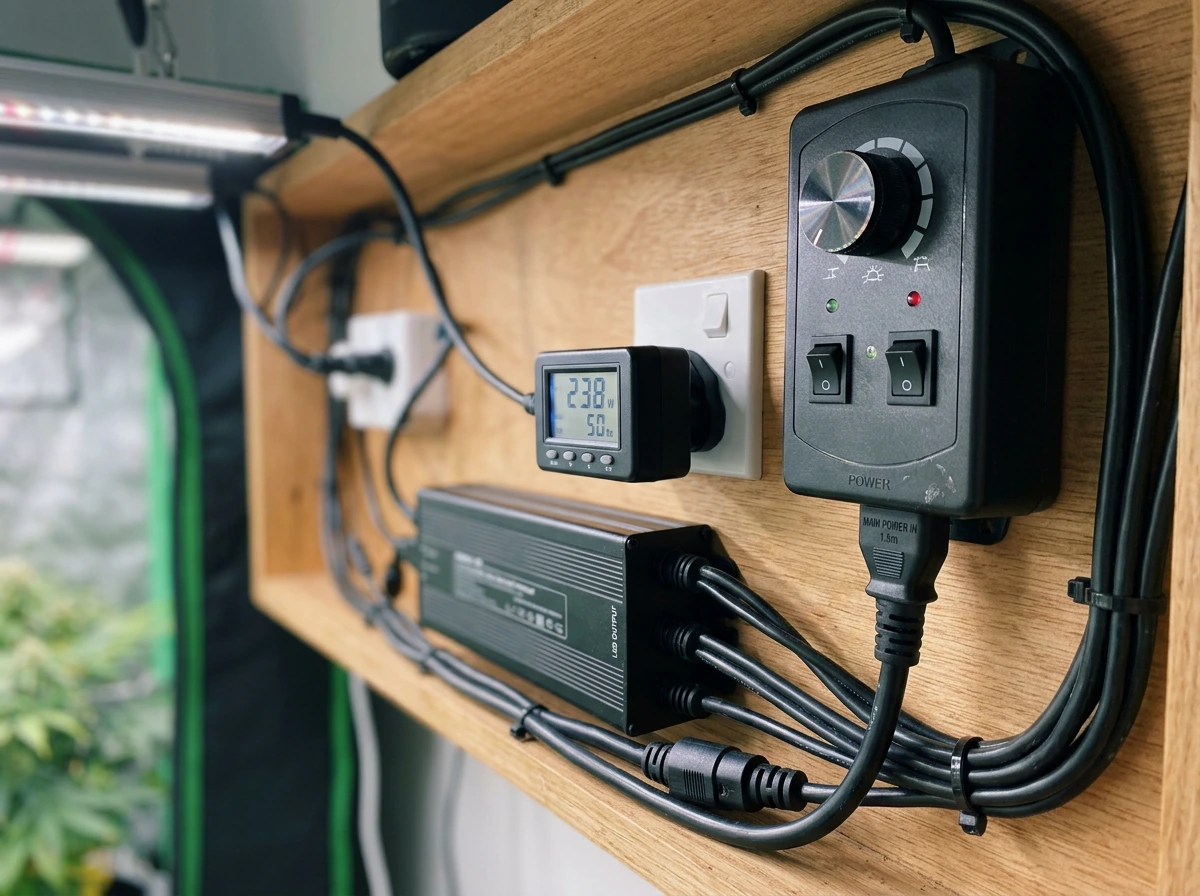
A good controller doesn't just add convenience. It can meaningfully improve results and reduce electricity costs, but only if it's matched properly to your fixture.
The basic function of any grow light controller is scheduling: turning lights on and off on a timer. Mechanical outlet timers do this reliably for around five dollars and work fine if you only need a single photoperiod across all your lights. Where dedicated grow light controllers add value is when you need multiple channels, precise sunrise/sunset ramp functions, dimming control, or integration with temperature and humidity sensors.
Dimming compatibility is the feature that matters most for most growers. Not all LED fixtures are compatible with all dimming controllers. Many quality LED grow lights use a 0 to 10V dimming protocol, which requires a controller that outputs 0 to 10V, not a standard phase-cut dimmer. Using the wrong dimming type can damage LED drivers. Before buying a controller with dimming capability, confirm the protocol your fixture uses and match it to the controller's output type.
Automation features like VPD-linked dimming, CO2-triggered intensity increases, and multi-zone scheduling are genuinely useful at scale but add complexity and cost that most hobby growers don't need. For a one or two tent setup, a quality timer with a simple 0 to 10V dimmer module is the practical choice. For larger setups running multiple lights across different growth stages, a multi-channel controller that lets you manage each zone independently pays for itself in operational simplicity.
Power draw is worth paying attention to when evaluating controllers because some grow light systems with integrated controllers report the combined wattage of the controller and the fixture together, while others report only the fixture. If you're calculating electricity costs or sizing a circuit, you need the combined draw. A 480W fixture with a controller that draws 15W is pulling 495W from the wall, not 480W. It's a small difference, but across multiple fixtures on a shared circuit it adds up.
Value and availability checks (including Canada shopping considerations)
Evaluating value in grow lights means looking past the price tag to cost per µmol/J of photon output, warranty terms, and the availability of support and replacement parts. A fixture that costs $50 more but carries a three-year warranty and uses standard replaceable drivers is often a better value than the cheaper option with a one-year warranty and a proprietary sealed driver.
When comparing prices across reviews, confirm the date of the review. Grow light prices have shifted significantly over the past few years as competition increased and component costs changed. Reviews from 2020 or 2021 may reference price points that no longer reflect the current market. For the most reliable pricing, check current retailer listings directly and cross-reference against the specifications reviewed, since manufacturers sometimes refresh a product line under the same name with different internal components.
Shopping from Canada: what actually changes
Canadian shoppers face a few practical differences that reviews aimed at US audiences don't usually address. The first is electrical compatibility. Canada runs on 120V/60Hz like the United States, so there's no voltage conversion issue for most fixtures. However, higher-wattage fixtures (600W and above) often have dual-voltage drivers that support 240V operation for more efficient power delivery. If you're running a high-wattage setup in Canada, confirm whether your electrical panel can support a 240V circuit and whether the fixture includes the appropriate plug for Canadian outlets.
Availability is the bigger practical issue. Many US-based direct-to-consumer grow light brands ship to Canada but charge significant shipping fees or route through distributors that add to the final price. Major brands with Canadian distribution or Amazon Canada listings include Spider Farmer, Mars Hydro, AC Infinity, and Gavita, among others. Buying through a Canadian retailer or a marketplace with fulfillment from Canadian warehouses avoids customs delays and often reduces total cost when currency exchange and duties are factored in.
Warranty service is worth checking specifically for Canadian buyers. Some brands offer warranty support through Canadian distributors, while others require you to ship products back to a US or overseas address at your own cost. That distinction matters if you're buying a premium fixture and want meaningful warranty protection. Look for brands that explicitly list Canadian service addresses or partner distributors in their warranty documentation.
When evaluating reviews for Canadian purchasing decisions, the performance metrics (PPFD, efficacy, spectrum) translate directly regardless of geography. The main adjustments are confirming current Canadian pricing rather than US pricing, verifying shipping and customs cost, and checking warranty service terms. The spec evaluation framework in this guide applies the same way whether you're ordering from a Canadian retailer or cross-border.
How to shortlist the right light for your setup
Start with your space dimensions and your target plants. Those two inputs will tell you your required PPFD range and your minimum coverage footprint, which together define the minimum fixture specifications you need. From there, filter reviews by fixtures that cover your footprint at your target PPFD. If you are shopping based on grow light mover reviews, make sure you focus on how the fixture performs at your target hanging height and PPFD map uniformity, not just the marketing wattage claims. Then rank the shortlist by efficacy (µmol/J), since that drives your operating costs. Warranty terms and build quality are the final tiebreakers.
- Measure your grow space and identify your coverage footprint target
- Determine your target PPFD range based on what you're growing (see the PPFD table above)
- Filter reviews to fixtures that publish PPFD maps covering your footprint at your target intensity
- Compare efficacy ratings (aim for 2.5 µmol/J minimum, prefer 2.7+)
- Check dimming compatibility if you plan to use a controller
- Verify warranty terms and service availability for your location
- Confirm current pricing from a retailer in your region before purchase
The grow light market in 2026 is genuinely good for buyers. Competition has pushed efficacy up and prices down significantly compared to even three years ago. The risk isn't finding a capable light at a fair price. The risk is buying based on marketing claims rather than independently measured data. Stick to reviews that publish PPFD maps, report testing conditions, and compare efficacy against price, and you'll avoid most of the bad purchases. If you are specifically looking for grow laser cap reviews, prioritize fixtures that publish the same kind of PPFD mapping and efficacy data PPFD maps, report testing conditions, and compare efficacy against price. grow light mover reviews grow light mover reviews
FAQ
How do I translate a review’s PPFD map into real spacing and plant distance for my setup?
Use the review’s stated hanging height and target footprint, then match that to your planned distance from the canopy. If your hanging height differs, treat the PPFD map as an estimate, and look for reviews that provide multiple height readings or an explicit conversion approach, since PPFD drops nonlinearly with distance and spread.
What’s the difference between “usable” and “average” photon numbers in grow light reviews, and which should I prioritize?
Average metrics can hide dead zones, usable metrics attempt to reflect what reaches the canopy under reflective conditions. If you grow in tents with reflective lining, prioritize the metrics explicitly tied to that environment, but also check for evenness (the presence of hot spots) so you do not overload only the center plants.
Why do two reviews show very different wattage, efficiency, or performance for what seems like the same grow light model?
Common causes include firmware revisions, different driver versions, and testing at different input conditions (line voltage) or different heights. Also, some reviewers report only fixture power while others include controller power, so verify whether “wattage” is fixture-only or includes the full system.
Do I need the highest efficacy LED, or can a slightly lower efficacy light be a better buy for my garden size?
If your priority is minimizing electricity and heat while keeping the same PPFD, higher efficacy is usually better. But if a lower-efficacy fixture covers your footprint more evenly at your working height, it can outperform in practice, so rank by cost per effective photon at the canopy (not just the top-line µmol/J).
How can I tell if a review’s test area is representative of my actual grow space?
Look for whether the test used reflective walls or a tent-like enclosure, and whether the reviewer stated the reflector or mylar coverage on all sides. Open-air tests can understate what you will get in a reflective tent, but open-air tests may better represent bare grow rooms, so match the environment rather than the brand name.
What should I check if I’m comparing reviews from different years but the same product name?
Confirm the exact diode set and driver model in the review, because manufacturers sometimes revise internals without changing the external label. Also check the review date against current pricing, and look for evidence that the tested unit is the same generation you are buying today.
Are PPFD targets listed for cannabis directly applicable to vegetables and houseplants?
PPFD targets are species and goal dependent, even if the physics is the same. Vegetables and ornamentals often benefit from more flexible ranges, but the practical decision is to match the review’s target PPFD and schedule to your plant stage, and then adjust height or dimming to stay within the recommended band for that crop.
What’s the safest way to use a high-output light for seedlings without bleaching or stunting?
Start by using dimming or increased hanging height rather than switching lights on at full power. Since most full-size fixtures can exceed seedling-safe PPFD, aim for 100 to 300 µmol/m²/s at the canopy, then re-measure after you lock in height and reflectivity, because tents and plant height can shift the effective intensity.
If a review says “coverage area 2x4” or “4x4,” does that guarantee my plants get the needed PPFD everywhere?
No, footprint claims usually indicate the nominal spacing, not whether you achieve the same PPFD at the edges. For decision-making, require a PPFD map across the full grid and confirm that edge readings are close enough to your target, otherwise you may need an extra fixture or a smaller plant layout.
How do I choose between buying a lamp, a fixture, and a full system when reading reviews?
If reviews focus on PPFD maps and efficacy, that usually describes the fixture. If you are buying a bulb or retrofit lamp, compatibility with your ballast or driver is the main risk, so prioritize review details about electrical matching, dimmer compatibility, and whether the bulb performs in your specific socket or controller environment.
What dimming setup issues cause the most problems for growers, and how do I avoid them?
The biggest issue is using the wrong dimming protocol (for example, a 0 to 10V fixture with a phase-cut wall dimmer). Another issue is that some controllers only dim within a limited range, so check the minimum dim level and confirm the fixture’s dimming type and whether the controller output matches the fixture’s input requirements.
Do controller specs like “multi-zone” or “VPD-linked dimming” matter for a small tent?
For one or two zones, the complexity often does not pay back unless you plan to dial automation. A practical approach is to start with a reliable timer plus correct dimming compatibility, then only add multi-zone or VPD control if you already have the sensors, climate stability, and reason to vary intensity during the day.
How should I compute electricity cost when a review lists fixture watts but I’m buying a fixture plus controller?
Use the combined watt draw. If a review lists only the fixture, add the controller’s stated wattage or measure it, since even a 10 to 20W difference can compound across multiple lights and long photoperiods.
What warranty terms are worth paying attention to beyond the length of coverage?
Look for how service is handled (replacement vs repair), whether drivers are covered separately, and whether the brand uses standard replaceable parts or proprietary sealed components. For long-term value, also note the turnaround expectations and whether warranty support requires shipping at your expense.
For Canadian buyers, what extra details should I confirm before ordering a high-watt fixture?
Confirm 240V support if you plan to use a 240V circuit, ensure the box includes the correct plug for Canadian outlets, and verify that warranty service is handled through Canadian partners rather than requiring returns to the US or overseas. Also check whether the total checkout cost includes duties and brokerage, since listings can show the product cost but not always the end-to-end landed price.
What is the best “next step” checklist I can use after reading grow light reviews?
Write down your tent dimensions, target plant stage PPFD range, and your planned hanging height. Then shortlist only fixtures with PPFD maps that include your footprint at that height, rank by efficacy (µmol/J) and availability of replacement drivers, and finally confirm dimming protocol, electrical requirements, and warranty service for your country.