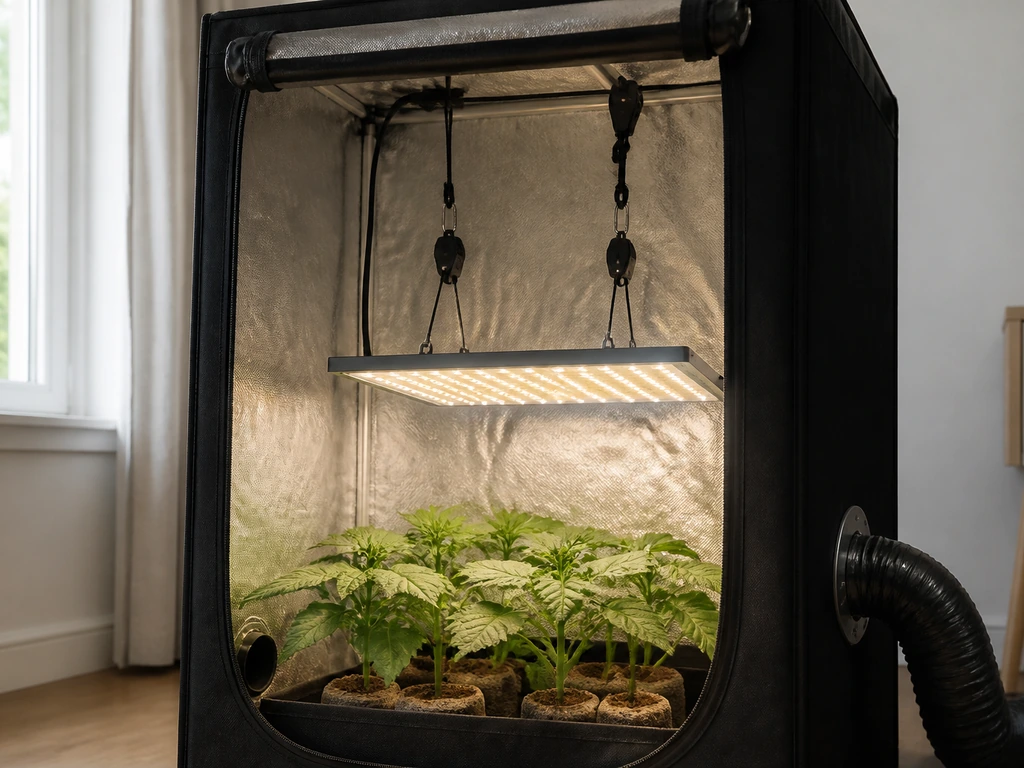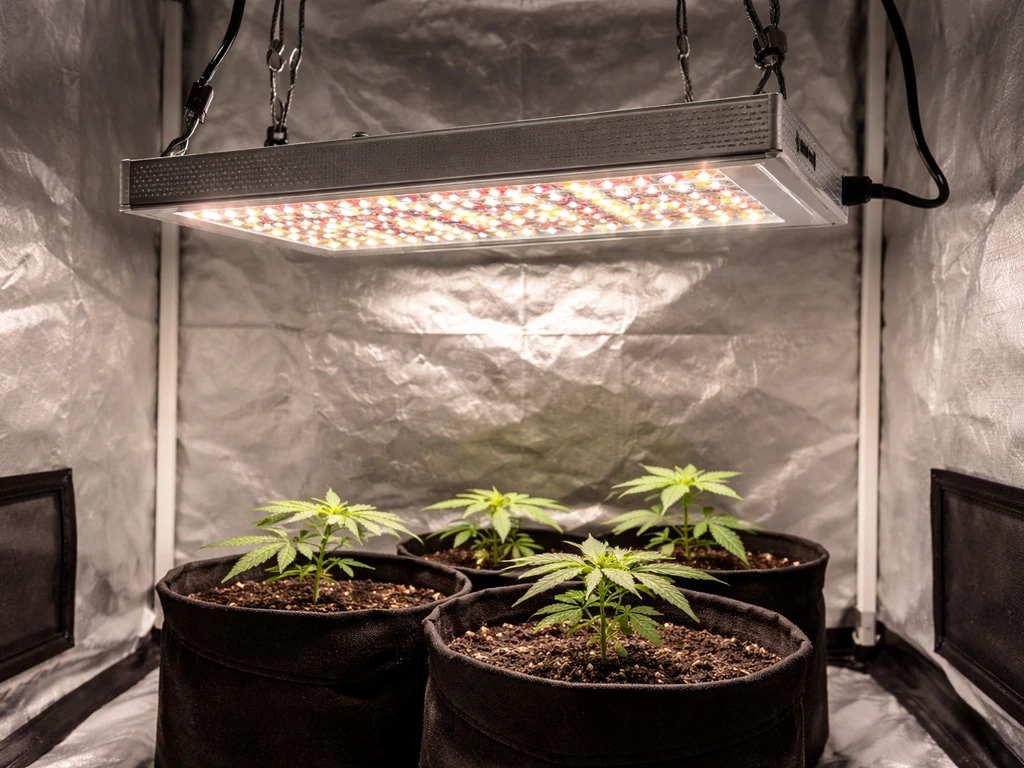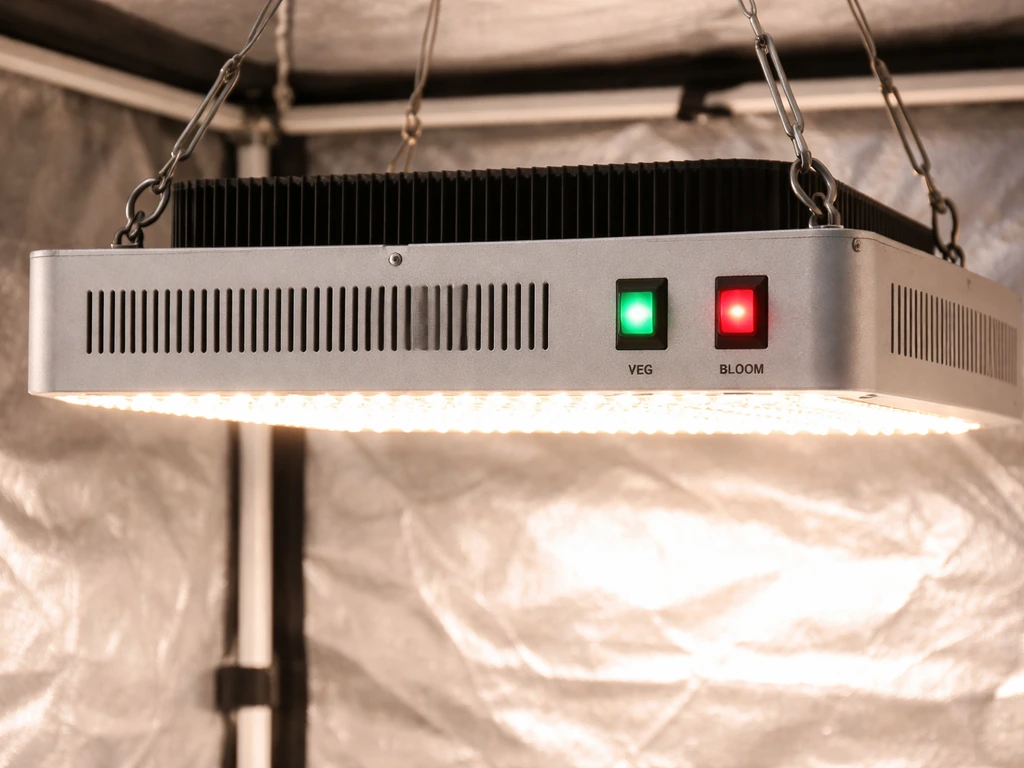
Actively cooled grow lights are worth buying in specific situations, but "chilled" is not a magic word. The short answer: if you're running a serious veg-to-flower cycle in a warm tent, or pushing LEDs hard at high drive currents, a thermally managed fixture will hold its output better over time and give you more reliable results than a passively cooled board running hot. If you're growing herbs under a 100W panel in a cool basement, you probably don't need one. Here's everything you need to make that call confidently.
Chilled Grow Lights Review: Cooling Performance and Picks

Marcus Caldwell
22 Apr 2026
What "chilled" actually means in grow lights
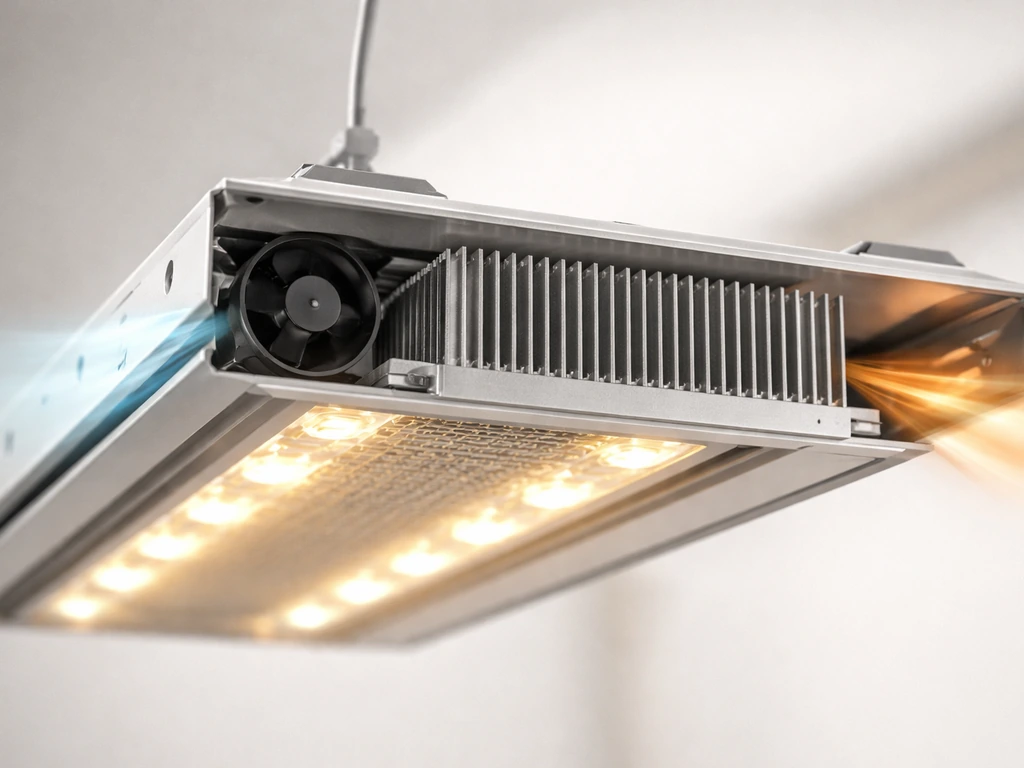
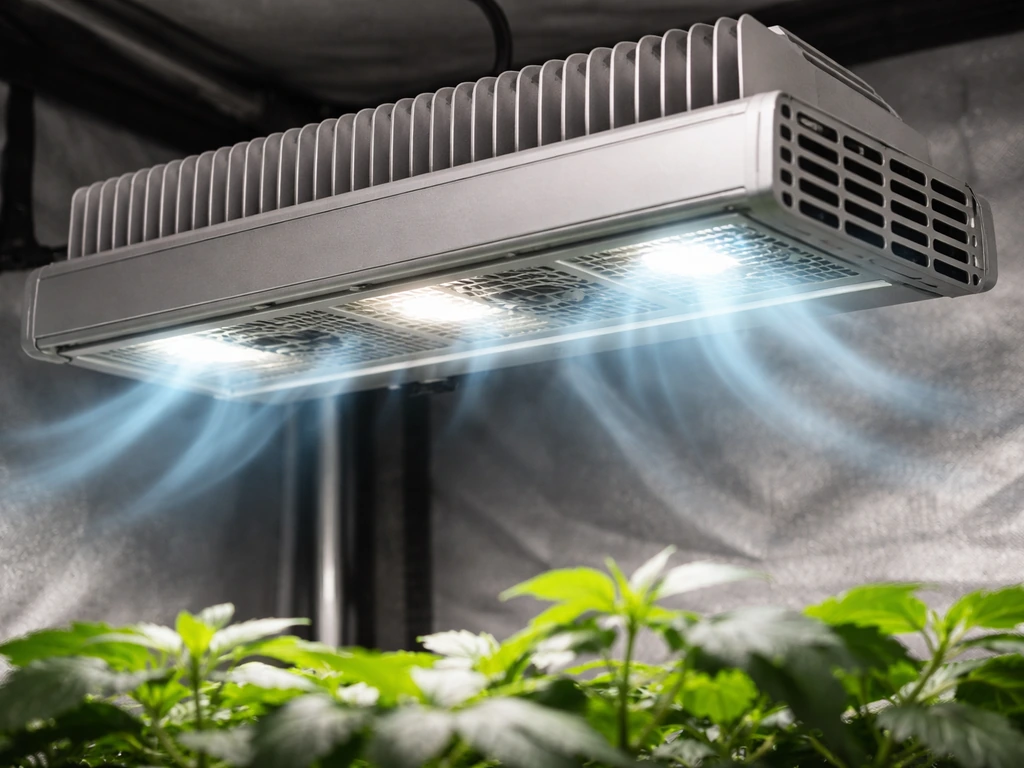
The word "chilled" in grow lights refers to active thermal management: the fixture is designed specifically to keep LED junction temperatures low, either through forced-air fans, ducted airflow, or both. It's not a regulated term, so different brands use it differently. The ChilLED brand (makers of the Growcraft ULTRA series) uses it to mean a fanless, passively cooled high-efficacy design with large heatsink mass and precise thermal engineering.
Other brands, like Rapid LED's Chilled Logic line, use it to signal a plug-and-play fixture built around high-efficacy chips like Samsung LM301B with thermal design as a primary engineering priority. Then there's the older "cool tube" approach, which is a ducted air-cooled reflector housing for HPS/MH systems, where an exhaust fan literally pulls air through the lamp housing and out of the grow space.
The common thread across all of these is junction temperature management. LED diodes become less efficient as they heat up, and sustained high junction temperatures accelerate lumen depreciation. The physics is straightforward: heat sinks alone can only move so much thermal energy passively. When you drive LEDs at higher currents for more output, a passive heatsink can become the bottleneck, and your actual PPFD from a "300W" fixture ends up being measurably lower at 10,000 hours than at hour one. Active cooling breaks that bottleneck. It lets manufacturers drive chips harder without the efficiency tradeoff, which is why properly cooled fixtures can advertise better long-run stability, not just peak specs.
The three main cooling approaches
| Cooling Type | How It Works | Typical Use Case | Key Trade-off |
|---|---|---|---|
| Passive heatsink only | Aluminum fins dissipate heat through convection; no moving parts | Low-to-mid wattage LEDs in cool environments | Heat limited at high drive currents; no noise, no maintenance |
| Active fan-cooled LED | One or more fans move air across the heatsink or through the chassis | Mid-to-high wattage LEDs in tents/small rooms | Adds noise (typically 30–45 dB-A); fan lifespan becomes a variable |
| Cool tube / ducted air-cooled | External duct and exhaust fan pull air directly through the lamp housing | HPS/MH systems 250W–1000W in tents | Requires 300+ CFM exhaust per 1000W unit; carbon filter must be in-line |
One important nuance: a fixture with a fan isn't automatically better than a passive one. A well-engineered passive design with sufficient heatsink mass and a conservatively driven LED can outperform a cheaply cooled active design. The question is whether the thermal solution matches the power being dissipated.
How to actually evaluate a chilled grow light
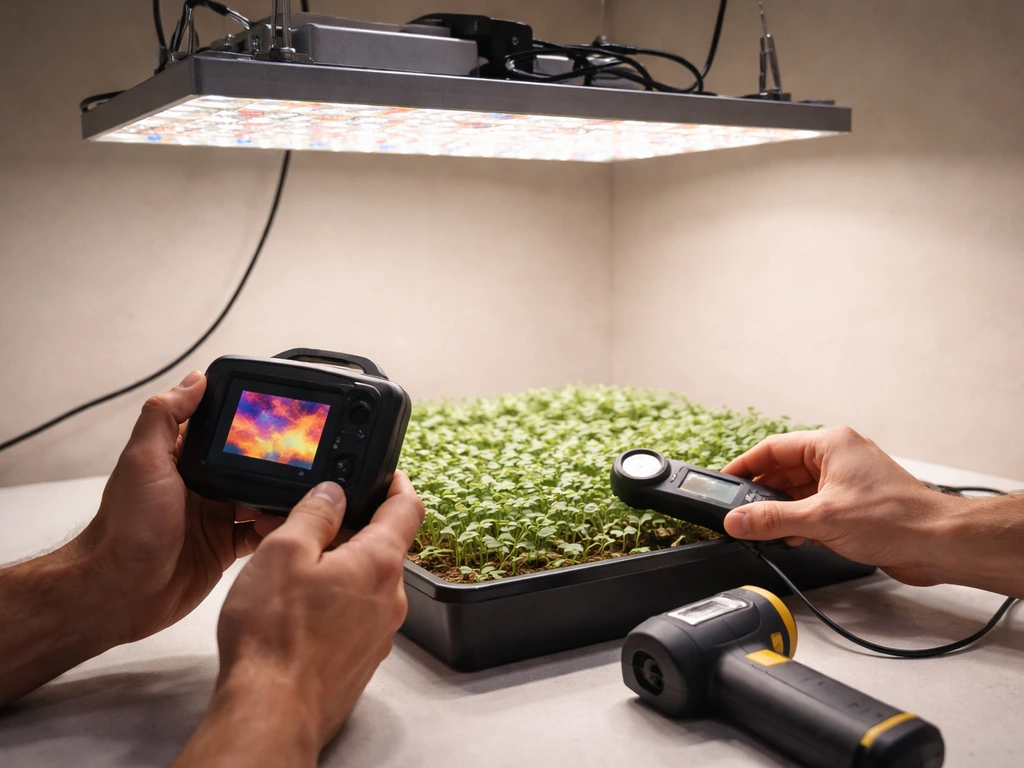
Reviewing a chilled grow light properly means measuring what actually reaches your canopy, not just reading the spec sheet. The most important metric is PPFD (photosynthetic photon flux density, measured in µmol/m²/s), taken with a calibrated quantum sensor at a fixed mounting height across a grid of measurement points. Testing protocol matters a lot here: LEDs are measurably more efficient when cold, so any honest PPFD review needs to be done after the fixture has reached normal operating temperature, not at startup. That's a detail a lot of budget reviews skip.
Temperature behavior over time is the second critical measurement. A heat gun pointed at the LED board and heatsink at 15-minute intervals after startup tells you whether the thermal design is keeping junction temps stable or allowing slow creep. The ChilLED Growcraft ULTRA X3-330W has been evaluated this way, with PPFD measurements taken at approximately 50.5 cm (20 inches) above the sensor after warm-up, and thermal readings cross-referenced to confirm that output data reflects real operating conditions rather than a cold-start snapshot.
Beyond those two core metrics, here's what else I look at when putting a chilled light through a real review:
- Coverage uniformity: PPFD mapped across a 2x2 and 3x3 footprint to find hot spots and dead zones
- Power draw at the wall (not rated wattage): a 330W fixture often pulls 290–340W depending on dimming level and driver efficiency
- Dimming behavior: does output scale linearly, and is there a minimum threshold before flicker or instability?
- Acoustical noise: measured in dB-A at 1 meter; some manuals publish this (33 dB-A is a common benchmark for quieter active-cooled units)
- Build quality: chassis rigidity, cable management, hanging hardware, and IP rating
- Fan filter condition and access: can you clean or replace it without tools?
Performance comparison: output, coverage, and consistency
Let's talk about what separates a genuinely well-cooled fixture from a standard one in practice. At the same rated wattage, a thermally managed fixture will typically show less output degradation between hour 0 and hour 5,000 of operation. This is where L70/L90 lumen maintenance ratings become meaningful: a fixture rated L90 at 36,000 hours under controlled thermal conditions only hits that rating if those thermal conditions are actually maintained in your grow.
Industry explainers that map the relationships between LM-80, LM-79, L-70, and TM-21 can be a helpful starting point when you want to interpret how those ratings connect to real long-term performance. Vantage Space’s glossary defines L70 as the point when a light source drops to 70% of its initial lumen output, which is why L70 is used to describe expected useful life for LEDs [L70/L90 lumen maintenance ratings become meaningful](https://www. vantagespace.
com/af-za/glossary/environmental-systems-hvac-lighting-acoustics/lumen-maintenance-l70). An explainer article on LED lifespan and lumen maintenance explains L70, L80, and L90 as lumen maintenance concepts and notes that projections are tied to an approachable standards approach L70/L90 lumen maintenance ratings become meaningful.
If you're running a 600W fixture in a 2x4 tent at 85°F ambient with no intake fan, the real L90 number is shorter than what's on the box.
The Rapid LED Chilled Logic line (available in 2x4 and 4x4 formats) uses Samsung LM301B diodes, which are among the most efficient chips available in commercial grow lights. When properly cooled, LM301B runs at roughly 2.9 µmol/J efficacy under ideal conditions. A 4x4 Chilled Logic fixture at full power in a climate-controlled space can realistically deliver 600–800 µmol/m²/s averaged across the canopy at 18–24 inches, which is well into flower territory. The ChilLED Growcraft ULTRA X3-330W is a narrower bar fixture designed for closer mounting distances and tighter canopy work, with peak PPFD measurements taken at around 20 inches showing strong center-point intensity.
Coverage uniformity is where many chilled fixtures earn their price premium. A well-designed bar layout distributes light more evenly than a single-board design, reducing the difference between center and edge readings. Uniformity ratios above 75% (edge vs. center PPFD) across a stated coverage area are a reasonable benchmark for a quality fixture. Below 60% and you'll see noticeably uneven growth unless you're rotating plants.
| Fixture | Form Factor | LED Type | Rated Wattage | Stated Coverage | Cooling Method |
|---|---|---|---|---|---|
| ChilLED Growcraft ULTRA X3-330W | Multi-bar | High-efficacy diodes | 330W | 3x3 to 4x4 ft | Passive (precision heatsink design) |
| Rapid LED Chilled Logic 4x4 | Board/bar | Samsung LM301B | ~400W | 4x4 ft | Active-thermal optimized |
| Rapid LED Chilled Logic 2x4 | Board/bar | Samsung LM301B | ~200W | 2x4 ft | Active-thermal optimized |
| Cool Tube 1000W HPS (reference) | Air-cooled reflector | HPS/MH lamp | 1000W | 4x4 to 5x5 ft | Ducted exhaust (300+ CFM required) |
Thermals, noise, and maintenance
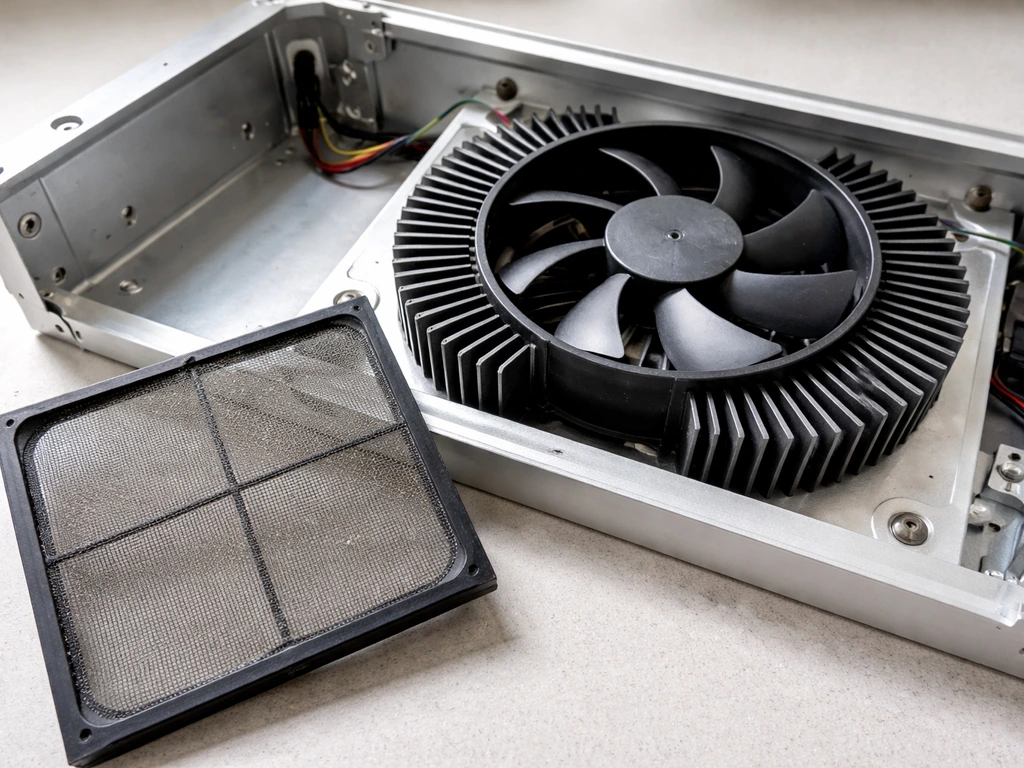
Fan-cooled fixtures introduce the one variable passive designs don't have: moving parts that wear out. A quality brushless fan in a grow light chassis has a rated lifespan of 30,000–50,000 hours, but real-world conditions in a grow tent (humidity, spores, particulate from soil or coco) shorten that. If a fixture has an accessible fan filter, clean it every 4–6 weeks in a typical grow environment. A clogged filter reduces airflow, raises junction temperature, and starts defeating the purpose of having active cooling in the first place.
Noise is a real consideration if your grow is in a living space. Fan-cooled fixtures in the 200–400W range typically run between 30–45 dB-A at close range. Some manufacturer manuals list this spec explicitly (33 dB-A is roughly the volume of a quiet library), but many don't. If noise matters to you, look for fixtures with temperature-controlled fan speed: they run quietly at lower temps and only ramp up when needed. Fixtures that run fans at full speed continuously are louder and often unnecessary unless you're consistently running at maximum power in a warm room.
Heatsink maintenance for passive designs is simpler: wipe down the fins periodically to prevent dust accumulation. Dust is an insulator, and a heavily coated passive heatsink is less effective than a clean one. For ducted cool-tube HPS setups, you'll need to ensure the activated carbon filter and inline fan are positioned correctly in the ducting run, with the fan pulling air through the tube rather than pushing it. Pushing creates back-pressure that reduces airflow efficiency and can cause the lamp to overheat.
Spectrum and grow-stage fit
Most chilled LED fixtures in 2026 ship with a full-spectrum white LED configuration, often described as "broad spectrum" or "sunlike." This typically means a phosphor-converted white LED centered around 4000K–5000K color temperature, with supplemental red diodes added to boost the red-to-far-red ratio for flowering. This works well across veg and flower without switching fixtures. The Rapid LED Chilled Logic and ChilLED lines both follow this approach.
For veg, you want your PPFD in the 200–600 µmol/m²/s range depending on the crop. Seedlings and clones are at the lower end (100–200 µmol/m²/s), established veg plants 300–600, and flowering crops want 600–900+ µmol/m²/s at the canopy. A well-cooled 330W fixture can comfortably hit flower-range intensity in a 3x3 space without thermal throttling, which is exactly what you want. A passively cooled fixture of the same rated wattage running warm may show 10–15% lower actual PPFD at equilibrium because the driver or LEDs are protecting themselves by slightly reducing output.
Dedicated veg/bloom dual-channel fixtures (separate red and blue channels) are less common in the chilled/actively cooled category, but they do exist. They offer the advantage of fine-tuning spectrum by stage, but in practice, most full-spectrum LEDs tuned for flowering produce good enough veg results that the added complexity rarely justifies itself for hobbyist growers.
Sizing, installation, and heat management
Get the mounting height right and most other installation variables become easier to manage. For a 330W bar-style fixture in a 3x3 space, 18–24 inches above the canopy is a reasonable starting range. Closer mounting increases intensity but narrows the coverage footprint and can cause bleaching on light-sensitive strains. Use your PPFD target (not the fixture's maximum rating) as the guide, and adjust height to hit that number at the canopy, not at the LED surface.
Room airflow directly affects how well any grow light performs thermally. A tent with no intake or exhaust will accumulate heat from the fixture, raising ambient temperature and reducing LED efficiency. Even a passively cooled fixture performs better when there's an active airflow exchange moving heat out of the space. A basic rule: size your exhaust fan to turn over the tent volume every 1–3 minutes, and make sure intake air is cooler than your target canopy temperature. If you're running a cool-tube HPS system, the ducted exhaust needs to be dedicated to the tube, not shared with the tent's general ventilation.
For cannabis specifically, canopy temperatures in the 70–82°F range are typical targets during active growth, with CO2-supplemented environments tolerating the higher end of that range when PPFD is also elevated. Keeping your ambient room temperature below 78°F when running a 400W+ fixture in a 4x4 space will do more for your long-run output stability than any spec upgrade.
Value for money: what you're actually paying for
Chilled and actively cooled grow lights carry a price premium over generic LED boards, and it's worth being clear about what that premium buys you. If you want specific buying guidance, these ipower grow light reviews can help you compare real-world performance and value across comparable models. In order of importance, you're paying for: (1) better long-run output stability, (2) higher drive current tolerance without efficiency loss, (3) lower risk of thermal throttling in warmer environments, and (4) in some cases, better build quality and warranty support.
The ChilLED Growcraft ULTRA X3-330W is a premium fixture, retailing in the $500–$700 range depending on the channel. The Rapid LED Chilled Logic 4x4 sits in a similar bracket. For that price, you should expect a 3-to-5 year warranty, documented efficacy data, and measurable output stability over 5,000+ hours. If a brand in this price tier can't provide real PPFD test data or won't publish their thermal design rationale, that's a red flag.
Total cost of ownership also includes electricity. At 330W running 18 hours/day for veg, you're drawing roughly 5.9 kWh/day. At $0.15/kWh that's about $0.89/day or $26/month per fixture. A higher-efficacy fixture costing $150 more upfront but drawing 20% less power pays back that premium in about 7 months of continuous operation. Run the numbers for your electricity rate before defaulting to the cheaper fixture.
| Factor | Budget LED (no thermal focus) | Chilled / Actively Cooled LED | Cool Tube HPS |
|---|---|---|---|
| Upfront cost (400W equiv.) | $80–$200 | $350–$700 | $100–$250 (plus ballast/lamp) |
| Efficacy (µmol/J) | 1.5–2.2 | 2.5–3.0+ | 1.2–1.6 |
| Output stability over time | Moderate (degrades faster if warm) | High (managed junction temp) | Moderate (lamp replacement cycle) |
| Noise | Low to moderate | Low to moderate (30–45 dB-A) | Fan noise from inline exhaust |
| Maintenance | Dust fins periodically | Clean fan filter every 4–6 weeks | Replace lamp, maintain ducting/filter |
| Typical warranty | 1–2 years | 3–5 years | Ballast: 1–2 years; lamp: consumable |
Chilled vs standard: who should buy which
Not every grower needs a chilled or actively cooled fixture. Here's a direct breakdown by scenario:
- Beginner with a 2x2 or 2x4 tent in a climate-controlled room under 75°F: A well-reviewed mid-range LED with quality passive cooling (Mars Hydro, AC Infinity, similar) will do fine. You don't need to spend $500+ on a chilled fixture for herbs or a first photoperiod grow.
- Serious hobbyist running a 3x3 or 4x4 tent through full veg-to-flower cycles: This is the sweet spot for chilled fixtures. You're pushing real intensity (600–900 µmol/m²/s in flower), ambient heat accumulates in the tent, and the long-run output stability of a thermally managed fixture pays off over multiple grows.
- Hot climate or warm room (ambient above 80°F regularly): Actively cooled fixtures are a meaningful upgrade here. Passive designs in warm rooms can thermally throttle or degrade faster than their spec sheets suggest.
- Commercial micro-scale or perpetual harvest setup (lights run 16–20 hours/day, 365 days/year): The long-run efficiency and stability of a chilled design, plus a meaningful warranty, makes strong economic sense at this usage level.
- HPS user wanting to reduce heat in the tent: A cool-tube air-cooled reflector is a proven option if you want to keep your HPS system. You'll need to size the exhaust (at least 300 CFM for a 1000W unit) and run dedicated ducting. If you're open to switching to LED entirely, a Chilled Logic or equivalent fixture will outperform HPS on efficacy and reduce total heat load.
One thing worth noting for comparison: if you're researching the broader grow light space, brands like Yintatech and Sylstar operate at the budget end of the LED spectrum with minimal thermal engineering, while ipower covers mid-range HID and LED hybrids. If you are considering iPower for your next setup, reading ipower grow light reviews can help you compare output consistency, thermals, and real-world performance.
If you're weighing a cool-tube approach instead of chilled LEDs, a cool tube grow light review can clarify how that ducted reflector setup performs in real tents. A cool tube grow light review helps you compare ducted HPS airflow performance, heat management, and real-world canopy results against chilled LED options cool-tube approach. None of those are in the same thermal-management tier as a purpose-built chilled fixture, which is relevant if you're weighing whether to step up in budget.
Similarly, cool-tube reflector designs are a solid middle ground for HPS users who aren't ready to switch to LED but need better heat control in their current setup.
The bottom line is this: "chilled" as a category is real and the thermal physics behind it are sound. Better junction temperature management genuinely produces more stable long-run output. Whether that's worth paying for depends entirely on how seriously you grow, how warm your environment runs, and how many hours per year those lights are on. If the answer to any of those is "quite a lot," a chilled fixture is one of the better investments you can make in your setup.
FAQ
How can I tell if a “chilled grow light” is actually preventing thermal throttling, not just cooling the moment I turn it on?
Check whether the fixture has thermal throttling logic (or driver current limiting) that maintains PPFD once it reaches steady-state. A practical way is to ask for PPFD after warm-up and again at 2 to 4 hours, not just the first-minute reading. If the manufacturer only shows startup output, expect a bigger drop in real use even if it has active fans.
Can I use a chilled grow light in a sealed tent without making thermals worse?
Yes, but the key is airflow capability versus heat load. If the fixture’s fan system is designed for open-air benches, it may underperform in a sealed tent, or if the canopy blocks intakes. Look for an airflow path that is not restricted by ducting or too-tight mounting, and confirm the review measured temperatures after steady operation.
If I buy a chilled LED, do I still need exhaust and intake fans?
A chilled fixture can reduce output drop, but it does not eliminate ventilation needs. You should still size intake and exhaust so that ambient stays near your canopy target (for cannabis, commonly within 70 to 82°F). If your room runs hot, the driver and optics still have limits, and you may end up paying for cooling hardware without solving the real problem.
How often should I clean the fan filter or air intakes on an actively cooled grow light?
You should clean the intake path and any fan filter more often than “manufacturer says so” if you see dust, coco fibers, or high humidity. A good decision rule is to inspect the filter every 2 to 3 weeks in dusty setups, because a partially clogged filter raises junction temps and quietly negates the chilled advantage.
What should I look for if noise matters in a bedroom or shared space?
Noise depends on fan curve, not just fan presence. If the light runs fans at a constant high speed, you will hear it. Prefer temperature-controlled fan ramps and look for real dB-A measurements at operating distance, or expect you may need to place it away from living areas.
Is active cooling always better than passive cooling for “chilled” performance?
Not always. Some higher-priced passively cooled “premium” units use large heatsinks and conservative current, which can beat a cheaper fan-cooled light with poor thermal design. The decision aid is to compare measured PPFD at steady state and the change from hour 0 to a few thousand hours, rather than relying on whether a fan exists.
What warranty and documentation should I expect to justify paying the chilled-light premium?
For “chilled” claims tied to reduced degradation, you want evidence of sustained output, like PPFD stability across warm-up and later timepoints. Also check warranty length and whether the warranty covers electronics under normal heat management. A short warranty with no thermal rationale is a warning sign in this category.
Will a chilled light automatically improve light uniformity across my canopy?
Sometimes the better value is not a single stronger light, but correct mounting height and airflow. A poorly mounted chilled fixture can still give uneven canopy intensity, especially on edge plants. Use the review’s uniformity numbers (center versus edge) to decide whether you need a bar layout, a wider fixture, or higher mounting to match your tent size.
What’s the most common mistake people make when matching a chilled light to their tent and plant spacing?
No. High PPFD requires both thermal stability and sufficient electrical efficiency. If a fixture is under-cooled but still advertised at high wattage, you may not get the promised photons at canopy after steady operation. Use PPFD targets and measured distance-specific results, since 18 inches and 24 inches can change canopy intensity a lot.
How do I factor fan lifespan and maintenance into the total cost of ownership?
Fans add a wear component, so plan for periodic maintenance. In typical grow environments, brushless fans can last a long time, but humidity and airborne particulates shorten life. If you cannot service or access the fan, factor that into your “chilled” cost of ownership.