The Byingo 4ft 64W is a decent, no-frills LED bar light that does one thing reasonably well: keeping seedlings and young vegetative plants alive and growing under a tight, elongated footprint. It is not a flowering light, it is not a replacement for a serious quantum board, and it will not carry a cannabis or tomato plant through to a heavy harvest. But if you need a plug-and-play T5 replacement for a propagation shelf, a seed-starting rack, or a 4-foot grow tray of leafy greens, it earns its price tag. Buy it for that use case, skip it for anything more demanding.
Byingo Grow Light Review: Coverage, Setup, and Performance

Marcus Caldwell
27 Apr 2026
What the Byingo grow light is and who it's for
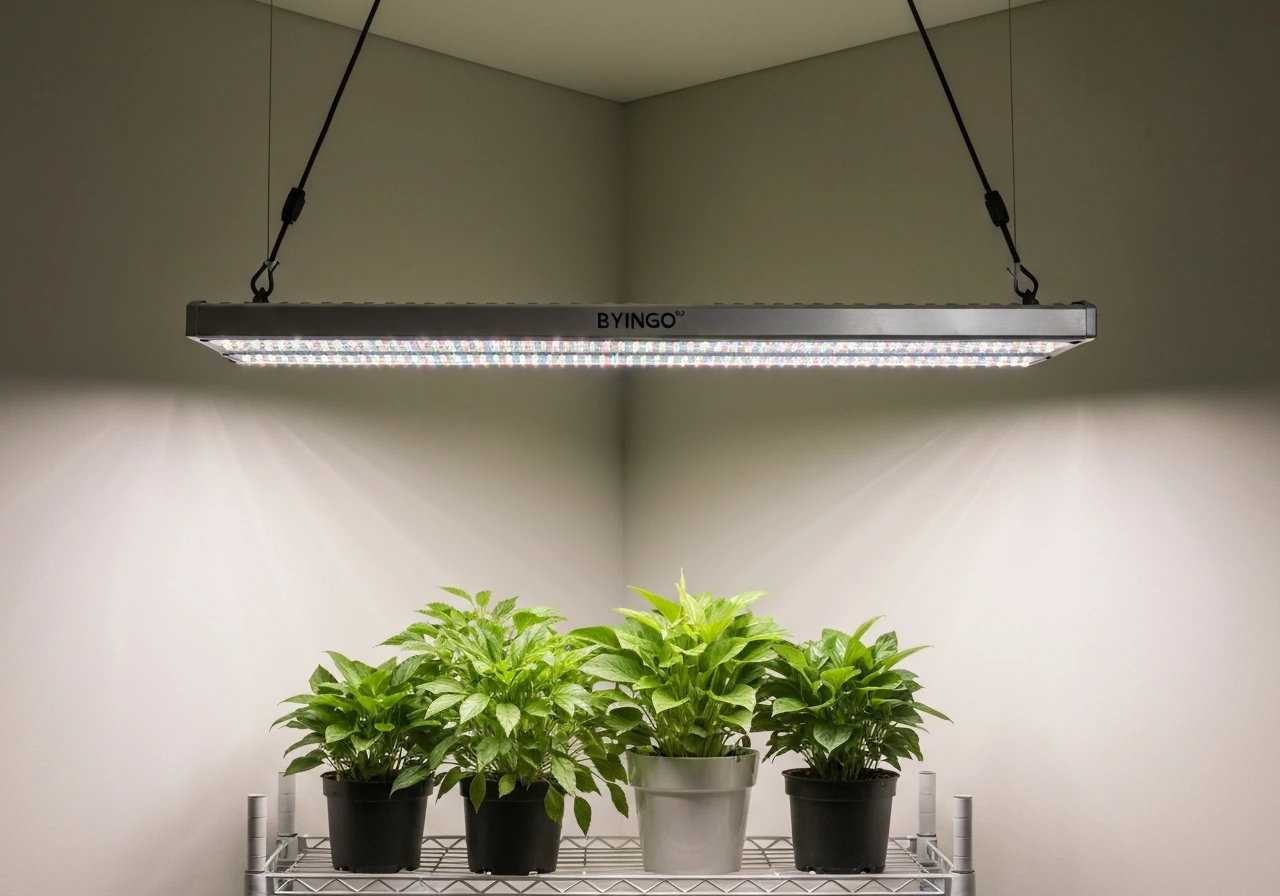
Byingo makes at least two sizes of this integrated LED bar fixture: the 2ft 32W and the 4ft 64W. Both follow the same design language: a single-bar, plug-and-play LED strip in an aluminum housing with a polycarbonate lens cover, targeting growers who want a drop-in replacement for fluorescent shop lights. The model covered most thoroughly here is the 4ft 64W, which retails around $92 and is aimed squarely at indoor herb growers, seed starters, and anyone running a propagation or early-veg setup on a shelf or in a small tent.
The fixture ships ready to hang, plugs into a standard 120V outlet, and includes an on/off switch on the power cord. There is no external driver box, no separate controller, and no dimming dial on the base unit. Up to four fixtures can be daisy-chained together using the extendable connector design, which makes it practical for covering a longer rack without running multiple separate plugs. That simplicity is both its appeal and its ceiling.
The target buyer is someone who has been running T5 or T8 fluorescents and wants better efficiency without the complexity or cost of a full-featured horticulture light. It is also a reasonable option for indoor herb gardens, microgreen trays, or starting vegetable seedlings before they go outdoors. If you are running a flower tent, growing fruiting plants to maturity, or need adjustable intensity, this is not the right tool.
Hands-on performance: brightness, coverage, and real output
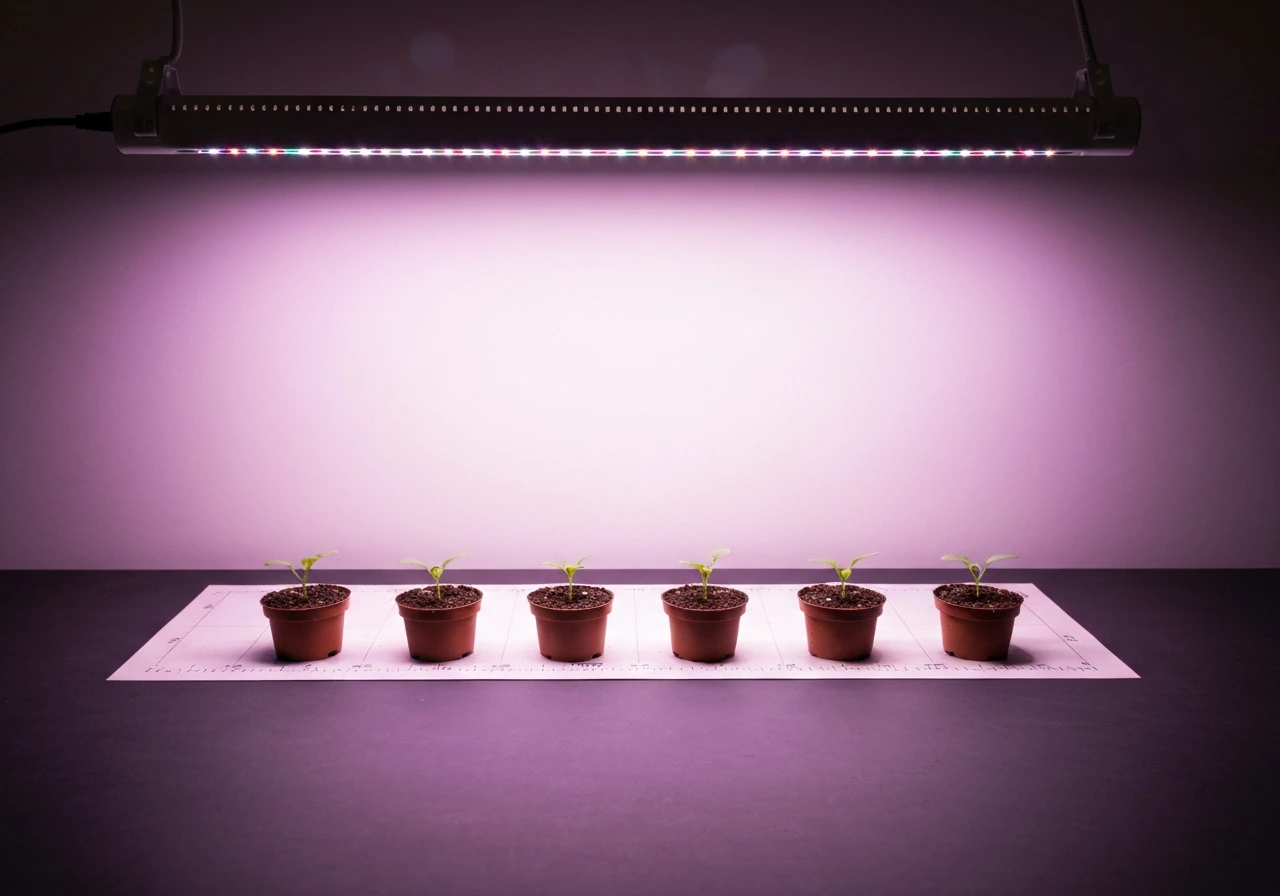
The manufacturer's stated coverage footprint for the 4ft 64W is 4 feet by 12 inches. That is a narrow strip, which makes sense for a single-bar design. In practice, this aligns with what a 64W LED bar can realistically illuminate at useful intensity: you are covering a single row of plants or a narrow shelf, not a square grow tent. If you are expecting to light a 2x4 tent with this fixture alone, you will have soft edges and a dim center canopy relative to what flowering plants need.
No manufacturer-published PPFD map was available for this light, which is a transparency gap worth noting. Based on the recommended hanging distance of 8 to 20 inches above the canopy, and using a rough lux-to-PPFD conversion (dividing lux by approximately 60 to 70 is a common method for full-spectrum white LEDs), the output at the closer end of that range should be adequate for seedlings and early veg, which typically need 200 to 400 micromoles per square meter per second. At 20 inches or more, intensity will drop off enough that flowering plants requiring 600 to 900+ PPFD would be underserved. Keep it within 10 to 14 inches for best results during vegetative growth.
As a T5 replacement, it performs credibly. T8 fluorescents in the 32W-per-tube range typically deliver lower PAR output and considerably worse efficiency than modern LEDs, so the Byingo does represent a real upgrade in photon delivery per watt for that comparison. Against dedicated horticultural LED panels using Samsung LM301B diodes or similar high-efficacy chips, however, the Byingo does not compete on raw output or efficiency per watt.
Spectrum breakdown and how it maps to growth stages
The Byingo 4ft 64W uses a full-spectrum design with blue output in the 400 to 510nm range and red output from 610 to 710nm. This covers the two most important photosynthetically active wavelength bands: blue for compact vegetative growth and root development, and red for stem elongation and early flowering stimulus. The blue-heavy portion makes it well-suited for seedlings and young veg, where you want dense, short growth rather than leggy stretching.
What is less clear from available data is the exact ratio of blue to red diodes and whether a meaningful portion of far-red (730nm) is included. High-end horticulture fixtures, including those built around LM301B-based boards or purpose-blended spectra, often add 660nm deep red and 730nm far-red to accelerate the Emerson effect and improve flowering transitions. The Byingo's spectrum does not appear to include that far-red component, which limits its usefulness at late flower. For seedlings and vegetative plants, this is a non-issue: the spectrum it provides is appropriate and functional.
| Growth Stage | PPFD Target | Byingo Suitability | Recommended Hanging Height |
|---|---|---|---|
| Germination / Seedling | 100–300 µmol/m²/s | Good | 16–20 inches |
| Early Vegetative | 300–500 µmol/m²/s | Good | 10–14 inches |
| Late Vegetative | 500–700 µmol/m²/s | Marginal | 8–10 inches |
| Flowering / Fruiting | 600–900+ µmol/m²/s | Not suitable | N/A |
For photoperiod scheduling, the general guidance that works with this fixture: run 14 to 18 hours of light per day for vegetative plants and 10 to 12 hours if you are attempting to trigger a flowering response. Keep in mind that because the light is limited in intensity, shorter photoperiods during flowering may produce disappointing results compared to a more powerful fixture.
Build quality, heat, and how long it will last
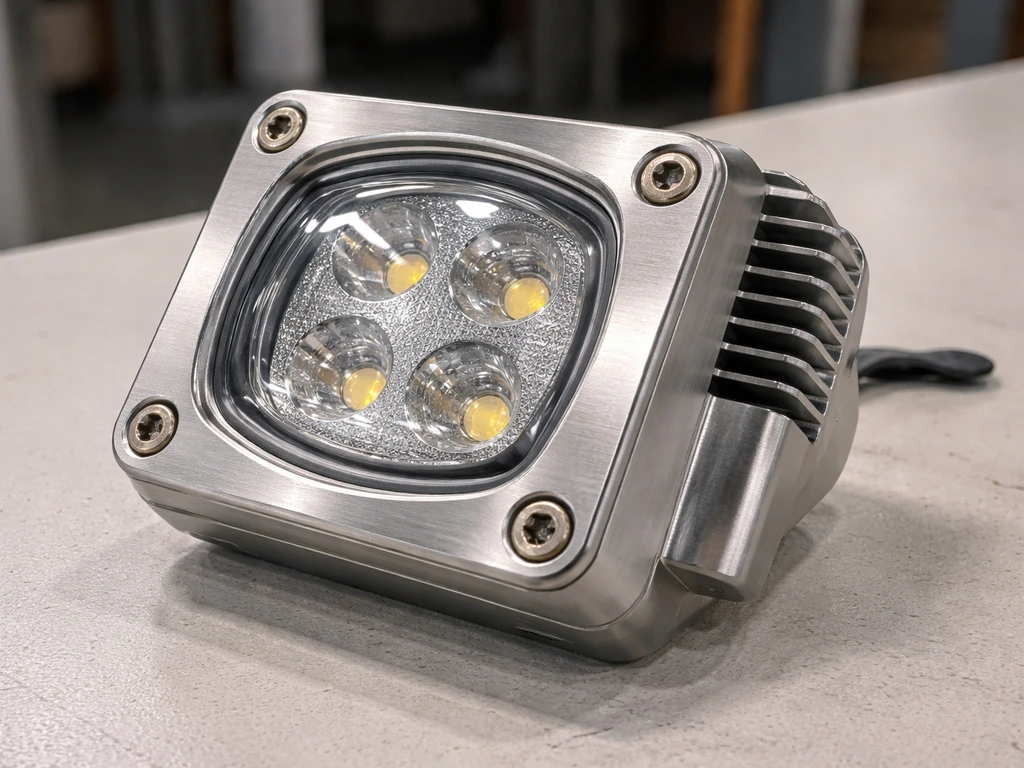
The housing is aluminum with a polycarbonate lens cover. Aluminum is the right call for heat dissipation, and at 64W the thermal load is modest enough that passive cooling handles it without a fan. The heat and noise score in hands-on testing comes in high (rated around 90%), which reflects the reality that at this wattage, bar-style LEDs stay cool and silent with no moving parts to wear out or create noise. This is a meaningful practical advantage for growers in shared living spaces or anyone who finds fan hum annoying during long photoperiod cycles.
The polycarbonate lens will yellow over time with prolonged UV exposure, which can reduce light transmission slightly over months of continuous use. It is not a dealbreaker, but it is worth noting for longevity. The on/off switch on the power cord is functional but basic; there is no dimmer, no smart controller, and no scheduling timer built in. You will need a separate outlet timer if you want automated photoperiod control, which is standard practice anyway.
Overall construction feels appropriate for the price. This is not a premium fixture with aerospace-grade housing, but the aluminum body is solid enough for a shelf or small tent environment. The connectors for daisy-chaining feel adequate. Warranty and customer support documentation for Byingo is sparse in publicly available information, which is a flag if long-term support matters to you.
Setup, coverage layout, and positioning it correctly
Hanging the Byingo is straightforward: the fixture includes mounting hardware, and most growers clip or hang it directly above a shelf, wire rack, or grow tent rail. Start at 16 to 20 inches above your seedling tray and drop to 10 to 14 inches once plants are in active vegetative growth. Below 8 inches you risk light stress on sensitive seedlings, though the fixture's modest output makes true light burn less likely than with higher-powered units.
For coverage planning, treat each 4ft 64W bar as covering a strip roughly 4 feet long and 12 inches wide at useful intensity. If you are working with a standard 2x4 grow tent, a single bar will cover one half of the floor footprint adequately for seedlings, but you would want two bars side by side (or one bar plus a second daisy-chained unit) to evenly cover the full width. The daisy-chain capability for up to four units is useful here: you can expand a 4-foot single bar into a wider or longer array without adding outlets.
- Hang the fixture 16 to 20 inches above the canopy for germination and seedlings.
- Lower to 10 to 14 inches once plants enter active vegetative growth.
- Use a standard outlet timer set to 16 hours on / 8 hours off for veg, or 12/12 for flowering attempts.
- For a 2x4 tent or shelf, use two bars daisy-chained side by side for even coverage.
- For a 4x4 space, plan on four units minimum, understanding the intensity will still be better suited to veg than flower.
- Check plants for stretching (etiolation) every few days and adjust height accordingly.
Power draw, efficiency, and value compared to alternatives
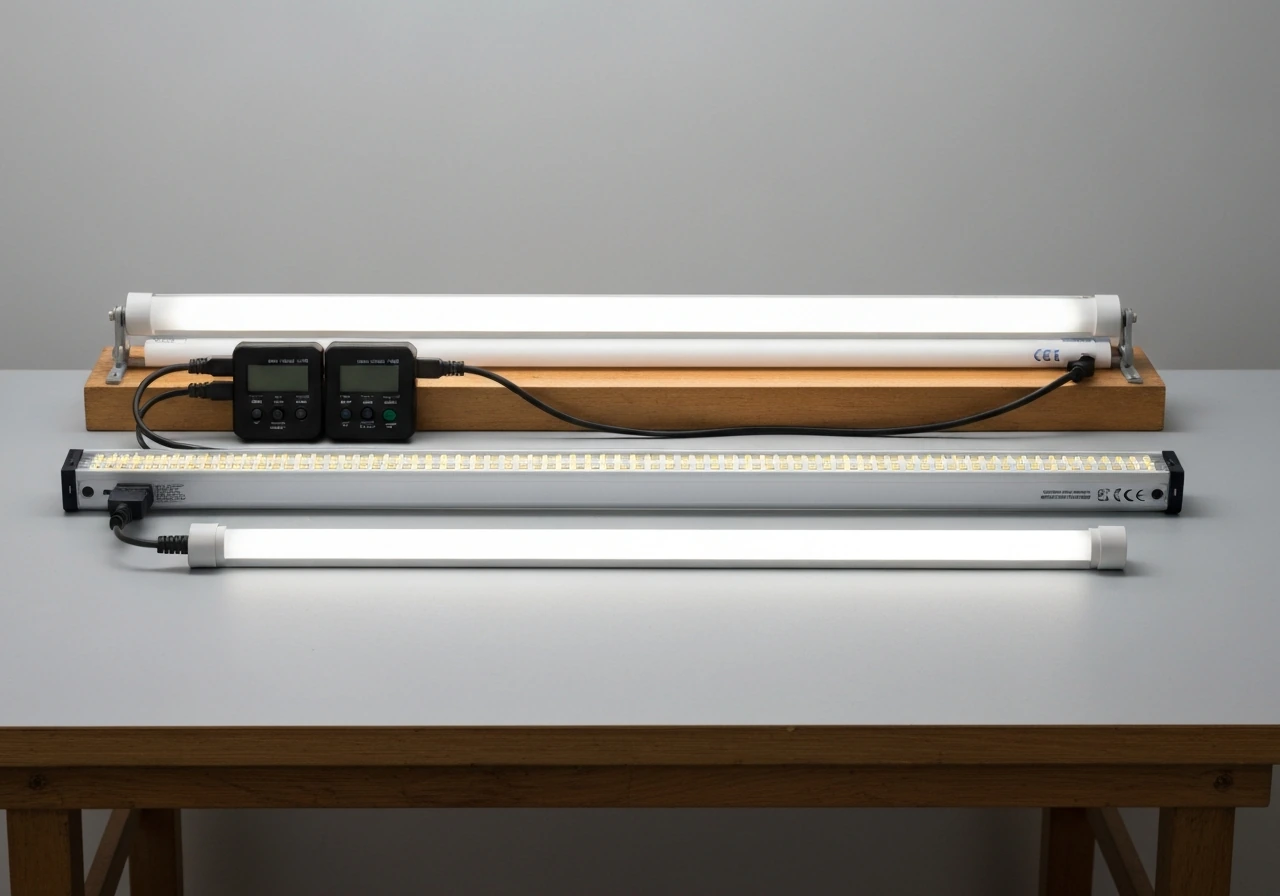
At 64W actual draw (120V), the Byingo 4ft 64W sits at a price point around $92, which works out to roughly $1.44 per watt. That is on the higher end for raw wattage cost compared to budget quantum board panels, but the form factor is different: you are paying for the bar design, the plug-and-play simplicity, and the T5 replacement footprint. The energy-saving claims (one retailer cited over 65% savings versus comparable fluorescent setups) are plausible given the efficiency gap between T5 fluorescents and modern LED diodes.
What you do not get with the Byingo is a published efficacy number in µmol/J (micromoles per joule), which is the standard efficiency metric for serious horticultural LEDs. Fixtures built around Samsung LM301B diodes, for example, typically achieve 2.5 to 3.0 µmol/J, which puts them well ahead of older LED designs in photon output per watt consumed. The Byingo's diode specification is not publicly disclosed in detail, so a direct efficacy comparison is not possible. What is fair to say is that at 64W, you are working with a limited photon budget regardless of efficacy, and that budget is appropriate for the light's stated use case of seedlings and early veg.
| Light | Wattage | Approx. Price | Best Use Case | Spectrum Type |
|---|---|---|---|---|
| Byingo 4ft 64W | 64W | ~$92 | Seedlings, early veg, T5 replacement | Full spectrum (blue 400–510nm, red 610–710nm) |
| Byingo 2ft 32W | 32W | Lower | Small shelves, propagation | Full spectrum (same family) |
| LM301B-based quantum board (e.g., 200W) | 200W | $120–$200+ | Full veg and flowering | White full spectrum + 660nm/730nm |
| T5 fluorescent (4-tube, 4ft) | 96W | $40–$80 | Seedlings, propagation | Phosphor white, lower PAR efficiency |
If your budget is fixed around $90 to $100 and you need a veg-only or seedling-only bar light, the Byingo makes reasonable sense. If you can stretch to $150 to $200, a quality quantum board panel built around LM301B or equivalent chips will outperform it significantly across veg and flower, and those are worth considering if you plan to grow past the seedling and early veg stage.
Real limitations, common complaints, and who should skip it
The most important limitation is the one the reviewer's own testing confirms: this fixture is not designed for mature plants under bloom. The Green Gardens of North Bay review says the Byingo 4ft 64W is intended for seedlings and/or early vegetative growth, not mature plants under bloom, and highlights its “Good 4 feet x 12 inch light coverage.”. If you are growing tomatoes, peppers, cannabis, or any fruiting plant through to harvest, the Byingo 4ft 64W will leave you with underdeveloped flowers and disappointingly light yields. The combination of limited wattage, a narrow coverage footprint, and a spectrum that lacks confirmed far-red wavelengths makes it a poor choice for anything requiring high PPFD over a meaningful canopy area.
There is no dimmer on the base unit, which limits your ability to fine-tune intensity for sensitive seedlings or to gradually increase light exposure as plants mature. If you want dimming control, you either need a different fixture or you manage intensity purely by adjusting hanging height. The lack of a published PPFD map or efficacy rating is a transparency issue that makes it harder to compare objectively to competitors.
- No dimming function on the base unit — intensity is managed by height only.
- No published PPFD map or µmol/J efficacy rating from the manufacturer.
- Coverage is limited to a 4ft x 12-inch strip — too narrow for square tent canopies without multiple units.
- Spectrum lacks confirmed far-red (730nm), limiting its value for flowering transitions.
- Warranty and support documentation is sparse; long-term replacement parts are not well documented.
- Polycarbonate lens can yellow with extended UV exposure over time.
- Not suitable for mature flowering plants or fruiting crops requiring high intensity.
Skip the Byingo if you are growing anything to flower or fruit, if you need a dimmable or controllable fixture, or if you are outfitting a grow space larger than a single 4-foot shelf. Also skip it if you prioritize transparent performance data: without a PPFD map, you are trusting manufacturer claims more than you should for a serious grow setup.
The bottom line: buy it, or look elsewhere?
Buy the Byingo 4ft 64W if you are replacing T5 or T8 fluorescents for a propagation shelf, seed-starting setup, or a rack of herbs and leafy greens. It does that job cleanly, runs cool and silent, plugs in without setup hassle, and offers a real improvement over fluorescent efficiency. At around $92, it is a fair price for what it delivers in that narrow use case.
Look elsewhere if you need anything more. Fixtures built around high-efficacy diodes like the Samsung LM301B deliver substantially more usable photons per watt, include far-red wavelengths important for flowering, and typically come with published performance data that makes comparison straightforward. If the Jamsung or GE BR30-style options are on your shortlist, those are also worth evaluating for specific shelf and supplemental lighting scenarios.
If you want an alternative bulb-style option, see my GE BR30 grow light review for how it performs for common indoor supplement and small-shelf setups. If you want, I also cover how the Jamsung grow light stacks up in my Jamsung grow light review. The Byingo earns a narrow recommendation: know what it is, use it accordingly, and it will not disappoint.
FAQ
Can I use the Byingo 4ft 64W for flowering, even if it is not ideal?
You can try it for very early bloom or for low-light “support” on already established flowering plants, but expect weak results. Because the fixture has limited photon budget and no confirmed far-red component, it usually cannot supply enough PPFD over a full canopy for consistent buds or fast development.
How do I set the best hanging height if I do not have a PPFD meter?
Use a two-step approach: start at about 16 to 20 inches for seedlings, then move to roughly 10 to 14 inches during active vegetative growth. Watch leaf posture and growth speed, if stems become stretchy or leaves look pale, raise intensity by lowering the bar in small increments, typically 2 to 3 inches.
Is the lack of dimming a dealbreaker for seedlings?
Not necessarily, because you can manage intensity with distance, but it adds risk if you move the light too fast. Without dimming, give seedlings time to acclimate over 3 to 5 days after each height change, and keep close to the recommended distance range instead of experimenting near the lower end.
Can I daisy-chain multiple Byingo bars on one outlet safely?
The light is designed to daisy-chain up to four fixtures, but you should still verify your outlet circuit amperage and any power-strip ratings. If you plan to combine fixtures with other high-draw equipment on the same circuit, leave headroom to avoid tripping breakers.
What timer should I use for photoperiod control?
Use a standard mechanical or digital outlet timer rated for the total wattage you are drawing. Add the fixtures to the timer, not the wall switch, and avoid bouncing the plug in and out for light cycling, stable power helps reduce wear on connectors.
Will the polycarbonate lens yellowing noticeably reduce performance?
It can, especially if it is exposed to strong UV through a window or in outdoor-adjacent environments. If you run continuous cycles for months, plan for gradual reduction in transmission and replace or reposition the fixture if you notice the same settings producing slower growth over time.
What plants are the Byingo best suited for under this “veg-only” limitation?
It is most appropriate for cuttings, propagation, sprouting, and leafy greens where you mainly need compact vegetative growth. It is also a good backup or supplemental light for herbs, as long as you treat it as “seedling stage support” rather than the primary light for fruiting crops.
How many Byingo bars do I need for a 2x4 tent to avoid uneven coverage?
For a typical 2x4 footprint, plan on two bars if you are trying to keep intensity consistent across the width. One single 4ft bar usually covers only about half the tent effectively at useful intensity, so the far side will typically run dimmer and grow slower.
Does the full-spectrum design mean I do not need to worry about spectrum at all?
Not quite. “Full-spectrum” in this context means it includes blue and red bands for photosynthesis, but that does not guarantee flowering-optimized wavelengths like far-red. For plants where flowering speed and transition matter, the absence of confirmed far-red is still a practical limitation.
What is a realistic expectation for growth rate compared to my old T5/T8 lights?
If you were using older T5/T8 fluorescents, you should expect better efficiency and more compact growth at the same shelf footprint, especially for seedlings. However, if your previous setup delivered higher PAR at canopy height, the Byingo may still feel less “punchy” during later stages because it does not match stronger horticultural fixtures.
Is there any risk of light stress or burning at the recommended minimum height?
With a 64W bar and a narrow, shelf-style output, true burns are less common than with high-power quantum boards, but stress can still happen. If you are using it for very young seedlings, start higher, lower gradually, and avoid staying below the lower height guideline for sensitive stages.
How can I compare the Byingo to other grow lights if there is no PPFD map?
Use a practical comparison method: compare your current canopy height and measured or expected PPFD from your existing fixture, then aim to match the seedling/veg target range. If a competitor provides µmol/J or PPFD maps, prioritize those specs because the Byingo relies more on assumptions than published measurement data.