AgroMax makes three LED grow lights that most people are actually asking about: the RAW 65 (65W, single-bar panel), the AFS 1830 (720W, 6-bar full-spectrum fixture), and the Prime-2200X (760W, 6-bar modular system). All three use Samsung chips and Meanwell drivers, which puts them in decent company at their price points. If you're a hobbyist running a 2x2 tent on a tight budget, the RAW 65 is a reasonable pick. If you're running a serious 4x4 flowering canopy and want certifications and dimming controls, the Prime-2200X is the most capable of the three. The AFS 1830 sits in the middle, offering strong output and good spectral depth without the Prime's modularity.
Agromax LED Grow Light Reviews: Best Model for Your Setup

Marcus Caldwell
12 May 2026
The AgroMax lineup: which model is which
AgroMax is HTG Supply's house brand, so these lights are sold primarily through HTG Supply's own channels. That matters because support, warranty service, and documentation all run through HTG Supply rather than a large third-party retail ecosystem. Here's a quick breakdown of the three main models worth knowing about.
AgroMax RAW 65
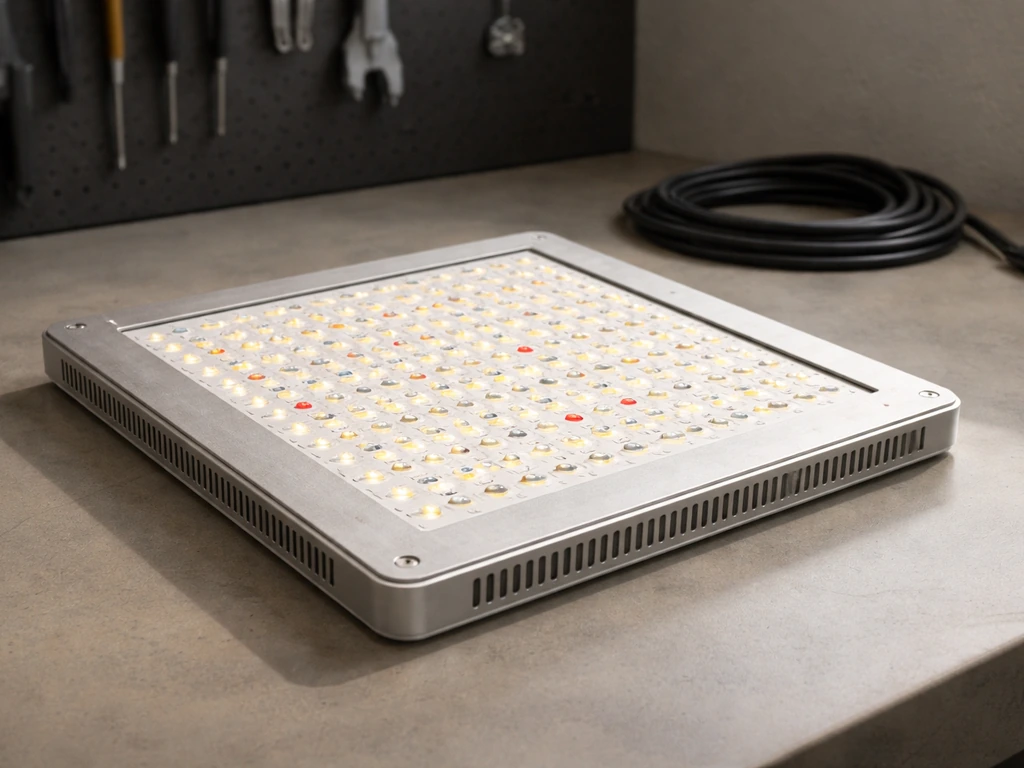
This is a compact 65W panel measuring 11.8" x 11.8" x 1.4". It uses Samsung LM301B chips paired with a Meanwell driver and claims 2.33 µmol/watt efficiency. The published coverage numbers are up to 2x2 ft for vegetative growth and 1.5x1.5 ft for flowering. PPFD measurements in the datasheet are taken 18 inches above the canopy in a 2x2 reflective tent, which is the right way to present it. Operating voltage runs 90-264 VAC, so it handles international power without an adapter. Build includes an aluminum heat sink and a dust and water-resistant conformal coating on the electronics. It's a single-bar, plug-and-play fixture with no dimming controls and no controller port.
AgroMax AFS 1830
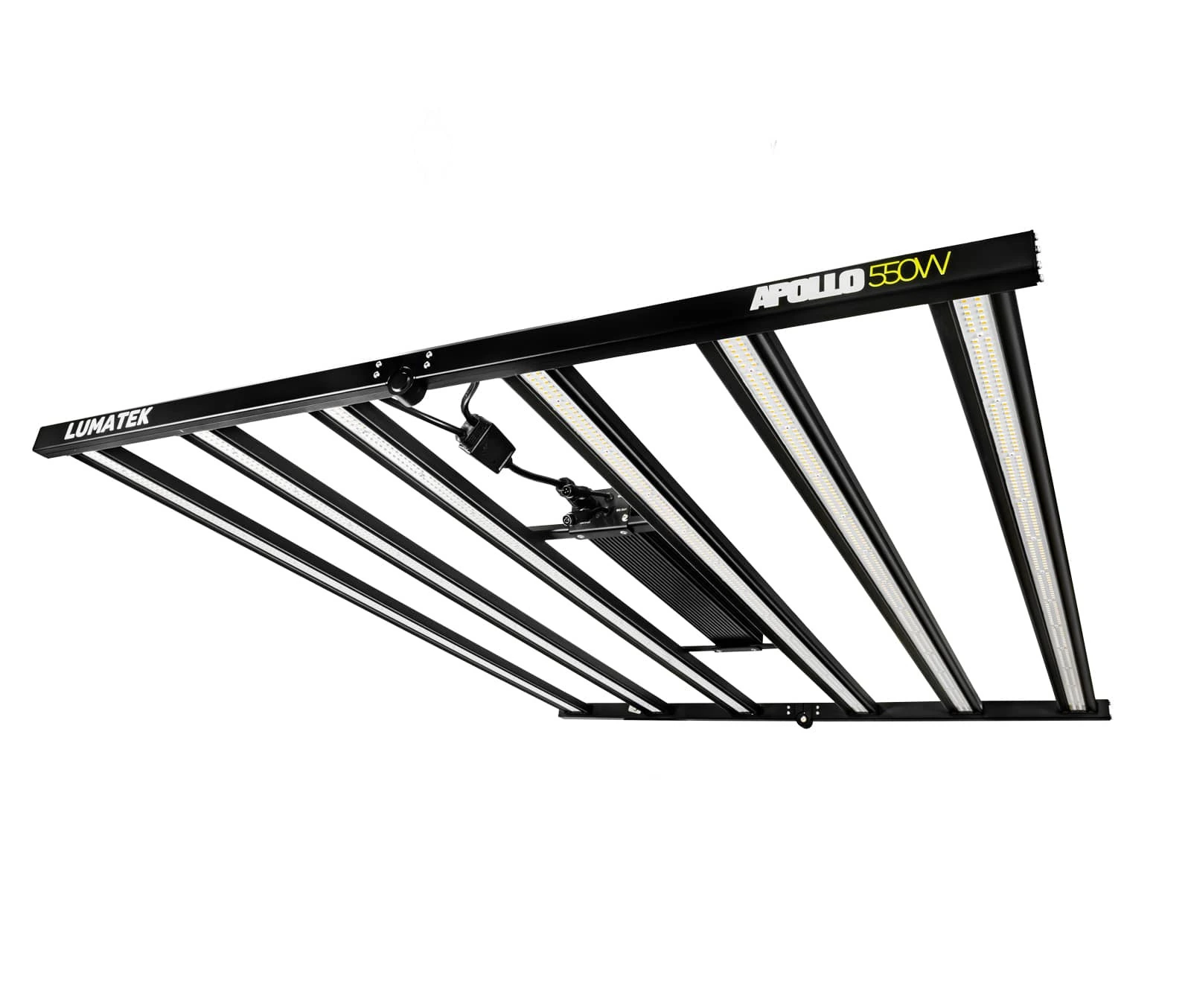
The AFS 1830 is a 6-bar fixture rated at 720W maximum, with a published PPF of 1830 µmol/s. The driver is a Mean Well XLG-240 and the primary chips are Samsung LM561C-5630, supplemented with dedicated red, blue, UV, and IR LEDs for a boosted spectrum. It includes onboard dimming, remote control capability (sold separately, supports up to 100 daisy-chained fixtures), and a damp-location rating. Construction is marine-grade aluminum. It ships with heavy-duty rope ratchet hangers and a standard NEMA 5-15 grounded plug. Warranty is 3 years.
AgroMax Prime-2200X
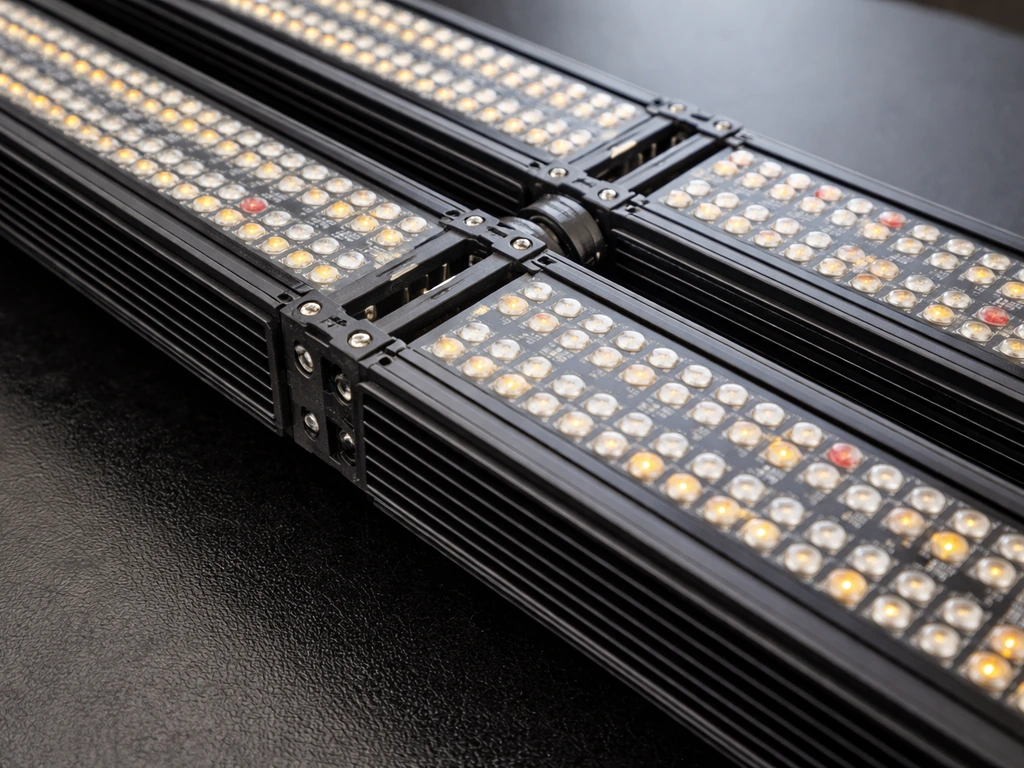
The Prime-2200X is AgroMax's flagship, rated at 760W with a published output of 2204 µmol/s and an efficacy of 2.90 µmol/watt. It's also a 6-bar system, but uniquely modular: the individual bars are removable and interchangeable, which means you can swap in specialized spectrum bars as they become available. It uses Samsung SMD chips, carries IP65, DLC Hort, and UL listings, and targets a 4x4 flowering footprint with a 120-degree light distribution angle. The blank" rel="noopener noreferrer">onboard dimmer has four fixed steps: 25%, 50%, 75%, and 100%. Box includes two hanging kits, a 120V power cord, a controller cable, and a 10-foot controller cable. Like the AFS 1830, it's blank" rel="noopener noreferrer">backed by a 3-year warranty covering defects in materials and workmanship.
| Spec | RAW 65 | AFS 1830 | Prime-2200X |
|---|---|---|---|
| Max wattage | 65W | 720W | 760W |
| PPF / µmol output | ~151 µmol/s (est.) | 1830 µmol/s | 2204 µmol/s |
| Efficacy | 2.33 µmol/W | ~2.54 µmol/W | 2.90 µmol/W |
| Primary chip | Samsung LM301B | Samsung LM561C-5630 | Samsung SMD |
| Driver | Meanwell | Mean Well XLG-240 | Not specified |
| Coverage (flower) | 1.5x1.5 ft | ~4x4 ft | 4x4 ft |
| Dimming | None | Onboard + remote | 4-step onboard |
| Certifications | Not listed | Damp-rated | IP65, DLC Hort, UL |
| Warranty | Not listed | 3 years | 3 years |
| Form factor | Single panel | 6-bar fixed | 6-bar modular |
Build quality and heat: what holds up under real use
AgroMax builds its lights around aluminum housings, which is the right call for passive heat dissipation. The RAW 65's heat sink is small but adequate for 65W, and the conformal coating on the electronics adds real protection in a humid grow tent environment where condensation is common. At 65W, heat is rarely an issue as long as you have basic air circulation.
The AFS 1830 and Prime-2200X are a different story at 720W-760W. Both use multi-bar designs that spread heat across a larger surface area rather than concentrating it in one spot, which is the correct approach. The AFS 1830's marine-grade aluminum designation matters here: it's built to handle humidity without corroding, which is a legitimate concern in a flowering tent running at 65-75% relative humidity. The Prime-2200X adds the IP65 rating, meaning it's protected against dust ingress and water jets, not just ambient moisture. For a long-term installation, IP65 is meaningfully better.
Thermal management at this wattage directly affects how consistent your output is over time. LED chips that run hot degrade faster and produce measurably less light within the first few thousand hours than chips running at optimal junction temperatures. Both the AFS 1830 and Prime-2200X use bar formats that help here, but you still need good tent ventilation. Expect both lights to run warm to the touch on the bars under full load. That's normal for bar-style fixtures. What you don't want is the driver running hot, and both units use external or well-ventilated driver configurations that avoid that problem.
User-reported experiences collected across grow diaries (including entries tracked on GrowDiaries for the AFS 1830 specifically) generally point to consistent output over multiple cycles without major failure reports. The 3-year warranty on the AFS 1830 and Prime-2200X gives you a reasonable safety net, though coverage is through HTG Supply and subject to the PRIME warranty terms, which cover material and workmanship defects rather than performance degradation.
How plants actually respond at each growth stage
Seedlings and clones
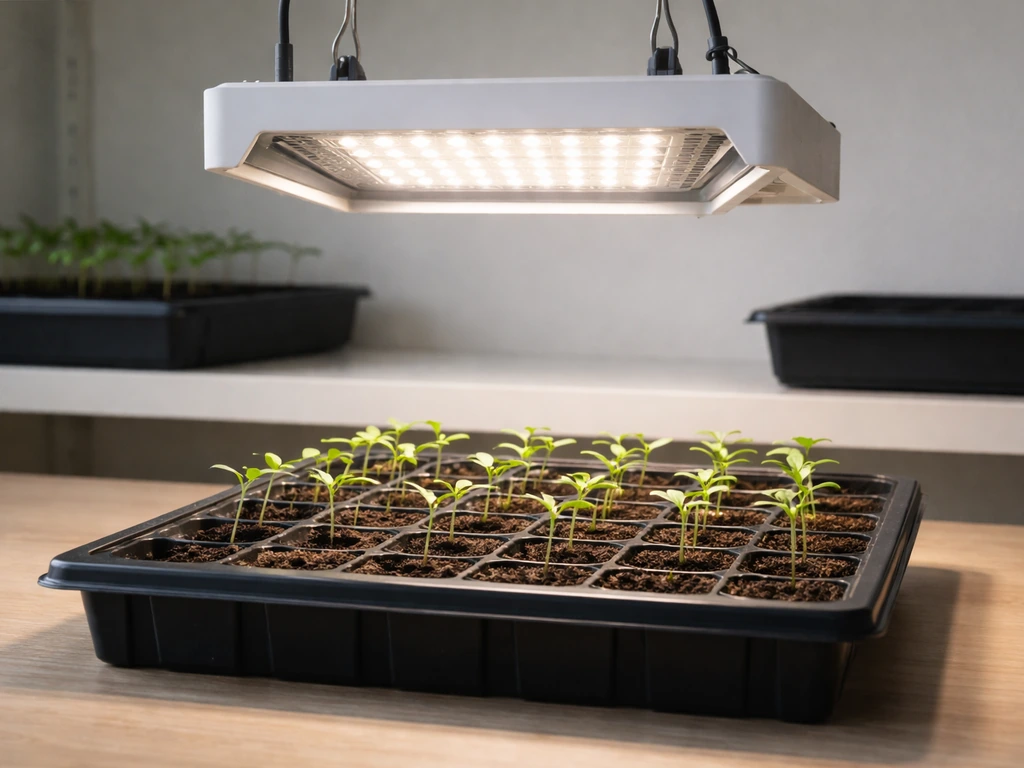
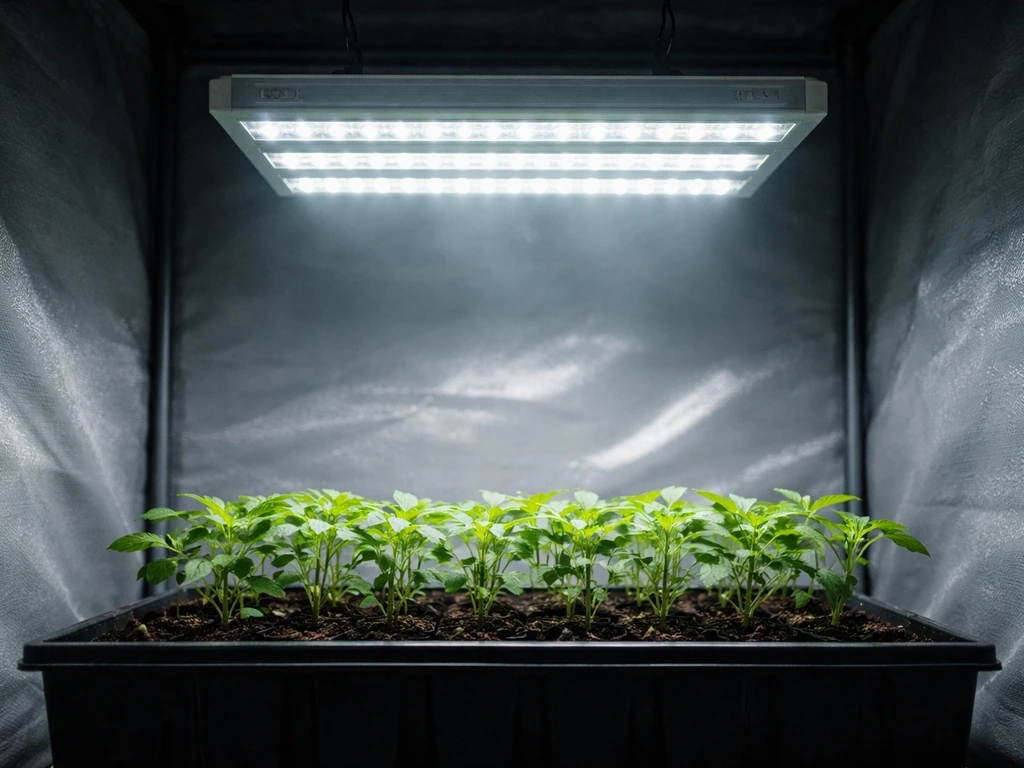
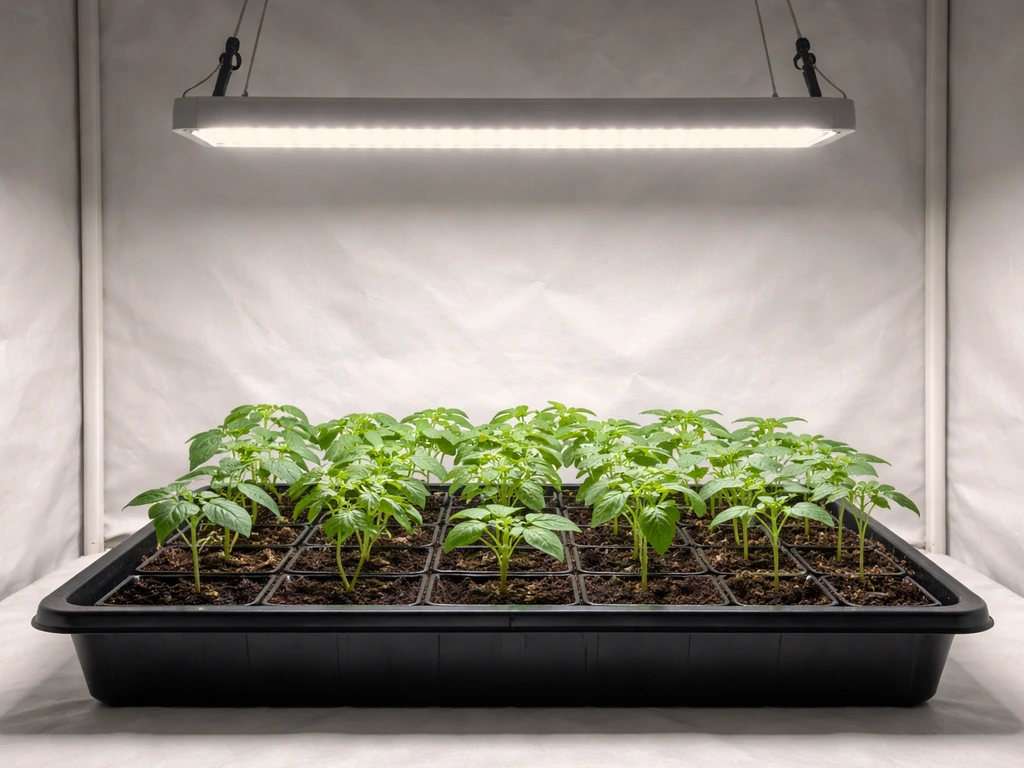
For seedlings and cuttings, the RAW 65 is honestly the most practical choice in the AgroMax lineup. At 65W hung higher (24-30 inches above the tray), you get gentle, even coverage over a small propagation area without the risk of light stress on young tissue. You don't need 720W over seedlings. If you already own an AFS 1830 or Prime-2200X, dimming them down to 25% for early propagation is workable, but both lights are overbuilt for that stage and you're still generating more radiant heat than a seedling tray needs.
Vegetative growth
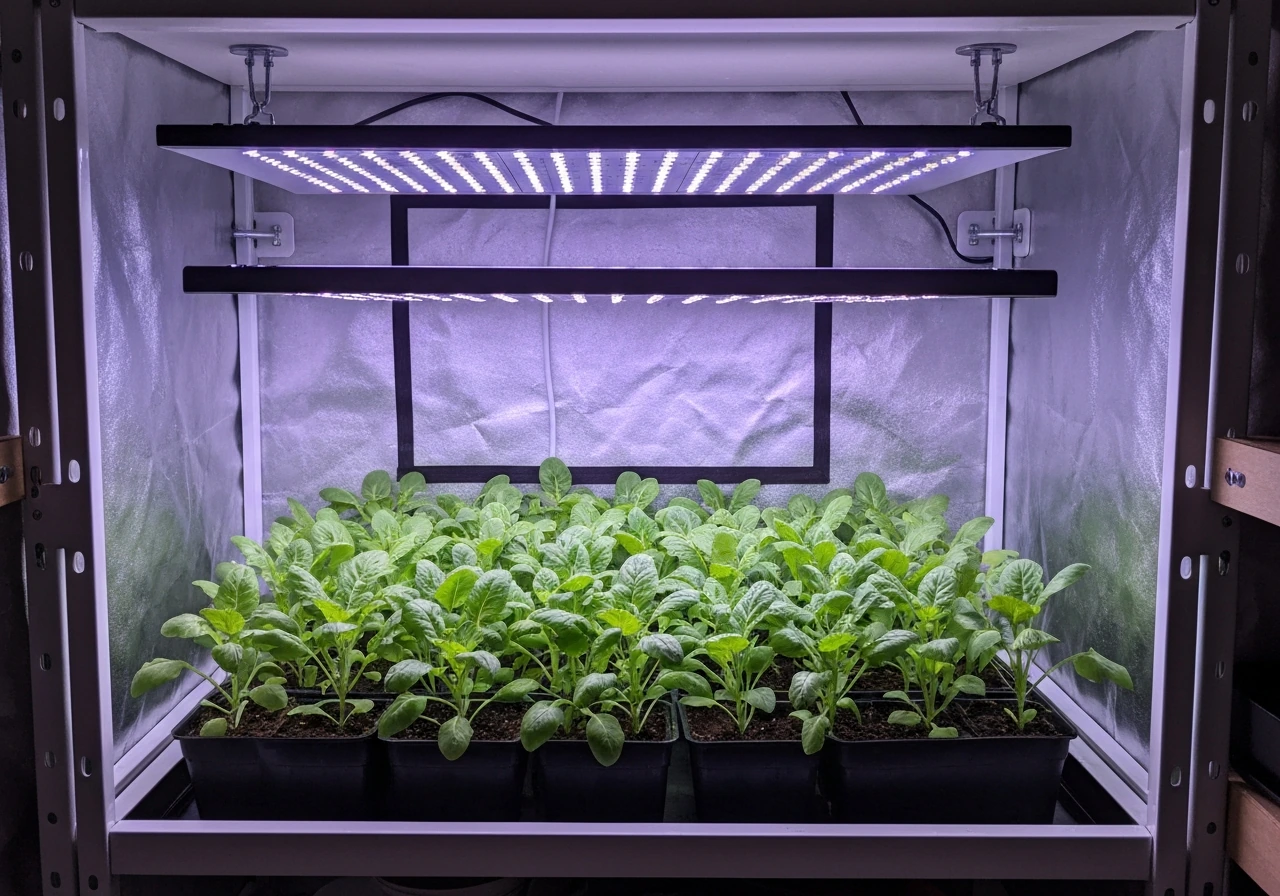
The RAW 65 covers a true 2x2 ft vegetative footprint at 18 inches. That's enough for 2-4 plants in veg depending on training style. For a 3x3 or 4x4 tent in veg, you're moving into AFS 1830 or Prime-2200X territory. Both lights can be dimmed back during veg, which saves on power costs and keeps the canopy from getting too much intensity before roots and structure are established. A common approach: run the AFS 1830 at 50-60% during veg, then push to full power as you transition to flower. The 6-bar format distributes light more evenly across the canopy than a single blurple panel would, which translates to more uniform internodal spacing and less stretching toward a hot center.
Flowering
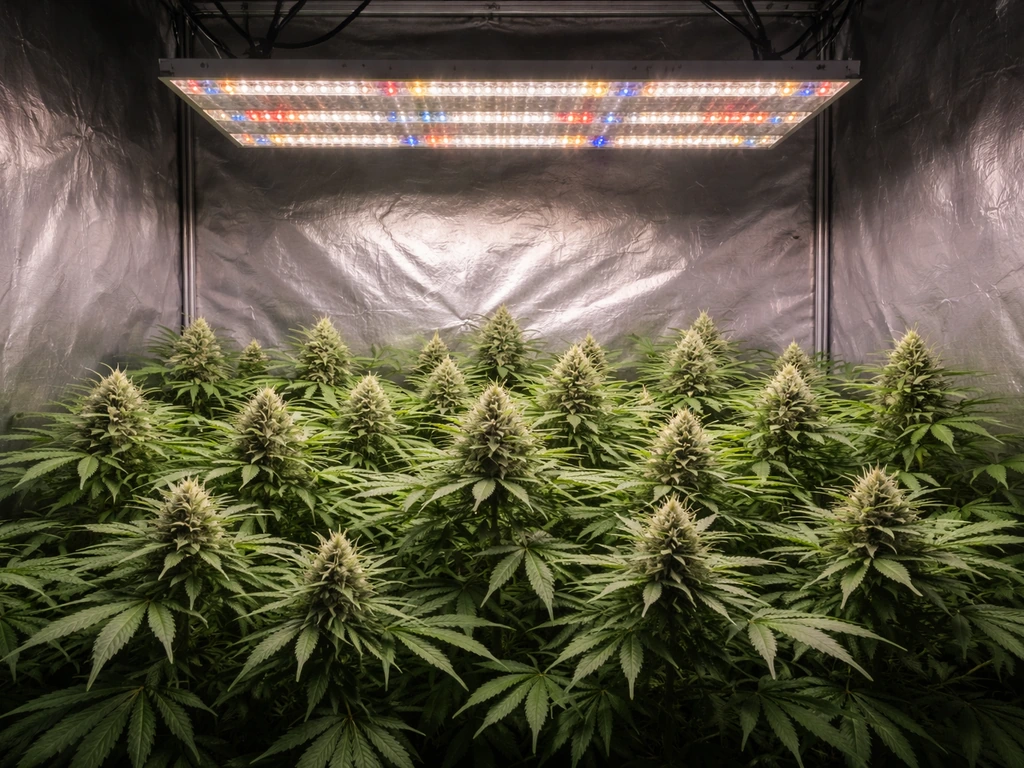
This is where the AFS 1830 and Prime-2200X are designed to operate. The supplemental red, blue, UV, and IR channels on the AFS 1830 are specifically useful here. UV LEDs contribute to secondary metabolite production in flowering plants, and the added red channels push into wavelengths that drive flowering responses. The Prime-2200X's 2.
90 µmol/watt efficacy is the strongest efficiency figure in the lineup, which matters when you're running a light for 12 hours a day for 8-10 weeks. Both lights targeting a 4x4 flowering canopy means you should expect PPFD values in the 600-900 µmol/m²/s range at canopy level under full power, which is appropriate for most flowering crops. Push beyond that footprint and the edge plants start to lose intensity.
Coverage and hang height: matching the light to your space
Coverage claims on grow light spec sheets are often optimistic, so it's worth understanding what the published numbers actually mean. The RAW 65's 2x2 ft vegetative and 1.5x1.5 ft flowering coverage is measured in a reflective tent at 18 inches above the canopy, which is a controlled environment. In a non-reflective space or a larger tent where the walls don't return scatter light, those numbers shrink. Treat the flowering footprint as the reliable number for yield-focused grows.
For the AFS 1830 and Prime-2200X, both target a 4x4 ft flowering canopy. At maximum power, hang height for the AFS 1830 is typically 18-24 inches for flowering and 24-36 inches for vegetative. The 120-degree light distribution angle on the Prime-2200X means the bars spread light broadly, which supports even coverage but also means intensity drops off more gradually as you raise the fixture. In a 5x5 tent, either of these lights can cover the space in vegetative growth with some sacrifice at the corners. For a 4x4 tent, they're well-matched.
- RAW 65: 2x2 ft veg / 1.5x1.5 ft flower, hang at 18" for PPFD reference readings
- AFS 1830: ~4x4 ft flower, hang 18-24" for full-power flowering, 24-36" for veg
- Prime-2200X: 4x4 ft flower target, 120° distribution, use dimming controls to dial in intensity at different hang heights
- In non-reflective spaces, reduce expected footprint by roughly 15-20% compared to tent measurements
- For seedlings and propagation, raise any of these lights and use the dimmer to avoid bleaching
Power draw, efficiency, and what it actually costs to run
The efficiency numbers tell a clear story here. The RAW 65 at 2.33 µmol/watt is solid for a budget panel of its class, though it lags behind newer top-tier chips. The AFS 1830 at approximately 2.54 µmol/watt (calculated from 1830 µmol / 720W) is better, and the Prime-2200X at 2.90 µmol/watt is the strongest of the three. For context, premium commercial fixtures from brands like HLG typically hit 2.8-3.1 µmol/watt, so the Prime-2200X is competing at that level on paper.
At the US average electricity rate of roughly $0.16/kWh (as of mid-2026), running the Prime-2200X at full power for 12 hours a day costs about $0.53 per day, or around $16 per month. The AFS 1830 at 720W runs about $0.49/day under the same conditions. The RAW 65 at 65W costs roughly $0.04/day. Dimming the larger lights during veg or propagation cuts these costs proportionally. If you're running a light at 50% power during veg, you're paying roughly half the flowering electricity cost.
For small-scale hobbyists, the per-month cost difference between the AFS 1830 and Prime-2200X is minimal (roughly $2-3/month). The bigger financial question is upfront cost. The Prime-2200X commands a premium over the AFS 1830, and whether the higher efficacy, IP65 rating, DLC Hort certification, and modular bar design justify that premium depends on how seriously you're running your setup. Casual growers running one or two crops a year probably don't need the Prime's credentials. Growers who run continuously and want every PPFD point they can get will appreciate the difference.
Setup, controls, and reliability
All three AgroMax lights are straightforward to set up. The RAW 65 is the simplest: unbox, hang, plug in. No controls, no cables to manage. It works well as a secondary or supplemental light even for growers who already own a larger fixture. The AFS 1830 and Prime-2200X both come with hanging hardware included, which is a small but appreciated touch compared to brands that make you source your own.
The AFS 1830's dimming control includes an onboard dial and the option to daisy-chain up to 100 fixtures to a single remote controller (controller sold separately). That remote control capability is useful if you're running a multi-light space and don't want to manually adjust each fixture. The Prime-2200X's four-step dimmer (25%, 50%, 75%, 100%) is simpler and less flexible than a continuous dial, but the four fixed steps cover the practical needs of most growth stages well enough. The Prime also ships with a 10-foot controller cable, so you can link fixtures without buying extra cables immediately.
Reliability-wise, the combination of Meanwell drivers and Samsung chips is a proven pairing. Meanwell drivers are industry-standard for a reason: they're thermally stable, well-rated for continuous duty, and the brand has a long track record in horticultural and commercial lighting. Samsung LM301B and LM561C chips are similarly well-documented. You're not working with unknown components here, which matters when you're trying to estimate how a light will hold up over 3-5 years of continuous use.
The UL listing on the Prime-2200X is worth noting separately. UL certification means the fixture has been tested by a recognized third-party safety lab, which is not a given at this price tier. The AFS 1830 does not list UL certification in its technical data, though its damp-location rating implies some level of safety testing. If electrical safety certification matters to your setup (rented property, commercial space, insurance requirements), the Prime-2200X is the safer choice.
How AgroMax stacks up against the competition
The honest comparison context for AgroMax is the crowded mid-tier LED grow light market. In the 65W class, the RAW 65 competes with small panels from brands like Spider Farmer and Mars Hydro, both of which also use Samsung LM301B chips and Meanwell drivers. The RAW 65 isn't dramatically different from those lights in performance, but it's sold through HTG Supply's channel, which some growers prefer for phone support and in-person availability if they live near an HTG store.
In the 700-760W range, the AFS 1830 and Prime-2200X compete against lights like the HLG 650R, Spider Farmer SE7000, and Mars Hydro FC-E8000. The Prime-2200X's 2. 90 µmol/watt efficacy and IP65 rating put it in genuinely competitive territory with those alternatives. The AFS 1830's supplemental UV and IR channels are a meaningful differentiator if full-cycle spectrum flexibility matters to you.
Other brands like Apollo also offer bar-style fixtures in this wattage class, and it's worth comparing hang-height recommendations and included accessories directly before committing. If you are also considering Apollo grow lights in this wattage class, check out our Apollo grow light review for a closer comparison Apollo lineup. The Apollo lineup, for instance, positions itself at a similar price point with different coverage geometry, so footprint comparisons are worth running side by side.
If you're comparing other boutique or less-established brands, AgroMax's backing by HTG Supply is a genuine advantage. HTG Supply has been operating since 1992, which means warranty claims and replacement parts are more likely to be honored five years from now than they would be from a brand-of-the-month import label with no domestic support structure.
| Light | Wattage | Efficacy | Footprint (flower) | Certifications | Best for |
|---|---|---|---|---|---|
| AgroMax RAW 65 | 65W | 2.33 µmol/W | 1.5x1.5 ft | Not listed | Budget 2x2 veg / small clones |
| AgroMax AFS 1830 | 720W | ~2.54 µmol/W | ~4x4 ft | Damp-rated, 3yr warranty | Full-cycle 4x4 with spectrum flexibility |
| AgroMax Prime-2200X | 760W | 2.90 µmol/W | 4x4 ft | IP65, DLC Hort, UL, 3yr warranty | Serious 4x4 flowering, modular upgrades |
| Spider Farmer SE7000 | 730W | ~2.85 µmol/W | 4x5 ft | ETL listed | Wider footprint alternative |
| HLG 650R | 650W | ~2.60 µmol/W | 4x4 ft | UL listed | Premium brand, proven track record |
| Mars Hydro FC-E8000 | 800W | ~2.75 µmol/W | 5x5 ft | ETL listed | Larger tent coverage |
Who should buy AgroMax (and who should look elsewhere)
The RAW 65 is worth buying if you're running a 2x2 tent, propagating clones, or want an inexpensive secondary light for a shelf or small side grow. It's not the most efficient panel on the market at 2.33 µmol/watt, but the Samsung LM301B and Meanwell driver combo means it's not going to fail on you in year two either. Skip it if you're trying to push density in a flowering tent, even a small one.
The AFS 1830 is the most interesting value proposition in the lineup. The supplemental UV and IR channels, the remote control capability for multi-fixture setups, and the marine-grade build make it a well-rounded option for a 4x4 full-cycle grow. It's not the most efficient light in the 720W class, but the spectral flexibility and control options make it competitive. If you want spectrum depth without paying Prime-2200X prices, this is your pick.
The Prime-2200X is the right choice if you're running year-round, want the best efficiency and the most rigorous certifications in the AgroMax lineup, and value the modular bar system for future spectrum customization. It's a more serious investment, and it performs like one. The 2.90 µmol/watt figure puts it close to the best commercial-grade LEDs available. If you're comparing it against alternatives from Spider Farmer, Mars Hydro, or HLG at similar price points, look closely at whether those brands offer comparable DLC Hort certification and IP65 ratings, because not all of them do at this tier.
One honest caveat: AgroMax is an HTG Supply house brand, which means third-party independent lab testing and PPFD maps from neutral sources are harder to find than for major retail brands. The published efficacy and coverage numbers come from AgroMax's own datasheets. They use credible components and the numbers are plausible, but growers who want independently verified PPFD maps before buying should factor that into their decision. Brands like HLG publish more extensive third-party documentation, which some growers reasonably prefer. If you want a deeper look at whether this model is worth the money, check the full Aovok Grow Light Review.
Your next steps
Start by locking in your grow space and primary growth stage. If you're running a 2x2 tent primarily in veg or propagation, the RAW 65 handles it at minimal cost. If you're running a 4x4 tent for flowering and want a single light that covers the whole space well, the choice comes down to AFS 1830 versus Prime-2200X.
If you want a deeper look at those specs and how they stack up, read the aokrean grow light review for a practical comparison AFS 1830 versus Prime-2200X. Use the Prime-2200X if certifications, IP65, and maximum efficiency matter. Use the AFS 1830 if spectrum flexibility and remote control across multiple fixtures is your priority.
If you're still comparing against other brands in this wattage range, compare DLC Hort status, IP rating, driver brand, chip model, and included hardware side by side. Those five factors will tell you more than the marketing copy on any product page.
- Identify your tent size and primary growth stage (propagation / veg / flower)
- Match wattage: RAW 65 for 2x2, AFS 1830 or Prime-2200X for 4x4 flowering
- Compare certifications: UL and DLC Hort on Prime-2200X vs. alternatives from Spider Farmer, HLG, or Apollo at similar wattage
- Factor in operating cost: multiply rated wattage by your local kWh rate and daily light hours
- Check HTG Supply's current pricing and availability, since AgroMax is a house brand with limited third-party retail distribution
- Request or download the datasheet PDF for your chosen model before purchasing to verify coverage charts and hang-height recommendations against your specific tent dimensions
FAQ
Can I run these AgroMax lights at less than full power for seedlings and early veg? Or do I risk uneven coverage?
Yes, but do it based on dimmer step behavior and canopy distance. For the AFS 1830 you have an onboard dial with intermediate output, while the Prime-2200X only has four discrete steps (25, 50, 75, 100). If you are switching from veg to early flower, start at 50 to 60 percent for 3 to 5 days, then increase, instead of jumping straight to 100 percent, because plants can show stress from sudden intensity changes even with LED bars.
What hang height should I trust, and how do I adjust if my tent is not very reflective?
Use published hang height as a baseline, then verify with either a PAR meter or at least a phone camera plus caution. For the RAW 65 the datasheet assumes about 18 inches above the canopy in a reflective tent, and the article explains that non-reflective rooms reduce effective footprint. If your space is not very reflective or you run higher than recommended, expect edges to underperform, so it can be better to raise plants to the light rather than raise the light too much.
If I want more than one fixture in the same tent, can I daisy-chain or sync them easily?
In most setups, you can run multiple lights, but the cable and control plan matters. The AFS 1830 supports remote control and can handle up to 100 daisy-chained fixtures, but the remote controller is sold separately, and you must plan cable length and outlet access so you do not end up with awkward extension wiring. The Prime-2200X includes a controller cable and links with its own control cable, so confirm your total run length to avoid stressing ports.
Are IP65 or damp-location ratings enough if I have heavy condensation or occasional splashes from watering?
You generally should not rely on water resistance for direct wetting. IP65 means protection against dust and water jets, but the practical best practice is to keep condensation drips off the bar ends and driver area, wipe down periodically, and ensure airflow so electronics do not sit in constantly wet conditions. For the AFS 1830, the article highlights damp-location and marine-grade housing, but it still benefits from avoiding splash and pooling.
If my tent is bigger than the fixture’s stated footprint, can I fix coverage problems by just dimming less or raising less?
They are different tools. Dimming in veg helps manage cost and intensity, but it does not replace proper plant training and canopy management, and it does not make a small fixture magically cover a large flowering footprint. If you are targeting a true 4x4 flowering distribution, the article says the AFS 1830 and Prime-2200X are designed around that area at full power, so for bigger tents you may need multiple fixtures or accept corner drop-off.
How should I plan for corner plants, given that spec-sheet coverage is measured in a reflective setup?
Budget models sometimes underestimate corner intensity, and the article already warns that spec-sheet coverage is often optimistic. For practical shopping decisions, treat the flowering footprint as the reliable number, and if you are trying to fill a 4x4 with an AFS 1830 or Prime-2200X, plan for slightly higher edge dimness as normal. A common mitigation is adding reflective sidewalls or using light distribution by plant positioning, keeping taller canopy areas closer to the fixture.
What’s the single biggest factor that will change long-term output consistency for these lights?
Performance variability over time usually comes from thermal management and driver heat, not chip brand alone. The article notes that chips running too hot degrade faster and reduce output, and that the Prime-2200X and AFS 1830 use bar formats that spread heat. Practically, keep at least basic tent ventilation, avoid enclosing the driver area, and do not block airflow with ducting or storage near the sides of the bars.
If my light seems dimmer after several cycles, will warranty cover it, or will they treat it as normal degradation?
Warranty is useful, but you should confirm what is considered a defect versus normal behavior. The article states the warranty covers material and workmanship defects, not performance degradation. If you notice output drops, first verify electrical basics (power quality, stable outlet, correct dimmer step, correct hang height) before assuming it is a warranty issue.
How can I estimate my monthly cost more accurately for my own schedule and electricity rate?
If your electricity plan is variable or you use a timer with frequent changes, it is still easy to estimate. Use wattage at the dimmer step, then multiply by hours per day and your kWh rate. The article provides monthly cost examples at full power, but your actual cost can change significantly if you dim in veg, run longer photoperiods in early flower, or have higher utility rates than the US average.
Can the RAW 65 work as a flowering light if I only grow one small plant?
For the RAW 65, the article frames it as a propagation and small veg tool. If you try to run it in flowering for dense canopies, you are likely to see reduced PPFD at the canopy edges and lower overall yield, even if your plants look okay early. If you want to experiment, consider using it as a supplemental side light for a few plants rather than expecting it to be the only flowering light.
Which one is easier to dial in, continuous tweaks or stage-based dimming?
Yes, but match controls to your workflow. If you only need simple stage-based adjustments, the Prime-2200X’s four-step dimmer is straightforward. If you like fine-tuning based on canopy response and you plan multi-light setups, the AFS 1830’s dial plus remote capability is more flexible, because you can adjust without manually reaching each bar system.
Any practical safety tips for cable handling and connector care in humid flower rooms?
Try to keep the system dry where connectors live. The article notes dust and water protection in different ways across models, but it also implies condensation is common in flowering tents. Use strain relief, avoid tight bends at cable exits, and after heavy humidity events, allow time for connectors and the driver area to dry before touching them.