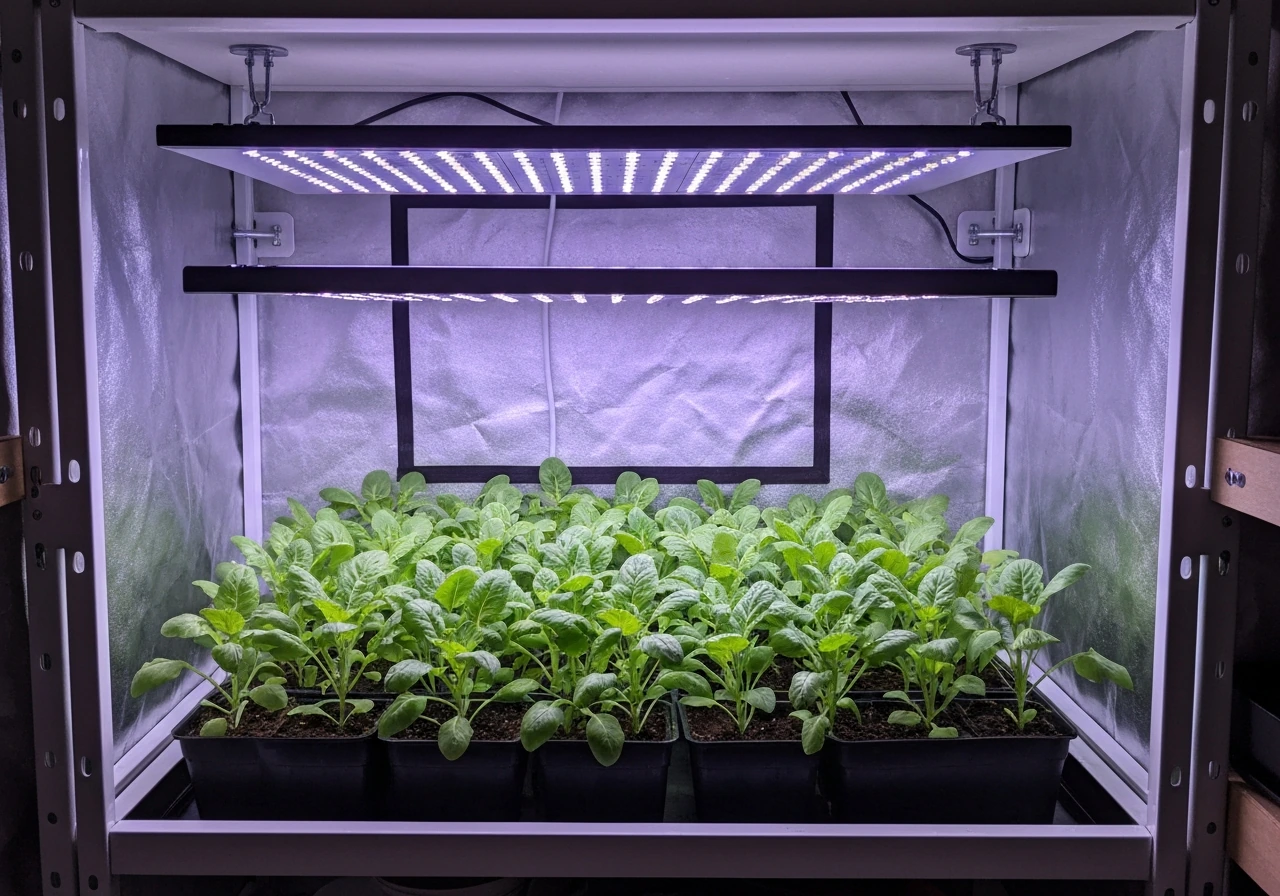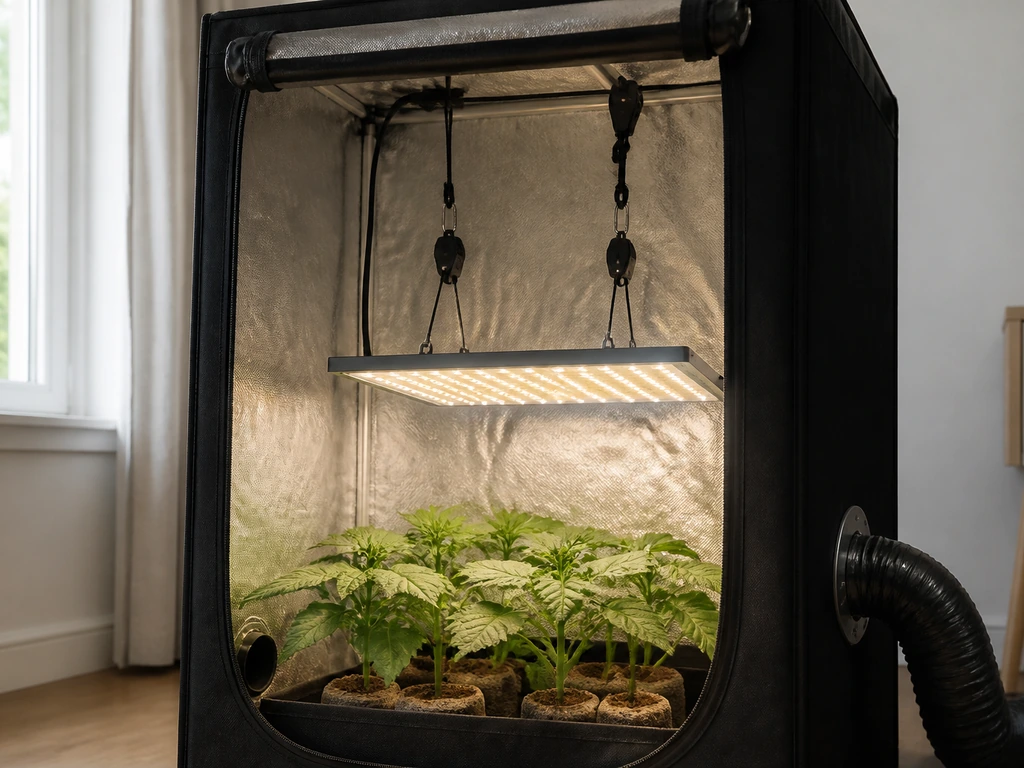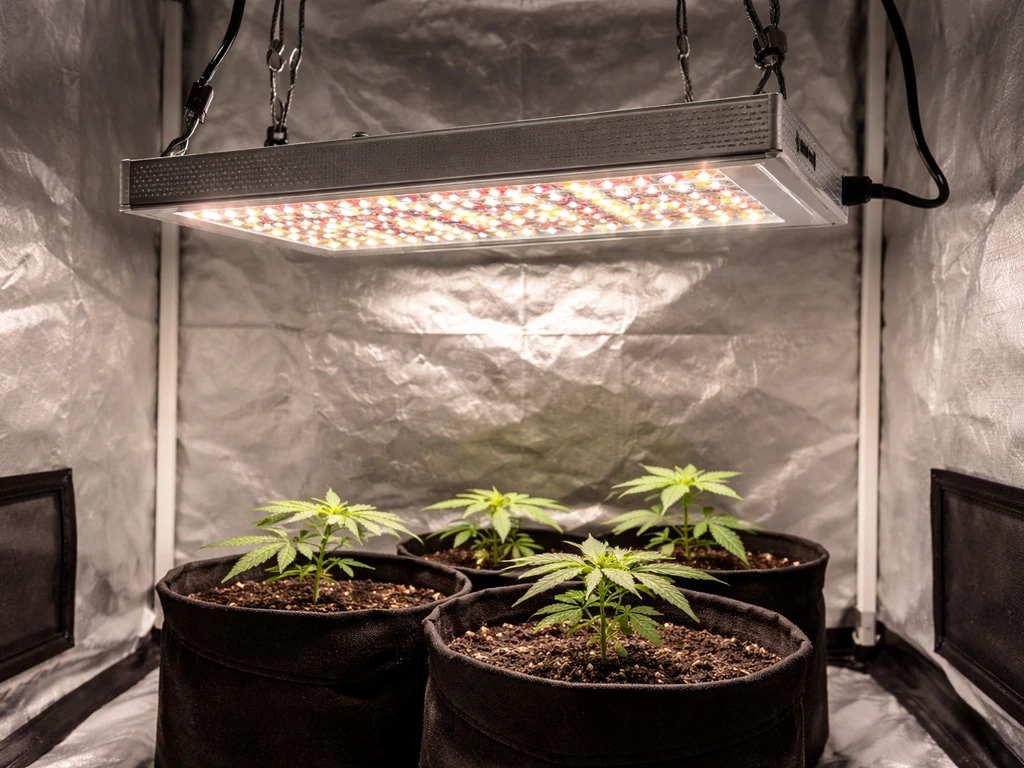
Aokrean makes two grow lights worth knowing about: the BL-C10A, a compact 10W desktop unit aimed at seedlings and small houseplants, and the KA-1000, a 200W-actual COB panel marketed at 1000W-equivalent for serious tent grows. Neither is a household name, but both offer something specific. The BL-C10A is a solid low-cost light for a single plant or a propagation tray. The KA-1000 has real COB output and coverage numbers that make it competitive in the mid-range panel market. Whether either one belongs in your setup depends on your space size, plant stage, and how much you want to spend. Here's the full breakdown.
Aokrean Grow Light Review: PPFD Results, Coverage, Setup Tips

Marcus Caldwell
4 May 2026
Which Aokrean models are we talking about?
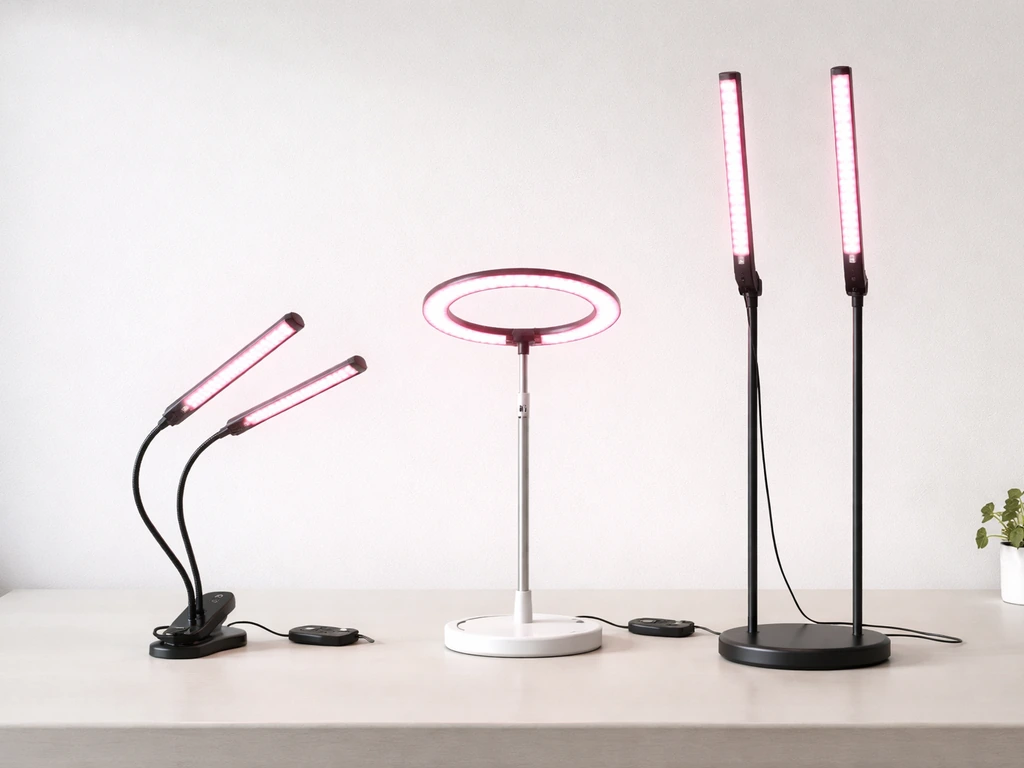
Aokrean's lineup is small but spread across very different use cases, which matters when you search by brand name and aren't sure what you're getting.
BL-C10A: the desktop clip/pole light
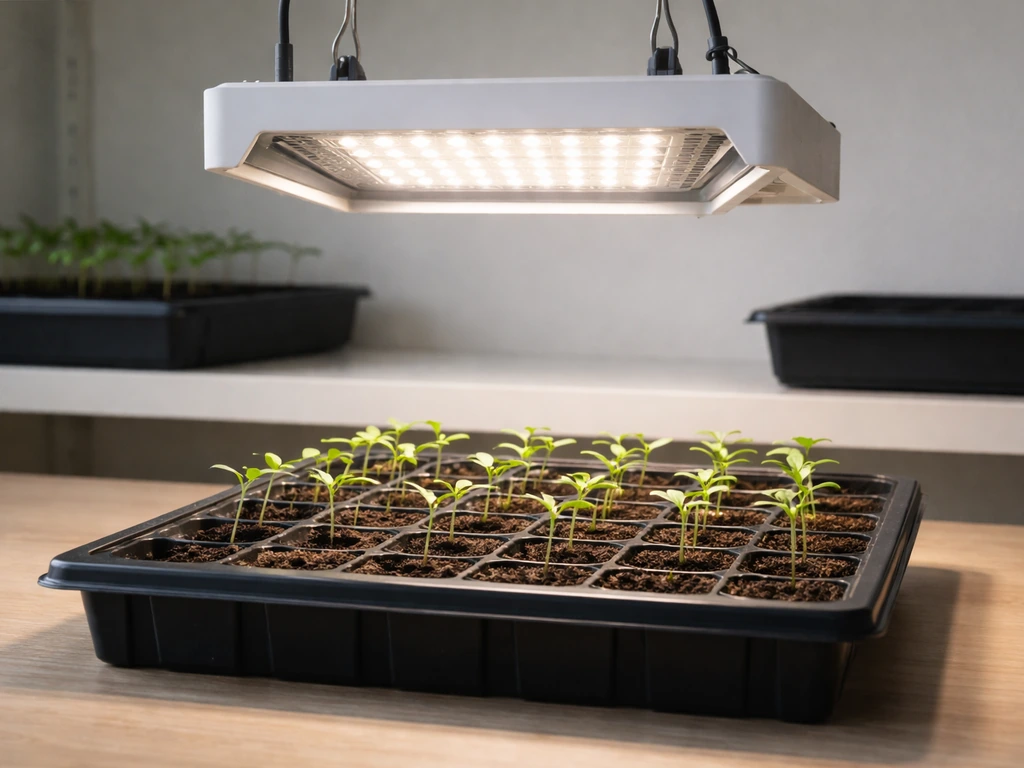
The BL-C10A is a 10W, 48-LED full-spectrum light rated from 380nm to 800nm. It runs on 5V USB power (requiring a 5V/2A adapter) and measures just 6.2 x 7.2 x 1.28 inches. It ships with a height-adjustable pole ranging from 6.5 to 26 inches, so you can raise it as your plants grow. This is a single-plant or small-cluster light: think a 4-inch herb pot, a propagation tray, or a succulent shelf. It is not a tent light. The manual positions it as suitable for all growth stages, seedlings through flowering, but realistically the 10W ceiling limits it to genuinely small plants in supplemental or low-demand situations.
Spectrum control on the BL-C10A is more flexible than most lights in this price range. You get three selectable modes: Natural White and Red (a warm mixed output), Cold White only, and All Lights On (the full 48-LED output). On top of that, there are 10 dimming levels. For a 10W light, that level of control is genuinely useful. The built-in timer offers 3H, 9H, and 12H auto on/off cycles. One honest caveat: the manual itself notes the timer may not be precise enough for strict stage-specific schedules, so if you need exact photoperiod control, you're better off pairing it with an external outlet timer.
BL-B10E: the halo kit
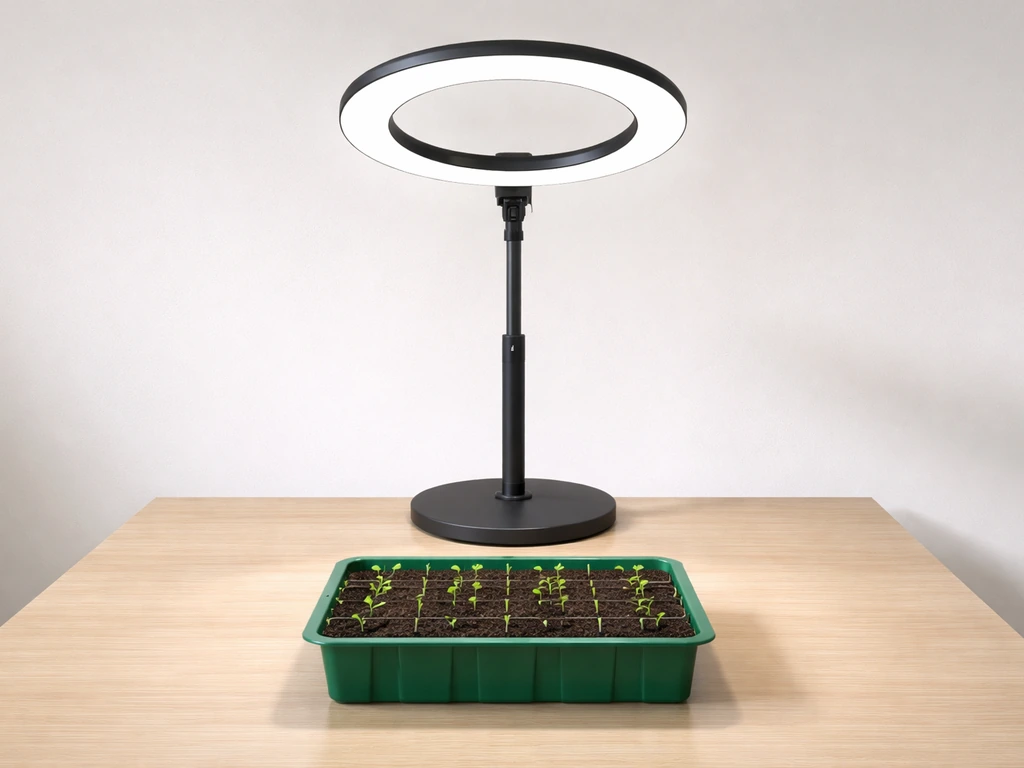
The BL-B10E is a separate model with a halo-style ring design, sold as a 2-pack bundle. Each unit comes with an extendable pole, an ABS base, a power adapter, and an inline controller for brightness and mode adjustments. The feature set is similar to the BL-C10A (full spectrum, multiple color modes, auto timer), but the form factor suits tabletop or shelf staging where you want a light that doesn't require wall-mounting or overhead suspension. If you're setting up a small plant display or a propagation station with multiple trays side by side, the BL-B10E 2-pack gives you more coverage without a ceiling anchor.
KA-1000: the COB panel
The KA-1000 is a different product category entirely. It uses 2 Cree COB LEDs plus 32 supplemental LEDs and draws 200W actual power (the "1000W" in the name is a marketing watt-equivalent, not real draw). Dimensions are 13.0 x 7.9 x 2.6 inches and it weighs 7.5 lbs. The spectrum covers 380nm to 760nm full spectrum. Aokrean claims a lifespan of at least 50,000 hours. The COB lenses run at two different beam angles: 120 degrees for the COB emitters and 90 degrees through the secondary optical lens, which helps concentrate light toward the canopy rather than scattering it sideways.
Brightness, coverage, and how even the light actually is
BL-C10A coverage reality
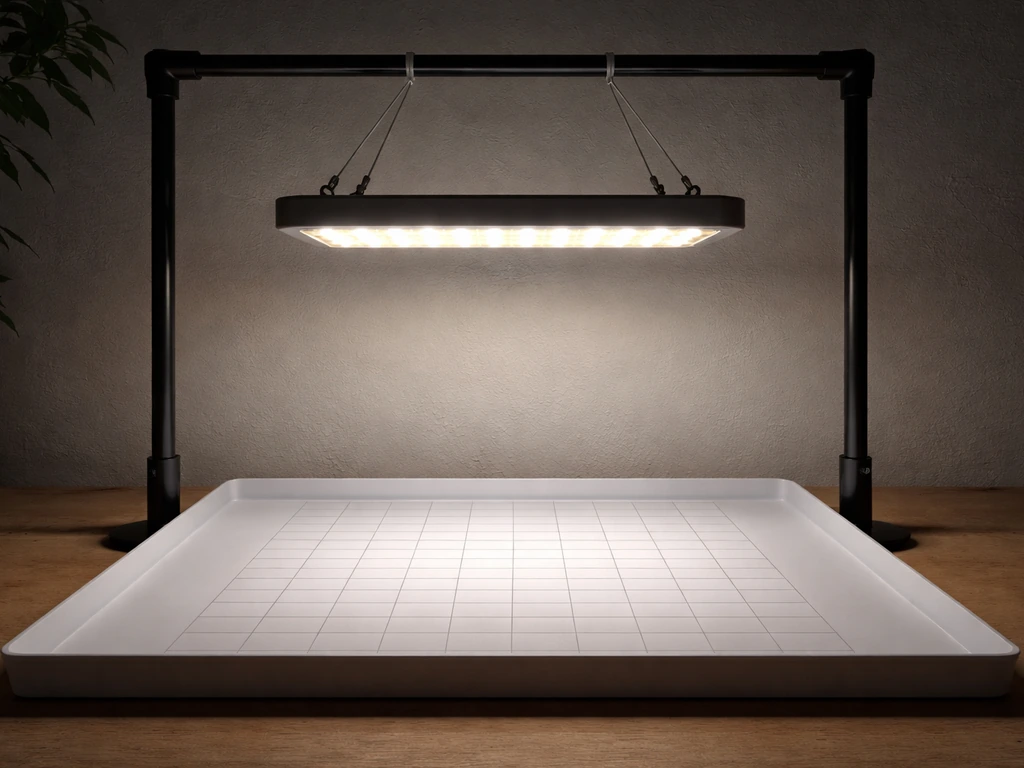
At 10W and 48 LEDs, the BL-C10A's light output is visible but limited. In All Lights On mode at its lowest hanging position (6.5 inches), the center of the footprint is noticeably bright, but edge uniformity drops off quickly once you move past 6 to 8 inches from center. The adjustable height range of 6.5 to 26 inches lets you chase the sweet spot as your plants grow, but at 26 inches you're spreading very little usable light. For practical purposes, keep this light at 8 to 14 inches above the canopy for anything beyond simple ambient supplementation. One plant per light is the realistic guidance here.
KA-1000 coverage footprint
Aokrean lists the KA-1000's core coverage area as 2.5ft x 2ft at a 24-inch hanging height, with a maximum coverage of 3.5ft x 3ft at the same height. The core zone is where intensity is high enough for flowering plants. The outer max-coverage zone is better suited for vegetative growth or lower-light plants. For a 2x2 or 2x3 tent, the KA-1000 fits well. Trying to push it to a full 3x3 tent means you'll be working with edge light levels that are better for veg than flower. The dual beam angles (90 and 120 degrees) help create a more rectangular footprint than typical single-COB lights, which improves uniformity compared to pure spot-style COBs.
PPFD and output numbers: what Aokrean claims and how to read them
blank" rel="noopener noreferrer">PPFD (photosynthetic photon flux density) measures how many usable light photons hit a square meter of canopy per second, expressed in µmol/m²/s. It's the most honest performance metric for grow lights, much more meaningful than wattage alone. PPFD, or photosynthetic photon flux density, is typically reported in µmol·m⁻²·s⁻¹ and can be measured with appropriate instrumentation such as quantum sensors blank" rel="noopener noreferrer">TECHNICALLY SPEAKING.
For the KA-1000, Aokrean publishes center-spot PPFD of 1,097 µmol/m²/s at 12 inches and 980 µmol/m²/s at 18 inches. These are center-spot figures, meaning the single brightest point directly under the fixture. Real canopy averages across the full coverage area will be lower, typically 60 to 75 percent of the center peak in well-designed COB lights.
That puts estimated average PPFD somewhere in the 650 to 820 µmol/m²/s range at 18 to 24 inches, which is a solid vegetative range and sufficient for many flowering cultivars. For reference: seedlings thrive at 100 to 300 µmol/m²/s, vegetative growth prefers 400 to 600, and flowering plants typically want 600 to 900+.
The KA-1000 covers all three stages depending on how high you hang it.
The BL-C10A doesn't publish PPFD figures, which is typical for budget desktop lights. At 10W, the absolute output is low. As a rough guide, a well-designed 10W LED can deliver around 200 to 400 µmol/m²/s at 6 to 8 inches over a very small footprint. That's enough for seedlings and slow-growing herbs but not enough for heavy-flowering plants. If you're using this for succulents or starting seeds before moving them under a larger light, it's fine. Don't expect it to flower a tomato plant.
Build quality, heat, and day-to-day reliability
BL-C10A build
The BL-C10A is a plastic-framed light in the style of most budget desktop grow lights. The USB power design (5V/2A) keeps it safe and simple, though it does mean you're working with a very limited power budget. The manual specifically flags adapter compatibility: use only the included or specified 5V/2A adapter, since swapping to an incompatible adapter can affect safety. At this wattage, heat is minimal. There's no fan, no heatsink to speak of, and no meaningful thermal concern. The 1-year warranty is standard for this price tier. Reliability over time is generally good for low-wattage passive lights like this since there are no fans to fail and minimal driver stress.
KA-1000 build
The KA-1000 is a heavier, more serious build at 7. 5 lbs. Using Cree COB emitters is a meaningful choice: Cree is a reputable LED manufacturer, and COB-style chips tend to run cooler per lumen than older diode arrays when paired with adequate thermal management. The 200W actual draw generates real heat, so the fixture needs proper airflow above it and should not be enclosed without ventilation.
Most users running this in a tent will want at least a 4-inch inline fan for the grow space regardless of the light. Aokrean doesn't publish driver brand or driver efficiency specs, which is a gap. For buyers who care about long-term reliability, knowing the driver brand matters as much as the LED brand. The 50,000-hour LED lifespan claim is standard for quality COB emitters, but actual fixture life depends heavily on the driver.
How to set up either Aokrean light properly
BL-C10A setup
- Use the 5V/2A adapter only. A mismatched adapter can damage the driver.
- Set the pole height to 8 to 12 inches above the top of the plant for seedlings and herbs. Lower than 6.5 inches risks heat stress on young plants even at low wattage.
- Start with All Lights On mode at 50 to 70 percent dimming for seedlings. Increase to full brightness as plants develop.
- Use the 12H timer cycle for herbs and most vegetables. If you're growing succulents or cacti, 9H is typically sufficient.
- For the most even coverage, center the light directly above the tallest plant. The footprint is small, so clustering more than 2 to 3 small pots beneath one BL-C10A will leave the outer pots underlit.
- If you need precise photoperiod control (critical for flowering plants), supplement the built-in timer with an external outlet timer. The manual flags the internal timer as potentially imprecise for strict schedules.
KA-1000 setup
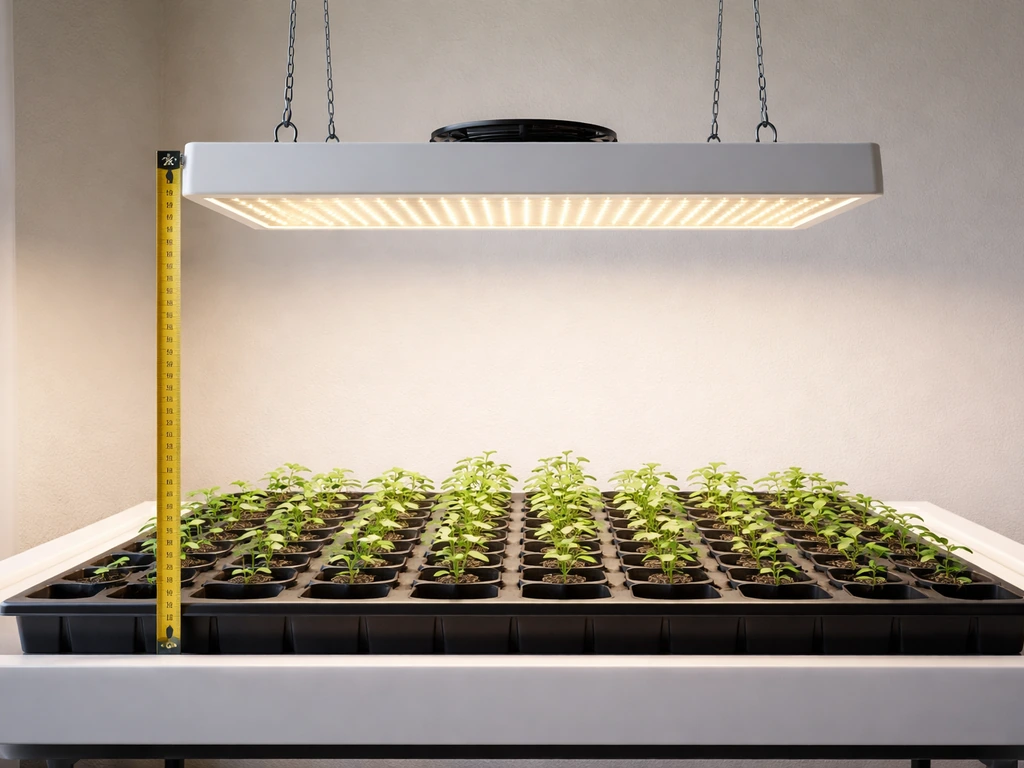
- Hang the KA-1000 at 24 inches above the canopy to start. This gives you the listed 2.5ft x 2ft core coverage and keeps intensity in the vegetative sweet spot.
- For seedlings, raise to 30 to 36 inches to reduce intensity. At 12 inches the center PPFD exceeds 1,000 µmol/m²/s, which is too intense for fresh seedlings.
- For flowering, lower to 18 to 20 inches to push center and mid-canopy PPFD into the 800 to 1,000 range.
- Make sure your grow space has active ventilation. At 200W actual draw, the fixture generates substantial heat that needs to move out of the canopy zone.
- Use an external timer for photoperiod control. Run 18H/6H for vegetative growth, 12H/12H for flowering.
- Don't try to light a 3x3 tent with one KA-1000 for flowering. The outer corners at that footprint will be too dim. Stick to a 2x2 or 2x2.5 core zone for flowering, and use the 3x3 footprint only for veg or low-light herbs.
Where Aokrean wins and where to look elsewhere
The BL-C10A is genuinely competitive for what it is: a low-cost, low-footprint desktop grow light with more spectrum and dimming control than most lights at its price. If you're starting seeds, growing herbs on a windowsill shelf, or supplementing low natural light for a small houseplant collection, it earns its spot. The 3-mode spectrum switching and 10-level dimming are real features, not just marketing, and the USB power keeps it simple and safe.
Where it loses is obvious: 10W is 10W. Competing lights like the ACKE LED series and some Apollo grow light models at similar or slightly higher price points offer more LEDs, broader footprints, or higher actual wattage. If you're comparing it to an Apollo grow light review, make sure you're looking at the actual wattage and the real coverage footprint, not just the marketing numbers Apollo grow light models.
If you're specifically comparing an Aokrean ACKE LED grow light review to alternatives, focus on the actual wattage draw, coverage, and driver quality rather than the marketing watt number. If you're growing anything that needs serious light output (peppers, tomatoes, cannabis, flowering annuals), the BL-C10A isn't your light regardless of price.
The KA-1000 is more interesting to compare. At 200W actual draw with genuine Cree COB emitters, it sits in a competitive segment alongside lights from brands like Agromax, AOVOK, and various budget COB panel makers. The COB center-spot PPFD claims are plausible for the wattage. The core 2.5ft x 2ft flowering footprint is honest and realistic. Where the KA-1000 would need to prove itself against better-documented competitors is in average PPFD uniformity and driver quality, neither of which Aokrean publishes clearly.
| Model | Actual Power | Best For | Coverage (Flowering) | Spectrum | Key Feature |
|---|---|---|---|---|---|
| Aokrean BL-C10A | 10W | Seedlings, herbs, single plants | 6–8 inch radius | 380–800nm full spectrum | 3 modes, 10 dimming levels, USB power |
| Aokrean BL-B10E | ~10W (est.) | Tabletop multi-plant setup | Small cluster, 2-pack | Full spectrum (multi-mode) | Halo design, 2-pack kit with bases |
| Aokrean KA-1000 | 200W | Veg/flower in 2x2 to 2x3 tent | 2.5ft x 2ft core | 380–760nm full spectrum | Cree COB LEDs, 50,000hr lifespan |
Is it worth your money? A buyer checklist
Both Aokrean lights offer reasonable value within their categories, but "reasonable value" depends heavily on your situation. Here's how to pressure-test the purchase before you commit.
- Confirm actual wattage, not marketing watts. The KA-1000 is 200W actual, not 1000W. Make sure your circuit and tent ventilation can handle real power draw.
- Verify the coverage area matches your grow space. The KA-1000's 2.5ft x 2ft core flowering footprint is honest but limited. Measure your tent before buying.
- Check whether PPFD data covers average canopy readings, not just center-spot peaks. Aokrean lists center-spot numbers; real average will be lower.
- For the BL-C10A, confirm you have or can source a 5V/2A USB adapter. Using the wrong adapter is a safety and performance risk.
- Assess whether the built-in timer is precise enough for your plants. If you're growing photoperiod-sensitive plants, plan for an external outlet timer.
- Consider driver brand and warranty length relative to alternatives. The KA-1000 offers a 50,000-hour LED lifespan claim, but Aokrean doesn't publish driver specs. One year of warranty (BL-C10A) is short; check the KA-1000 warranty terms before purchasing.
- Compare price per watt against alternatives. In the 200W COB panel segment, brands with published third-party PPFD maps and longer warranties (2+ years) are worth the comparison before defaulting to the KA-1000.
- If you're buying the BL-B10E as a multi-plant solution, confirm that two units will cover your specific tray or shelf dimensions. Each unit has a small footprint.
The bottom line: the BL-C10A is a solid buy for beginner indoor gardeners who want more control than a basic clip light offers, at a price that's easy to justify for one or two small plants. The KA-1000 is a more serious investment with competitive COB output for a 2x2 to 2x3 tent, but it competes in a crowded market where brands like Agromax and AOVOK offer comparable or better-documented specs at similar price points. Do the PPFD math for your specific space, check the current price delta, and if Aokrean comes in at a meaningful discount with similar specs, it's a reasonable choice. If you are also considering AOVOK models, this AOVOK grow light review can help you compare specs and real-world performance side by side.
FAQ
How do I compare Aokrean’s PPFD numbers to the kind of light my plants actually need?
Use PPFD as your anchor, then sanity-check height and coverage. Aokrean’s KA-1000 PPFD values are center-spot, so you should estimate average PPFD across your whole planted area using the typical 60% to 75% of peak rule mentioned in the review. Then compare that average range to your stage targets (seedlings around 100 to 300, veg 400 to 600, flowering commonly 600 to 900+).
Are Aokrean’s coverage footprints realistic for both flowering and vegetative growth?
They are most realistic as a staging guideline, not a guarantee. The KA-1000’s “core” footprint is where intensity is highest enough for flowering, while the outer “max” footprint drops toward veg/low-light. If you spread high-demand flowering plants across the entire max area, expect uneven results, especially at the edges.
What hanging height should I start with for the KA-1000 if I don’t know my plant’s light tolerance?
Start conservative. Since their published PPFD drops when moving from 12 inches to 18 inches, beginning around 18 to 24 inches gives you room to adjust upward later if plants look light-starved. If you start too close, edge plants can still be underpowered while center plants bleach, so use a gradual height change and watch leaf response.
Why doesn’t the BL-C10A publish PPFD, and how should I plan around that uncertainty?
Budget desktop lights often skip PPFD reporting, so you have to rely on practical placement and conservative expectations. For the BL-C10A, treat it as a supplemental or propagation light, not a canopy driver. Practically, plan to keep it close (roughly 6 to 8 inches for best results on tiny plants), and keep goals limited to seedlings, herbs, or low-demand houseplants.
Can I run the BL-C10A on a different USB adapter than the included 5V/2A?
Stick to the specified 5V/2A adapter guidance from the manual. Even if the connector fits, an incompatible adapter can change electrical behavior and raises safety concerns. If you must replace it, match output voltage and current rating, and avoid fast-charger modes that aren’t intended for the device.
Is the built-in timer on the BL-C10A accurate enough for strict schedules?
Probably not for people who follow exact photoperiod timing. The manual notes the timer may not be precise for stage-specific schedules, so for strict consistency use an external outlet timer. That also reduces drift if you rely on the same schedule every day.
What is the biggest mistake people make when trying to use the KA-1000 for a 3x3 tent?
Treating the entire 3x3 as “flower-ready.” The review notes the KA-1000’s full 3x3 attempt leads to edge levels that are better for veg than flower. If you want a 3x3 footprint, consider either centering fewer flowering plants, raising your intensity (different fixture), or accepting that outer plants will run lower.
How can I check whether the KA-1000 is too intense or too weak without buying extra gear?
Use plant-based signals plus placement adjustments. If centers show bleaching, rapid droop, or very light-colored leaves, raise the fixture or reduce exposure time. If plants stretch, internodes lengthen, and new growth looks slow or narrow, lower the light or increase photoperiod (within safe limits). For best certainty, a PPFD meter is the only way to verify actual averages, but visual monitoring is a useful first step.
Do I need a fan for the KA-1000, and can I run it without airflow in a tent?
You should not enclose it without ventilation, because the 200W actual draw creates meaningful heat. The review suggests at least an inline fan approach for tent setups. If airflow is weak, LED output and driver lifespan can suffer, even if the fixture still “works” on day one.
Why does driver quality matter as much as Cree COB LEDs on the KA-1000?
LED chips can last for tens of thousands of hours, but the driver often determines real long-term stability. Aokrean does not publish driver brand or efficiency details, so two fixtures with similar LED claims can fail at different rates. If you care about multi-year reliability, look for better driver transparency in competing models.
What should I budget for besides the Aokrean light itself?
For the KA-1000, budget for airflow (inline fan and ducting), plus the hanging setup and safe power management. For the BL-C10A, budget mainly for the correct 5V adapter if you do not already have one that matches the specified rating. In both cases, factor in any external timer you may want for photoperiod precision.
Which Aokrean model should I choose if I’m between “seedlings” and “early veg” in a small area?
If you truly have a tiny footprint, the BL-C10A can work for starting seedlings or small herbs, especially if you can keep it very close to the plants. If your plants will need stronger, more uniform canopy light for early veg without constant repositioning, the KA-1000 is usually the better fit for a 2x2 to 2x3 space, because its higher output is built for that canopy scale.