The Grow Light Science Grow 300 is a legitimate, well-built LED bar light that delivers real results for small-to-mid-sized indoor grows. At 321W actual draw, a 2.75 μmol/J efficacy rating, and Samsung LM301B diodes paired with OSRAM 660nm reds, it sits comfortably in the upper tier of its wattage class. A single unit handles a 2.5' x 5' flowering footprint confidently, and two units together will cover a 5' x 5' tent for flower. It is not the cheapest option in this class, but the 5-year warranty, reputable components, and consistent light distribution make it a solid buy for growers who want reliability over bargain pricing.
Grow Light Science Grow 300 Review: Worth It for Indoor Growing?

Marcus Caldwell
24 Apr 2026
What the Grow Light Science Grow 300 actually is
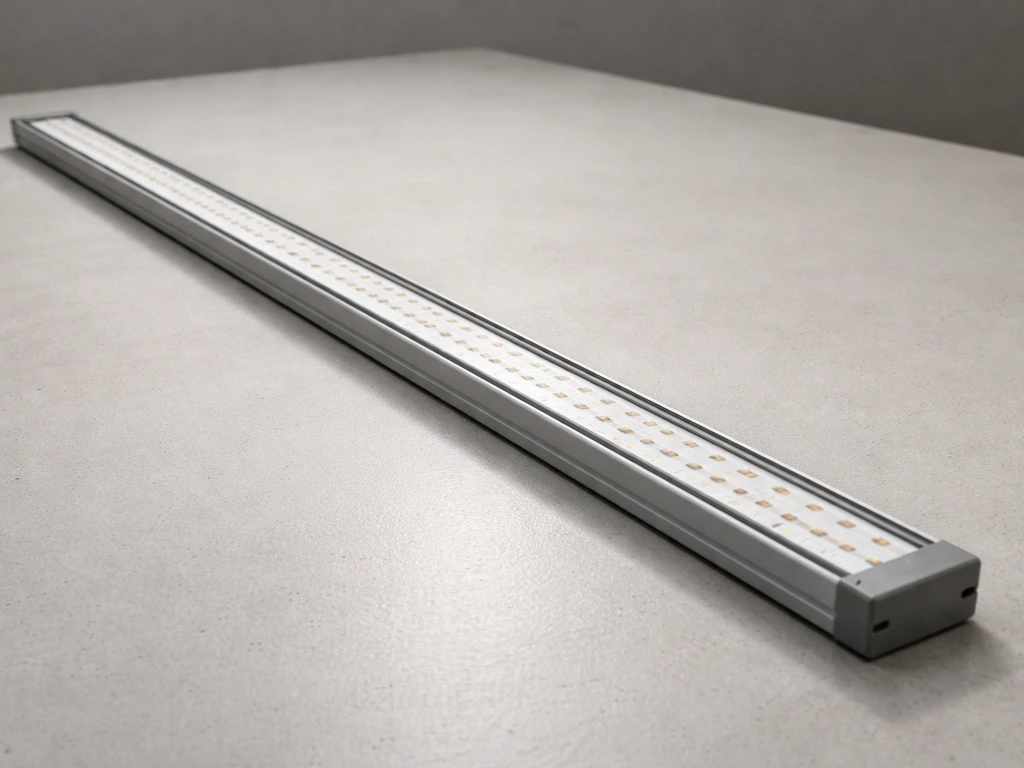
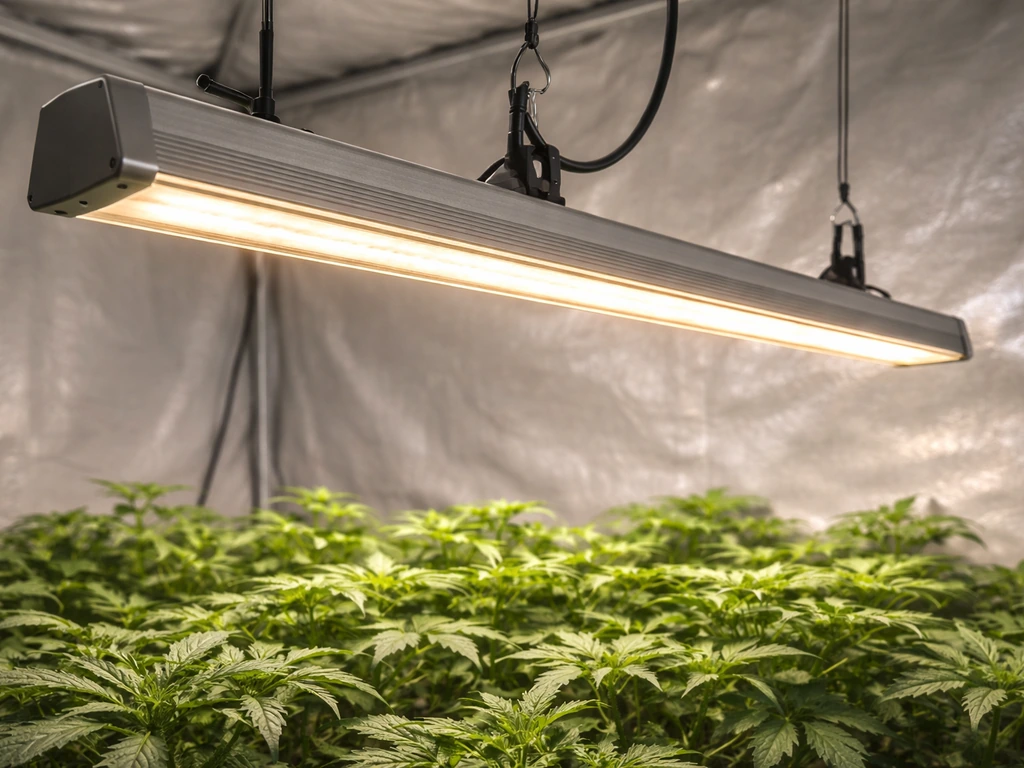
The Grow 300 is a linear LED bar fixture, 46.1 inches long by 12.6 inches wide and only 2.9 inches deep. It looks nothing like the boxy blurple panels that flooded the market a few years ago. Instead it is a single long bar housing 1,056 top-bin Samsung LM301B white diodes supplemented by OSRAM Hyper Red 660nm LEDs. The driver is a Mean Well ELG series or WeledPower HHA series unit (depending on production batch), and the fixture is fully dimmable via a 0–10V input across the full 0–100% range.
The current spec sheet puts actual power draw at 321W, total PPF at 884 μmol/s, and usable PPF at 813 μmol/s. PAR efficacy lands at 2.75 μmol/J from the manufacturer. The light accepts a wide voltage range (AC 120–270V), which means it works on North American and European power without an adapter. The design was first released in late 2019 and the updated version carrying these specs dropped in November 2020, so any unit you buy in 2026 should reflect the revised, higher-output configuration.
Who is this for? It is aimed at indoor growers running a single tent in the 2.5 x 5 to 5 x 5 foot range who want a durable, scalable fixture. The bar form factor makes it easy to array multiple units over a larger canopy, and Grow Light Science designed it explicitly with that pairing in mind. If you are running a 4 x 4 or 5 x 5 tent and want to fill it out over time, starting with one Grow 300 and adding a second is a logical path.
Coverage, PPFD, and light distribution in real grows
Coverage numbers from the manufacturer are reasonable and match what independent testers have observed. A single Grow 300 covers up to 3 x 6 feet for vegetative growth and 2.5 x 5 feet for flowering. Two units together push that to 6 x 6 feet for veg and 5 x 5 feet for flower. These are not inflated marketing figures in the way many budget lights inflate their coverage claims.
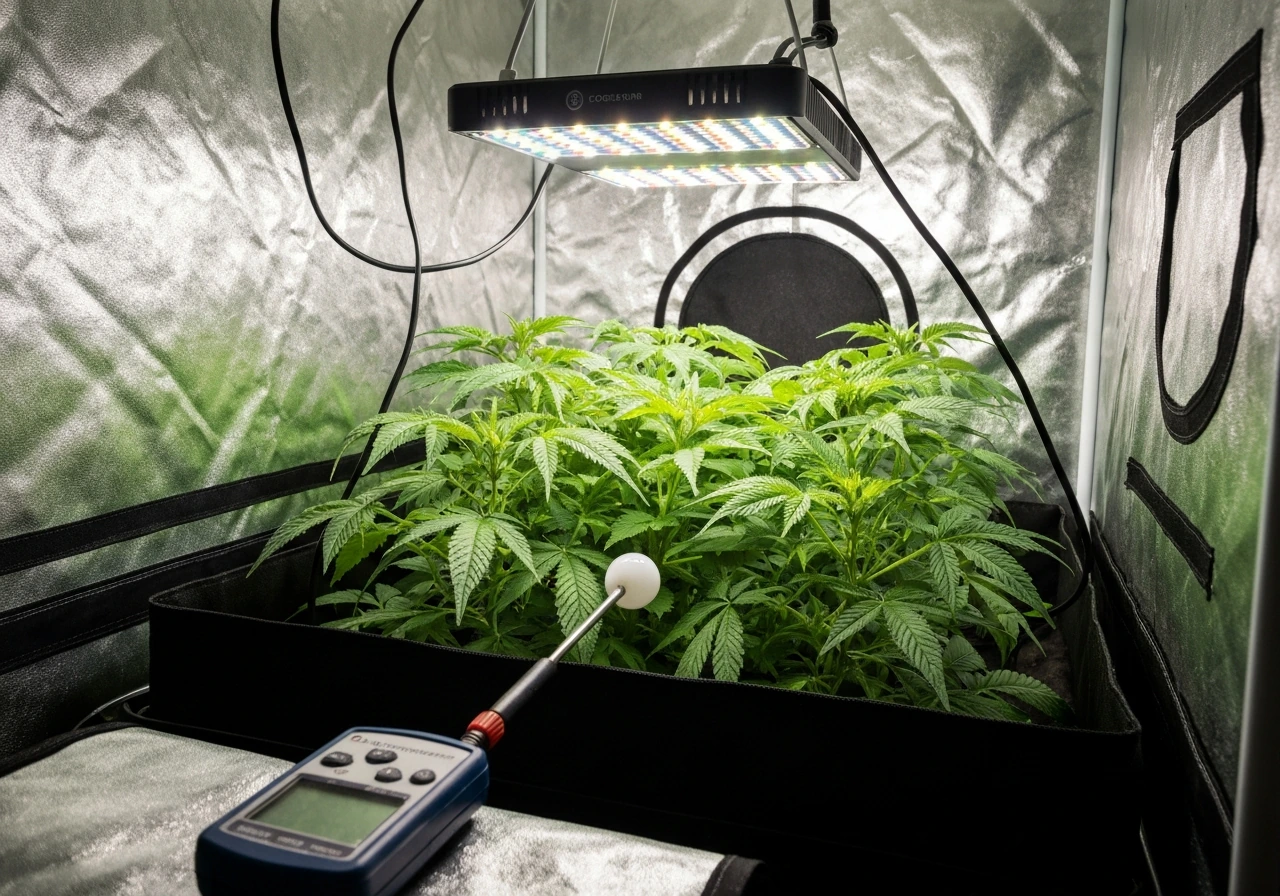
PPFD output is genuinely competitive. At flowering hang heights (12 to 24 inches above canopy), real-world PPFD readings land in the 600 to 1,500 μmol/m²/s range depending on exact height and dimmer setting. Independent testing by MIGRO put system efficiency around 2. MIGRO publishes independent testing that evaluates efficiency, light distribution, and overall performance in controlled environments Independent testing by MIGRO put system efficiency around 2.. 4 μmol/W under real operating conditions, which is slightly below the 2.75 μmol/J spec but still very respectable for the class. MIGRO also noted notably even light distribution across the canopy footprint, which is one of the Grow 300's genuine strengths. A bar-style fixture naturally spreads light more uniformly than a square panel, and this light takes good advantage of that geometry.
Real growers running this light report using it at around 12 inches above canopy at roughly 60% power during early flowering stages, which tracks with the PPFD range above. At full power and 18 inches, you are looking at solid flower-stage intensities without burning risk in most crops. The 120-degree beam angle contributes to that even spread. If you are targeting 800–1,000 μmol/m²/s for most flowering cannabis or fruiting plants, one unit at 18–24 inches on 70–80% power gets you there across a 2.5 x 5 footprint.
Spectrum and how it performs at each grow stage
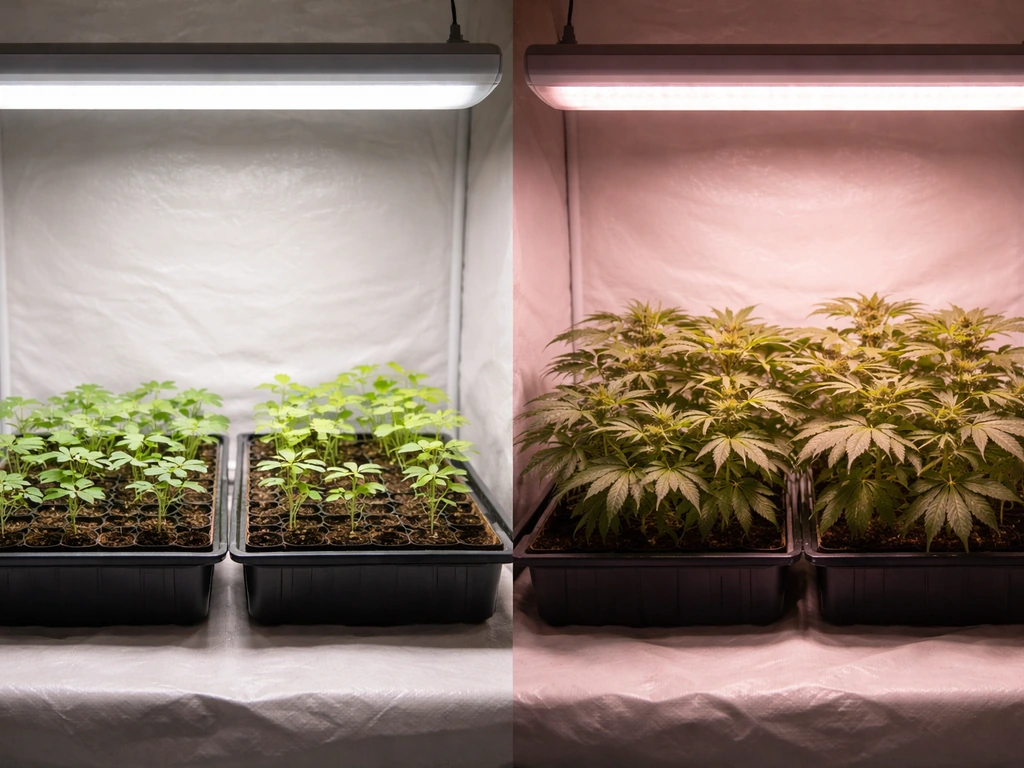
The Grow 300 runs a broad-spectrum white-dominant output from the Samsung LM301B diodes, augmented by the OSRAM 660nm deep red. The white diodes produce a full, continuous spectrum similar to what you get from high-CRI LEDs (CRI 90 on this fixture), meaning plants get a representative spread of wavelengths across the photosynthetically active range. The 660nm OSRAM addition boosts the red region specifically tied to flowering response and chlorophyll absorption peaks.
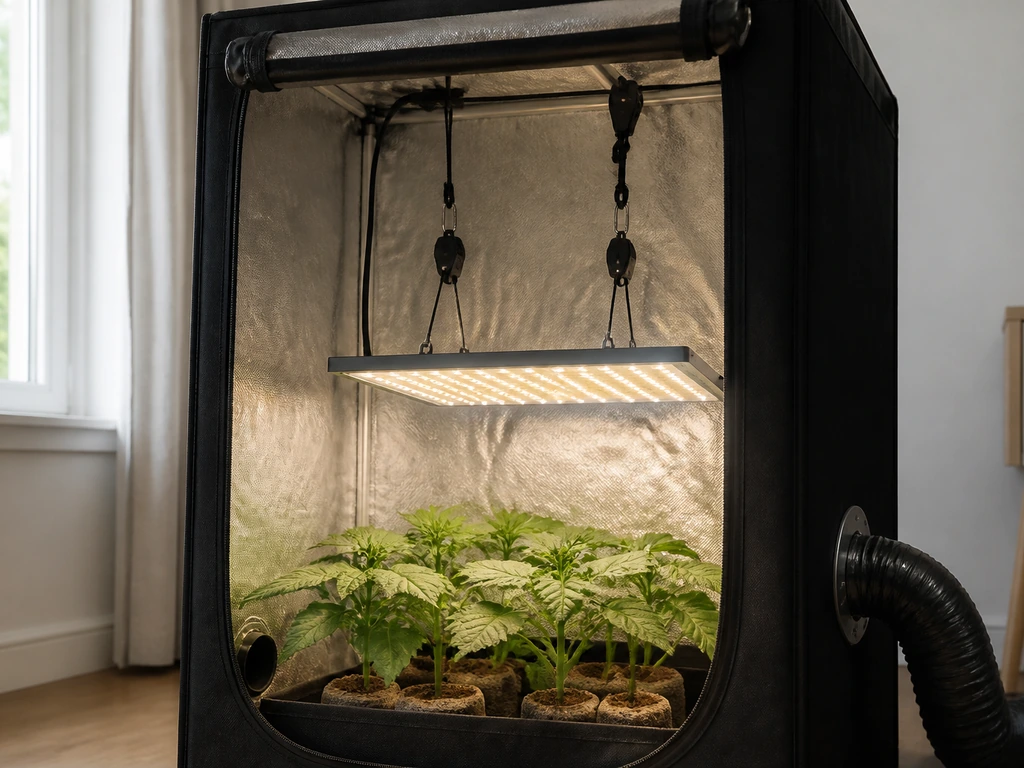
For seedlings and early veg, you will want to hang the light at the higher end of the recommended range (36–48 inches) and dim it back to 30–50%. The broad-spectrum white output is gentle enough for young plants without triggering light stress, and the even distribution means you do not get hot spots burning seedling tips. During mid-to-late veg, drop to 24–36 inches and run 60–80% power. The full spectrum supports compact, bushy vegetative growth without the stretching you sometimes see under red-heavy or narrow-spectrum panels.
Flowering is where the 660nm OSRAM LEDs pull their weight. The red supplementation supports transition into bloom and encourages dense bud development. Run the light at 18–24 inches above canopy at 80–100% for peak flowering intensity. The combination of broad-spectrum whites and targeted deep red is well-suited for a full-cycle grow without needing to swap lights between stages. This makes it a practical choice for growers who want one fixture that handles everything from clone to harvest.
Build quality, cooling, controls, and long-term reliability
The physical build is one of the Grow 300's stronger selling points. The housing is a solid aluminum extrusion profile, which acts as a passive heatsink. There are no active cooling fans, which means no moving parts to fail and no fan noise in your grow space. In practice, the fixture runs warm but not hot under normal operating conditions. Passive thermal management works fine here because the diodes are efficient enough that waste heat stays manageable at the operating wattages involved.
The Mean Well or WeledPower driver is a quality component. Mean Well's ELG series is used widely across commercial and semi-commercial LED horticulture fixtures and has a strong reliability track record. The 0–10V dimming interface is a standard industrial protocol, which means the dimmer control is clean and linear. You will not get flickering or instability at low dim settings the way cheaper drivers sometimes produce.
Grow Light Science backs the Grow 300 with a 5-year warranty. The terms cover manufacturing defects with a repair or replace remedy evaluated by the company. Five years is meaningfully better than the 1–3 year coverage common on budget fixtures. For a light sitting in the $400 range, that warranty depth is appropriate and gives real peace of mind for a fixture you are going to run for hundreds of hours per year. Warranty and construction quality were the two factors that came up most often in real buyer discussions around this light, and both hold up to scrutiny.
Pros, cons, and what buyers actually complain about
- Even, uniform light distribution from the bar form factor — a genuine practical advantage over square panel designs
- Top-bin Samsung LM301B diodes plus OSRAM 660nm deliver a high-quality, full-cycle spectrum at CRI 90
- 321W actual draw with 2.75 μmol/J rated efficacy is competitive for the price tier
- Passive cooling means zero fan noise and no moving-part failure points
- Clean 0–10V dimming via quality Mean Well or WeledPower driver
- Wide voltage range (120–270V AC) works globally without adapters
- 5-year manufacturer warranty is strong for the category
- Designed to scale — two units cover a 5x5 flower footprint efficiently
- Price sits around $400, which is higher than budget alternatives at similar wattages
- Single unit coverage for flowering (2.5 x 5 feet) means a 4x4 or 5x5 tent requires two units and a bigger upfront investment
- The bar form factor, while great for distribution, requires more ceiling clearance and mounting thought than a compact square panel
- No onboard display or app control — dimming is via external 0–10V signal only, so you need a compatible dimmer controller
- Shipping cost has come up as a concern in buyer discussions, particularly for international orders
- Independent efficiency testing (MIGRO: ~2.4 μmol/W actual) is slightly below the spec sheet figure, as is common across the industry
The most common friction point real buyers mention is the cost-to-coverage calculation. If you need to fill a 4 x 4 tent today and budget is tight, the Grow 300 pushes you toward buying two units, which quickly moves you past $800. That is a real consideration. The light itself performs well, growers are generally satisfied with results, but the entry price for full tent coverage is higher than competing options if you do not already own one unit.
Is the price worth it, and who should actually buy this
Street pricing for the Grow 300 has been seen around $400 (with some listings showing a discount from a higher MSRP near $500). Occasional promo codes can knock a further 5% or so off that. At $400, you are paying a moderate premium over budget LED alternatives, but you are getting verified top-bin diodes, a quality driver, passive cooling with no fan failure risk, and a 5-year warranty. The value proposition is solid if those things matter to you. If you want to keep costs down without sacrificing performance, a budget grow lights review can help you compare options side by side before you buy budget LED alternatives. If you are choosing between the Grow 300 and budget options, check out induction grow lights reviews for more buying guidance and real user takeaways.
The best-fit buyer for a single Grow 300 is someone running a 2 x 4 or 2.5 x 5 tent for flowering, or a 3 x 6 space for veg-stage growth. It is also a great fit if you are planning to scale up and want to build a matched array over time. Buying two now for a 5 x 5 space is a higher upfront cost but gets you a coherent, warranty-backed system that should run reliably for years.
If your budget is tight and you are willing to accept shorter warranty coverage and less vetted diode quality, budget-tier fixtures can cover similar wattage classes for less money, though the trade-offs in efficiency, longevity, and spectrum quality are real. The Grow 300 is not overkill for serious hobbyists, it is priced and specced appropriately for someone who wants the grow to work right the first time.
How it compares to similar lights
The most direct comparison in the same wattage class is the Spider Farmer SF-series, which also uses Samsung LM301B diodes and targets similar coverage footprints. Spider Farmer options in the 300W range are generally priced lower, which is their main competitive advantage. A retail listing for the Spider Farmer G3000 describes it as a 300W-class full-spectrum, dimmable LED grow light, which you can use as a comparison point within this same 300W tier Spider Farmer G3000 is listed as a 300W-class full-spectrum dimmable LED grow light. However, the Grow Light Science warranty depth (5 years vs. Spider Farmer's 3 years) and the specific build execution of the Grow 300 give it an edge for buyers prioritizing longevity and support.
| Light | Actual Draw | Efficacy (μmol/J) | Flowering Footprint (1 unit) | Warranty | Approx. Price |
|---|---|---|---|---|---|
| Grow Light Science Grow 300 | 321W | 2.75 (spec) / ~2.4 (independent test) | 2.5' x 5' | 5 years | ~$400 |
| Spider Farmer SF-series (~300W) | ~300W | ~2.5–2.7 | 2.5' x 4' to 2.5' x 5' | 3 years | ~$250–$320 |
| Budget-tier Samsung LM301B bar (~300W) | ~280–320W | ~2.0–2.4 | 2' x 4' to 2' x 5' | 1–2 years | ~$150–$250 |
If you are also considering the Grow Light Science Grow 200 (a smaller sibling in the same line), that unit makes more sense for a 2 x 4 tent or small veg space where the Grow 300's output would be excessive and harder to dial back without sacrificing the efficiency sweet spot. The Grow 300 is the right choice when you need to cover a longer or wider canopy footprint and want the option to pair a second unit later.
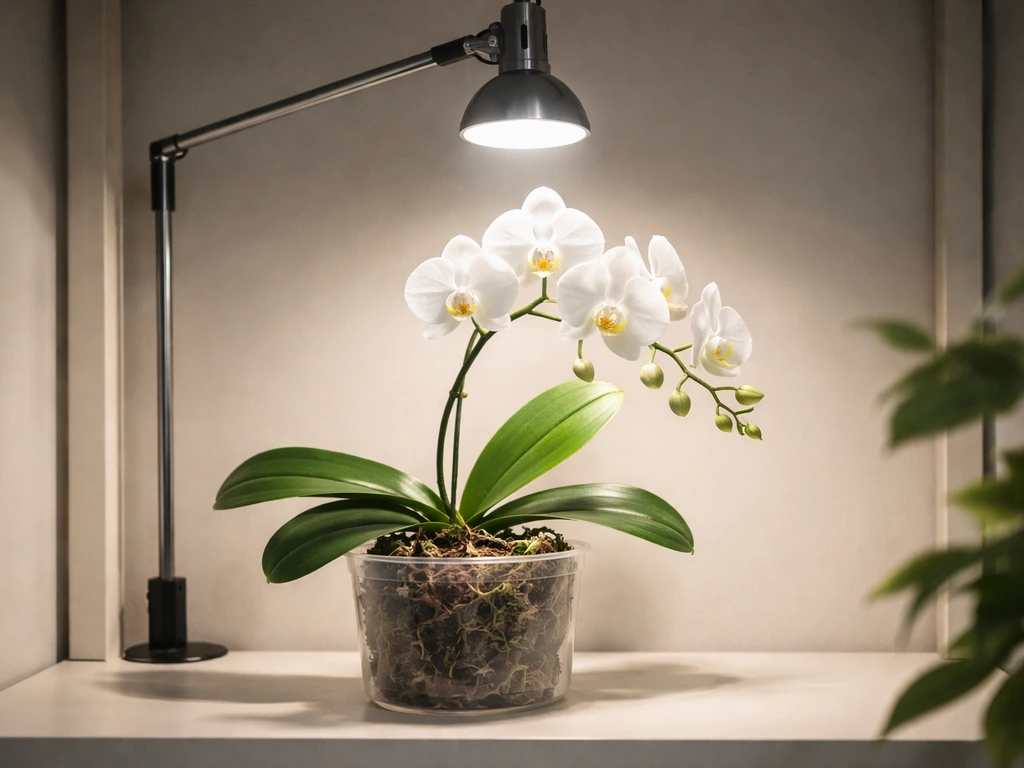
For growers interested in specialty crops like orchids or other light-sensitive plants where spectrum precision matters, the Grow 300's broad-spectrum white output with CRI 90 is genuinely well-suited. It is a more forgiving and complete spectrum than single-channel red/blue fixtures, and the dimmability lets you tailor intensity to sensitive plants without specialized controllers.
How to set it up and what to do before you buy
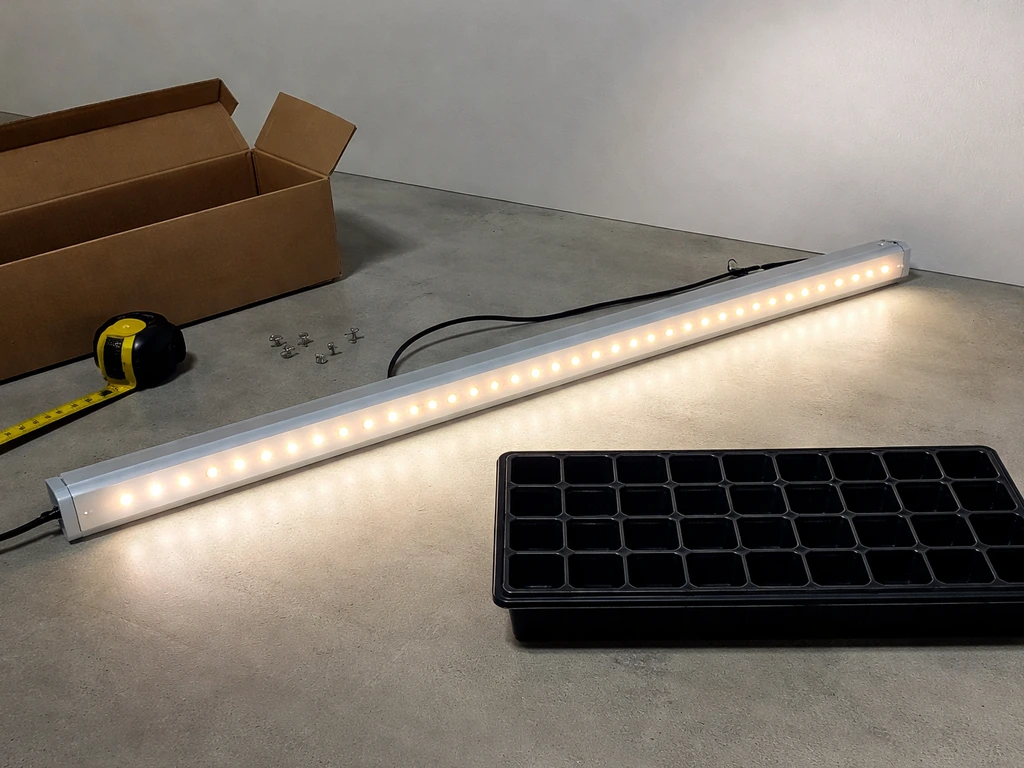
Before you order, confirm your tent or grow space dimensions against the coverage footprints. If you are flowering in anything larger than 2.5 x 5 feet, budget for two units from the start rather than trying to stretch one. The math on two units covering a 5 x 5 flower space is clean and well-supported by real-world grower reports.
- Mount using adjustable rope ratchets at the hanging points provided on the fixture. Start at 36–48 inches above your plants for seedlings/early veg, then lower to 24–36 inches for late veg and 18–24 inches for flowering.
- Connect a compatible 0–10V dimmer controller (not included). This is required for dimming — the light does not have an onboard dial. Make sure your controller is rated for the driver type in your unit.
- Start seedlings at 30–40% power to avoid light stress. Ramp up to 60–70% through veg and push to 80–100% during peak flower.
- If running two units in a 5 x 5 tent, space them evenly across the length of the tent and run matching power/dimmer settings on both for uniform canopy coverage.
- Check the hanging height and power combination against the PPFD targets for your specific crop. Most flowering cannabis targets 800–1,000 μmol/m²/s; most leafy greens and herbs are happy at 200–400 μmol/m²/s.
- Register your warranty with Grow Light Science after purchase. The 5-year coverage is a meaningful benefit — do not skip the registration step.
If you find the Grow 300 is out of stock or temporarily over budget, check whether a current promo code is available from the manufacturer's site directly, a 5% discount has been offered through various channels and may be active at time of purchase. For anyone still deciding between the Grow 300 and a budget alternative, the honest answer is: if you plan to grow seriously for more than one or two cycles, the Grow 300's build quality and warranty will likely save you money over time compared to replacing cheaper hardware sooner. If this is a casual trial grow, a budget option might be more sensible until you commit to the hobby.
FAQ
Can I use a 0 to 10V controller (or smart dimmer) with the Grow 300 for automatic dimming schedules?
Yes, because the Grow 300 uses a 0 to 10V dimming input and paired Mean Well or WeledPower drivers, it is typically compatible with most 0 to 10V dimmer controllers. The catch is that you need a true 0 to 10V output, not an on-off timer dimmer, and you should wire the dimming line securely to avoid intermittent flicker at lower settings.
Should I run the Grow 300 at 100% the whole flowering period, or dim it?
Most growers do not need to run it at full power continuously. A practical approach is to start around 70 to 80% for early-to-mid flowering, then adjust weekly based on actual plant response and your measured PPFD if possible. Running 100% at excessive hanging heights can still under-deliver intensity, while running it too low at 100% can cause tip stress in sensitive strains.
What’s the best way to hang and adjust the Grow 300 if my canopy is uneven?
If your goal is consistent canopy intensity, stagger your bar height adjustments rather than keeping the entire fixture at one level when plants grow unevenly. With a bar layout, minor height differences across the canopy can create local PPFD swings, so lifting or lowering the fixture by small increments (for example, 1 to 2 inches) can help you fine-tune without changing dimmer settings.
Will one Grow 300 be enough for a 4 x 4 flowering tent?
For the stated coverage, a single Grow 300 is usually fine for small flowering areas up to about 2.5 x 5 ft, but a 4 x 4 tent typically ends up underpowered if you rely on one unit. If you have a 4 x 4, plan on two units or be prepared to accept lower intensity and slower canopy fill, especially late flowering.
Does the Grow 300 still need airflow or clearance if it has no cooling fan?
The passive heatsink design means no fans, but that does not mean it is “set-and-forget” thermally. Keep at least a few inches of clearance around the fixture, avoid enclosing it tightly against reflective walls, and ensure your grow space has normal exhaust so ambient temperature does not climb unnecessarily.
What are common mistakes when transitioning from veg to flowering with this light?
To reduce the chance of stress, use dimming during the switch from veg to bloom rather than changing only the height. A common mistake is jumping plants from veg height and 60 to 70% directly to bloom height and 90 to 100% without a transition period, which can show up as leaf tacoing or slowed growth.
Can the Grow 300 be used for specialty plants like orchids, and how should I start?
Yes, but you should treat it as a spectrum that is “broad enough” rather than a replacement for tight-spectrum specialty needs. For very light-sensitive or boutique crops, start at the upper hanging height and 30 to 50% output, then increase gradually while watching for bleaching or leaf curl.
How do I know when to add a second Grow 300 instead of moving the first one lower?
Use the dimmer and height together to avoid extremes. If you find you must keep the fixture very low to hit target PPFD, that often signals you are under-covering your footprint. In that case, adding a second unit is usually more effective than trying to compensate with position.
Do I need a transformer for international use, and what should I verify before wiring?
Voltage compatibility is broad (AC 120 to 270V), so you generally do not need a separate power transformer. The practical checklist is to verify you are using the correct AC input region if your local outlet differs from what the seller configured, and to confirm the 0 to 10V dimming wiring matches your controller.
Is it important to center the Grow 300 over the canopy, or can I offset it?
If you are buying one to cover only part of a tent, you may still get good results, but it helps to align the bar length with your crop’s long axis and keep consistent hanging height across the covered area. The easiest mistake is placing the bar off-center so one side runs hotter, then dimming to “fix” it and reducing overall PPFD for the whole canopy.
Will dimming the Grow 300 also help with grow room heat and plant stress?
Dimming helps both intensity and heat load at the driver and LED level, but it does not replace good environmental control. If your room runs hot, you can unintentionally reduce fixture effectiveness and increase stress on plants, so track both canopy temperature and leaf behavior when adjusting power.
What can void warranty risk-wise on the Grow 300, beyond normal wear?
Plan on warranty coverage being most straightforward for manufacturing defects, not for damage caused by drops, improper mounting, water ingress, or electrical miswiring. Before hanging it, check that your mounting method supports the full fixture weight and that strain relief is used for the power and dimming leads.