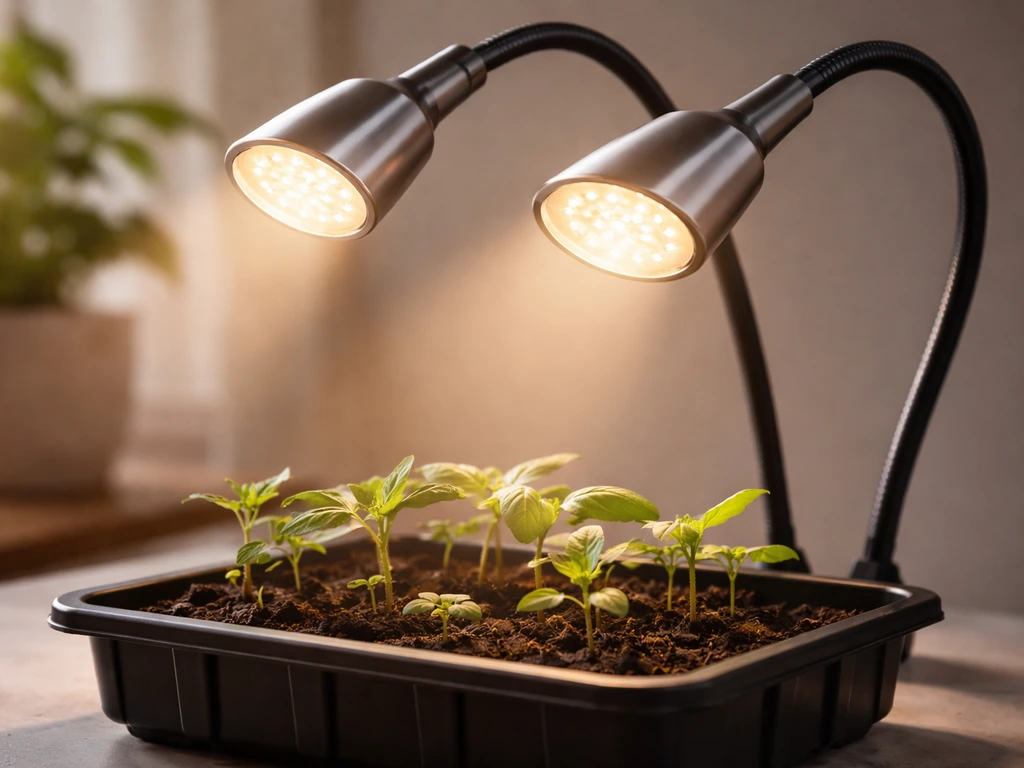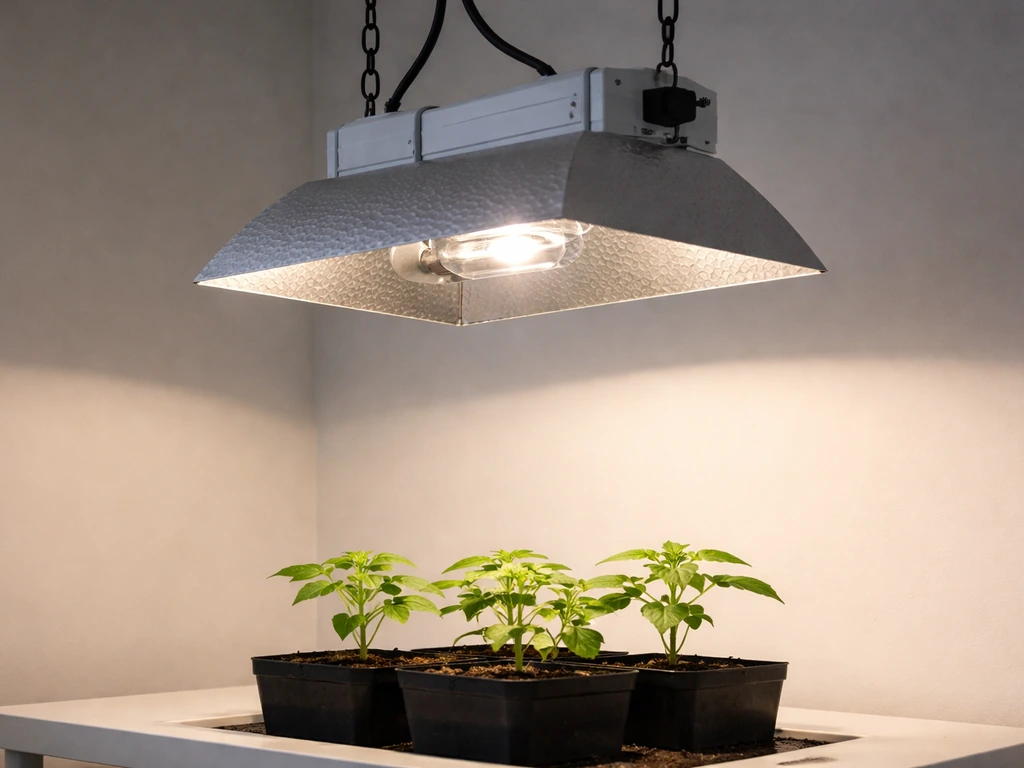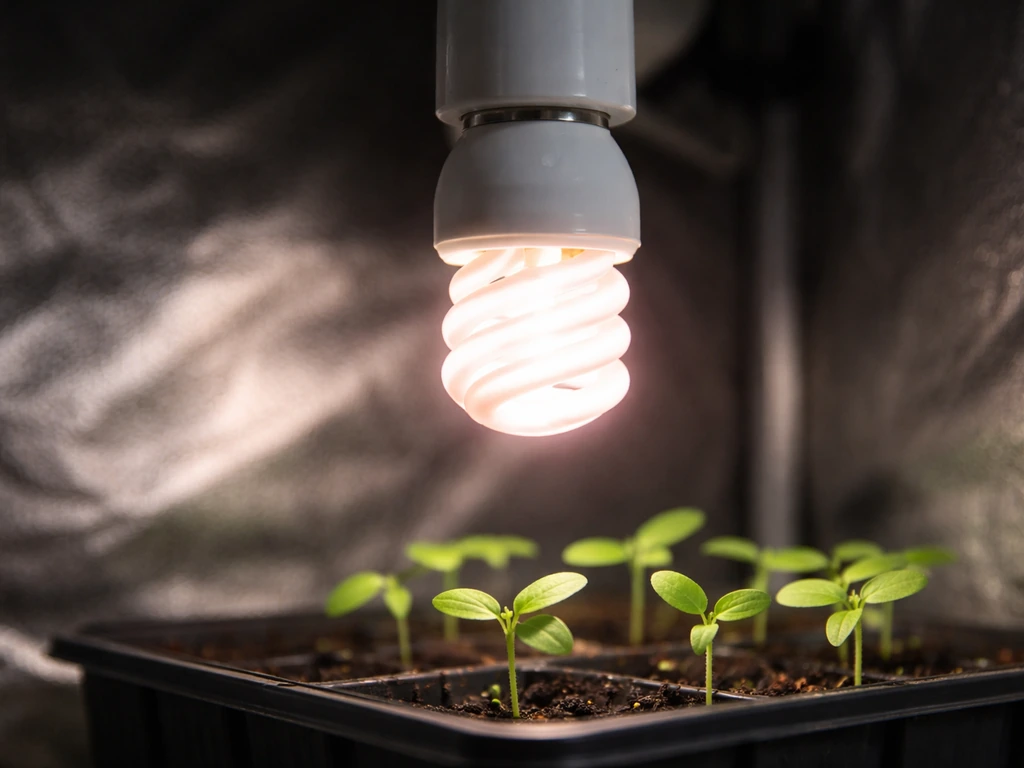
CFL grow lights are genuinely useful for seedlings, clones, and low-light houseplants, and a well-chosen 125W to 250W CFL setup can carry most hobbyists through vegetative growth without spending much money. They stop making sense when you need high canopy PPFD for flowering dense crops like cannabis or tomatoes, because the output-per-dollar math flips hard toward LED or HID at that point. If you're buying in 2026, the Hydrofarm Agrobrite FLCDG125D is the most consistently recommended ready-to-run CFL system for small spaces, and pairing a 6500K bulb for veg with a 2700K bulb for flowering covers the spectrum split that most stage-targeted CFL grows need. Everything else below is about making sure you don't overpay, underpowered, or cook your plants in an enclosed fixture.
CFL Grow Light Reviews: Best Bulbs, Specs, and Setup Guide

What CFL grow lights are (and when they actually work)
A CFL grow light is a compact fluorescent lamp, the spiral or folded-tube bulb type, adapted for plant growth by dialing in the color temperature and output spectrum to favor photosynthetically active radiation (PAR, 400–700 nm). Most CFL grow bulbs use a medium screw base (E26/E27) or mogul base (E39/E40) depending on wattage, so they drop into standard fixtures or purpose-built reflector hoods. The key distinction from a hardware-store CFL is color temperature targeting: grow-specific CFLs are sold in 6400K–6500K (blue-skewed, good for veg and seedlings) and 2700K (red-skewed, for flowering), rather than the 2700K–3000K 'warm white' range used for home lighting.
Where CFLs actually deliver: seedling trays, clone domes, herb gardens on a countertop, leafy greens, low-light tropicals, and early vegetative stages for any plant up to about 2–3 feet of canopy width. They run cool enough to place 6–12 inches from the canopy without leaf burn, they're forgiving on ballast compatibility, and the initial cost is low. A single 125W CFL system can be had for $40–$80 and requires zero technical setup beyond screwing in a bulb and plugging in a timer.
Where CFLs fall short: anything requiring high PPFD at canopy level for flowering or fruiting. CFL efficacy sits around 44–80 lumens per watt depending on lamp size, and even translating generously into PAR, you simply can't hit the 400–600 µmol/m²/s PPFD that flowering cannabis or fruiting tomatoes need across a reasonable coverage footprint without stacking so many bulbs that the cost and heat management become impractical. That's not a knock on the technology for its intended use, it's just the ceiling you'll hit.
CFL grow light specs that matter for plant growth
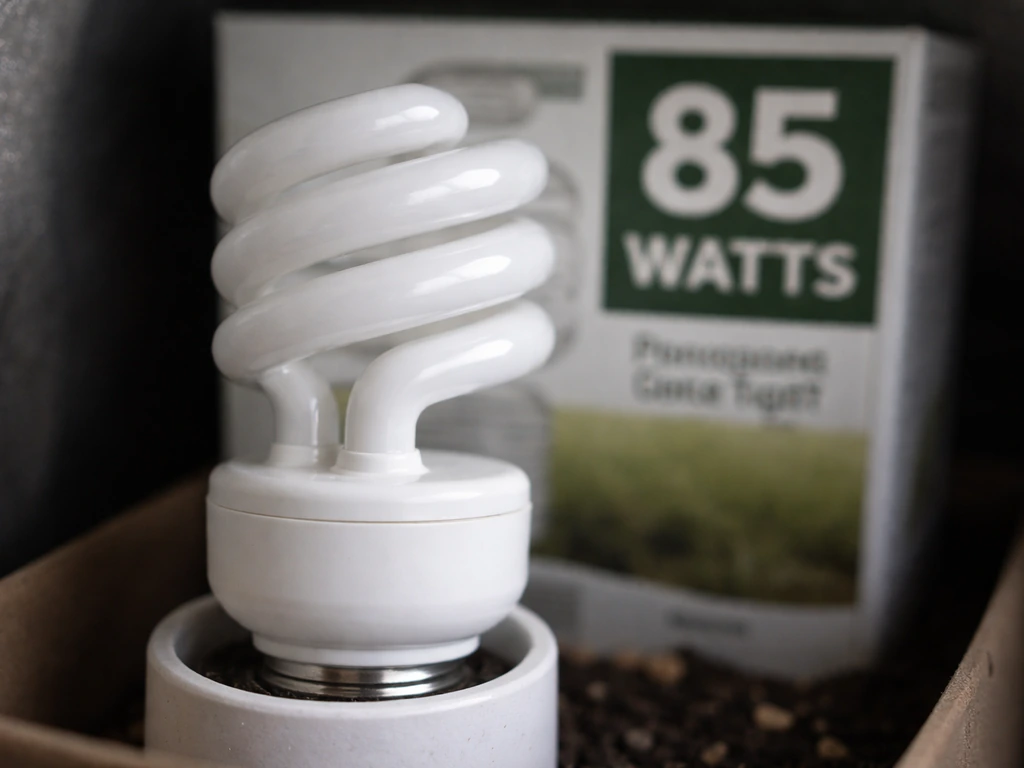
Most CFL packaging leads with 'equivalent wattage,' which is a comparison to incandescent bulbs and tells you almost nothing about plant performance. What you actually need to look at is the actual wattage drawn, the lumen output, the color temperature (CCT), and if you can find it, PPFD at a defined distance. Here's what each of those means for your plants.
Actual wattage vs. equivalent wattage
A bulb labeled '125W equivalent' might draw only 26–32W at the wall. That's the real wattage and the real power draw. When planning how many bulbs you need, use actual wattage, not equivalent. A TCP 9W CFL, for example, produces 495 lumens at 9 real watts, which is useful for a desktop herb pot but not a 2x2 grow tent.
Color temperature (CCT) and spectrum
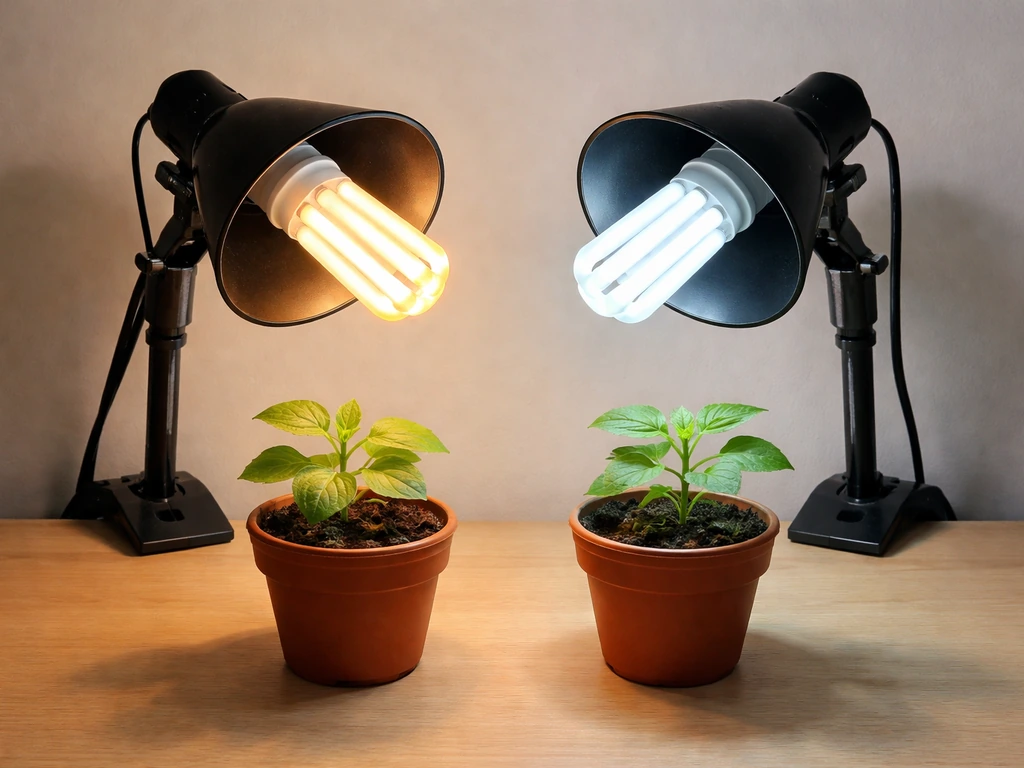
CFL grow bulbs are commonly sold in three CCT ranges: 2700K (warm/red spectrum for flowering), 5000K–5500K (neutral/full spectrum, good all-around), and 6400K–6500K (cool/blue spectrum for veg and seedlings). The University of Vermont Extension specifically points to values near 6500K as a solid guide for plant growth lighting. Blue light in the 400–500 nm range supports compact, leafy growth and inhibits stem elongation (stretch), which is exactly what you want for seedlings and veg. The 2700K range shifts output toward 600–700 nm red wavelengths, which plants use more during reproductive/flowering stages.
Lumens vs. PPFD
Lumens are a human-vision metric and don't map directly to plant usable light. PPFD (photosynthetic photon flux density), measured in µmol/m²/s, is what actually tells you how much PAR is hitting your canopy. The problem is that almost no CFL box lists PPFD. You can estimate it with a PAR meter or a PAR-capable app, but out of the box you're working from lumens as a rough proxy. As a rule, PPFD drops fast with distance, so a CFL producing 8,000 lumens at the bulb delivers very different canopy intensity at 6 inches vs. 12 inches. Don't compare bulbs by box lumens alone without accounting for distance.
Daily light integral (DLI)
DLI ties PPFD and photoperiod together into one plant-relevant number: DLI (mol/m²/day) = 0.0036 × PPFD (µmol/m²/s) × hours of light per day. Most leafy greens and herbs want a DLI of 12–17 mol/m²/day; seedlings need 6–10; flowering crops want 20–30+. A 125W CFL at 6 inches might deliver ~150–200 µmol/m²/s at the canopy. At 18 hours, that's a DLI of roughly 9.7–13 mol/m²/day, which is fine for seedlings and herbs, borderline for veg, and not enough for flowering crops. That math is why CFL ceilings are real.
Other specs to check before buying
- Base type: E26/E27 for most household-scale CFLs, E39/E40 mogul for 200W+ grow lamps. Match to your fixture before ordering.
- Rated average life: ENERGY STAR-qualified CFLs are tested for lumen maintenance at 100 hours and lifetime performance. Output degrades over time, so a bulb used for a 6-month grow will produce measurably less light at the end than the beginning.
- Enclosure rating: CFLs should not be used in totally enclosed fixtures unless specifically rated for it. Heat buildup reduces output and shortens bulb life significantly.
- CRI (color rendering index): Less critical for plants than for photography, but higher CRI bulbs tend to have broader spectral output, which is generally better for plant use.
- Dimmability: Most CFL grow bulbs are not dimmable. Reflectors and positioning are your intensity controls, not a dimmer.
How we evaluate CFL grow lights
Our review framework focuses on five things: real wattage and actual measured output (not marketing claims), spectrum confirmed by CCT and available PAR data, build quality and fixture compatibility, coverage footprint at a standard 6-inch and 12-inch distance, and cost per usable PAR over the bulb's rated life. For systems like the Hydrofarm Agrobrite, we also look at the reflector design, socket and cord quality, and whether the bundled bulb actually matches the claimed CCT on the label.
We don't treat lumen ratings on packaging as a verdict. Lumens are tested under controlled conditions that don't match a grow environment, and ENERGY STAR test methodology anchors initial lumen ratings at 100 hours, not at hour one. For grow use, what matters is how much PAR reaches the canopy at a consistent distance across the grow period. Where we can measure PPFD directly (with a calibrated meter), we report it at 6 and 12 inches above a flat surface. Where we can't, we note the gap.
Pros and cons in our verdicts are grounded in: plant stage suitability, coverage area, heat safety, ease of use for beginners, and honest price-to-output comparisons against similarly priced LED options available in 2026. We are not looking for the 'best CFL ever made'; we're looking for the best CFL for your actual situation.
Best CFL options by use case
Seedlings and clones
This is where CFLs are genuinely hard to beat on value. Seedlings and clones need low-to-moderate PPFD (around 100–200 µmol/m²/s), short fixture-to-canopy distances are no problem because there's no height, and the gentle heat output of a CFL is actually an advantage in clone domes where you want warmth without drying. For this stage, a 6500K bulb is the right call. A single 125W CFL (actual draw around 85–95W depending on brand) positioned 4–6 inches above a seedling tray covers a 1–2 square foot footprint adequately. If you're running a 2x2 tray, two 65W–85W actual-draw CFLs or one 125W system like the Hydrofarm Agrobrite FLCDG125D is a solid fit.
The Hydrofarm Agrobrite FLCDG125D is the most practical all-in-one CFL system for this use case: it comes with a 6400K bulb, a built-in reflector, and a plug-in cord, so there's nothing extra to buy. It's available in both 6400K (veg/seedling) and 2700K (flowering) versions. For seedlings specifically, go 6400K.
Vegetative growth
For veg, stick with 5500K–6500K bulbs to keep plants compact and encourage leaf development. At this stage, plants are bigger and you're often covering more canopy area, so wattage matters more. A single 125W CFL is adequate for one medium plant; for a 2x2 space with multiple plants, you want 200–250W of actual CFL draw, which means either stepping up to a 200W or 250W CFL system or running two 125W units side by side. Keep the fixture 6–10 inches from the canopy and raise it as plants grow.
The common 300W dual spectrum CFL grow light (which often runs two bulbs, one 6500K and one 2700K, simultaneously) is a popular choice for covering both veg and early flowering in one fixture. If you want more detail on that specific format, the dual spectrum 300W CFL category is worth a dedicated look on its own. If you are specifically shopping for a dual-head setup, our Casalux Dual Head Plant Grow Light review breaks down whether its coverage and output justify the price.
Flowering
Switch to 2700K for flowering. This is where CFLs start showing their limits, but they can still produce results for low-to-medium demand crops like herbs, compact auto-flowering varieties, or ornamental flowering plants. For photoperiod plants that need a 12/12 light cycle to flower, CFL timing is the same as any other light: 12 hours on, 12 hours uninterrupted dark. At this stage you want maximum actual wattage you can afford and fit. A 250W CFL (actual draw) at 6–8 inches with a quality reflector can push 250–350 µmol/m²/s at canopy level, which is workable for modest flowering targets.
Be realistic: if you're trying to flower cannabis or any high-PPFD crop in a 2x2 or larger space for maximum yield, CFL will leave you wishing you'd bought an LED panel. If you are shopping specifically for cannabis lighting performance, check cannabis grow light reviews to compare real output for flowering targets. That's not a failure of the bulb; it's a ceiling on the technology at practical distances and wattages.
| Use Case | Recommended CCT | Minimum Actual Watts | Fixture-to-Canopy Distance | Best Pick |
|---|---|---|---|---|
| Seedlings / Clones | 6400K–6500K | 85–125W | 4–6 inches | Hydrofarm Agrobrite FLCDG125D (6400K) |
| Vegetative Growth | 5500K–6500K | 125–250W | 6–10 inches | 200W–250W CFL system or dual 125W |
| Flowering (low demand) | 2700K | 200–300W | 5–8 inches | 250W–300W CFL or dual-spectrum 300W |
| Herbs / Leafy Greens | 5000K–6500K | 65–125W | 4–8 inches | Single 125W CFL or 2x 65W |
Coverage, spacing, and how many watts or bulbs you need
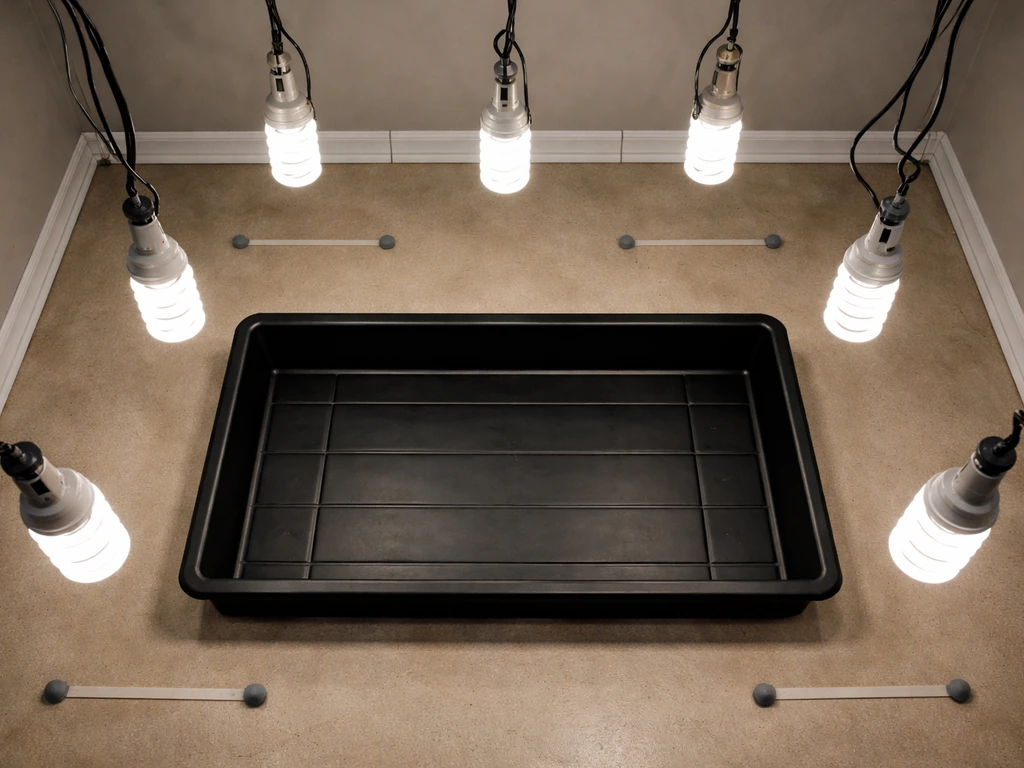
A common starting point for CFL grows is 50–75 actual watts per square foot for vegetative stages, and 75–100 actual watts per square foot if you're pushing into flowering. These are ballpark figures, not laws, and they're based on the modest PPFD output of CFLs at typical distances. In a 1x1 foot footprint, a single 85–100W actual-draw CFL is adequate for veg. In a 2x2 (4 square feet), you want 200–300W of actual CFL draw.
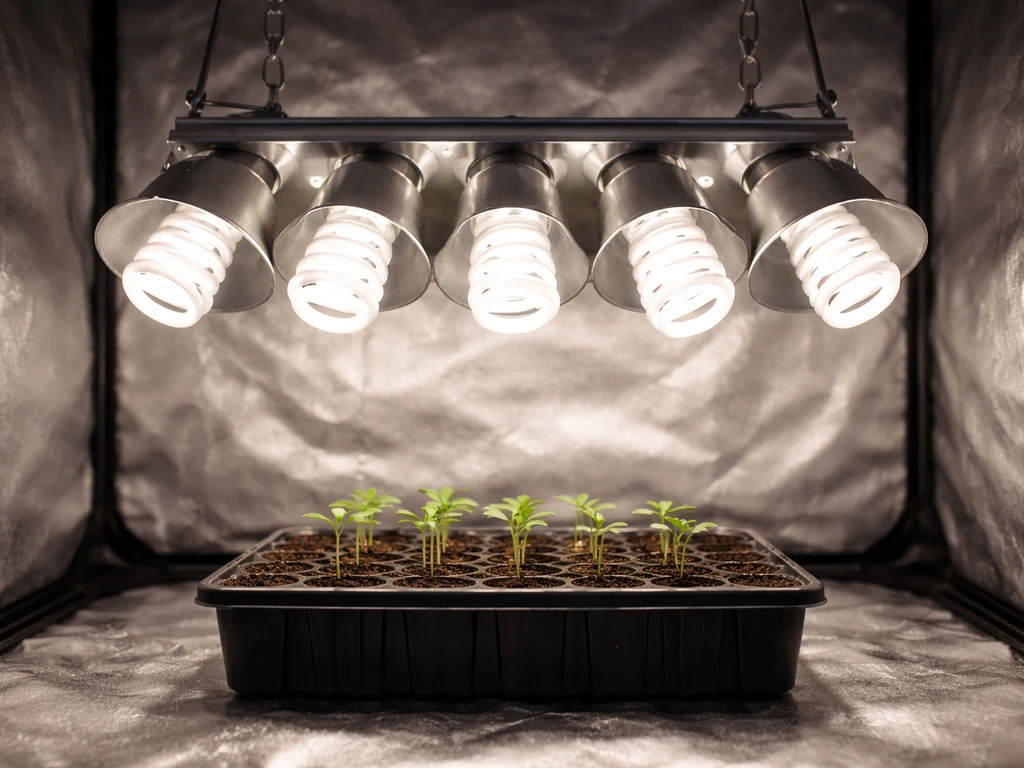
PPFD drops off quickly with distance, which is the dominant factor in CFL coverage planning. At 6 inches, a 125W CFL might produce around 150–250 µmol/m²/s at the center of the beam but drops significantly at the edges. At 12 inches, center PPFD can drop by 40–60%. This is why multiple bulbs arranged around or above the canopy (side-lighting or close multi-bulb arrays) are a common CFL technique: you're trying to maintain uniform intensity across the plant, not just at the top. After you set up your fixture, validate the PPFD with a PAR meter at canopy level before you trust it. Don't assume the box spec translates to your specific geometry.
As a starting point for fixture height, 6–12 inches from the canopy is the practical range for most CFL grow bulbs. Start at 6 inches for seedlings (no risk of light burn, and the intensity is appropriate), and raise to 10–12 inches for larger plants where you're trading some intensity for coverage area. Adjust based on whether you see stretching (too far) or tip bleaching (too close, very rare with CFLs but possible with high-wattage systems).
For photoperiod: run 18 hours on / 6 hours off for veg, and 12 hours on / 12 hours dark for flowering. Use a mechanical or digital timer. Don't rely on manual switching; even small inconsistencies in the dark period can delay or disrupt flowering in photoperiod-sensitive plants.
Setup tips, safety, and common mistakes to avoid
Setup tips
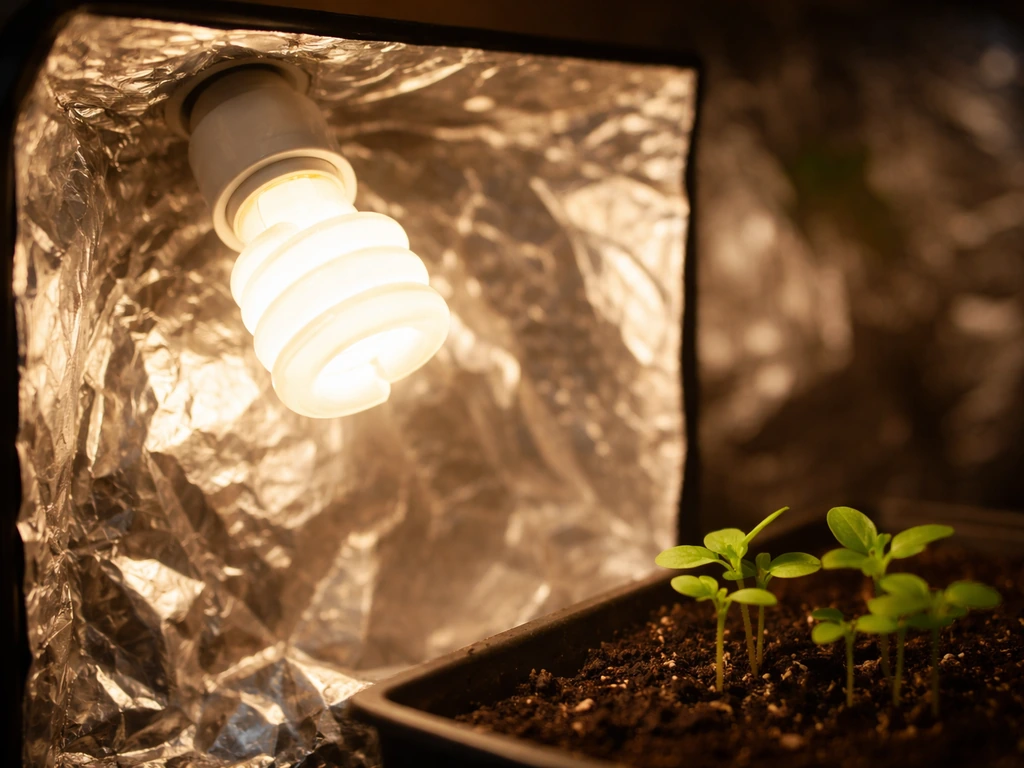
- Use a reflector. A bare CFL wastes a large portion of output in directions that don't hit your plants. Even a simple mylar reflector behind the bulb meaningfully increases effective canopy intensity.
- Match base type to your fixture before you order. E26/E27 works in standard sockets; the larger E39/E40 mogul base is required for 200W+ grow CFLs and needs a compatible fixture or adapter.
- Don't use CFLs in totally enclosed fixtures unless the bulb is specifically rated for it. Heat buildup in a sealed enclosure reduces lumen output and shortens bulb life, and in worst cases creates a thermal management problem.
- Set a timer immediately. Consistent photoperiod is non-negotiable for flowering plants and beneficial for all growth stages.
- Replace bulbs after 8,000–10,000 hours of use, or about 12–18 months of typical indoor growing. CFL output degrades measurably over time even though the bulb still lights up.
Common mistakes
- Buying based on 'equivalent wattage' instead of actual wattage. A 125W equivalent bulb may draw only 26–32W. Always check actual draw.
- Not accounting for PPFD drop-off with distance. Hanging a CFL 18–24 inches above the canopy dramatically reduces effective intensity, often below what the plant needs.
- Using a single 6500K bulb for the entire grow cycle without switching to 2700K for flowering. You can get away with it, but results during flowering will be noticeably weaker.
- Running multiple CFLs in an enclosed space without ventilation. CFLs don't run as hot as HID, but a cluster of 200W+ actual draw in a sealed tent will heat up and stress plants.
- Comparing CFL lumens specs to LED PPFD specs as if they're equivalent. They're not the same metric, and the comparison will mislead you.
- Skipping the timer and manually switching lights. Even a few hours of variation in the dark period can delay flowering or cause light stress in photoperiod plants.
Safety
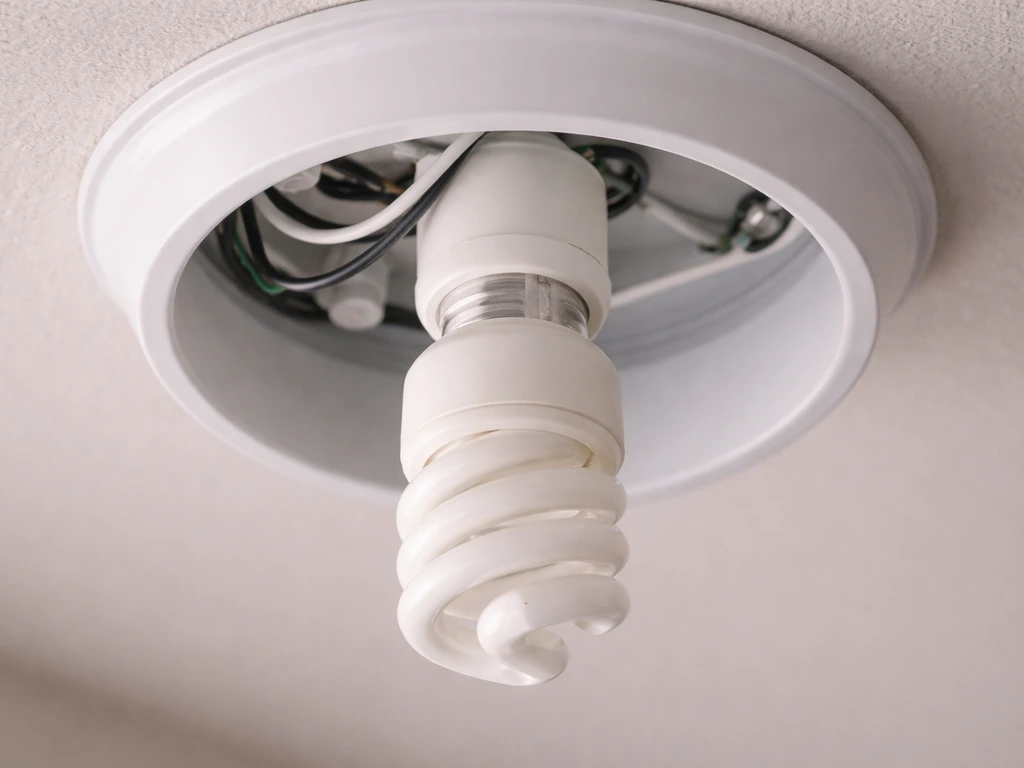
CFLs are safe in properly rated fixtures. UL testing has found no fire or shock hazards in CFLs used in fixtures designed for them. The practical safety rules for growers: don't use in enclosed fixtures without an enclosure rating, keep cords away from standing water, and don't leave ballast-based fixtures in contact with flammable materials like cardboard or plastic sheeting. Mercury is present in CFL bulbs; dispose of them at a CFL recycling point rather than in household trash, and follow EPA cleanup guidance if a bulb breaks.
CFL vs. other light types: value and upgrade paths
The honest comparison here is less about which light type 'wins' and more about where each one makes sense for your stage and budget.
| Light Type | Upfront Cost | Efficacy (lumens/watt or µmol/J) | Best For | Ceiling / Limitation |
|---|---|---|---|---|
| CFL | Low ($20–$100 system) | 44–80 lm/W | Seedlings, clones, herbs, small veg | Low PPFD output at distance; not suitable for high-demand flowering |
| LED panel | Medium–High ($80–$400+) | 1.5–3.0+ µmol/J (modern) | All stages; scales well; best long-term value | Higher upfront cost; quality varies widely by brand |
| HID (HPS/MH) | Medium ($100–$300) | High intensity; 100–150 lm/W | Flowering, commercial veg, larger spaces | Heat, ballast complexity, electricity cost at scale |
| CMH/CDM | Medium–High ($150–$350) | High quality spectrum; ~100+ lm/W | Full cycle, quality-focused grows | More complex setup than CFL; higher upfront cost |
For most hobbyists in 2026, the upgrade path from CFL looks like this: start with a CFL system for seedlings and early veg, then move to a quality LED panel when you're ready to flower or scale up. The cost of a mid-range LED panel (around $100–$200) is now low enough that it often makes more sense to buy LED from the start for anything beyond a small seedling operation. CFL still wins on simplicity and immediate low cost for the very early stages of a grow, especially if you already have compatible fixtures.
If you're comparing CFL to CDM (ceramic discharge metal halide) or CMH options, the CDM/CMH delivers significantly higher intensity and better spectral quality at a higher upfront price. If you are considering a CMH setup, a 315W CMH grow light review can help you compare real output, coverage, and cost against CFL and LED options for your stage CMH options.
If you are specifically comparing CDM grow light options, you may want to read a dedicated cdm grow light review before choosing a fixture CDM (ceramic discharge metal halide). That's a meaningful upgrade for anyone growing flowering crops seriously.
Similarly, if you've been looking at Sylvania grow light bulbs or other branded CFL options and wondering whether the premium is worth it, the honest answer is that spectrum and actual wattage matter more than brand name for CFL bulbs, and most quality-tier CFL grow bulbs from established manufacturers perform comparably within the same CCT and wattage class.
Your next steps after reading this
Before you buy anything, take five minutes to measure your grow space and answer these questions: How many square feet of canopy do you need to cover? What growth stage are you lighting for? Do you already have a fixture and just need bulbs, or are you starting from scratch? Those three answers determine your actual wattage target, the right CCT, and whether a complete CFL system or individual bulbs makes more sense.
- Measure your grow space footprint in square feet. Multiply by 50–75W (actual) for veg, or 75–100W for flowering, to get your target CFL wattage.
- Pick your CCT: 6500K for seedlings and veg, 2700K for flowering, or a dual-spectrum setup if you want one fixture to cover both.
- Check fixture compatibility: do you have an open fixture or reflector hood, and what base type does it take? E26/E27 for most standard CFLs, E39/E40 for 200W+ systems.
- Set up a timer before your first grow day. 18/6 for veg, 12/12 for photoperiod flowering.
- After installation, verify PPFD at canopy level with a PAR meter or app before relying on distance-from-box as your only guide. Adjust fixture height to hit your target range.
- Plan your replacement schedule. After 8,000–10,000 hours, replace the bulb even if it still lights up, because lumen and PAR output will have dropped enough to affect plant performance.
If you work through that checklist and find your wattage target is pushing above 300W of CFL draw for a single grow space, that's a clear signal to look at LED panels instead. The cost crossover point has dropped significantly, and in 2026 a quality LED will outperform an equivalent CFL investment on PPFD, coverage, and operating cost over a full season. CFL earns its place for small, early-stage, and low-light grows. Know that range, and it's a genuinely solid tool.
FAQ
Do I need a “grow” CFL bulb, or can I use a regular 2700K or 6500K CFL from the hardware store?
You can sometimes use a regular CFL if it clearly states the real wattage, correct CCT (for example 6400K to 6500K for veg, 2700K for flowering), and matches the socket type (E26/E27 or E39/E40). The main catch is that many home bulbs are not built with the same reflector-friendly form factor and may not list usable PAR data, so results can vary more than with bulb-and-hood CFL kits.
What’s the safest fixture height for CFLs if I’m new, and how do I adjust after the first week?
Start higher, then move down cautiously. For seedlings, begin around 6 to 8 inches above the canopy, then lower by small increments only if plants look stretched and reach upward. If you see tip bleaching or the upper leaves start to look “washed” or overly stressed, raise the fixture instead. Also remember CFL intensity drops across the beam edges, so if only outer leaves look weak, you may need spacing or multiple bulbs, not just height changes.
How many CFL bulbs do I actually need for a 2x2 or 4x4 space?
Plan using total actual wattage and approximate canopy PPFD, not “equivalent wattage.” A common starting point from the article is roughly 50 to 75 actual watts per square foot for veg and 75 to 100 for flowering, but you should refine it by distance and coverage. If you cannot keep the fixture within the 6 to 12 inch range, you’ll need more wattage or a different arrangement (for example, close multi-bulb arrays) because PPFD falls off faster than most people expect.
Can I run a CFL on a dimmer or modify power to increase output?
Don’t. CFLs and their ballasts are designed for specific operating conditions, and dimming or electrical modifications can reduce output, shorten bulb life, or cause unstable light performance. If you need more intensity, the practical solution is higher actual wattage, better reflector geometry, or switching light technology when you hit the CFL ceiling.
Is it okay to leave CFL lights on continuously for seedlings, or is there a benefit to a photoperiod?
Most hobbyists will run a fixed schedule like 18 hours on for veg, which keeps growth steady and avoids heat and electrical stress from continuous runtime. Continuous lighting can work for some plants, but it removes your ability to coordinate watering routines and can increase the chance of environmental swings, like drying out faster under warm bulbs. If you do run longer days, keep the dark period consistent for predictable growth.
If my CFL bulb says a lumen number, why do my plants look dim compared to expectations?
Lumen claims do not account for the distance to canopy, reflector effectiveness, and the fact that lumens are weighted for human vision, not plant photon flux. Another common mismatch is using the bulb in the wrong housing type, where the light spreads too widely or is blocked. The fix is to validate by measuring PPFD at canopy level (ideal) or at least standardize distance and reflector setup before comparing bulbs.
Do CFL bulbs degrade quickly, and should I replace them on a schedule?
CFL output declines over time, and the rate depends on bulb quality and how hot they run in your fixture. Because many ratings are anchored around test conditions near the 100 hour mark, your real usable PAR can drop noticeably during a season. A practical approach is to check plant response and, if you have a PAR meter, re-measure after several hundred hours to decide whether replacement is worth it.
What should I do if I break a CFL bulb in my grow room?
Treat it like a hazardous break event. Isolate the area, ventilate, and follow EPA-style cleanup steps for CFL mercury residue rather than vacuuming casually or sweeping immediately. Keep people and pets out, and dispose of cleanup materials properly at a local HHW or CFL recycling program.
Are CFLs really cool enough to use close to leaves, or can they still burn plants?
CFLs run relatively cool compared with HID, but “cool enough” still depends on fixture design and bulb wattage. Starting around 6 inches for seedlings is usually safe, but higher-watt CFLs placed too close, or reflector setups that trap heat, can still cause stress. If you see bleaching or leaf curl, adjust height upward and check that the fixture is in a rated housing with proper ventilation.
Do CFLs work for flowering photoperiod plants, or is it only for herbs and greens?
CFLs can support flowering of low-to-moderate demand plants, especially compact varieties and certain ornamental flowers, as long as you accept lower yields and stricter spacing and wattage limits. For photoperiod flowering, the key is uninterrupted dark, use a reliable timer, and ensure you have enough actual wattage to reach the target PPFD. If you need dense canopy PPFD for heavy flowering, this is where LED typically becomes the better path.
Should I choose 2700K or 6500K if I’m unsure what stage my plants are in?
If you are lighting seedlings, clones, and early vegetative growth, choose 6400K to 6500K to support compact growth. For flowering, switch to 2700K. If you want one bulb for a long transition period, 5000K to 5500K is often the “all-around” compromise mentioned in the article, but it is not as optimized as stage-specific CCT.
What’s the biggest mistake when buying CFL grow lights in 2026?
Buying based on marketing like “equivalent wattage” or relying on box lumens without confirming real wattage and how the bulb fits your reflector or fixture. Also, many people underestimate distance. Before purchasing, confirm your socket type, the fixture’s safety rating, and plan for a setup where you can keep the bulb within the 6 to 12 inch range for consistent coverage.