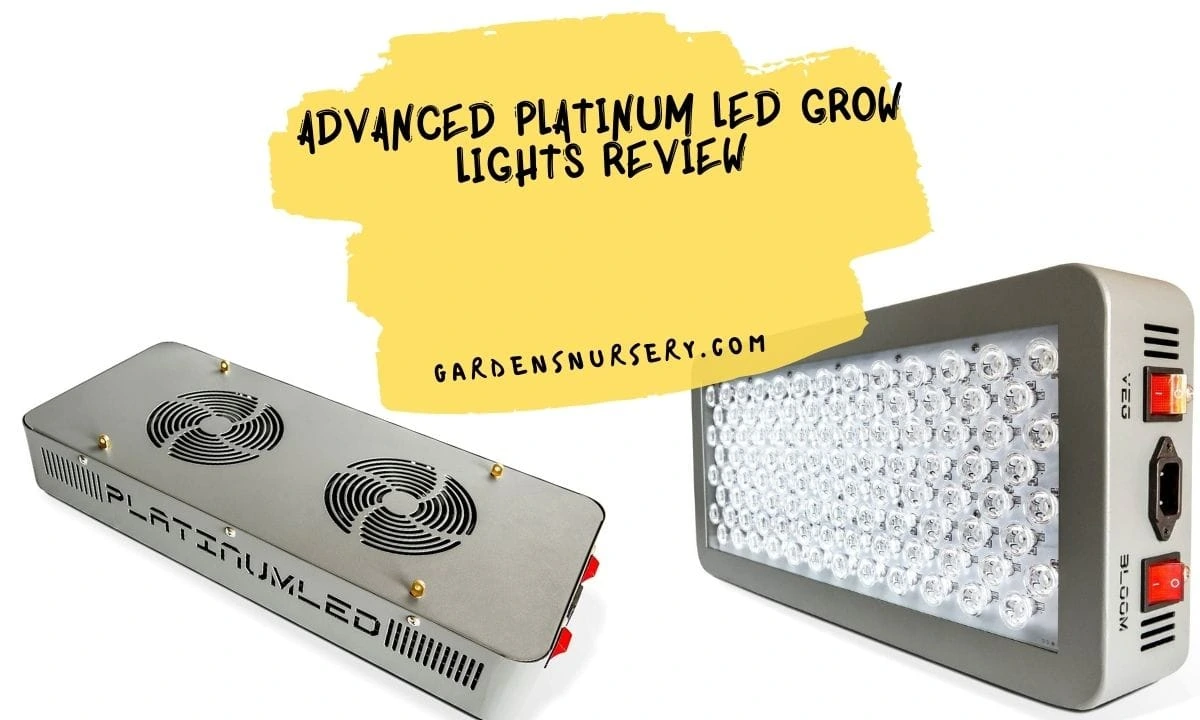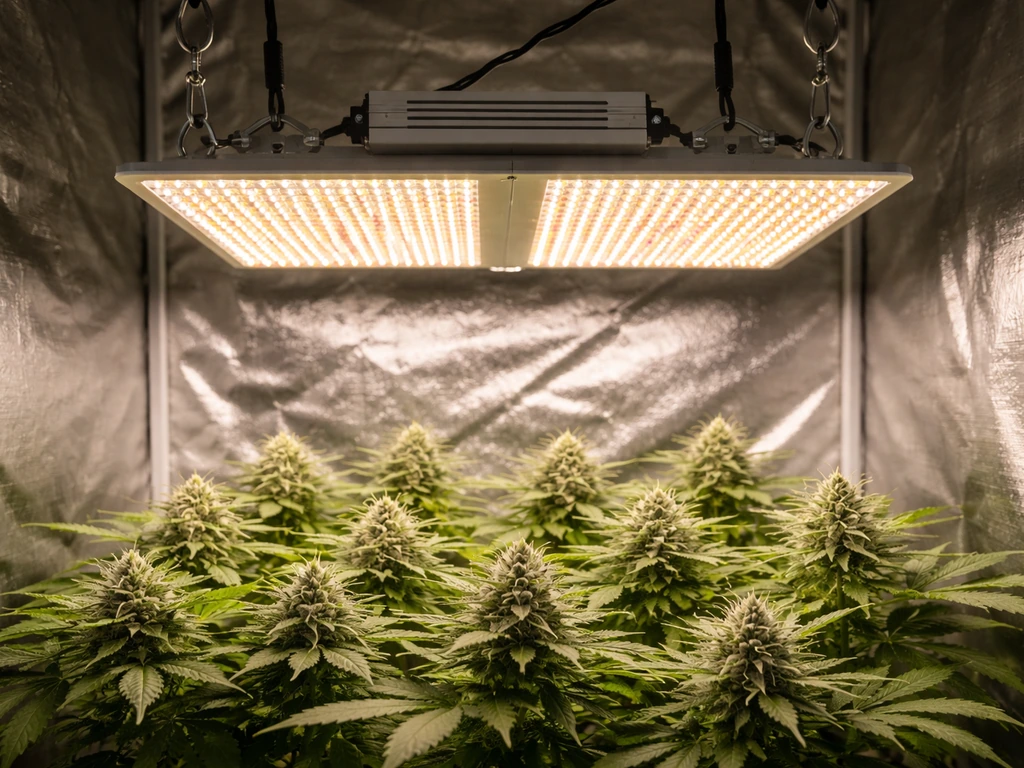
The HLG 600H is worth buying if you need a serious, high-output light for a 4x4 to 5x5 flowering canopy and you want something that runs cool, quiet, and efficiently without a lot of fuss. It is built around the Mean Well HLG-600H driver series (up to 96% efficient, fanless, IP65/IP67 rated) paired with four Samsung LM301H-based QB288 V2 quantum boards, and in Rspec configuration it adds Osram SSL 660 nm deep-red diodes for a more complete flowering spectrum. The total system draws around 620 W, puts out roughly 1,525 µmol/s PPF, and HLG targets a 5x5 footprint at 28 inches for flowering. If that describes your grow space, this light deserves a serious look.
HLG 600H Grow Light Review: Coverage, PPFD, Pros and Cons

Marcus Caldwell
13 May 2026
Quick verdict and who it's for
This is a premium, prosumer-grade grow light aimed at growers who are past the beginner phase and want reliable, efficient output for a dedicated flowering tent or room. It is not the cheapest option in the 600 W class, but it is one of the most efficient, and HLG's build quality and driver choices back that up. If you are running a 4x4 to 5x5 tent and growing cannabis, tomatoes, peppers, or any other high-light crop through flower, the HLG 600H Rspec is a genuinely good fit. Hobbyists running a 3x3 tent would be overpowering their space unless they plan to dim the unit down, which it handles well. Commercial growers running racks of lights might want to look at HLG's modular options, but for a single-tent setup this is hard to beat at this wattage.
One thing to set expectations on: the "HLG 600H" label refers both to the Mean Well HLG-600H driver used inside the light and to HLG's (Horticulture Lighting Group) complete 600-class grow light kit. This review covers the full HLG 600W QB288 V2 Rspec complete unit, which uses that driver. If you are shopping for just the driver for a DIY build, a lot of the specs below still apply, but the performance numbers are specific to the assembled kit.
HLG 600H specs, design, and build quality
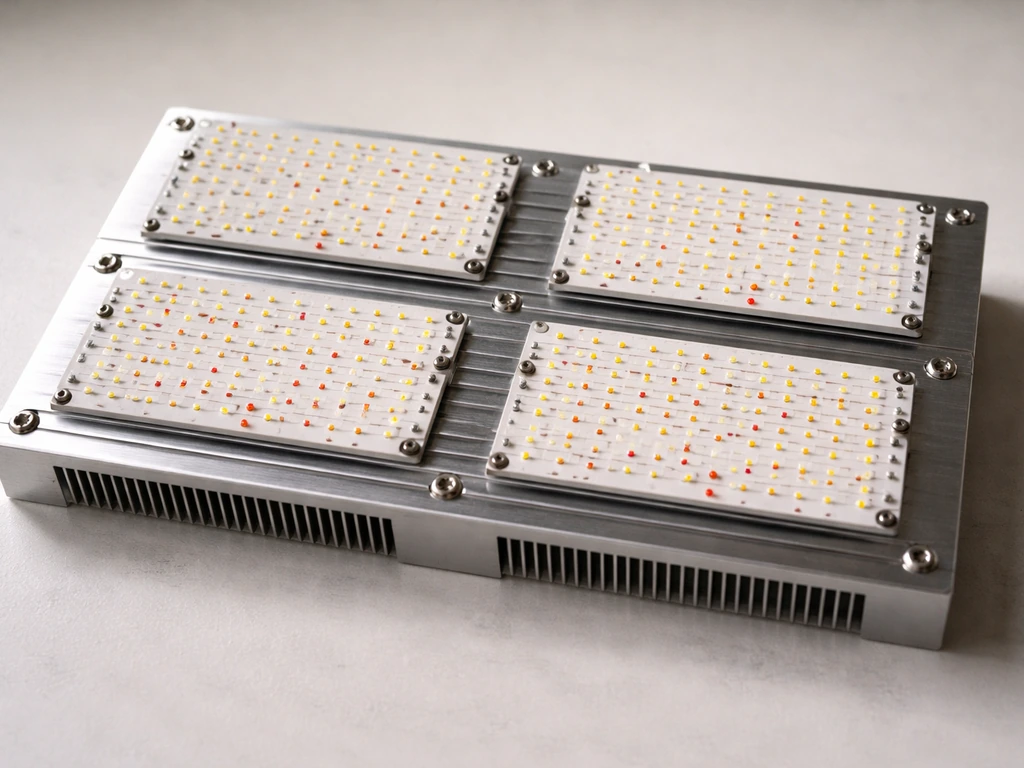
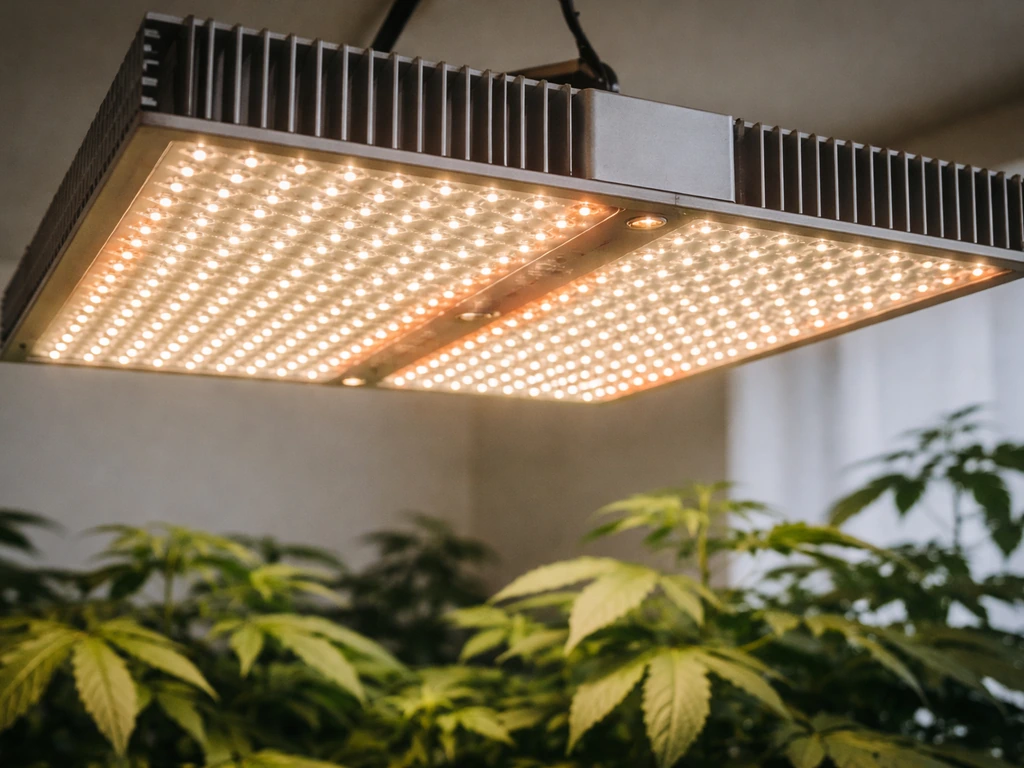
The HLG 600W Rspec kit is built around four QB288 V2 Rspec quantum boards mounted on a single aluminum heatsink frame. The boards use Samsung LM301H white diodes (typically a 3000K or 4000K base spectrum) combined with LH351 660 nm deep-red emitters, which is what the "Rspec" designation means. The assembled unit draws 620 W at the wall in full operation, delivers a quoted PPF of 1,525 µmol/s, and HLG markets it as the output equivalent of a 1,000 W DE HPS fixture, which is a reasonable comparison when you factor in that most of the photons are hitting useful wavebands rather than being wasted as heat at the lamp.
The driver is the Mean Well HLG-600H series, which sits at the heart of why this light performs as well as it does. It is a fanless, passively cooled unit rated at up to 96% efficiency, which means very little energy is being dumped as heat compared to older driver designs. The driver accepts a wide input voltage range of 90 to 305 VAC, so it works on standard 120V US household circuits and 240V setups without modification. The specific variant used in this kit runs at the appropriate constant current for the board configuration. The driver measures roughly 10 inches by 5.7 inches by 1.9 inches, and because it is mounted externally or remote-mountable, you can position it outside your tent to keep heat out of the canopy space.
Build quality is genuinely good. The aluminum heatsink frame is solid, the boards are cleanly assembled, and the whole unit feels like it was designed to last rather than look impressive on a shelf. HLG specifies a minimum suspension load of 23 lb for the mounting hardware, and the unit is designed for chain or rope ratchet suspension only, not surface mounting. You need at least 15 inches of clearance between the top of the light and the ceiling or hanging structure, and it must be hung above a non-combustible surface. These are not unusual requirements for a grow light of this size, but worth confirming before you hang it.
| Spec | Detail |
|---|---|
| Total draw (wall) | ~620 W |
| PPF output | 1,525 µmol/s |
| Diodes | Samsung LM301H + Osram LH351 660 nm (Rspec) |
| Driver | Mean Well HLG-600H series (fanless, up to 96% efficient) |
| Input voltage | 90–305 VAC |
| Driver ingress protection | IP65/IP67 (model dependent) |
| Dimming | 3-in-1: 0–10 VDC, PWM (100 Hz–3 kHz), or resistance |
| Dimming range | ~6% to 100% of nominal output |
| Min. ceiling clearance | 15 inches |
| Suspension load minimum | 23 lb rated hardware |
| Cooling | Passive (no fans) |
| Mounting | Chain or suspension only |
Light performance review: coverage, PPFD, and efficiency
HLG's own recommended heights give you a practical starting framework. For flowering, they target a 5x5 canopy footprint at 28 inches mounting height. For vegetative growth, they bump the height to 40 inches and widen the usable footprint to 6x6. Independent lab PPFD reports referenced by HLG cover measurements at 24 and 30 inches in open-area conditions, and the published PPFD charts show results at multiple heights from 24 inches up to 36 inches. This kind of data transparency is one of the things that sets HLG apart from brands that publish a single cherry-picked number.
In practical terms, at 24 inches over a 4x4 canopy you are going to see center PPFD values that are intense, likely approaching or exceeding 1,200 µmol/(m²·s) at the hotspot, with edge values lower. A 4x4 at that height is arguably being slightly overpowered by this light, which is actually useful: you can dim it back to 70 or 80% and still hit target PPFD while reducing heat output and power consumption. At 28 inches over a 5x5, the intensity spreads more evenly, which is where HLG is pointing you for a reason. Uniformity improves meaningfully as you raise the fixture, so do not chase the highest PPFD number at the lowest possible height without considering edge-to-center variation.
The efficiency story here is genuinely strong. At 1,525 µmol/s from 620 W, you are getting roughly 2.46 µmol/J of efficacy, which is competitive with the best lights in this wattage class as of 2026. For context, a well-run 1,000 W DE HPS typically delivers around 2.1 µmol/J or less, so the HLG 600H Rspec is pulling ahead on photon output per watt consumed, and doing it with far less radiant heat at the canopy.
Spectrum, dimming, and how it performs across grow stages
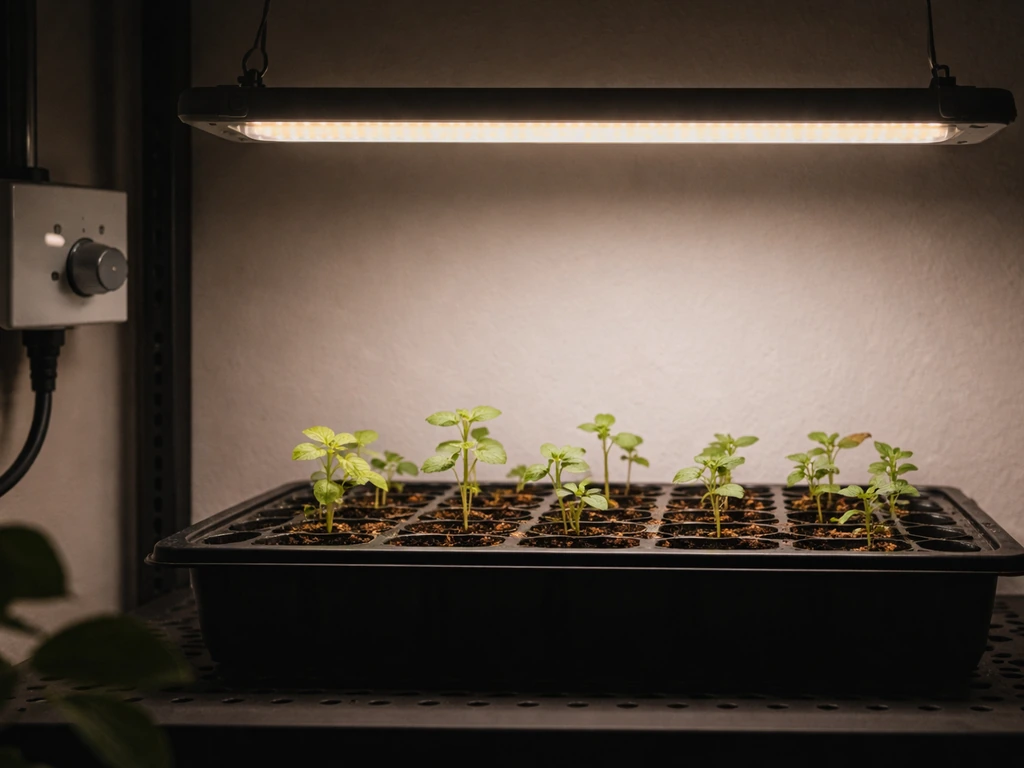
The Rspec spectrum is the right tool for most indoor crops through all major growth stages, but it is optimized for flower. The Samsung LM301H white diodes produce a broad spectrum covering blue through green through red wavebands, and the added Osram 660 nm deep-red emitters hit the secondary chlorophyll absorption peak that promotes stem elongation, flowering response, and fruit set. This is not a pure "bloom" or "veg" switch setup, it runs the same full spectrum all the time, which is actually simpler and more effective than toggling separate channels.
For seedlings, you want to dim this light significantly. Running 620 W over freshly germinated seeds at 24 inches will stress them. Dial it down to 20 to 30% and raise it to 36 to 40 inches until plants are established, then gradually lower height and increase intensity as plants develop. During veg, HLG suggests 40 inches at lower power, and that tracks with general practice for vigorous but not stretched growth. For flowering, 28 inches at or near full power over a 5x5 is where this light does its best work.
The 3-in-1 dimming on the Mean Well HLG-600H driver is one of its most practical features. You can dim via a 0 to 10 VDC signal, PWM (100 Hz to 3 kHz range), or a simple resistance pot, which means it is compatible with standard grow room controllers, timer-dimmer combos, and basic manual potentiometers. The functional dimming range runs from about 6% up to 100% of nominal output. Below 6% the output behavior is not defined in the spec, so for practical purposes treat 6% as the floor. One important wiring note: the DIM- terminal is not the same as the output negative (-V), and connecting them incorrectly will cause problems. Follow the wiring diagram in the manual precisely.
Installation, mounting height, and best practices
Hanging this light correctly matters more than most growers realize. Here is a practical height and intensity guide based on HLG's specifications and independent PPFD data:
| Growth Stage | Recommended Height | Target Coverage | Notes |
|---|---|---|---|
| Seedlings | 36–40 inches | Up to 6x6 | Dim to 20–30%, raise slowly as plants grow |
| Vegetative | 40 inches | 6x6 footprint | Reduce height gradually as canopy fills |
| Flowering | 28 inches | 5x5 footprint | Full or near-full power; monitor canopy temp |
| Small tent (3x3) | 24–28 inches | 3x3 at ~60–70% dim | Dimming required to avoid light stress |
Because the driver is fanless and the heatsink relies on passive convection, you do not need to worry about fan noise or fan failure, but you do need adequate airflow in the grow space. The heatsink will get warm to the touch under full power, which is normal. A basic oscillating fan or inline exhaust keeping air moving across the heatsink will help maintain efficiency and extend component life. In a well-ventilated 5x5 tent, canopy temperatures should stay manageable, but check your canopy with a digital thermometer during the first week and adjust height or dimming if you are seeing leaf temperatures above 82 to 85 degrees Fahrenheit.
For a 5x5 tent, plan on a 6-inch inline exhaust fan rated at 400 to 440 CFM minimum. The light itself adds significant heat, and even though it is more efficient than HPS, 620 W of electricity eventually becomes heat in your space. A carbon filter and inline fan combination is the most practical solution. You do not need a dedicated cooling fan aimed directly at the driver in most setups, but in a poorly ventilated space or in a hot climate, remote-mounting the driver outside the tent is a smart move.
The unit hangs on chain or rope ratchets only. Do not improvise a mounting solution. Ensure your tent crossbars or ceiling mount point can handle at least 23 lb with a safety margin, and double-check that the minimum 15-inch ceiling clearance is maintained above the fixture.
Value versus alternatives: how the HLG 600H stacks up
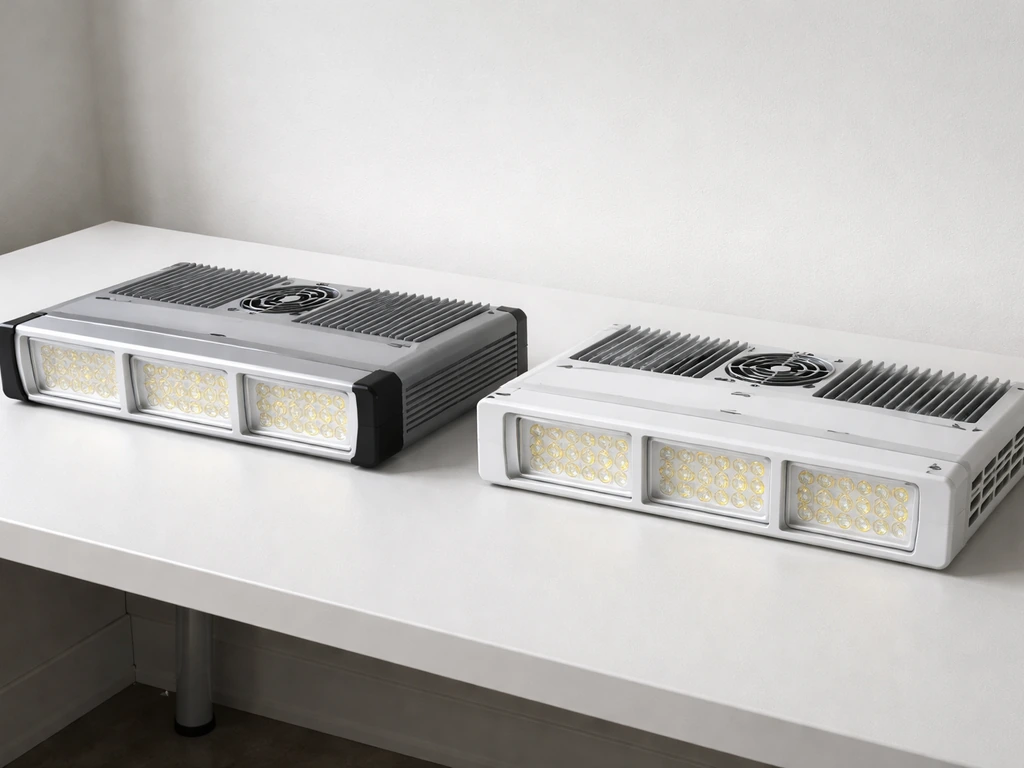
The HLG 600H Rspec is a premium product at a premium price. If you are also considering value brands such as Hipargero, it helps to read a hipargero grow light review to compare build quality and expected performance. You are paying for the Mean Well driver quality, the Samsung LM301H diodes, the Rspec optimization, and HLG's track record. Whether that premium is justified depends on your priorities.
In the same 600 W class, lights like the ChilLED Growcraft X6 (cited at around 1,270 µmol/(m²·s) average PPFD at 24 inches over a 4x4) compete on coverage and intensity. The HLG Rspec's edge is in diode quality, driver reliability, and the specific 660 nm Rspec optimization for flowering. If you are comparing on pure PPFD per dollar, some Chinese-built quantum board lights will appear more cost-effective on paper, but Mean Well driver longevity and Samsung diode L70 lumen maintenance ratings (typically 54,000 hours or more) justify the higher upfront cost over a multi-year grow operation.
Within HLG's own lineup, the broader HLG grow light range includes other configurations worth comparing depending on your tent size and budget. Growers running a 4x4 exclusively might find smaller HLG options more cost-efficient, while those running multiple tents should look at HLG's commercial fixtures. There are also budget-tier brands like Garpsen and Hipargero that occupy a lower price point if first cost is the primary constraint, though they differ significantly in driver quality and expected lifespan. If you are specifically considering the Garpsen Grow Light Review options, compare their driver quality and lifespan expectations against the Mean Well and Rspec build here.
| Light | Approx. Wattage | Coverage (Flower) | Key Strength | Key Trade-off |
|---|---|---|---|---|
| HLG 600H Rspec | 620 W | 5x5 | Driver quality, Rspec diodes, long-term reliability | High upfront cost |
| ChilLED Growcraft X6 | ~600 W | 4x4–5x5 | Strong PPFD uniformity claims | Less established long-term data |
| Budget QB (Garpsen/Hipargero class) | 500–600 W | 4x4 | Low first cost | Driver quality and longevity uncertain |
| HLG 650R (or similar HLG step-up) | 650 W | 5x5 | Newer diode spec, higher efficacy | Higher price than 600H Rspec |
My honest take: if you are going to run this tent for two or more grow cycles a year for several years, the HLG 600H Rspec pays for itself in reliability and efficiency versus a budget alternative that may need replacing or start showing degraded output after two years. If you are running a one-off experiment or are budget-constrained, there are functional alternatives, but they involve trade-offs in driver longevity and spectrum quality.
Honest pros, cons, and common questions answered
What this light does well
- Exceptional driver efficiency (up to 96%) means less wasted energy and less heat generated per photon delivered
- Completely silent operation due to the fanless Mean Well driver design
- Flexible dimming (0–10V, PWM, or resistance pot) works with nearly every grow controller on the market
- Rspec diodes are genuinely well-matched to flowering crops, not just marketing language
- IP65/IP67 driver rating provides real protection in humid grow environments
- Wide input voltage range (90–305 VAC) works on US 120V and 240V without adapters
- Transparent PPFD data published by HLG at multiple heights gives you real planning data
- Passive cooling eliminates fan failure as a maintenance concern
Where it falls short or requires attention
- Price premium is real; budget is the biggest barrier for most hobbyists
- 620 W is too much light for a 3x3 tent unless you plan to run it heavily dimmed
- Passive heatsink needs adequate airflow in the grow room or tent to maintain efficiency
- Minimum dimming floor of ~6% means you cannot effectively use this as a very low-output supplemental light
- Dimming wiring requires care: DIM- is not the same as output ground (-V), and incorrect wiring causes problems
- No built-in timer; you will need a separate outlet timer or controller
- At 620 W on a 120V circuit, this draws over 5 amps, so check circuit capacity if running multiple lights
Common questions growers ask
Does it run hot? The heatsink gets warm under full power, but the canopy temperature impact is significantly lower than a comparable HPS setup because most of the energy going into the room is in useful photon wavebands rather than infrared radiation. In a ventilated tent, this is manageable. Remote-mount the driver if you want to reduce in-tent heat further.
How long will it last? Samsung LM301H diodes are rated for very long L70 life (the point at which output drops to 70% of original), typically 54,000 hours or more under proper thermal conditions. The Mean Well HLG-600H driver is an industrial-grade component built for continuous duty. Realistically, if you maintain good airflow and do not run the fixture in extreme heat, you should expect many years of full-output operation before any noticeable degradation.
Can I use it with a timer? Yes, but use a quality mechanical or digital outlet timer, not a cheap lamp dimmer. The dimming function is handled separately through the DIM terminals on the driver. Turning the light on and off via a timer is completely fine. Do not use a lamp dimmer in-line with the power input to try to reduce output; use the actual dimming input terminals.
Is it good for veg as well as flower? Yes, the broad Samsung white spectrum covers veg growth well. For dedicated veg, you would dim it down and raise it higher, but you do not need to buy a separate veg-specific light. The Rspec deep-red adds more value in flower than in veg, but it does not hurt vegetative growth.
What else do I need to buy? At minimum: a quality rope ratchet set rated for the weight, a 6-inch inline exhaust fan with carbon filter for a 5x5 tent, an outlet timer, and a digital thermometer/hygrometer to monitor canopy conditions. If you plan to dim the light, a compatible 0–10V controller or a simple resistance potentiometer wired to the DIM terminals is all you need. None of this is complicated, but the ventilation piece is non-negotiable at 620 W.
FAQ
What height should I start with if I have a 4x4 tent but want to run this full power?
Start around 24 inches if you want maximum intensity, then measure at least a couple of weeks of canopy temperatures and adjust. If your hotspot PPFD is exceeding your target and leaves are showing heat stress, dim to 70 to 80% before lowering height further, since edge coverage improves more reliably as you increase height.
Do I need a PAR/PPFD meter, or can I rely on the published charts?
You can rely on manufacturer charts as a baseline, but a meter is still useful to catch room-specific effects like reflective walls, hanging height variance, and airflow. If you cannot measure, use a conservative first-week approach: dim to 60 to 80% and look for leaf-stress or stretch before going to full output.
Can I run it at 100% during the first few weeks of flower, or should I ramp up?
Ramping is safer. Even if you plan full power later, start near 80 to 90% for the first part of flower, then increase once canopy temperature and transpiration stabilize. This reduces stress during the transition stretch and helps avoid overly dry conditions under high PPFD.
What is the practical minimum dim level I can use reliably?
Treat about 6% output as the effective floor, below that the behavior is not defined in the spec. If you are using a controller, test the lowest setting with the actual wiring you have, confirm the light responds consistently, and avoid going lower than the driver effectively supports.
Is it safe to dim using a wall dimmer or smart plug?
Avoid smart plug-based power cycling for dimming. Use the driver’s DIM input for true dimming (0 to 10V, PWM, or the resistance method). A cheap AC dimmer can cause flicker, unstable output, or driver errors.
What happens if I accidentally wire the DIM- terminal to the output negative (V-)?
It can prevent proper control and may cause the driver to behave unpredictably. Since DIM- is not the same as the output negative, double-check polarity and terminal labels against the manual before powering, especially if you are using a controller with shared ground.
Can I mount the driver inside the tent or does it need to be outside?
It can be inside if you have decent airflow, but remote-mounting is recommended for reducing in-tent heat near your canopy zone. If your tent runs hot, keeping the driver outside plus directing exhaust to the tent can noticeably lower canopy temperature and improve thermal headroom.
Do I need to cool the heatsink directly with a fan?
Usually not, but you do need airflow across the heatsink. A small oscillating fan inside the tent or better still an exhaust strategy that moves air through the space is more effective than aiming a powerful fan at the board area and neglecting overall circulation.
How do I plan exhaust sizing if I’m using this in a 5x5 with a carbon filter?
Plan for at least a 400 to 440 CFM inline fan minimum for a 5x5, then account for duct length and filter restriction. If your tent is in a hot room or the duct run is long, bump the fan size or shorten the run to prevent heat soak and maintain stable canopy temperatures.
Is the 23 lb suspension rating a real safety requirement or just a guideline?
Use it as a real requirement, not a suggestion. Use rated chain or rope ratchets, confirm your ceiling or crossbar can handle at least the specified load with a safety margin, and avoid makeshift mounting points that can fail under vibration or load shifting.
Can I use this for seedlings, or will it damage them at close distance?
Use it only with significant dimming for seedlings. The key is starting intensity, around 20 to 30% is a safer initial range, and you still want enough height to avoid localized hotspots. Watch for clawing, persistent droop, or unusually dark color as signals to lower intensity or increase height.
Will the deep-red (Rspec) affect growth timing or stretching differently than a non-Rspec version?
It can shift flowering signaling and can make flower response more robust, but it will not replace good environmental control. If you notice extra stretch, adjust both dimming and height, since photoperiod, temperature, and humidity drive much of the stretch behavior during the transition.
How can I tell if the light is too intense even when temps look okay?
Look for PPFD stress signs that appear before big temperature spikes, including leaf canoeing, very tight internodes early in flower, or slow recovery after watering. If those show up, reduce intensity first (dimming), then reassess canopy temperature and PPFD distribution.
What is the best replacement strategy, should performance drop over time?
With proper thermal management, you should expect many years of near full output, but plan to re-evaluate after multiple cycles. If you ever see a persistent drop in canopy response at the same dim setting, verify airflow and check for obstructions that could raise heatsink temperature, then measure PPFD to confirm whether output has actually fallen.