If you're hunting for grow light science progrow 1800 review from 2024, here's the short version: the best light for you depends almost entirely on what you're growing, how much space you have, and what you're willing to spend upfront versus over time. from 2024, here's the short version: the best light for you depends almost entirely on what you're growing, how much space you have, and what you're willing to spend upfront versus over time. grow light science progrow 1800 review LED technology has matured enough that even mid-range quantum board and bar-style fixtures now outperform what flagship HIDs were doing five years ago. But that doesn't mean every LED is worth buying, and it definitely doesn't mean one light fits every situation. This guide will walk you through what separates a genuinely good grow light from a well-marketed one, which lights stood out in 2024 testing, and how to size and set up whatever you buy correctly from day one.
Grow Light Reviews 2024: Best Picks and How to Choose

What grow light reviews in 2024 should actually cover
A lot of grow light reviews stop at 'looks bright, plants seemed happy.' That's not enough information to spend $150 to $800 on a fixture. A rigorous 2024 review should measure or verify the following, and if a review doesn't address these points, treat it as a starting point rather than a final answer.
- PPFD (photosynthetic photon flux density) at target mounting heights, measured across the full canopy footprint, not just at center
- Canopy uniformity, meaning how close corner readings are to the center reading (a tight spread matters more than a high peak number)
- Actual wall power draw, which is almost always lower than the marketed wattage and is what you actually pay for on your electricity bill
- Usable photon efficiency in µmol/W, calculated from wall power draw, not rated wattage
- Thermal performance: how hot the fixture and driver run under continuous operation
- Spectrum output and whether it's genuinely full-spectrum or just marketed that way
- Build quality, driver brand, and warranty terms
- Real coverage area at useful PPFD levels for the stated use case, not just maximum footprint at unusably low intensities
The usable photon efficiency metric is worth paying attention to specifically. It tells you how much photosynthetically useful light you're getting per watt of electricity consumed. A fixture drawing 200W at the wall that produces 500 µmol/m²/s across a 3×3 footprint is more efficient than one drawing 300W to achieve the same result. Some reviewers, including the team at Coco For Cannabis, compute this directly from wall power measurements rather than nameplate ratings, which gives you an honest number to compare across brands.
Best grow lights by use case
Seedlings and early starts
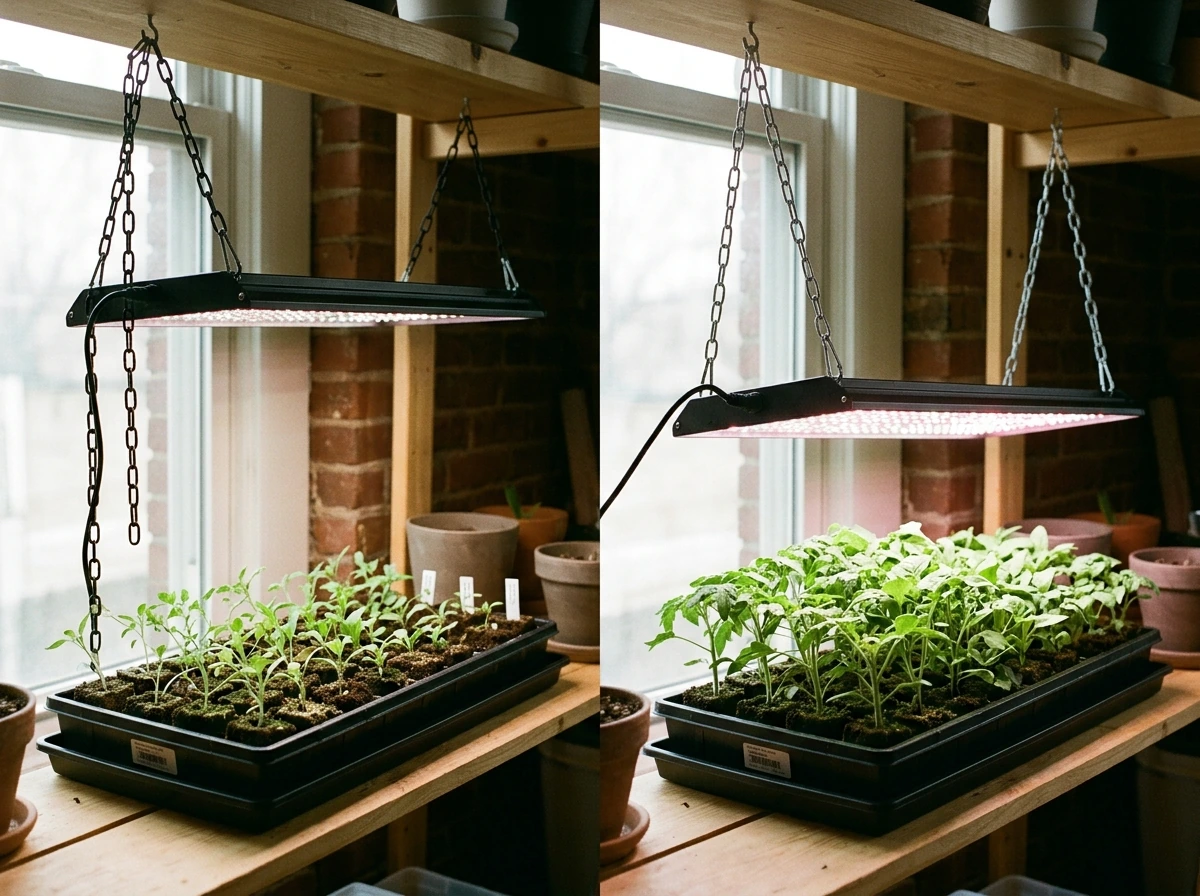
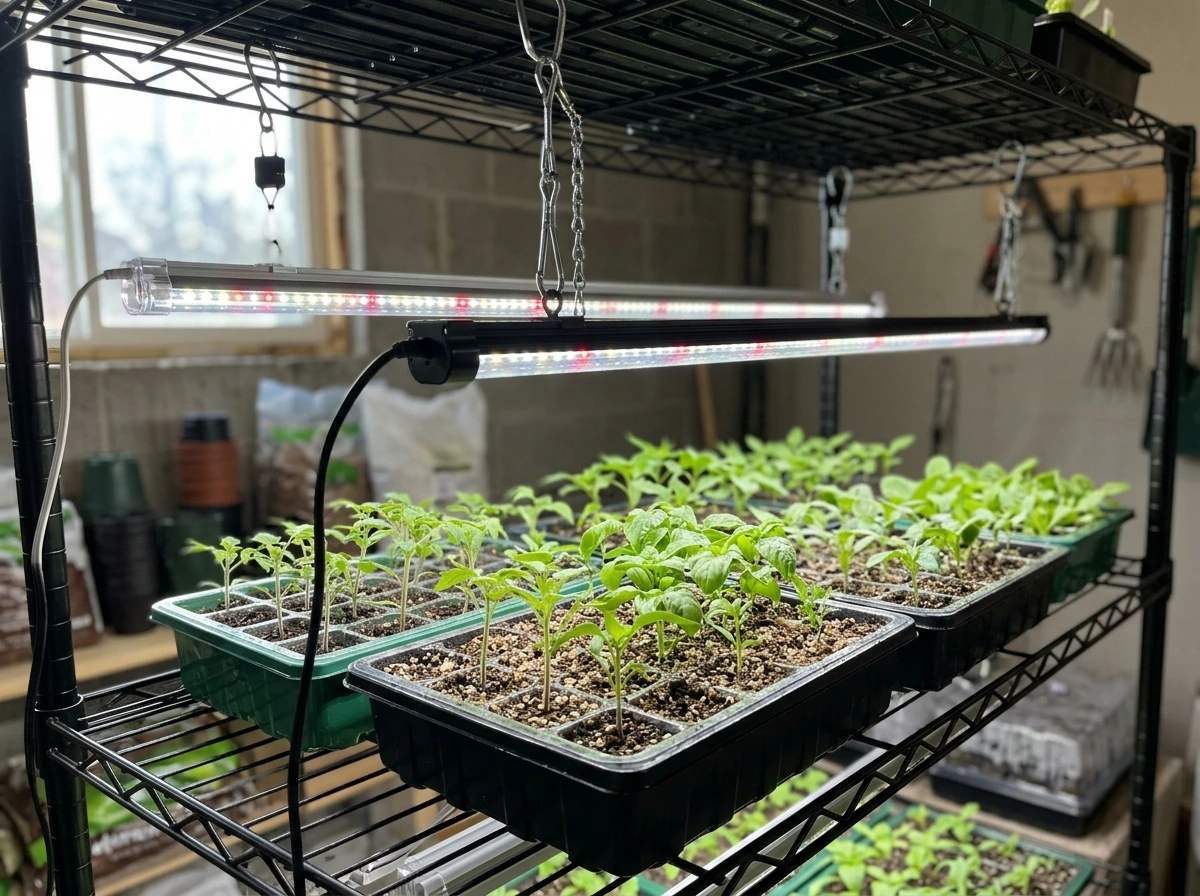
Seedlings need gentle, even light. You're aiming for roughly 100 to 300 µmol/m²/s at canopy level, which means you either need a dimmable fixture hung high or a purpose-built lower-output panel. Over-lighting seedlings is one of the most common beginner mistakes. A full-power quantum board at 18 inches will bleach seedlings or stunt them with light stress before they've established roots. For germination trays and early veg, a compact T5 fluorescent or a dimmable LED bar panel (50 to 100W actual draw) set to 30 to 50% power is genuinely ideal. If you're buying one light to cover both seedlings and later vegetative growth, prioritize dimming capability over raw output.
Vegetative growth
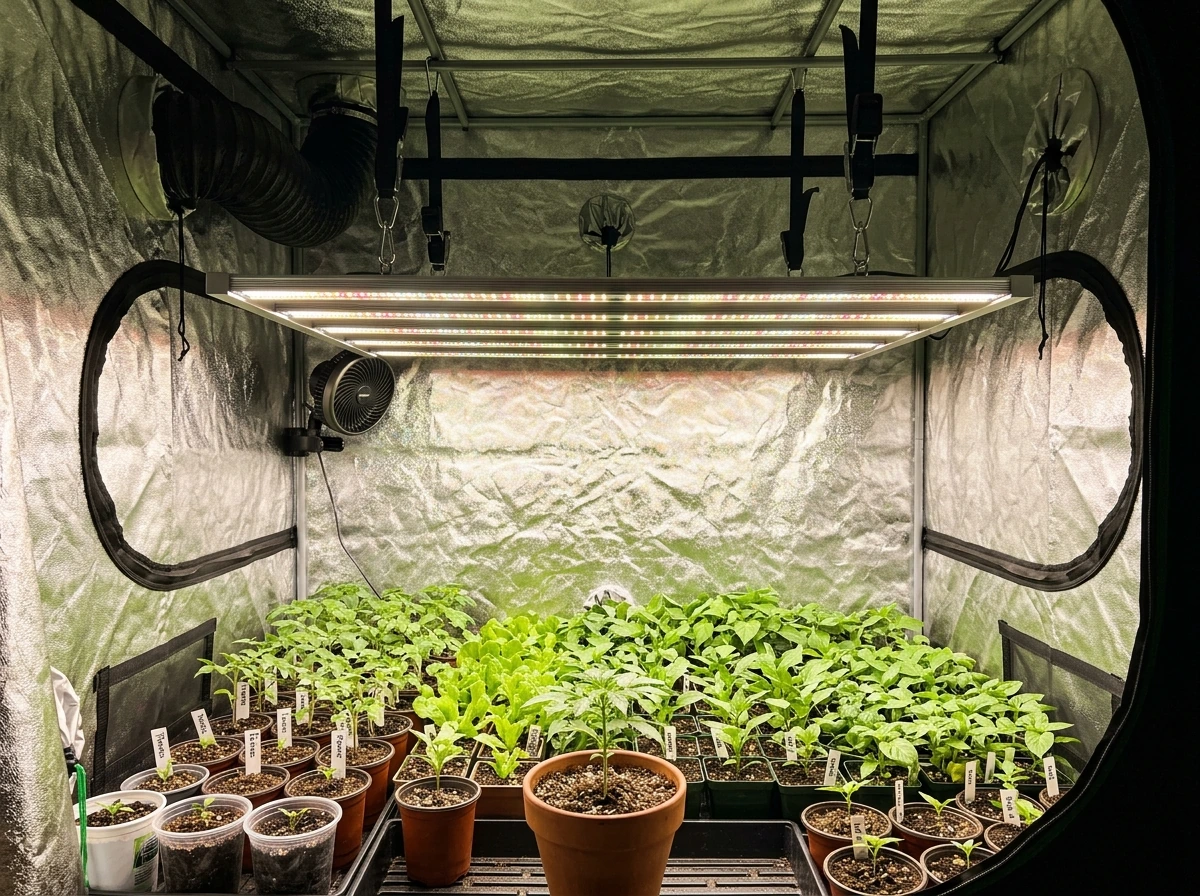
Veg stage plants respond well to 400 to 600 µmol/m²/s with a blue-weighted or balanced full-spectrum light. This is where mid-range quantum boards shine. Lights like the Mars Hydro TSW 2000, Spider Farmer SF-2000, and comparable fixtures consistently deliver solid PPFD in this range across a 3×3 or 4×4 footprint without overheating or spiking electricity costs. Look for fixtures with Samsung LM301B or LM301H diodes as a baseline quality indicator. The LM301H runs slightly more efficiently and handles higher drive currents better, which matters in lights that push higher wattages.
Flowering and fruiting
Flowering plants need more: typically 600 to 900+ µmol/m²/s at canopy, with some high-light fruiting crops like tomatoes and peppers benefiting from even higher intensities if CO2 supplementation is involved. This is where you need a fixture with genuine output rather than just good efficiency. Bar-style lights (like those from HLG, Gavita, or Growers Choice) and high-powered quantum boards excel here because they spread intensity more evenly than single-source COB setups. For a 4×4 flowering space, you're realistically looking at 400 to 600W of actual wall power to hit target PPFD consistently across the footprint. Going cheap here costs you yield.
Herbs, leafy greens, and kitchen gardens
Herbs and leafy greens are low-demand and forgiving. Basil, lettuce, spinach, and similar plants do well at 150 to 300 µmol/m²/s, which means almost any quality LED panel will be overkill at full power. For a small countertop or shelf grow (1×2 feet), a purpose-built grow light strip or small panel in the 30 to 60W range is plenty. If you're scaling to a full 2×4 or 3×3 shelving unit, a mid-range bar panel or quantum board dimmed to 40 to 60% will cover you without wasting electricity. Don't spend $400 on a flowering light for herbs. It's genuinely unnecessary.
Best grow lights by technology and spectrum
Full-spectrum quantum board LEDs
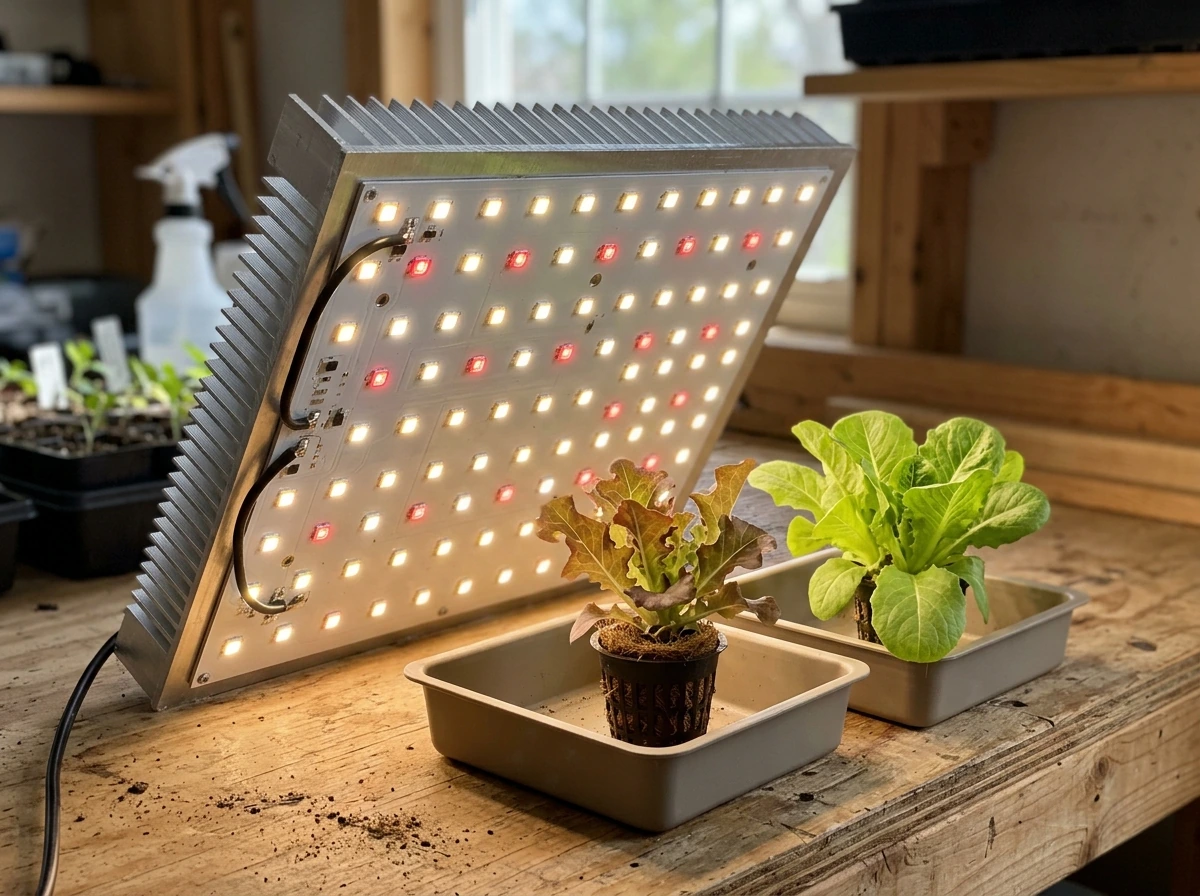
Quantum boards are the dominant technology in 2024 for good reason. They use densely packed, low-heat diodes spread across a large surface area, which produces even light distribution and runs cool enough that many fixtures are passively cooled. The best ones use Samsung, Osram, or Epistar diodes and pair them with a quality Meanwell driver. Efficiency ratings of 2.5 to 3.0+ µmol/J are achievable in this category. The main trade-off is that cheap quantum board clones flood the market and can look identical to quality units while using inferior diodes and no-name drivers that fail early. Stick with brands that publish actual PPFD test data.
COB (chip-on-board) LEDs
COB fixtures concentrate high-intensity output from a small source, which produces intense center hotspots and weaker coverage at the edges. For small, single-plant grows or for supplemental side lighting, COBs are effective. For canopy coverage across a 3×3 or larger footprint, they're less efficient in practice because uniformity suffers. Multi-COB arrays (four or nine COBs spread across the fixture) solve some of this problem, but at similar price points a quantum board or bar light typically delivers better uniformity. COBs do run hotter and require active cooling, which adds noise and another potential point of failure.
Bar lights (LED strip arrays)
Bar lights are the current top pick for serious flowering grows and commercial setups. By spacing multiple LED bars across the fixture, they achieve the most uniform canopy coverage of any format. HLG, Gavita, and Growers Choice lead in this category. The trade-off is cost: a quality bar light for a 4×4 space starts around $500 and runs up from there. For hobbyists who plan to grow consistently for years, it's worth it. For someone trying it out on a small scale, a quantum board is the better entry point. Bar lights also tend to have lower profile heights, which matters in tents with limited vertical space.
Blurple and single-band LEDs
The old-school blurple panels that dominated Amazon circa 2017 to 2019 are largely obsolete for serious grows. They're not full-spectrum, the marketed wattages are wildly inflated, and the actual PPFD output per dollar is far below what current quantum boards deliver. Some blue/red-only fixtures are still used in specialized research or supplemental contexts, but for practical home growing, skip them entirely. If a cheap LED fixture's listing emphasizes the purple glow in the photos, that's a red flag.
Performance testing metrics that actually matter
When you read grow light reviews, there are a handful of numbers that tell you whether a light will actually perform in your space. Here's how to interpret them without a horticulture degree.
PPFD and why peak numbers are misleading
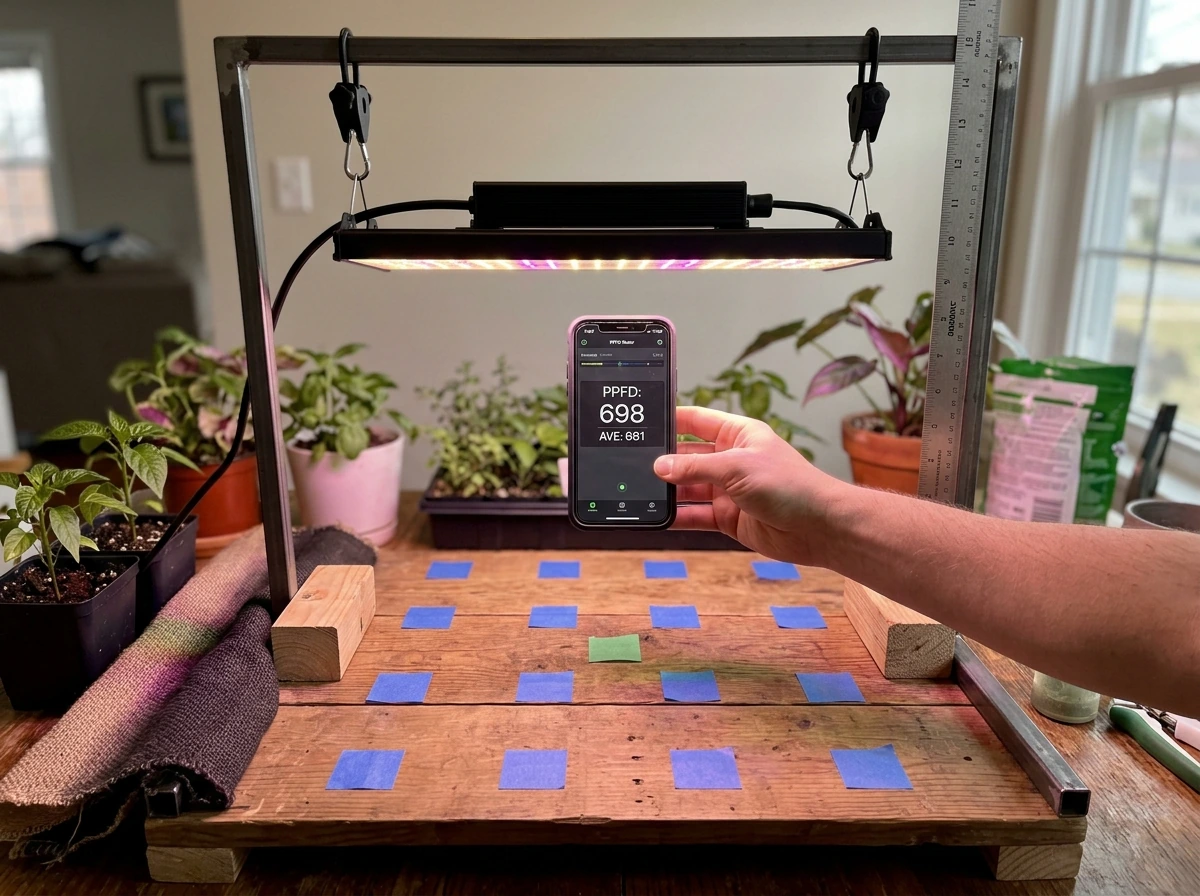
PPFD is measured in µmol/m²/s and tells you how many photons useful to photosynthesis are hitting a square meter per second. A manufacturer might advertise a peak PPFD of 1,200 µmol/m²/s, but that number is at the center of the footprint at a specific height. The number that matters is the average PPFD across your entire canopy, including corners. A light that delivers 1,200 at center but 400 in the corners produces patchy growth. Testing that maps PPFD at multiple points across the footprint, and then averages them, gives you the number you can actually plan around. For reference, the Atreum Hydra 1000 measured an average PPFD of 642.3 µmol/m²/s across a defined canopy test area in independent testing, which is a solid mid-range result for a light in its class.
Uniformity
Uniformity describes how consistent light intensity is across the footprint. A common way to express it is the ratio of the lowest measured PPFD to the highest, or the standard deviation of readings across a grid. For practical growing, you want corner readings to be at least 60 to 70% of the center reading. Below that, plants near the edges will underperform. Bar lights typically achieve the best uniformity. Single-COB designs are the worst. Quantum boards land in the middle, with performance depending heavily on reflector design and mounting height.
Efficiency (µmol/J or µmol/W)
Efficiency tells you how much useful light you get per unit of electricity. Higher is better. Entry-level lights from reputable brands land around 2.0 to 2.3 µmol/J. Good mid-range fixtures hit 2.5 to 2.8. Top-tier 2024 lights from HLG, Gavita, and similar push past 3.0. Calculating this from wall power draw (not rated wattage) is the honest method. A light rated at 300W that actually draws 220W at the wall and delivers 550 µmol/s of total photon output has an efficiency of about 2.5 µmol/J. That's a meaningful number. Rated wattage without wall draw measurements tells you almost nothing useful.
Measuring PPFD yourself
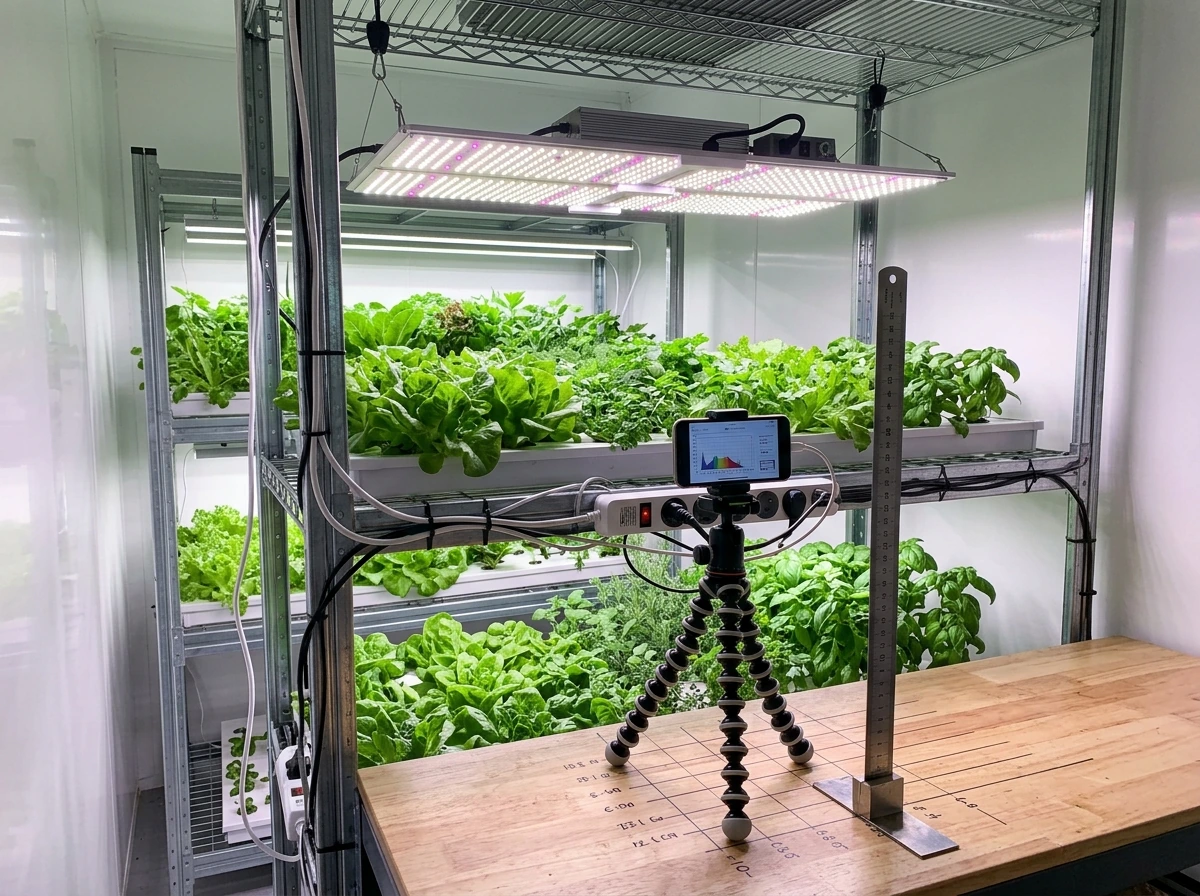
If you want to verify manufacturer claims or dial in your mounting height, you can measure PPFD yourself with an app like Photone (formerly Korona). The important caveat: the app requires correct calibration and the right diffuser setting to produce accurate readings. Using the wrong diffuser type or skipping calibration can produce errors large enough to meaningfully throw off your setup. Photone's own documentation notes that a diffuser type mismatch can make readings almost twice as high as they should be. If you use the physical diffuser accessory, you must apply a custom calibration because the diffuser blocks a portion of light and the default calibration doesn't account for that. Treat app measurements as directionally useful rather than lab-grade precise, and cross-reference against manufacturer PPFD maps when possible.
Coverage and sizing for your space
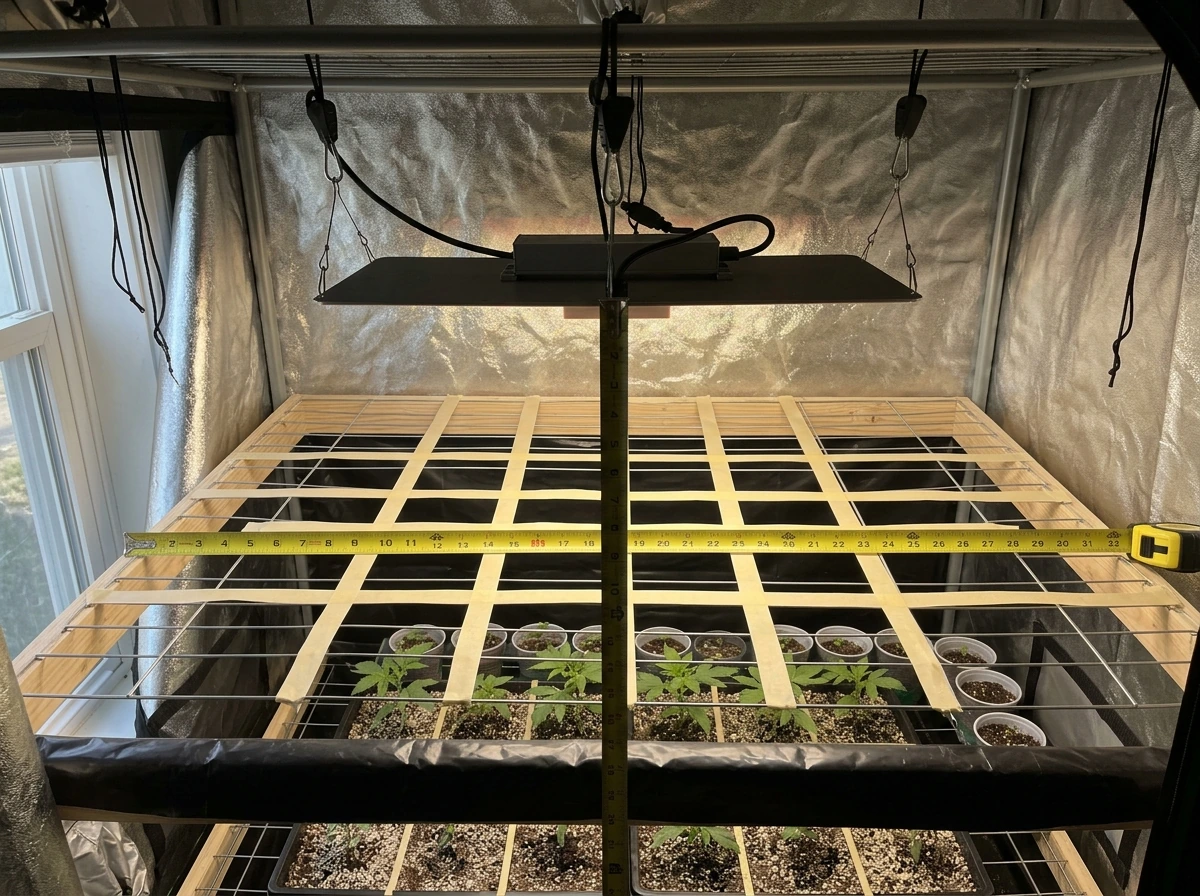
Getting the coverage right is where a lot of growers go wrong, usually by either buying too little light or buying the right light and hanging it at the wrong height. Here's a practical sizing framework.
| Grow Space | Use Case | Target PPFD (µmol/m²/s) | Recommended Actual Wall Watts | Light Type |
|---|---|---|---|---|
| 2×2 ft (0.37 m²) | Seedlings / herbs | 100–300 | 40–80W | Small quantum board or bar panel |
| 2×4 ft (0.74 m²) | Veg / herbs / greens | 300–500 | 100–150W | Mid quantum board |
| 3×3 ft (0.84 m²) | Veg to early flower | 400–700 | 200–250W | Quantum board or multi-bar |
| 4×4 ft (1.5 m²) | Full-cycle flowering | 600–900 | 400–600W | Bar light or high-power QB |
| 4×8 ft (3.0 m²) | High-yield flowering | 600–1000 | 800–1200W | Two bar lights or commercial QB |
Mounting height has a direct and dramatic effect on PPFD and footprint. Hang a light higher and you spread the photons across a larger area but reduce intensity at canopy. Lower mounting increases intensity but shrinks coverage and risks light burn if you're not careful. Independent testing on the Atreum Hydra 1000, for example, found an optimal height range of roughly 28.5 to 35.5 cm for their specific 2×2 canopy test. Every fixture has its own optimal range, and that range shifts depending on your canopy size. Use manufacturer PPFD maps as a starting point, then adjust based on plant response.
Plan for expansion from the start. If you think you might scale from a 2×4 to a 4×4 in the next year, buy a fixture or driver setup that supports that. Some bar light systems are modular and allow you to add bars later. Buying two smaller lights instead of one larger one also gives you redundancy and more flexible coverage.
Value for money in 2024
The grow light market in 2024 is competitive enough that you don't need to spend top dollar to get reliable performance. But you do need to spend past a certain floor. Budget fixtures under $80 for a 4×4 space almost universally use inferior components that either underperform immediately or fail within 12 to 18 months. Here's how to think about value honestly.
Cost per useful output
Divide the fixture cost by the total µmol/s of usable light output, or more practically, by the PPFD delivered across your full coverage footprint. A $200 light delivering average 600 µmol/m²/s across a 3×3 is better value than a $150 light delivering 350 µmol/m²/s. Running cost matters too: a light drawing 50W more than a comparable competitor will cost you an extra $30 to $60 per year in electricity depending on your rates and photoperiod, which adds up over a five-year driver lifespan.
Driver quality and expected lifespan
The driver is the most likely component to fail in a grow light. Meanwell drivers (particularly the HLG series) are the industry standard for a reason: they're rated for 50,000+ hours, run cool, and are repairable if they do fail. Generic no-name drivers found in cheap fixtures are often rated for 20,000 hours or less and run hot, which accelerates diode degradation even if the driver itself doesn't fail first. When evaluating a fixture, look for the driver brand in the specs. If it's not listed, ask the manufacturer or assume it's generic.
Dimming and timer features
Dimming is not a luxury. It lets you use one fixture across seedling, veg, and flowering stages without burning young plants or running at unnecessary intensity. 0 to 10V dimming (compatible with most Meanwell drivers) is the most flexible implementation. Some fixtures now include integrated timers and programmable schedules, which is convenient but not essential if you're already using a standalone timer. Daisy-chain dimming capability matters if you're running multiple fixtures in the same space and want to adjust them together.
Top brands and models compared
Here's an honest overview of the brands and models that earned their reputations through 2024 testing. This is not an exhaustive list, but these are the names that consistently appeared across independent reviews with documented performance data.
| Brand / Model | Type | Actual Wall Draw | Best For | Who It's For | Approx. Price (2024) |
|---|---|---|---|---|---|
| HLG 300L Rspec | Quantum board | ~260W | 4×4 flowering | Advanced growers, high-yield grows | $400–$450 |
| Spider Farmer SF-2000 | Quantum board | ~200W | 3×3 veg/flower | Beginners to intermediate | $160–$200 |
| Mars Hydro TSW 2000 | Quantum board | ~300W | 4×4 veg/light flower | Beginners, value-focused | $150–$190 |
| Gavita Pro 1700e LED | Bar light | ~645W | 4×4 to 5×5 heavy flower | Experienced / commercial growers | $900–$1,100 |
| Growers Choice ROI-E680 | Bar light | ~680W | 4×4 to 5×5 flowering | Advanced growers, commercial | $800–$1,000 |
| Atreum Hydra 1000 | Quantum board | ~100W | 2×2 to 2×3 veg/flower | Beginners, small tents | $100–$130 |
| ViparSpectra KS5000 | Quantum board | ~500W | 4×4 to 5×5 flowering | Intermediate to advanced | $350–$420 |
For beginners: the Spider Farmer SF-2000 and Mars Hydro TSW 2000 are the two most consistently recommended entry points in 2024 reviews. Both use quality diodes, include a Meanwell or equivalent driver, and deliver honest PPFD output backed by published test data. The SF-2000 edges ahead on efficiency; the TSW 2000 covers a slightly larger footprint at full power. Either will serve a first-time grower well in a 3×3 or 4×4 tent for veg-focused or light-flowering grows.
For advanced growers: HLG leads on build quality and US-based support, and their fixtures consistently achieve top-tier efficiency. Gavita and Growers Choice dominate in commercial-scale bar light performance. If you're running a 4×4 or larger dedicated flowering space and care about maximizing yield per square foot, these are the fixtures worth the higher investment. The ViparSpectra KS5000 offers competitive performance at a lower price point than HLG, with independent PPFD testing (including usable photon efficiency data published by reviewers like Coco For Cannabis) confirming its output claims are reasonably accurate.
Buying checklist and mistakes worth avoiding
Before you buy
- Measure your actual grow space footprint and vertical height available (account for the fixture itself, hangers, and space above the canopy)
- Define your primary use case: seedlings only, veg, flowering, or full cycle
- Set a realistic budget that includes running cost, not just purchase price
- Verify the manufacturer publishes actual PPFD test data, not just rendered simulations
- Check the driver brand and warranty length (minimum 3 years; 5 years is better)
- Confirm dimming capability if you plan to use the light across multiple growth stages
Common mistakes that cost money or plants
- Buying based on marketed wattage rather than actual wall draw: a '1000W LED' drawing 100W at the wall is not a 1000W light
- Hanging the light too low for the growth stage: seedlings need distance, not intensity; most growers start too close
- Ignoring heat and ventilation: even efficient LEDs generate heat, and a tent without adequate airflow will cook plants regardless of light quality
- Overlooking coverage uniformity: a high peak PPFD with poor edge coverage grows uneven canopies
- Skipping the warranty check: some budget brands offer 1-year warranties with no real support infrastructure; returns can be painful
- Buying a light sized for the maximum footprint claim rather than the useful coverage footprint at target PPFD
- Using a PPFD measurement app without proper calibration: wrong diffuser settings can produce readings nearly double the actual value, leading to badly miscalibrated setups
- Not accounting for light degradation: LED output drops over time (typically 10 to 20% over 50,000 hours); factor this into long-term grow planning
Safety considerations
Don't skip UL or ETL certification if you're running lights in an enclosed tent or any space where water is present. A lot of the cheapest fixtures skip third-party electrical safety certification entirely. This matters more than it sounds. Drivers in enclosed tents run hot, and a poorly made driver near irrigation or humid air is a real fire risk. Certified fixtures cost more because the testing costs money. That's a worthwhile trade-off.
If you want to go deeper on specific fixture types, our detailed coverage on grow light reflector comparisons If you want to go deeper on specific fixture types, our detailed coverage on grow light reflector comparisons and grow light mover setups covers two areas where setup decisions can meaningfully extend coverage and uniformity beyond what the fixture alone delivers. covers two areas where setup decisions can meaningfully extend coverage and uniformity beyond what the fixture alone delivers. and grow light mover setups covers two areas where setup decisions can meaningfully extend coverage and uniformity beyond what the fixture alone delivers. covers two areas where setup decisions can meaningfully extend coverage and uniformity beyond what the fixture alone delivers. and grow light mover setups covers two areas where setup decisions can meaningfully extend coverage and uniformity beyond what the fixture alone delivers. and grow light mover setups covers two areas where setup decisions can meaningfully extend coverage and uniformity beyond what the fixture alone delivers. For a broader retrospective on how the market has evolved, the [2021 and 2020 grow light review roundups](/budget-grow-light-reviews/grow-light-reviews-2021) are useful context for understanding how much the technology has improved over a short period. grow light reviews 2020
FAQ
Can I rely on “peak PPFD” numbers in grow light reviews or listings for my grow room?
Usually not by itself. Peak PPFD is often measured at the center at a specific height, so you want the average PPFD across the full footprint and corner readings (or a grid map). If a review only shows one value, treat it as incomplete for planning and height selection.
What’s a quick way to tell whether a review is using wall power correctly for efficiency comparisons?
Look for mention of wall wattage or direct power measurement, not just advertised wattage. If the review reports usable photon efficiency computed from wall power, you can compare it more fairly across brands; if it relies only on spec sheet wattage, the efficiency figure is likely overstated.
How do I avoid over-lighting when I’m new, especially if my tent height is fixed?
Start with dimming or a higher mounting position, then verify with canopy measurements (or plant response) after 3 to 5 days. Seedlings are the most sensitive, so resist the urge to “dial in” by jumping to full power immediately, especially under quantum boards or bar lights.
Should I buy one light and dim it for all stages, or switch fixtures between veg and flower?
If your budget allows only one fixture, choose a model with real dimming range and stable output across dim levels. For many growers, this beats buying a second light early, but you must still meet flowering PPFD targets, and “seedling friendly” dimming does not automatically mean “high output enough” for flower.
Do I need to measure PPFD myself with an app, or can I trust the manufacturer’s maps?
You can usually use manufacturer PPFD maps as a starting point, but app-based checks help you account for your exact hang height and canopy distance. If you do measure with an app like Photone, use the correct diffuser accessory and calibration steps, because mismatches can produce large errors that lead to incorrect dosing of intensity.
What if my corners are consistently lower than the center, but the average PPFD looks fine?
Average PPFD can mask edge underperformance. If your corner readings are below roughly 60 to 70% of center, you may get uneven growth, slower edge development, or taller canopy gaps. In that case, consider adjusting hang height slightly, repositioning, or switching to a format known for better uniformity (bar lights or well-designed quantum boards).
How do I estimate electricity cost from a grow light’s real power draw?
Use wall power draw (watts at your actual setting) times your daily runtime. Then multiply by your local electricity rate, and compare that across lights of similar PPFD coverage. The article suggests 50W differences can mean meaningful annual cost over long photoperiods, so always base calculations on measured or stated wall draw.
Is dimming down to 30 to 50% always best for seedlings and early veg?
It’s a common starting point, but not a universal rule because fixtures vary in spectral balance and how evenly they maintain output when dimmed. Use the target PPFD range as the priority, then confirm with canopy response and (ideally) PPFD measurements at seedling height.
What’s the most important thing to check about the driver when evaluating grow light reviews?
Confirm the driver brand is listed (for example, Meanwell) and that the driver is rated for the expected operating environment. If reviews do not mention a driver model or certification context, you should assume build quality risk is higher, especially in humid tent setups where heat management matters.
Should I prioritize UL or ETL certification if I’m only using lights in a hobby tent?
Yes. Hobby setups often still involve enclosed spaces, condensation, and irrigation humidity, which increases risk if a driver or wiring is marginal. Certification is one of the easiest “safety floor” indicators when comparing cheap fixtures, and skipping it is a common cost-cutting trade.
Are COB lights always worse than quantum boards for home grows?
Not always. COBs can work well for small single-plant grows, side lighting, or supplemental illumination where hotspots are acceptable and you can manage distance carefully. If you need uniform coverage across a 3×3 or larger canopy, the review should demonstrate edge coverage and uniformity, since single-source COB designs often struggle there.
If I want to expand from a 2×4 to a 4×4 later, what should I plan for now?
Plan for fixture modularity and electrical compatibility. Some bar systems allow adding bars later, and multiple smaller lights can provide redundancy and easier coverage adjustments. Also ensure your dimming approach and wiring layout can support the later footprint without redesigning everything.