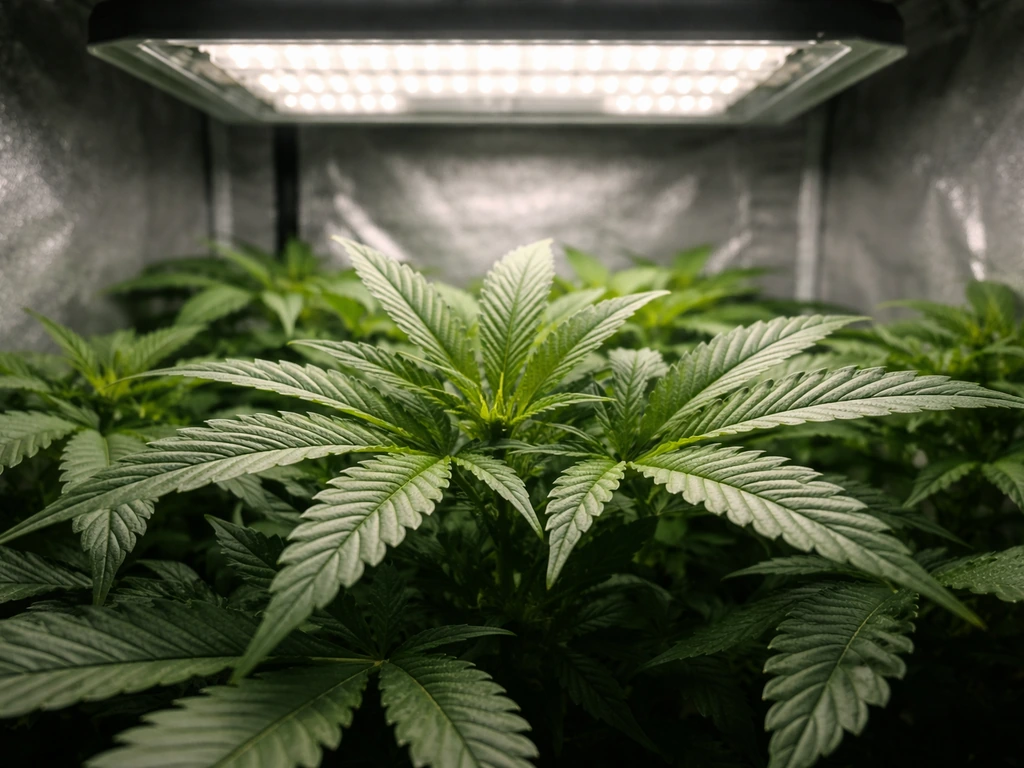
For most home growers running a 4x4 tent, a quality full-spectrum LED in the 400-500W true draw range (not the inflated "equivalent" wattage you see on Amazon listings) will cover you through seedling, veg, and flower with room to adjust. The best cannabis grow light reviews focus on actual PPFD at canopy height, photosynthetic photon efficacy (PPE in µmol/J), coverage uniformity, and real heat output, not just how bright the center point looks or what the box claims. A CDM grow light review should be judged the same way, with real PPFD, PPE, and coverage at canopy height. If you know how to read those numbers, you can cut through the noise fast and pick a light that actually performs.
Cannabis Grow Light Reviews: How to Choose LED Lights

Marcus Caldwell
14 May 2026
What a cannabis grow light review should actually measure
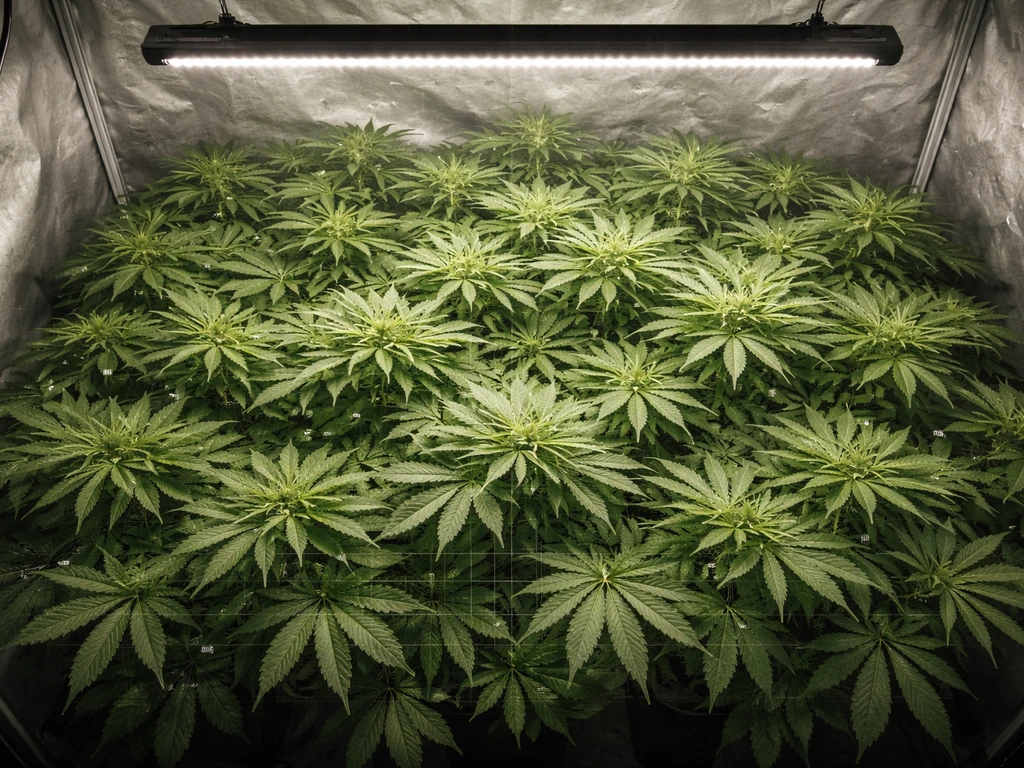
The single most important number in any honest grow light review is PPFD, photosynthetic photon flux density, measured in µmol/m²/s. It tells you how many usable photons are hitting the canopy every second. Wattage tells you how much power a fixture draws from the wall. Those are not the same thing, and conflating them is the most common mistake both reviewers and growers make.
A quality review will show a PPFD map: a grid of readings taken at a fixed height (usually 18 or 24 inches) across the full grow area. The center reading is almost always the highest, so any reviewer who only reports that number is giving you a misleading picture. Look for average PPFD across the whole footprint, and pay attention to how much it drops at the corners. A difference of more than 40-50% between center and edge is a red flag for uneven canopy development.
Related to PPFD is DLI, daily light integral. It converts your intensity reading into a daily photon budget: DLI (mol/m²/day) = 0.0036 × PPFD × light hours per day. Seedlings want a DLI around 15-20, veg plants around 30-45, and flowering cannabis wants 40-65 mol/m²/day. Knowing this lets you set your photoperiod intelligently instead of guessing.
The other metric worth knowing is photosynthetic photon efficacy (PPE), expressed in µmol/J. It tells you how efficiently a fixture converts electrical energy into usable plant light. Modern high-quality LEDs from reputable brands hit 2.5-3.0 µmol/J. Budget fixtures often land below 2.0 µmol/J, which means you're paying more in electricity for less plant-usable light over time. Any review worth reading will list PPE alongside wattage.
How to read review claims with a critical eye
- "Equivalent wattage" claims (e.g., "1000W equivalent") are marketing, not electrical draw — ignore them and look for actual wall-draw watts
- PPFD readings without a height or measurement grid are nearly meaningless; always ask at what distance the reading was taken
- "Full spectrum" is used loosely — check whether the review specifies red/blue/white LED ratios or reports a spectral power distribution chart
- Lumen ratings are tuned for human vision, not plant photosynthesis; a fixture optimized for lumens may underperform on PPE
- Third-party testing (from independent labs or reviewers using a calibrated quantum meter) is far more reliable than manufacturer-provided data sheets
LED spectrum choices: full spectrum vs targeted grow and flower setups
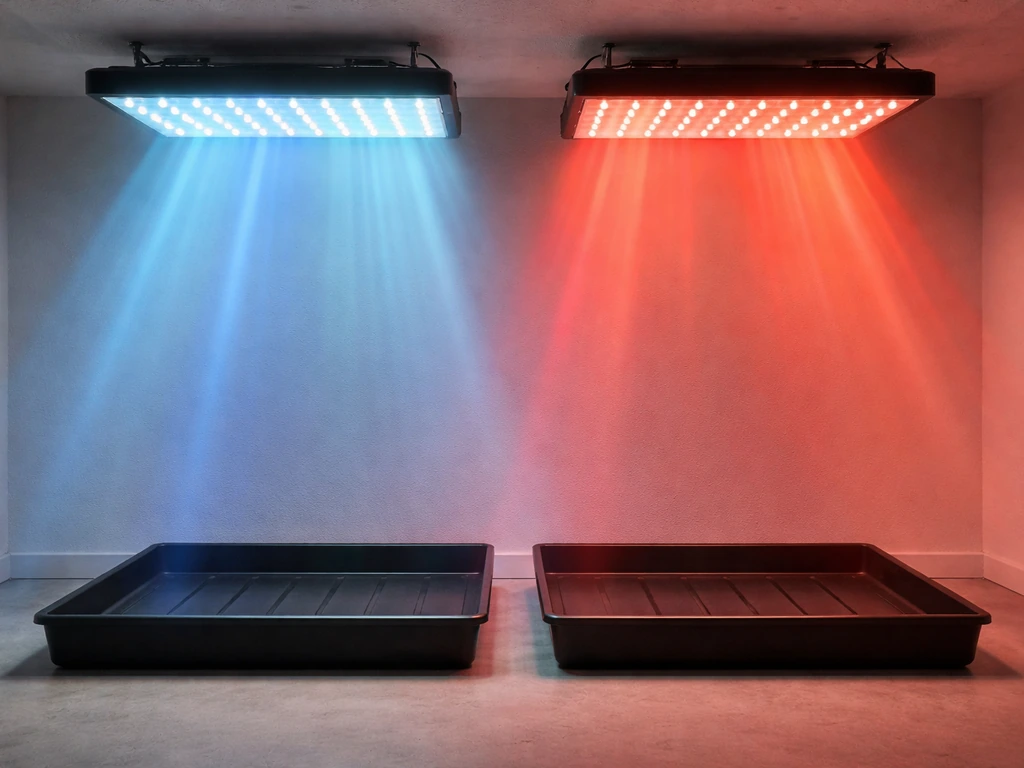
Cannabis uses the full PAR range (400-700 nm) but responds most strongly to blue light (400-500 nm) during vegetative growth and red light (620-700 nm) during flower. Far-red (700-750 nm) can extend the Emerson effect, boosting photosynthetic efficiency in flower when used carefully. Most modern white-LED fixtures cover all of this reasonably well, which is why full-spectrum quantum-board style lights have become the default recommendation for small-scale growers.
The older approach of using separate blue-dominant lights for veg and red-dominant lights for flower still has fans, and it works. But it requires two fixtures or a fixture with switchable spectrum modes, adds cost and complexity, and the practical yield difference over a well-designed white-spectrum LED is smaller than the marketing suggests. For most home growers, a single full-spectrum LED with a dimmer is simpler, cheaper to run, and easier to manage.
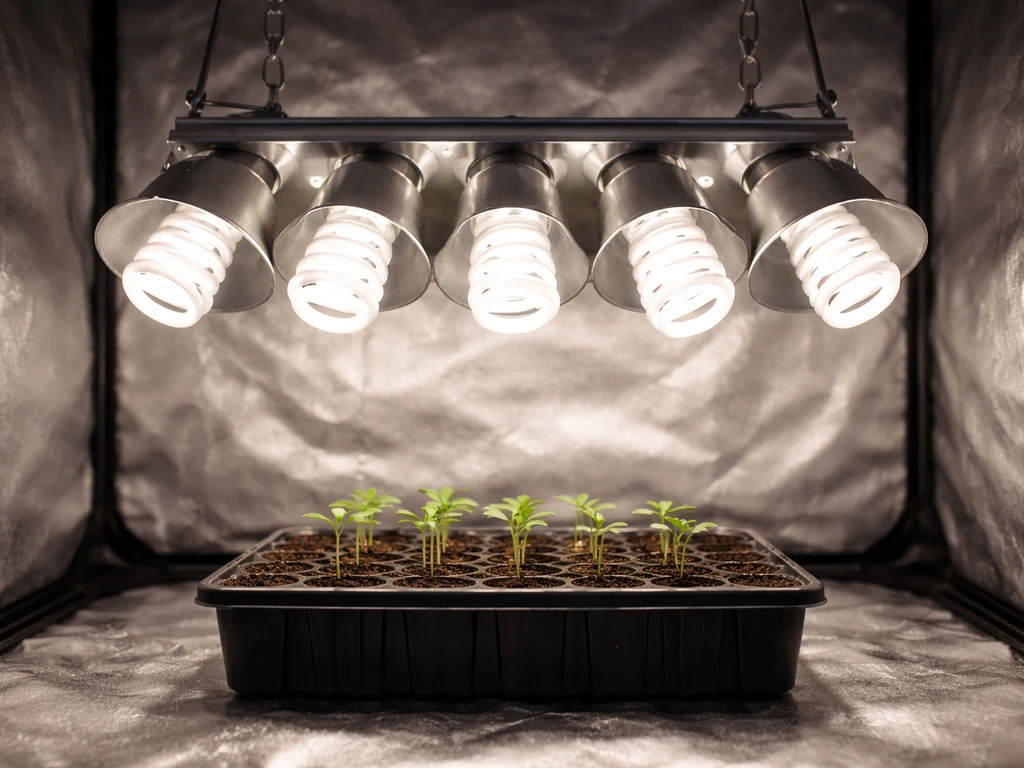
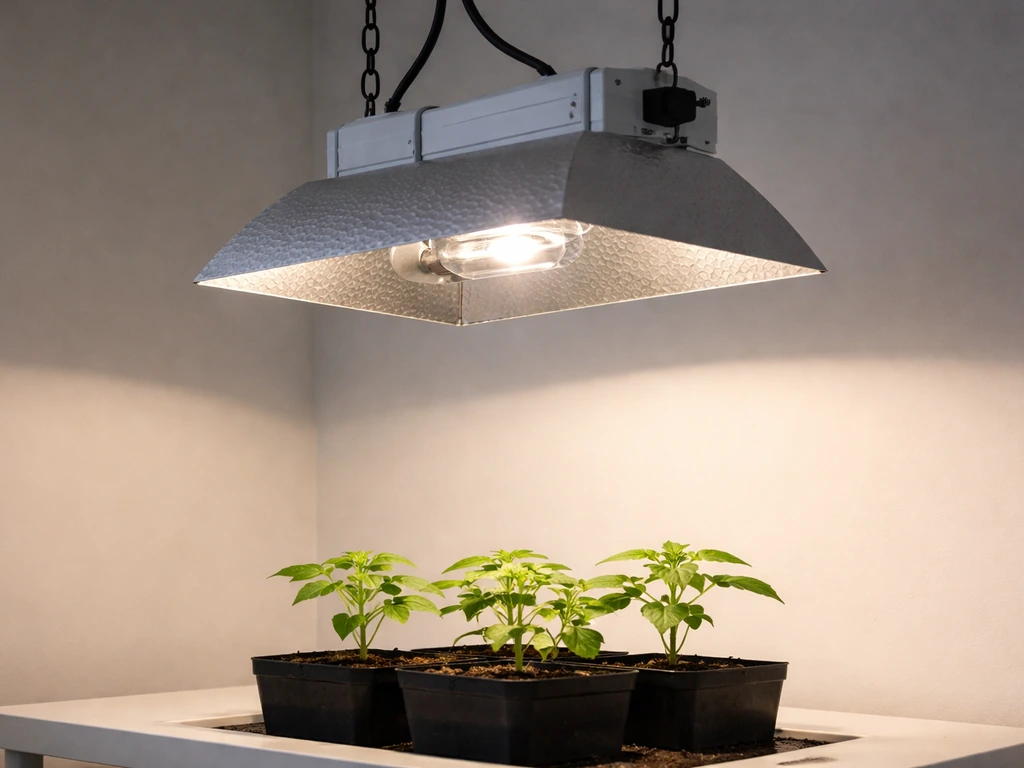
Specialized CMH (ceramic metal halide) and CDM fixtures do produce excellent spectra for cannabis, with a high CRI that mimics sunlight closely. If you're researching those options, the 315W CMH category specifically is worth comparing against comparable-wattage LEDs on efficiency and canopy penetration. CFL and dual-spectrum CFL setups serve growers on tight budgets or those running small clone/seedling areas, but their PPE rarely matches modern LED at equivalent wattage. If you are evaluating cfl grow light reviews, compare their reported PPFD and PPE at canopy height, not just how bright the center looks.
Spectrum by growth stage: a practical guide
| Growth Stage | Target PPFD (µmol/m²/s) | Target DLI (mol/m²/day) | Spectrum Priority | Light Hours |
|---|---|---|---|---|
| Seedling | 100-300 | 15-20 | Balanced white / mild blue | 18 |
| Vegetative | 400-600 | 30-45 | Blue-leaning full spectrum | 18 |
| Early Flower | 600-800 | 40-55 | Full spectrum with red emphasis | 12 |
| Peak Flower | 800-1000+ | 55-65 | Red + far-red boost | 12 |
Wattage, efficiency, and coverage: matching the light to your space
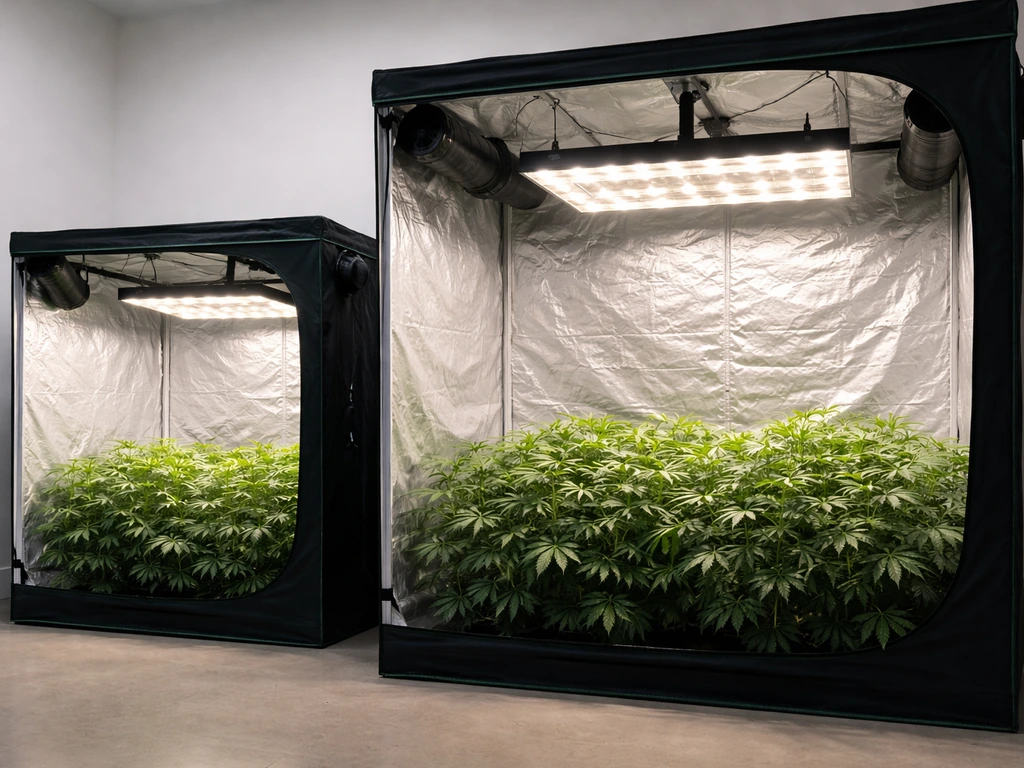
A reliable rule of thumb for LED grow lights in cannabis flower is 25-50 true watts per square foot of canopy, depending on how hard you want to push the plants and how efficient the fixture is. At 2.5 µmol/J efficiency, 300W covers roughly a 3x3 foot flowering footprint adequately; 400-500W covers a 4x4. For larger spaces, you're better off running two fixtures to improve uniformity than one oversized single panel.
Higher-efficiency fixtures let you cover the same area with less wattage, meaning lower electricity bills and less heat. This is where PPE really pays off over a grow season. A fixture pulling 400W at 3.0 µmol/J delivers the same photon output as a 480W fixture at 2.5 µmol/J. Over six months of daily 12-hour flower cycles, that 80W difference adds up to real money depending on your electricity rate.
One thing reviews don't always make clear: coverage ratings from manufacturers are almost always given for veg, where PPFD requirements are lower. The flowering footprint for any given fixture is smaller. If a light claims a 4x4 coverage area, treat that as the veg footprint and expect effective flowering coverage closer to 3x3 or 3.5x3.5, unless the review specifically confirms adequate flowering PPFD across the full stated area.
Performance factors beyond brightness
Uniformity
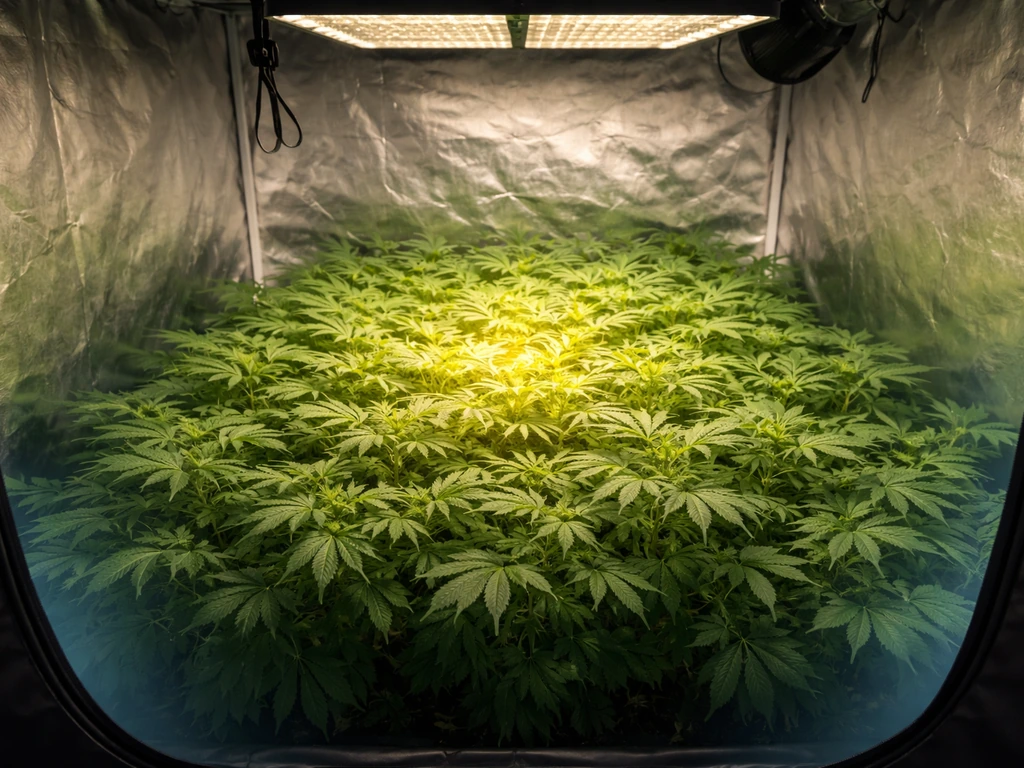
Uniformity, how evenly PPFD is distributed across the canopy, matters more than peak intensity in a practical grow. Plants at the edges of the tent that receive significantly less light than center plants will lag behind, creating uneven harvests. Look for reviews that report a uniformity ratio or at least provide a multi-point PPFD map. A good fixture at proper hanging height should show edge readings no lower than 60-70% of the center reading.
Heat management
LED fixtures run cooler than HPS or CMH, but they still generate heat, especially at the driver. Most quality LED panels use passive aluminum heatsinks with drivers mounted externally or on the back panel. In a sealed tent, even a 400W LED will raise ambient temperature by 5-10°F above room temperature, which matters a lot if your grow room is already warm. Reviews should report operating temperatures at the fixture surface and, ideally, the effect on tent temperature during testing.
Dimming and control
A dimmable driver is one of the most underrated features in a cannabis grow light. It lets you run lower intensity during seedling and early veg stages (protecting young plants from light stress), ramp up through flower, and adjust output if temperatures rise. Look for stepless dimming (0-100% continuous) rather than just two or three preset levels. Some higher-end fixtures support 0-10V controller compatibility, which allows multiple lights to be daisy-chained and dimmed from a single controller, a major quality-of-life upgrade in a multi-light setup.
Drivers and build quality
The driver is the component most likely to fail in an LED fixture, and the brand matters. Meanwell drivers (HLG and ELG series) are the standard benchmark for reliability in the enthusiast and commercial LED space. Fixtures using branded Meanwell drivers typically carry longer warranties and have documented longevity. Unknown or unbranded drivers are a common cost-cutting measure in budget lights and the first thing to check in any review. Separately, look at the diode brand, Samsung LM301B and LM301H diodes are widely used in quality fixtures and have well-documented performance data.
How to check a review before trusting it
Not all grow light reviews are created equally. Some are written from manufacturer data sheets without any hands-on testing. Here's a practical checklist for evaluating whether a review is actually useful before you rely on it to make a purchase decision.
- Does the review report actual wall-draw wattage measured with a meter, or just the manufacturer spec?
- Is there a PPFD map with multiple measurement points, not just a center reading?
- Is PPE (µmol/J) calculated or reported, or does the review stick to lumens and "equivalent watts"?
- Does the reviewer note what quantum meter or light meter they used, and whether it's PAR-calibrated?
- Are heat and noise observations included from actual operation, not just from the spec sheet?
- Does the review acknowledge coverage limitations (veg vs flower footprint)?
- Is there a long-term note on driver reliability or warranty experience, or is this a first-impressions post?
- Are negative trade-offs acknowledged honestly, or is the review uniformly positive?
If you're comparing multiple reviews across brands, say, evaluating a quantum-board LED against a CDM fixture or a dual-spectrum CFL option, make sure the reviews are using the same measurement methodology and height. A PPFD reading at 18 inches is not directly comparable to one taken at 24 inches, and a reviewer using an uncalibrated phone-based lux meter is giving you data that's more noise than signal.
Value and buying decisions: cost per effective output
Price per watt is a crude metric. A better way to compare value is cost per µmol/s of delivered photons across the coverage area. You can approximate this by taking the fixture price, dividing by the PPF output (total photons per second, often listed on spec sheets as µmol/s), and comparing that number across competing models. A fixture that costs $400 and delivers 1000 µmol/s costs $0.40 per µmol/s. One that costs $300 but only delivers 600 µmol/s costs $0.50 per µmol/s, more expensive per unit of useful light despite the lower sticker price.
Operating cost matters too, especially over a multi-year growing career. At $0.15/kWh (roughly the US average in 2026), a 400W light running 18 hours a day during a veg cycle costs about $1.08/day. A 500W less-efficient fixture delivering the same photon output costs $1.35/day, a difference of about $97 over a typical six-month grow year (18-hour veg plus 12-hour flower). Higher upfront cost on an efficient fixture often pays back within one or two grow cycles.
Warranty is an easy thing to skip past when buying, and a painful thing to regret. Look for a minimum three-year warranty with documented customer support. Five years is the current standard among the better LED brands. Check whether the warranty covers the driver separately, since that's the most failure-prone component. A fixture with a great warranty from a brand that's been operating for at least five years is a meaningfully lower risk than a newer brand offering the same coverage on paper.
| Budget Range | Typical PPE (µmol/J) | Typical Warranty | Who It's For |
|---|---|---|---|
| Under $150 | 1.5-2.0 | 1 year or none | Very small spaces, seedling/clone areas, CFL-level needs |
| $150-$300 | 2.0-2.5 | 1-3 years | 2x4 tents, single-plant growers, budget veg setups |
| $300-$500 | 2.5-2.8 | 3-5 years | 4x4 tents, intermediate growers, full cycle cannabis grows |
| $500+ | 2.8-3.0+ | 5 years | Serious home growers, 5x5 and larger, multi-light setups |
Setup and optimization: getting the most from your light
Mounting height and spacing
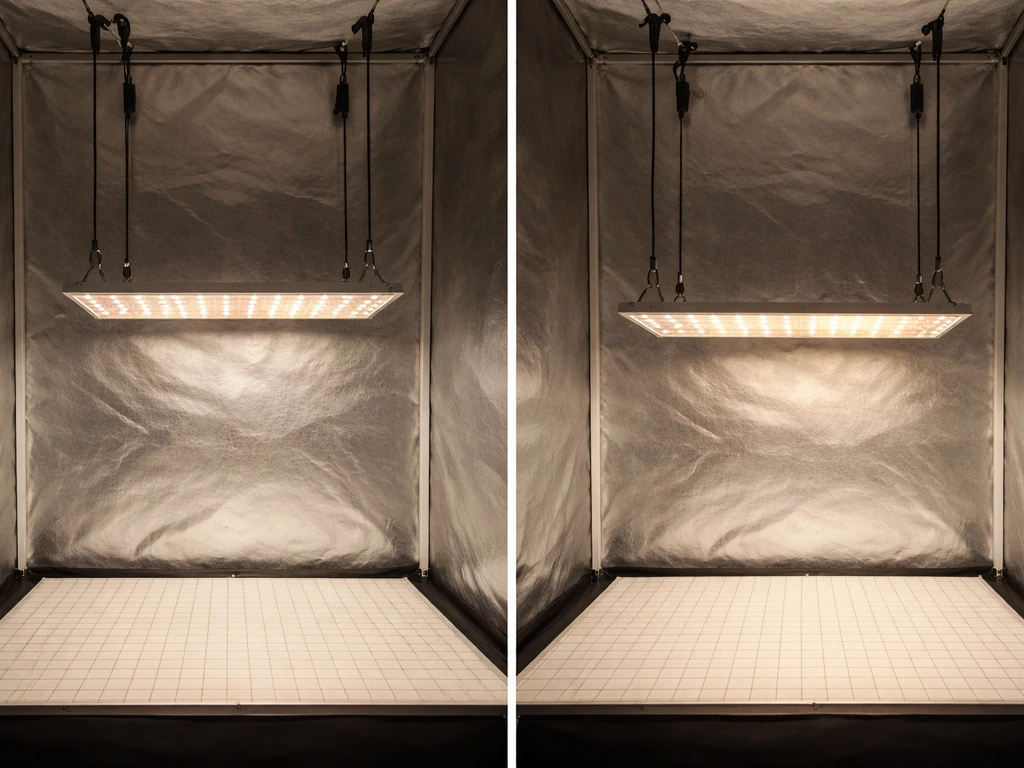
Hanging height is the variable growers underestimate most. Every few inches of adjustment changes both the PPFD intensity and the uniformity of coverage at the canopy. Most quantum-board LEDs perform best for flowering cannabis at 18-24 inches above the canopy, close enough for high intensity, far enough to spread light across the full footprint. During seedling stage, push the light higher (30-36 inches) or dim it significantly to avoid bleaching. During early veg, 24-30 inches with mid-range dimming works well. Mark your ratchet hangers at each setting so you can repeat it consistently.
If you're running two lights in a larger tent (say, two fixtures side by side in a 4x8), position them so their coverage footprints overlap slightly rather than butting up against each other. This smooths out the middle zone and reduces the hot spot directly below each light. Run both on the same controller if possible so output is matched.
Ventilation and heat management
Cannabis grows best with canopy temperatures between 75-85°F (24-29°C) during the light cycle and 65-75°F during dark. LED fixtures contribute less heat than HPS or CMH, but in a small tent with limited airflow, temperature can still creep up. Size your inline fan and carbon filter for at least 1x air exchange per minute in the tent volume, more in hot climates or summer grows. Position intake low and exhaust high to encourage efficient heat removal. If you're growing in a warm environment, a fixture with an external driver (mounted outside the tent) meaningfully reduces in-tent heat load.
Stage-by-stage adjustments
The dimmer on your fixture isn't just for energy savings, it's a growth management tool. Start seedlings at 20-30% output with the light high in the tent. Ramp to 50-70% as plants enter veg and lower the fixture incrementally to maintain your target PPFD. Going into flower, push to 80-100% output and dial in the final hanging height. Watch your plants: light-stressed leaves will tacoed (curl upward at the edges) or show bleaching near the tops. If you see either, raise the fixture or reduce output before the next light cycle.
Training techniques like LST (low-stress training) and ScrOG (screen of green) pair especially well with LED setups because they spread the canopy and expose more of the plant to the high-intensity zone directly below the light. A well-trained plant under a quality LED can outperform a poorly managed plant under a more expensive fixture, the light matters, but how you use it matters just as much.
Choosing your light: a quick decision path
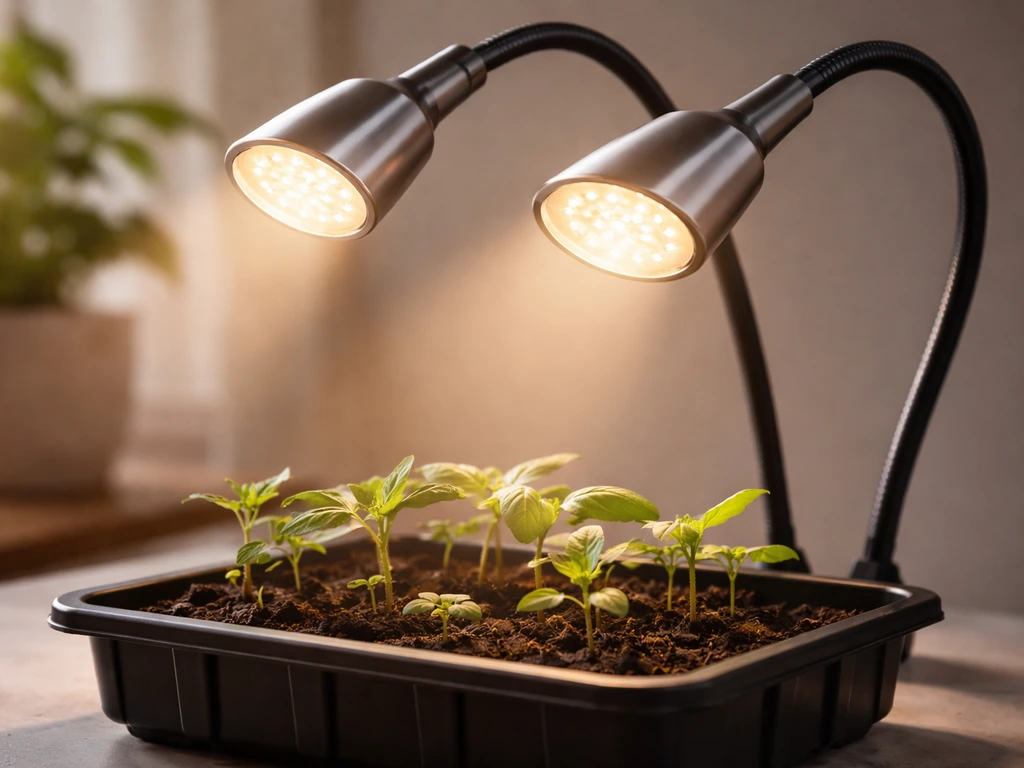
If you're in a 2x4 tent or smaller on a budget, a quality CFL or budget LED in the 150-200W true-draw range covers your needs. Look at dual-spectrum CFL reviews if you're keeping costs minimal and don't want to invest in LED upfront. If you're specifically comparing a 300W dual spectrum CFL grow light review, focus on the PPFD map and PPE results rather than wattage marketing claims dual-spectrum CFL. For a 4x4 tent doing full cannabis cycles, a 400-500W quantum-board LED from a brand using Meanwell drivers and Samsung diodes is the most reliable recommendation in 2026, it balances performance, efficiency, and longevity better than any other option at that price tier. For spaces 5x5 and larger, plan for two fixtures rather than one oversized panel, and look for fixtures with 0-10V controller compatibility so you can manage them as a matched pair. Whatever space you're working with, prioritize reviews that show a real PPFD map, report PPE, and come from someone who tested with a calibrated quantum meter, everything else is secondary. If you want a hands-on look at one popular option, read the Casalux Dual Head plant grow light review and compare its PPFD, PPE, and coverage. A sylvania grow light bulb review should break down PPFD, PPE, coverage uniformity, and real heat output so you can judge performance instead of marketing.
FAQ
How can I tell if a cannabis grow light review is using credible PPFD measurements?
Check whether the reviewer states the measurement height (for example, 18 or 24 inches), the method (calibrated quantum sensor, not a phone lux app), and whether they provide a multi-point PPFD grid or map. If they only share center intensity or “lux converted to PPFD” without showing the sensor and calibration approach, treat the results as unreliable.
What’s the practical difference between PPFD and DLI when choosing a light?
PPFD is how bright the canopy is at a specific moment, while DLI is the daily photon total plants receive. Two fixtures can have similar PPFD but different DLI if one is meant for longer photoperiods or if its effective flowering coverage is smaller, so you should verify DLI for your intended light hours, not just look at raw PPFD.
Can I trust manufacturer “equivalent wattage” or coverage claims when reading grow light reviews?
Usually no. “Equivalent” wattage can be based on marketing comparisons, and “4x4 coverage” often assumes veg conditions. Use the review’s PPFD map to estimate what you will actually get at the corners during flower, and plan for smaller effective flowering coverage unless the reviewer confirms adequate edge PPFD.
How much dimming flexibility should I expect from a good LED for cannabis?
Look for stepless dimming (continuous adjustment) and a dimming range that reliably holds spectrum behavior. Preset dim levels can be harder to dial in for edge uniformity, especially in small tents, and reviews that only describe power numbers without noting whether output control feels smooth are often missing an important quality detail.
Is it better to buy one strong light or two smaller lights for a wider tent?
For 5x5 and larger, two fixtures almost always help uniformity because you can overlap coverage footprints slightly. This reduces hot spots and under-lit center zones between fixtures. If you go single-light, you will usually sacrifice corner PPFD consistency, which can show up as uneven canopy development at harvest.
If two lights have the same PPE, why might one perform better in my tent?
PPE only measures conversion efficiency. Real performance also depends on effective coverage at canopy height, how much PPFD falls off toward edges, and heat-related behavior (for example, driver temperature or thermal throttling). A review that includes operating temperature and edge PPFD will reveal when “equal PPE” lights still behave differently for your specific setup.
What should I do if the edges of my canopy are consistently under-lit?
First, confirm hanging height accuracy across the whole tent and ensure both lights (if you use two) are on the same output level via a controller. Then adjust with dimming and slight repositioning rather than only raising or lowering one side. Training like ScrOG or LST can also flatten the canopy, reducing how much edge plants lag behind.
How do I interpret uncalibrated meter results in some grow light reviews?
Be cautious with lux readings, especially phone-based meters, because lux depends on the sensor’s spectral response. Reviews that convert lux to PPFD without using a calibrated quantum sensor can be off significantly. If the review does not report a true quantum measurement at canopy height, use it only for general impressions, not for sizing your grow.
Do higher-efficiency LED fixtures always save money over time?
They usually do, but only if the light actually delivers comparable usable photons to your canopy and maintains output at your real operating temperature. A less efficient fixture that runs cooler may narrow the gap, while an efficient fixture that overheats could throttle. Prefer reviews that discuss both efficiency (PPE) and real heat impact on the tent.
What warranty details matter most on LED grow lights?
Confirm the driver warranty terms, not just the total years. Since the driver is the most common failure point, a longer warranty that excludes the driver is less protective. Also look for evidence of support history, because a new brand with a long warranty can still be a higher practical risk if support is hard to reach.
Should I choose a full-spectrum LED or separate veg and flower lights?
For most home grows, a single full-spectrum LED with strong dimming and good coverage uniformity is easier to manage and usually close in yield to more complex dual-fixture approaches. Separate veg/flower setups can help if you are optimizing tightly for spectrum during training and canopy stage, but they add cost and increases the chance of mismatched schedules.
Where should I set the hanging height during different cannabis stages?
Use stage-based targets rather than a single fixed height. Seedlings typically need higher mounting or reduced output to avoid bleaching, while flowering often runs best at a lower height range for intensity and coverage. If your light has stepless dimming, you can hold a consistent height while adjusting output, which often improves uniformity.
How should I size my tent airflow to account for LED heat?
Even “cool running” LEDs add heat, especially from the driver. If your driver is inside the tent, expect higher in-tent heat load and size your inline fan and exhaust for at least about one air exchange per minute in the tent volume, more in warm climates. Reviews that mention how tent ambient temperature changes during testing are particularly useful here.