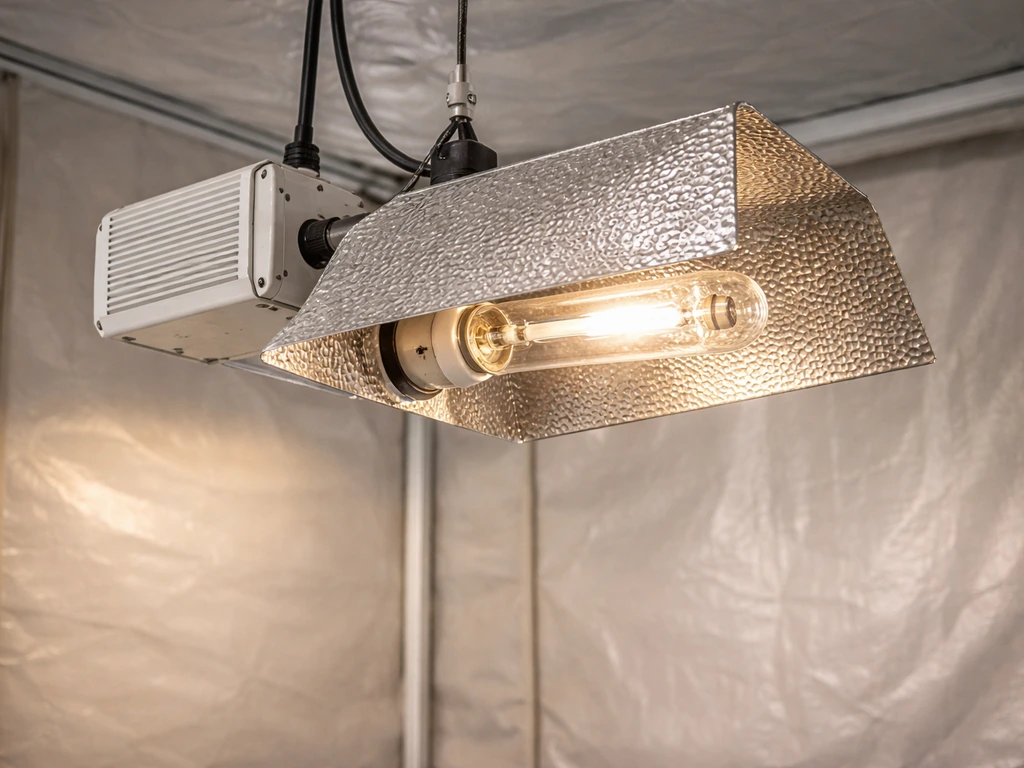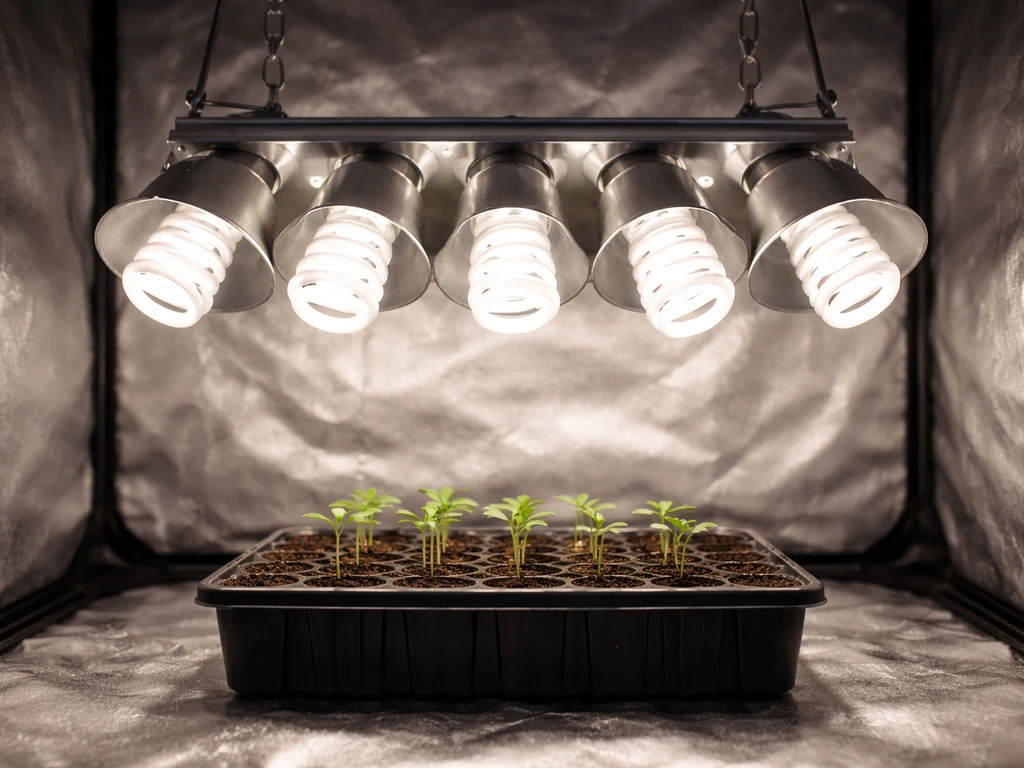
A 300W dual-spectrum CFL grow light is a reasonable option for seedlings, clones, and small vegetative grows on a tight budget, but it will leave you frustrated if you expect LED-level efficiency or try to flower anything more than a plant or two in a compact space. The '300W' label is real wattage here, not an LED-equivalent claim, so you're working with a genuine compact fluorescent that draws 300 actual watts. That's worth knowing upfront because it shapes everything: heat output, coverage, running costs, and how far it can realistically take your plants.
300W Dual Spectrum CFL Grow Light Review and Buyer Guide

Marcus Caldwell
19 May 2026
What '300W dual spectrum CFL grow light' actually means
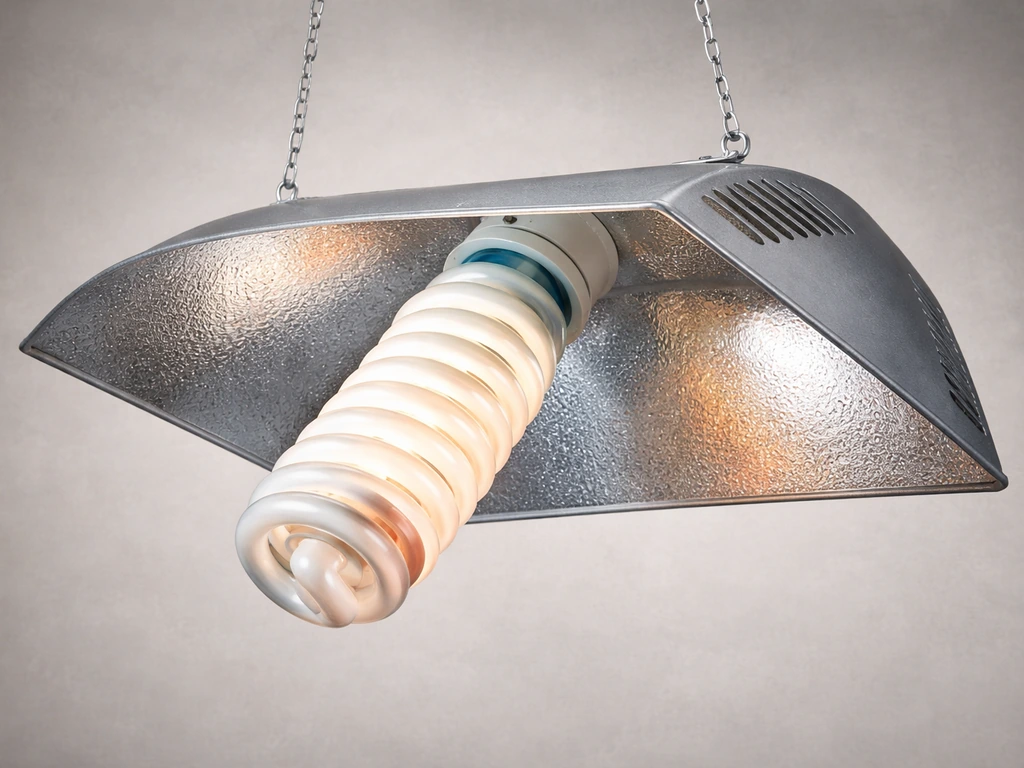
CFL stands for compact fluorescent lamp. In grow-light terms, a dual-spectrum CFL combines two color temperatures in a single bulb, typically around 6400K (cool blue) and 2700K (warm red). The 6400K side supports vegetative growth by mimicking daylight and encouraging photosynthesis, while the 2700K side pushes flowering and fruiting by replicating the warmer light of late summer. The Spectromaster CFL 300W Dual Spectrum, for example, explicitly packages these two color temperatures together so growers don't need to swap bulbs between growth stages.
The '300W' designation refers to actual electrical draw, not an equivalent rating. This is different from the way LED brands often label their products (e.g., a '300W LED' that only draws 130W from the wall). With a CFL, if the spec sheet says 300W, that's what your electricity meter sees. At that wattage, you're dealing with a physically large lamp, usually in an 8U (octuple tube) folded configuration, mounted in a reflector housing. Many 300W CFL kits, like the Growit CFL Light Kit 300W, ship the bulb with a dedicated wing reflector specifically to spread that output more evenly across the canopy.
On the output side, CFLs generally produce somewhere between 33 and 100 lumens per watt depending on wattage and form factor. A 300W unit in good condition might hit around 75 lm/W, putting total lumen output in the 20,000 to 22,500 lumen range. That sounds impressive until you compare it to T5 tubes (which can reach 93 lm/W in some configurations) or modern LEDs, which convert a significantly higher share of those watts directly into photosynthetically useful light (PAR). Lumens also measure human-perceived brightness, not plant-usable light, so the effective PAR output is what actually matters for growing.
Build quality, spectrum behavior, heat, noise, and mounting
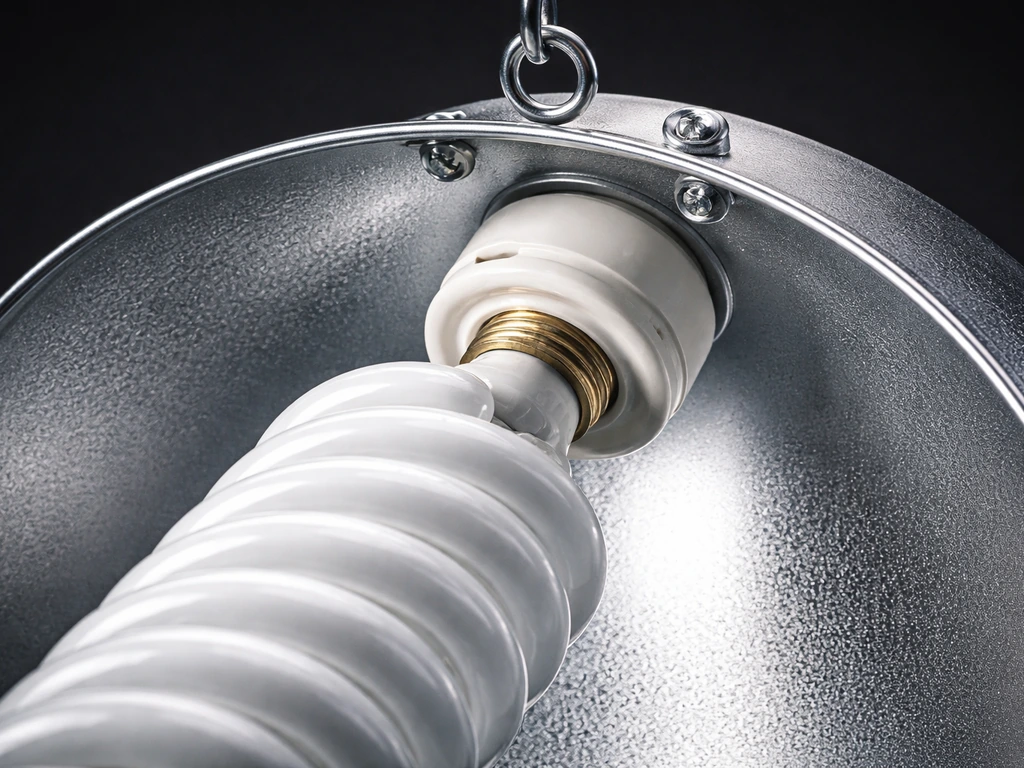
Construction and build quality
Most 300W CFL grow kits follow a similar physical format: a large spiral or multi-tube folded CFL bulb screwed into a porcelain or ceramic lamp holder, surrounded by a pressed-steel or aluminum wing reflector with a matte white or specular interior surface. The reflector quality varies quite a bit between brands. Budget kits often use thin stamped aluminum that dents easily and may not hold its shape well over repeated handling. Better units use thicker gauge material and a more consistent reflective coating. Check that the lamp holder feels solid and that the connection between bulb and socket is snug, because a loose fit leads to flickering and uneven spectrum output.
Spectrum behavior in practice
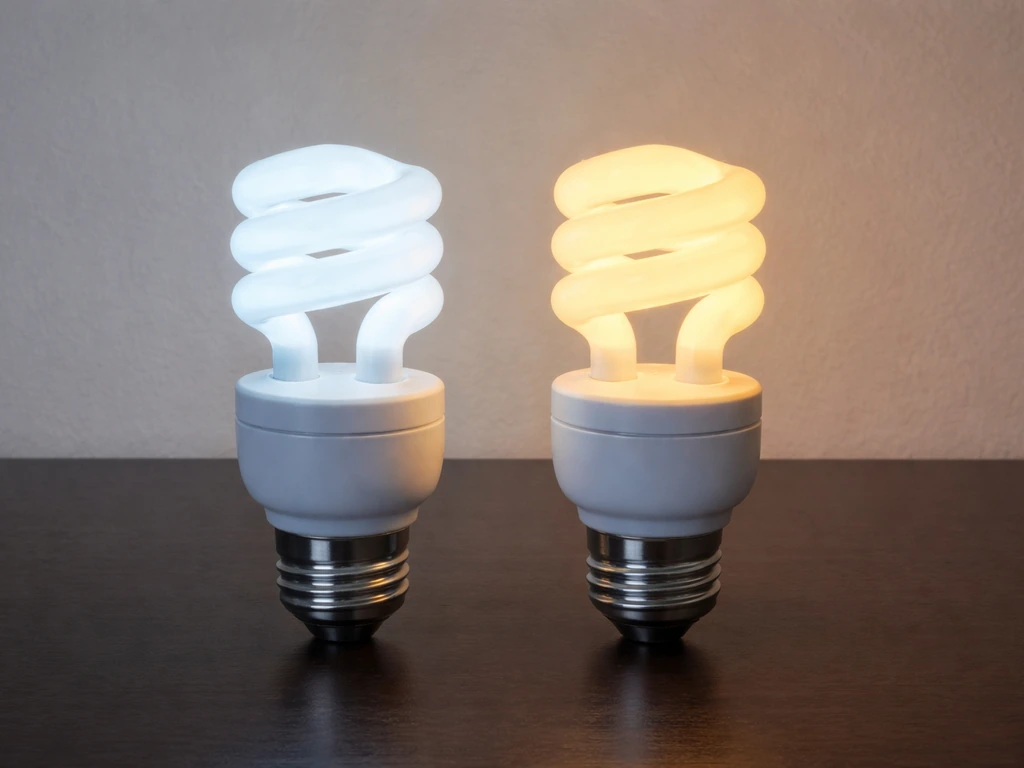
Dual-spectrum CFLs work by blending phosphor coatings inside the tube to emit at both color temperature peaks simultaneously. In practice, the blend isn't perfectly even across the canopy. You'll tend to get a slightly warmer output toward the center where intensity is highest and a cooler fringe toward the edges. For most seedling and vegetative work, this doesn't matter much. For late-stage flowering, the 2700K component is genuinely useful, but a single dual-spectrum CFL at this wattage won't deliver the kind of red-spectrum intensity that a dedicated HPS or modern full-spectrum LED provides. Think of the dual-spectrum feature as a convenience for small grows, not a replacement for stage-specific lighting in a serious flower setup.
Heat output
A 300W CFL runs warm. Not HPS warm, but warm enough to matter in a small tent or cabinet. You'll want at least 6 to 8 inches of clearance between the bulb and any nearby surface, and you'll definitely need ventilation. In an unvented 2x2 ft space without airflow, a 300W CFL can push ambient temperature up by 5 to 10 degrees Fahrenheit compared to a comparable LED. That extra heat load has to go somewhere, which means your fan and filter setup needs to account for it. The upside: in a cold basement or garage grow during winter, the residual warmth can actually be useful.
Noise and flicker
A properly working CFL grow light should be nearly silent. There's no fan in the bulb itself, so the only noise comes from your ventilation system. If you hear buzzing from the ballast, that's a sign of incompatibility or early failure. Flicker is a separate issue: [CFLs with magnetic ballasts flicker at twice the mains frequency](https://www.
bltdirect. com/do-energy-saving-bulbs-flicker-when-you-turn-them-on-2), so 100Hz or 120Hz depending on your region. In most cases this is imperceptible, but [a failing ballast or a bulb reaching end of life can make flicker visible and erratic](https://www. bulbamerica.
com/pages/are-my-compact-fluorescents-supposed-to-flicker). If you notice flickering, check the bulb connection first, then test a different outlet to rule out power supply issues. CFL grow bulbs typically have a rated lifespan around 10,000 hours, after which lumen output and spectrum quality degrade noticeably even if the bulb still lights up.
Mounting and setup flexibility
Most 300W CFL kits come with a basic rope ratchet or chain hanger. The reflector usually has a single mounting point at the top center, which limits how you can angle it. This matters more than people expect: if you're trying to side-light tall plants or cover an irregular space, a single-point center mount is limiting. Some kits include a swivel fitting that lets you tilt the reflector slightly. For hanging height adjustments, a ratchet hanger is almost mandatory because you'll be moving the light frequently as plants grow.
Real-world performance: coverage, distance, and results by growth stage
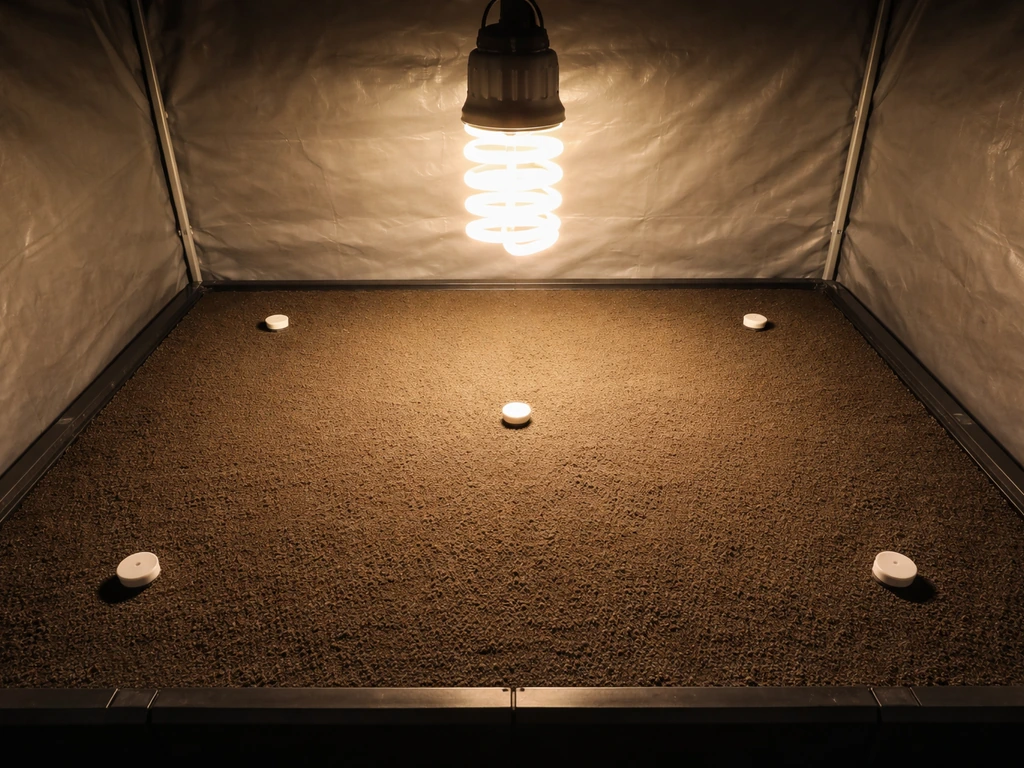
CFLs in the 300W class typically deliver a PPFD (photosynthetic photon flux density) of roughly 50 to 200 µmol/m²/s at canopy height, depending on hanging distance and reflector quality. That's the useful range for fluorescent-class lighting. To put it in context: seedlings and clones are happy with 50 to 150 µmol/m²/s, vegetative growth wants 200 to 400 µmol/m²/s, and flowering plants push for 400 to 600+ µmol/m²/s. A 300W CFL sitting at 8 to 12 inches above the canopy can hit the lower end of the vegetative range at the center of its beam, but PPFD drops off quickly toward the edges.
In practical coverage terms, a 300W CFL with a wing reflector covers roughly 2x2 ft (about 0.37 m²) adequately for seedlings and young vegetative plants. Push it to a 2x3 ft footprint and you'll notice weaker growth at the edges. For flowering, keep the footprint tighter, closer to a 1.5x1.5 ft area, to maintain enough intensity over the canopy. Distance to the canopy also changes by stage: 6 to 8 inches for seedlings and early veg, 4 to 6 inches for late veg and early flower. At those distances, watch leaf temperature with your hand test. If your hand feels uncomfortably warm after 10 seconds, the light is too close.
| Growth Stage | Target PPFD (µmol/m²/s) | Recommended Hanging Height | Effective Coverage Area |
|---|---|---|---|
| Seedlings / Clones | 50–150 | 8–12 inches | Up to 2x2 ft |
| Vegetative | 200–400 (CFL hits lower end) | 6–8 inches | 2x2 ft max |
| Flowering | 400–600+ (CFL struggles here) | 4–6 inches | 1.5x1.5 ft ideally |
Expected results are consistent with what you'd expect from a mid-power fluorescent: healthy, compact seedlings and vegetative growth, with noticeably slower and less dense flowering compared to HPS or LED at equivalent wattage. If you want a faster way to see real-world performance, browse cfl grow light reviews that compare coverage, heat, and flowering results.
If you are specifically comparing the Casalux Dual Head plant grow light, this same spectrum and intensity tradeoff will drive the results you can expect dual-spectrum CFL. If you want a quick decision based on real-world results, check the 315W cmh grow light review for how this class of setup compares 300W dual-spectrum CFL. Plants will flower under a 300W dual-spectrum CFL, but don't expect heavy yields.
This is a finishing light for small personal grows, not a production tool.
Value check: how it stacks up against LEDs and T5s
This is where the honest conversation gets uncomfortable for CFL fans. A 300W CFL draws 300W from the wall and converts roughly 75 to 85 of those watts into visible light, with a further loss when you isolate only the plant-usable PAR wavelengths.
Modern full-spectrum LEDs in the same price bracket, like the Spider Farmer G3000 (which lists a roughly 3x3 ft coverage area), are drawing 300W but delivering measured PPF values upward of 630 µmol/s with efficacy ratings around 2. 1 µmol/J. CFL efficiency in PAR delivery terms sits considerably lower.
T5 fluorescent tubes perform better than CFLs on a lumens-per-watt basis too, with T5 tubes reaching around 93 lm/W compared to most CFLs in the 70 to 85 lm/W range, and T5 fixtures distribute that light more evenly across a longer footprint.
| Light Type | Typical Efficacy | Heat Output | Coverage (300W) | Upfront Cost | Running Cost |
|---|---|---|---|---|---|
| 300W Dual-Spectrum CFL | 70–85 lm/W, lower PAR/W | Moderate-high | ~2x2 ft | Low-moderate | High (true 300W draw) |
| T5 Fluorescent (equiv.) | ~93 lm/W, moderate PAR/W | Low-moderate | 2x4 ft fixture | Moderate | Moderate |
| 300W-class LED | High PAR/W (~2.1 µmol/J) | Low | 3x3 ft | Moderate-high | Low-moderate |
The CFL wins on simplicity and upfront cost. A complete 300W CFL kit often costs less than a comparable quality LED, and there are no driver electronics to fail. But the running costs offset that advantage quickly. At average US electricity rates, 300W running 18 hours a day costs roughly $29 to $35 per month. A 300W-draw LED covering more area at higher efficiency costs the same to run but does more useful work per dollar of electricity. Over a 12-month grow cycle, the LED typically pays back its higher upfront cost through efficiency savings. For a single short grow, the CFL is fine. For ongoing growing, the math shifts toward LED.
Who should buy this light (and who should skip it)
Good fit: these growers will get real value
- Beginners starting their first indoor grow who want a simple, plug-and-play setup without configuring LED drivers or understanding quantum boards
- Growers propagating seedlings and cuttings who need gentle, even light without the intensity risk of high-power LEDs
- People running small cabinets or micro-tents in the 1.5x1.5 to 2x2 ft range who don't need to cover more ground
- Budget growers who need a functional light now and plan to upgrade later
- Growers in cold environments where the supplemental heat from a CFL is genuinely useful for maintaining tent temperature
Not the right tool: these growers should look elsewhere
- Anyone focused on maximizing flower yield, where PAR intensity and spectrum precision matter significantly
- Growers running spaces larger than 2x2 ft who need consistent coverage across the canopy
- People in warm climates or hot grow rooms where adding CFL heat makes temperature management harder
- Long-term growers who will run lights continuously for multiple cycles (the efficiency math favors LED quickly)
- Anyone comparing this to LED alternatives and expecting similar PAR output for the same wattage
If you're also exploring other CFL options or comparing against different fluorescent technologies, a broader look at CFL grow light reviews covers the category more fully, and for growers who want to understand how spectrum-specific lighting performs in more demanding grows, CDM and CMH options (like 315W CMH setups) offer a middle ground between CFL convenience and HPS-level output.
Common problems and how to fix them
Hot spots burning leaf tips
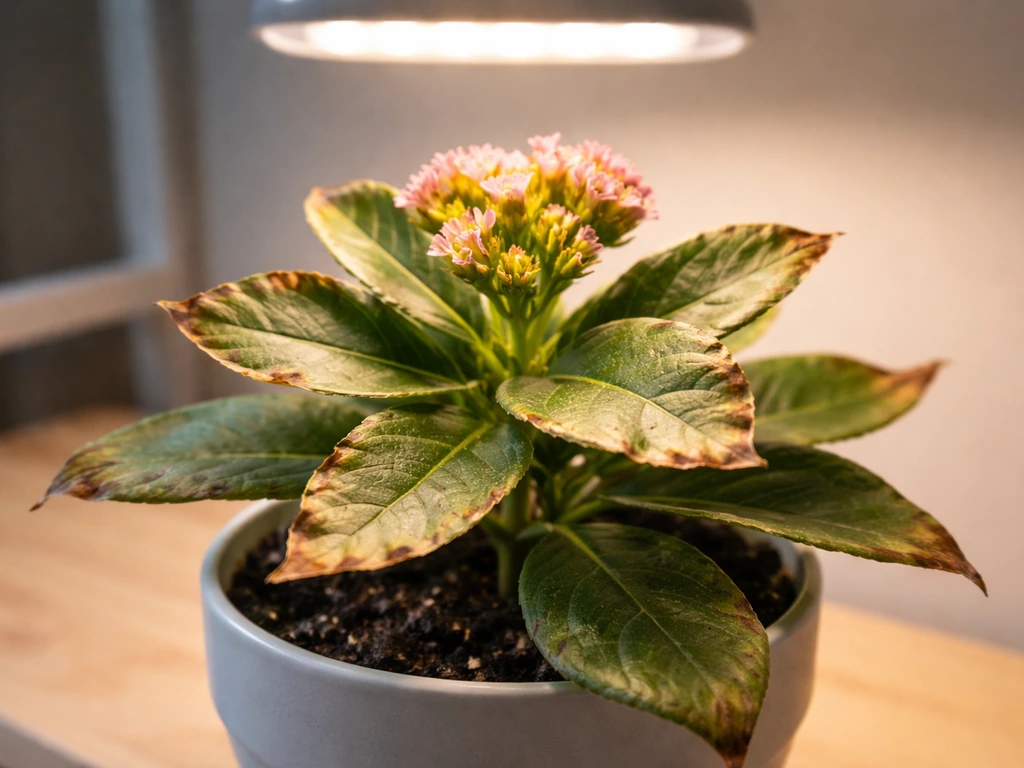
The most common issue with 300W CFLs is heat stress at the center of the canopy directly under the bulb. The bulb radiates heat downward, and if you're running the light closer than 6 inches to compensate for low PPFD, the center plants will show bleached or curled leaf tips while edge plants look fine. Fix this by raising the light and training plants to grow more horizontally (LST or low-stress training), which spreads the canopy and reduces the intensity difference between center and edge plants.
Weak or slow flowering
If plants stretch excessively after flipping to 12/12 and bud sites are sparse or airy, the CFL's PPFD during flowering is almost certainly the limiting factor. A 300W CFL simply doesn't hit the 400 to 600 µmol/m²/s that flowering plants want, especially after you account for the drop-off a few inches from center. You can partially compensate by adding supplemental side lighting (even lower-wattage CFLs angled at the bud sites from the sides), or by keeping the plant count very low and training aggressively to keep all bud sites at optimal distance from the light.
Uneven coverage across the canopy
Because a CFL is a point-ish source rather than a panel, intensity falls off quickly as you move away from center. In a 2x2 space, the corners can receive 40 to 50% less light than the center directly under the bulb. Rotating plants every few days helps equalize exposure. A well-designed wing reflector improves this, but doesn't eliminate the gradient. If your kit's reflector has dents or a worn coating, replace it. A clean, specular reflector makes a meaningful difference to edge coverage.
Flickering and ballast issues
Visible flicker at startup is normal for CFLs and usually settles within 30 to 60 seconds. Persistent flicker during operation usually means the bulb is nearing the end of its life (check hours of use against the 10,000-hour rating), the connection between bulb and socket is loose, or there's an issue with the ballast. Try a different outlet or circuit first to rule out unstable mains power. If the bulb is over 8,000 hours of use, replace it regardless. Spectrum quality and lumen output degrade significantly in the last quarter of a CFL's rated life.
Wrong light timing for growth stage
A dual-spectrum CFL makes it tempting to just leave the light on the same schedule through both stages. Use 18 to 20 hours of light per day for vegetative growth and drop to 12/12 to trigger flowering for photoperiod plants. The dual spectrum doesn't change these photoperiod requirements; it just means you don't need to swap bulbs between stages.
Verdict and what to check before you buy
A 300W dual-spectrum CFL grow light earns its place in one specific scenario: you need an affordable, simple light for a small space growing seedlings, clones, or vegetative plants, and you're not chasing maximum yield. It does that job without complexity. The dual-spectrum design is genuinely useful for avoiding bulb swaps, the setup is straightforward, and the hardware is durable enough for casual use. If you want a quick walkthrough of how the Spectromaster CFL 300W performs in practice, see our cdm grow light review dual-spectrum design. Where it falls short is efficiency and intensity for flowering, coverage area beyond 2x2 ft, and long-term running costs compared to modern LEDs.
If you're comparing this against a similarly priced T5 fixture, the T5 wins on efficiency and coverage uniformity for the same wattage. If you're comparing against a budget LED at a similar price point, the LED wins on PAR output, coverage, and running cost. The CFL wins on simplicity and upfront price, but only if you're buying it for the right application.
Buying checklist: run through this before you purchase
- Confirm your grow space is 2x2 ft or smaller. Larger than that, you'll need a second light or a different solution entirely.
- Verify the kit includes a reflector. A bare CFL bulb without a reflector wastes a significant portion of its output. Look for a wing or parabolic reflector included in the package.
- Check that the ballast is electronic, not magnetic. Electronic ballasts run cooler and reduce perceptible flicker.
- Factor in your electricity rate and run hours. At 300W true draw over an 18-hour vegetative schedule, you're looking at 5.4 kWh per day per light. Calculate your monthly running cost before committing.
- Plan your ventilation before the light arrives. A 300W CFL needs active airflow in any enclosed space. Size your inline fan and carbon filter to handle the additional heat load.
- Set a bulb replacement reminder at 8,000 hours. Don't wait for the light to fail. Replace proactively to maintain spectrum quality.
- If you're growing for yield rather than propagation, price out a comparable budget LED before finalizing. The efficiency gap is real and compounds over multiple grow cycles.
FAQ
Will a 300W dual-spectrum CFL let me skip the growth and flowering schedule changes?
No, a dual-spectrum CFL does not remove the need for a flowering trigger. You still run a photoperiod schedule (typically 18 to 20 hours for vegetative growth, then 12/12 for flowering on photoperiod strains). The benefit is convenience, not a different light chemistry that changes photoperiod requirements.
How do I know if my 300W dual-spectrum CFL will be too hot for my tent or cabinet?
For 300W CFLs, the biggest safety check is clearance and airflow. If you cannot keep at least 6 to 8 inches from the bulb to nearby surfaces and actively ventilate the space, you can quickly get localized heat stress at the canopy and higher room temperatures. In practice, a small inline fan and an exhaust path matter more than switching from one brand to another.
Can I use a 300W dual-spectrum CFL for full flowering in a 2x3 space?
Yes, but only if your setup can keep intensity where it matters. Since PPFD drops off toward the edges and center gets the most heat, late-stage flowering often turns airy if bud sites are not kept within the closer distance zone (about 4 to 6 inches for late veg into early flower). If you try to fill a larger footprint, consider fewer plants or aggressive training plus possible side lighting.
What is the best way to set hanging height if my canopy temperature is the problem?
Choose lamp distance based on leaf temperature, not only on “inches from the canopy.” Use the hand test after 10 seconds, if it feels uncomfortably warm you are too close, and if leaves stay cool you can likely raise intensity slightly by lowering the light. Also remember the center will always run warmer than corners, so leaf symptoms in the middle are an early warning.
My plants grow unevenly with the CFL, what should I troubleshoot first?
Inspect the reflector and the bulb-to-socket fit. Dents, worn coatings, or a loose socket connection can increase spectrum unevenness and lower edge output. If you see persistent hot spots or weak corners even at proper distance, replace or upgrade the reflector first before buying additional lights.
What causes CFL flicker that doesn’t go away after startup?
If you notice flicker during operation, first check bulb seating and test a different outlet or circuit to rule out power instability. If the bulb is near the end of its expected service life (around the 10,000-hour mark), replace it even if it still lights up normally, since output and spectrum quality degrade late in life.
How do I get better bud density with a dual-spectrum CFL when the yields are usually light?
A dual-spectrum CFL can help reduce the need to swap bulbs, but it cannot replace the intensity level needed for dense flowering. If you want tighter buds and higher yields, plan for shorter crop times at a lower plant count, or supplement with side lighting so flower sites get more of the light closer to the effective distance range.
Should I trust lumen numbers when comparing CFLs for plant growth?
Lumens are not the same as plant-usable PPFD. Even if two lights have similar lumen ratings, reflector quality, bulb condition, and spectral distribution can make one much better for growth. For buying decisions, treat lumens as rough brightness only, and prioritize footprint, distance flexibility, and known canopy coverage behavior.
How do I estimate monthly cost accurately between a CFL and an LED?
Yes, but your electricity cost calculation should be based on actual wall draw, since CFLs are labeled by real wattage and LEDs are often not directly comparable by watt-per-watt efficiency. Also factor your schedule, for example 18 to 20 hours/day veg plus 12/12 flowering, and consider whether you will reuse the light across multiple cycles because the longer the use, the more efficiency differences matter.
What’s the best way to handle the center-versus-edge light drop-off?
Rotate the plants, but also consider training to spread the canopy horizontally. Rotating every few days helps correct the point-source gradient, while LST reduces the intensity and heat difference between the center under the bulb and the edges. If you keep tall plants directly under the lamp, you amplify the unevenness.
Would adding smaller CFLs as side lighting improve flowering performance?
Yes, if you keep it as supplemental, not primary. Because the main CFL may not deliver enough PPFD for flowering across the whole canopy, side-angled lower-watt CFLs can improve coverage at bud sites. The key is to maintain safe distances so you avoid center heat stress while trying to boost lateral intensity.