What exactly is a "Holland Star" grow light?
The name "Holland Star" (also written "HollandStar" as one word) covers a small line of COB LED grow lights sold primarily through Amazon and third-party resellers. The model that almost everyone is actually asking about is the HollandStar X5. It shows up in listings under several names: "HollandStar X5 1500W," "HollandStar 250W COB LED," and occasionally "HollandStar X5 1500W White." All of those names point to the same physical product, a fixture built around five integrated COB LED chips arranged on a single board.
The "1500W" in the product name is a marketing wattage, not a real power draw. This is a common convention among budget Amazon grow lights where the listed wattage refers to a theoretical maximum based on individual LED chip ratings, not what the driver actually pulls from the wall. Real-world users and community reports consistently put the X5's actual wall draw at 210–250W, and the manufacturer's own product copy quietly acknowledges this, stating that the light "just consumes about 210–230W." Keep that in mind every time you see the "1500W" label.
Model identification: wattage, spectrum, and versions
There is really one core model to know: the HollandStar X5. Variations across listings are mostly cosmetic or packaging differences rather than hardware generations. Here is what the spec sheets and product listings actually say:
| Spec | What the listing claims | What real-world use shows |
|---|
| Marketed wattage | 1500W | Marketing figure only |
| Actual wall draw | 210–230W (per manufacturer copy) | 230–250W (user-reported) |
| LED type | 5x integrated COB LEDs | Confirmed by multiple growers |
| Spectrum | Full spectrum, 380–800nm | Includes visible + some IR/UV |
| Stated PPF efficiency | 2.5–2.8 µmol/s/W | Not independently verified |
| Cooling | Two fans + ventilation holes in board | Active cooling, audible fans |
| Typical coverage (bloom) | ~2x2 to 2.5x2.5 ft effective | Consistent with 250W actual draw |
The "White" version referenced in some listings appears to refer to the fixture's housing color, not a different spectrum tuning. There is no separate White-spectrum or dual-channel version in the documented line. If you see an X5 listing that claims significantly higher actual wattage or a different chip count, treat it with skepticism. Quality control across units has been inconsistent enough that some buyers have received lights that did not match the factory spec on arrival.
Coverage and hanging height
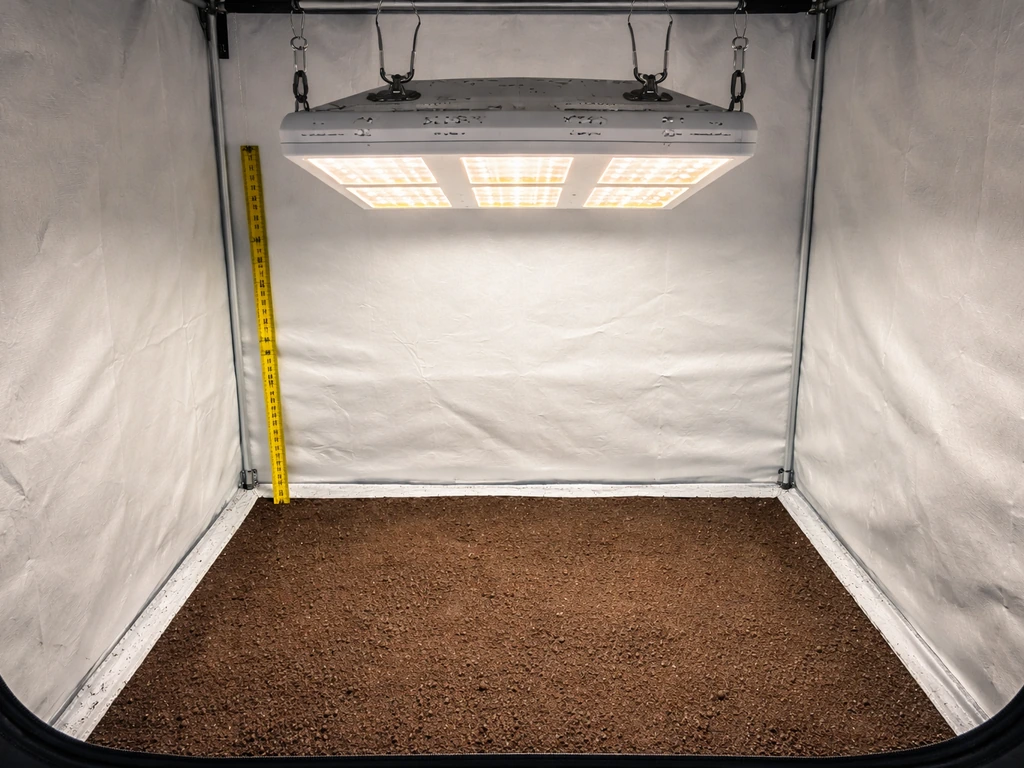
Most growers running the HollandStar X5 are working in compact spaces. The most commonly reported setup is a 24x24 inch (2x2 foot) tent or closet, which matches the light's realistic output well. One grower documented running the X5 at roughly 22 inches above the plant canopy in a 24x24x78-inch closet, which is a reasonable starting point for mid-to-late vegetative growth. At that height, the COB cluster delivers a concentrated hot spot in the center with noticeable falloff toward the edges of even a 2x2 footprint. Spread the canopy wide and the outer plants will receive meaningfully less light than those directly below the COBs.
The manufacturer claims a PPF efficiency of 2.5–2.8 µmol/s/W. At 250W actual draw, that works out to a theoretical PPF of roughly 625–700 µmol/s total. That number sounds reasonable for the price tier, but no independent grid measurement has confirmed it, so treat it as a ballpark rather than a guarantee. A canopy-focused 2×2 grow-light guide explains that 2×2 coverage math framed with PPFD, area, and electrical efficiency is why the wattage advertised on a box does not always match what you measure at canopy level why marketed wattage doesn’t always translate to measured canopy PPFD. For context, a quality mid-range LED from an established brand typically delivers verified PPF in that same range at a similar wattage, but with a more uniform distribution across the footprint.
Intensity and PPFD at common heights
Without a calibrated quantum sensor and a proper PPFD grid test, any specific numbers here would be speculation. Without a calibrated quantum sensor and a proper PPFD grid test, marketed output numbers cannot be validated at canopy level, so PPFD testing is the key way to verify claims PPFD testing at canopy level. What community data does confirm is that adjusting hanging height is the primary lever growers use to manage intensity with this light. Raising it to 24–28 inches softens the center hot spot and evens out coverage slightly, which matters more in a COB design than in a bar-style LED where the emitters are already spread out. If you are chasing 400–600 µmol/s/m² for vegetative growth, a 20–24 inch hang in a 2x2 is a reasonable starting point. For flowering targets above 800 µmol/s/m², you are likely pushing this light to its limits in anything larger than a 1.5x1.5 foot footprint.
Build quality, cooling, and day-to-day reliability
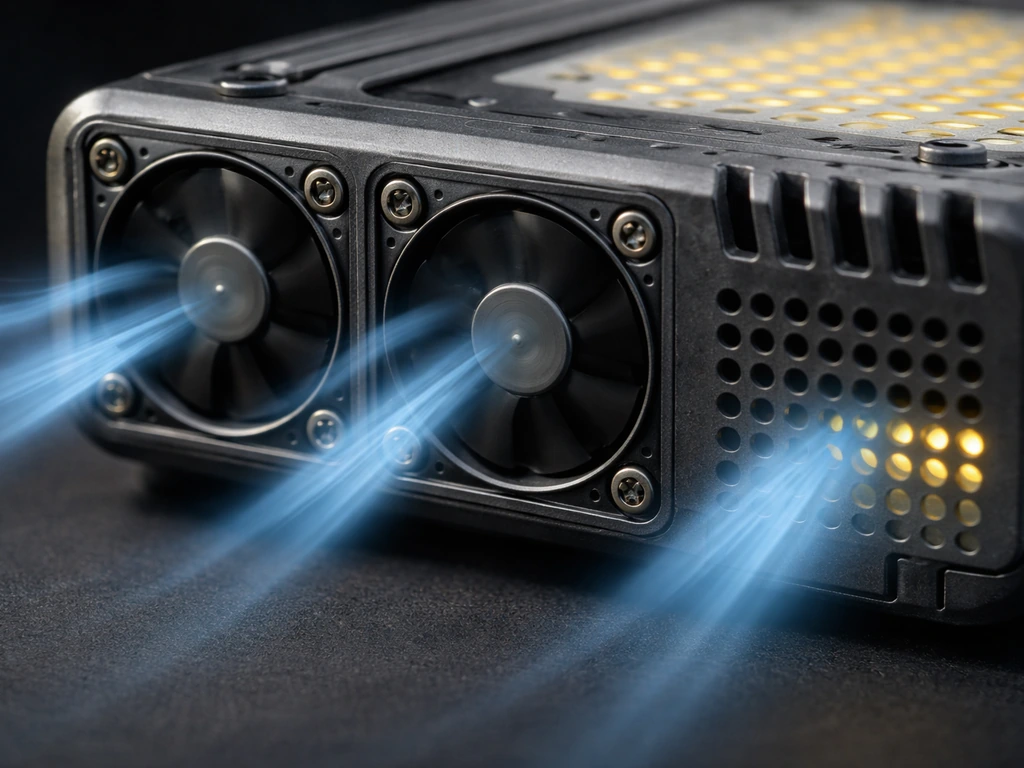
The X5 uses active cooling: two small fans built into the housing plus ventilation holes cut into the LED board itself. In practice this keeps operating temperatures manageable, but the fans are audible. In a quiet room or a small apartment grow, the fan noise is a real consideration. The housing is lightweight plastic and aluminum, consistent with the budget price point. It does not feel premium, but it functions adequately in a dry, controlled environment.
The more significant concern is quality control. There are documented cases of X5 units arriving outside factory specs, including at least one instance of a light that was confirmed to be underperforming relative to what was advertised, requiring a replacement. This is not a widespread manufacturing defect in the traditional sense, it is more a symptom of loose tolerances and inconsistent assembly that shows up across many budget COB lights sold through marketplace channels. When you buy one, plug it in and verify it actually runs at the expected wattage with a cheap plug-in power meter. If the draw is significantly below 200W, contact the seller immediately.
There is no dimmer or onboard timer on the X5. You get an on/off switch and a hanging kit. That simplicity is fine for beginners, but it means you need an external timer (a basic mechanical outlet timer works perfectly) and you have no way to reduce intensity for seedlings other than raising the fixture higher.
Value for money: price vs output vs lifespan
The HollandStar X5 typically sells in the $50–$80 range depending on the platform and seller. At 250W actual draw, that puts the cost-per-watt at roughly $0.20–$0.32/W, which is competitive at the very low end of the market. Compare that to a mid-tier option like the Mars Hydro TS 1000W LED, which draws around 150W actual but comes with verified PPFD data, a dimmer, and a more consistent build. The TS 1000 costs more per unit but delivers more confidence in what you are actually getting.
The X5's efficiency claim of 2.5–2.8 µmol/s/W, if accurate, is acceptable for a COB design but trails modern bar-style LEDs that routinely hit 2.8–3.0+ µmol/J. For a full brand-level comparison that includes efficiency ratings across price tiers, the Mars Hydro grow light review is a useful reference because it shows what a few more dollars buys in measured output consistency. On lifespan, COB LEDs generally hold up well if the thermal management is adequate. The X5's active cooling is a positive sign, but the driver quality on budget lights is often the weak link. Realistically, plan for 2–3 years of regular use before output degradation becomes noticeable, rather than the 50,000-hour theoretical LED lifespan.
Warranty coverage on marketplace-sold units like the X5 varies significantly by seller. Some listings offer a 1-year warranty through the reseller, others offer nothing meaningful. Always buy from a seller with a clear return policy, because the QC variability makes that protection genuinely useful.
Where this light actually works well
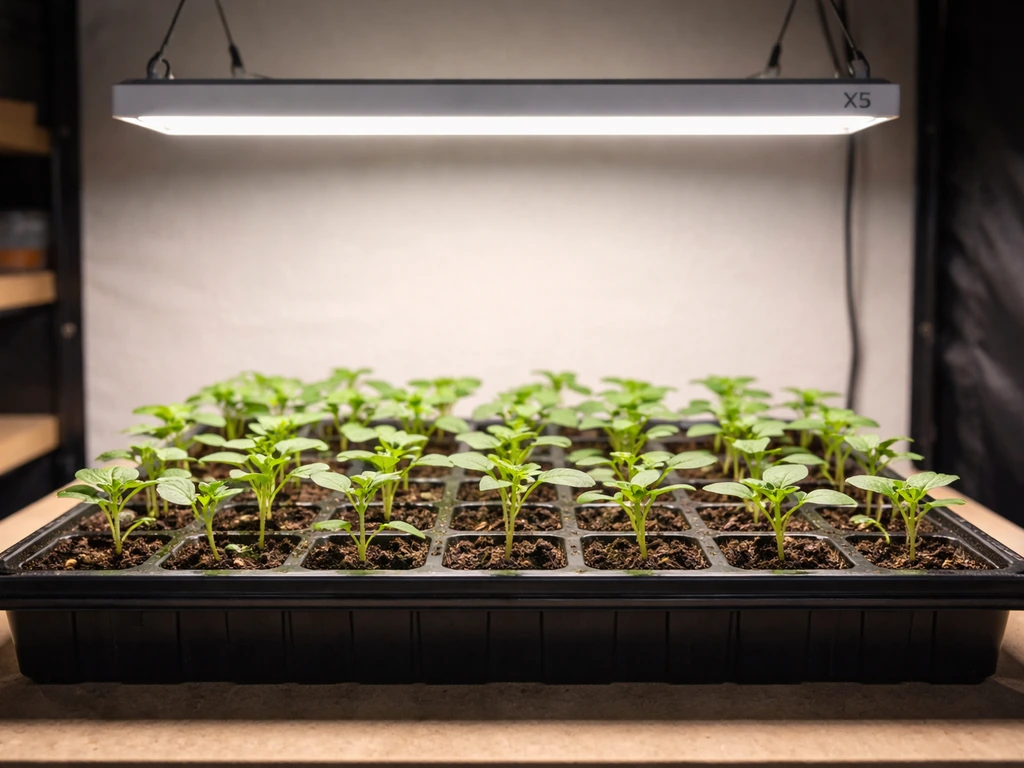
The HollandStar X5 fits a specific and honest set of use cases. Stretching it beyond those will lead to frustration.
- Seedlings and early veg: Hang at 24–30 inches, and the X5 provides adequate intensity without burning tender seedlings. This is arguably the light's strongest use case.
- Vegetative growth in a 2x2: With the light at 18–22 inches, the X5 can sustain healthy veg growth for most fast-growing annuals, herbs, and leafy greens.
- Flowering in a 1.5x1.5 to 2x2 space: The center of the footprint gets adequate intensity for modest flowering performance, but do not expect the canopy uniformity of a quality bar-style LED.
- Herbs and leafy greens: Low light-demand crops like basil, lettuce, spinach, and mint are well-suited to the X5's output. These plants do not need the upper end of the PPFD range, so the light's limitations matter less.
- Cannabis in a micro grow: Possible in a 2x2 with realistic expectations. You can get plants through veg and flower, but yield will be limited by the light's coverage uniformity and the absence of dimming control during early stages.
For cannabis specifically, a lot depends on how you manage the grow. If you are running autoflowers in a 2x2 closet, the X5 is workable as a starter light. If you are trying to maximize yield in a 3x3 or larger, it will not cover the space adequately and you will see the edges of the canopy suffer. In that situation, you would be better served by something with more even distribution. For comparison, even entry-level options reviewed on this site, like the Marswell LED grow light, offer better documented coverage footprints for that space.
If your budget is genuinely constrained and you are comparing the Holland Star to something like the lighting fixtures sold at big-box hardware stores, the COB LED design in the X5 is a step up. A harbor freight grow light review illustrates that category well, and the HollandStar holds its own against those options in both spectrum quality and intensity. It is also a clear upgrade over seed-starting panel lights. For reference, the Ferry Morse grow light is another comparable budget option worth checking if you are weighing alternatives at a similar price point.
Setup tips and how to get the most from this light
Hanging height by growth stage
- Seedlings (first 1–2 weeks): Start at 28–32 inches above the tray. COB hot spots can stress seedlings if hung too close.
- Early vegetative (weeks 2–4): Lower to 22–26 inches as plants establish. Watch for light bleaching on the newest growth directly below the COBs.
- Late vegetative: 18–22 inches is a practical range for most plants in a 2x2. Check for any leaf curling or bleaching on center plants.
- Flowering: 16–20 inches for most flowering crops. The COB center column will be your most productive zone, so train plants toward it.
Pairing with other gear
Because the X5 has no onboard timer, an external mechanical or digital outlet timer is essential. Set it before you plug in the light, not after. For seedlings and veg, an 18/6 schedule (18 hours on, 6 hours off) is standard. For flowering cannabis, switch to 12/12. For herbs and greens, 16/8 works well and keeps electricity costs down.
Ventilation matters more than most beginners expect. The X5 generates real heat at 250W, and in a sealed 2x2 tent without airflow, canopy temperatures can climb quickly. A small inline fan exhausting air through the top of the tent, combined with passive intake at the bottom, will keep the environment stable. Aim for canopy temperatures in the 72–82°F range. If the tent runs hot, raise the light and increase exhaust airflow before making any other adjustments.
Reflective walls help significantly with a COB light. If you are using a tent, the Mylar walls are already doing this job. If you are growing in a closet or box, line the walls with white paint or reflective film to bounce the light that misses the canopy back toward the plants. This is especially important at the edges of a 2x2 footprint where the COB falloff is steepest.
Finally, verify your unit with a plug-in power meter when it arrives. A sub-$15 outlet watt meter will tell you immediately if your X5 is drawing in the expected 210–250W range. If it reads significantly below 200W or shows erratic readings, contact the seller right away. This one step will save you weeks of wondering why your plants are not responding the way they should.