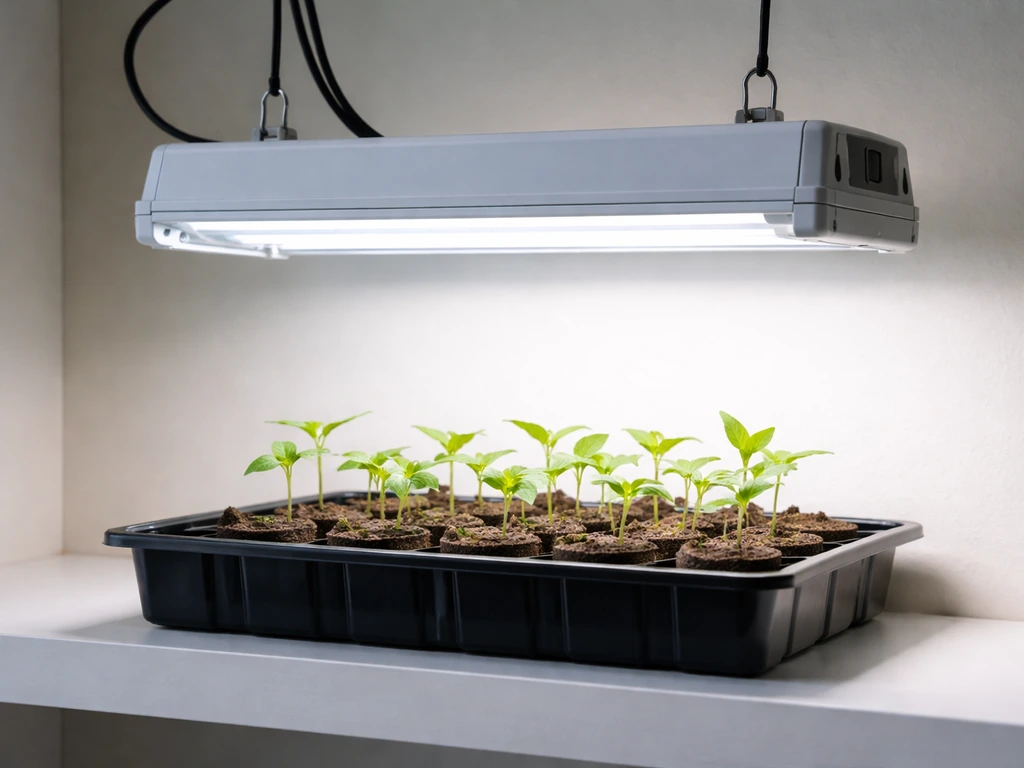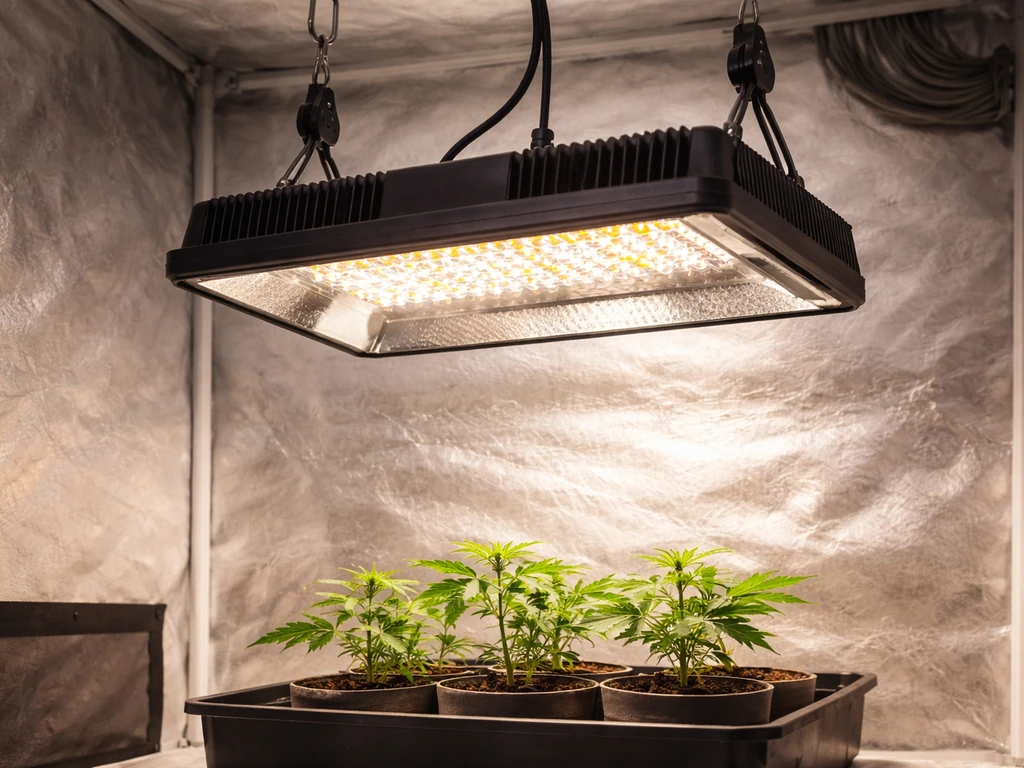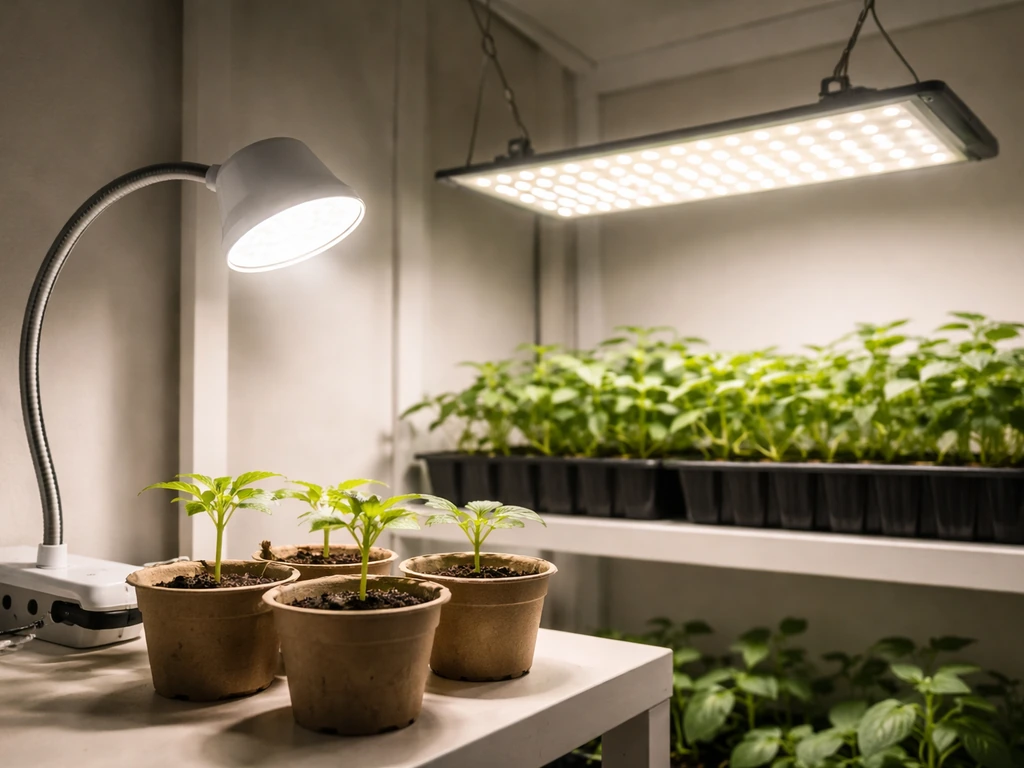
The Jhotec 1000W LED grow light (model GRL-001) is a budget-tier, full-spectrum fixture that works reasonably well for seedlings, herbs, and small vegetative grows, but it falls short of what serious flowering plants need from a dedicated grow light. It carries a 3.8 out of 5 average rating across buyer reviews, and the specs tell a familiar story for this price bracket: decent coverage for a compact space, active fan cooling, remote control, and a full-spectrum diode mix that includes 450nm blue, 660nm red, UVA, and assisted green. It is not the light I would recommend for a demanding flower cycle, but for a 2x2 or small herb shelf, it punches close to its weight.
Jhotec Grow Light Review: Worth It for Indoor Plants?

Marcus Caldwell
19 May 2026
What the Jhotec grow light actually is
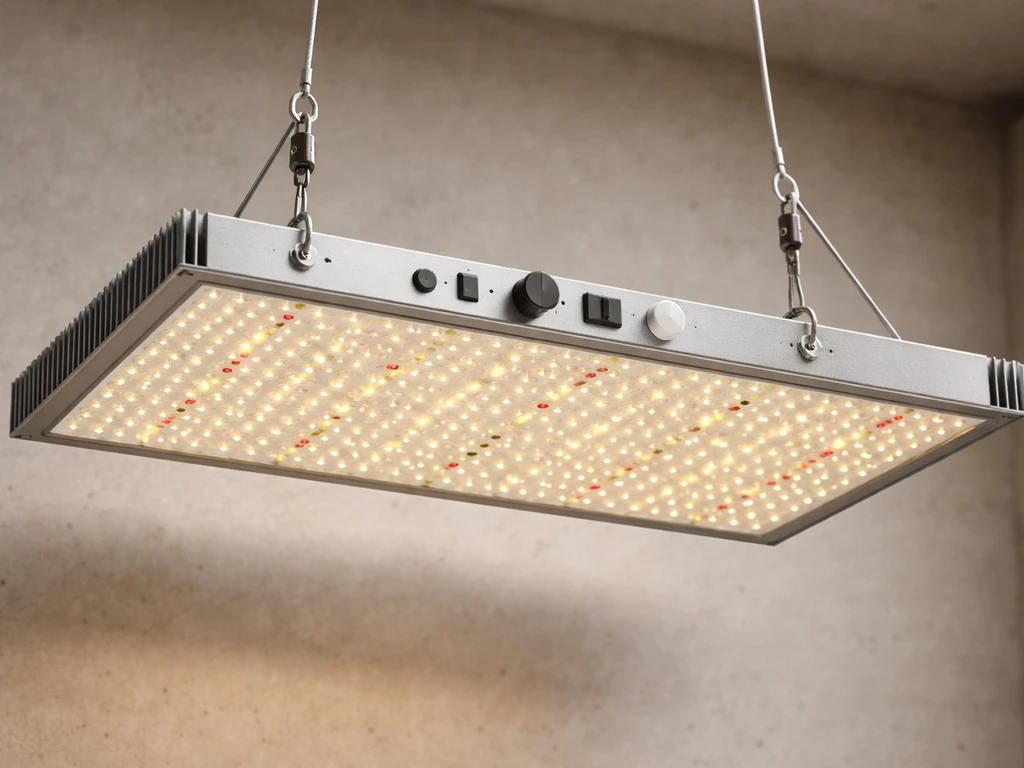
The most commonly searched variant is the Jhotec 1000W LED, sold under MPN GRL-001 and ASIN B07FP7816B. Like most lights in this class, the '1000W' label is a marketing equivalent, not the actual draw from the wall. The real power consumption is substantially lower, which is typical of blurple-adjacent budget LEDs that borrow watt figures from theoretical HPS comparisons rather than actual electricity use.
The spectrum is full-spectrum in the broad sense: primary emitters at 450nm (blue) and 660nm (red) are the workhorses, supplemented by UVA chips and some green-wavelength LEDs. The beam angle is 120 degrees, and the listed luminous flux is 25,000 lumens. At one meter distance the fixture measures around 18,000 lux, dropping to roughly 15,000 lux at 1.5 meters. Those are lux figures, not PPFD, so take them as relative brightness indicators rather than precise photosynthetic output measurements. The claimed efficiency rating is 1.60 umol/J, which is on the low end by 2025-2026 standards but acceptable for the price tier. Rated lifespan sits between 50,000 and 100,000 hours.
There is also a Jhotec 600W variant that shows up in real-world grow journals, including a White Widow seed-to-harvest grow documented on GrowDiaries. A GrowDiaries entry documenting the White Widow grow specifically references the JHOTEC Light Emitting Diodes 600W variant, showing it is used by at least some real-world growers a White Widow seed-to-harvest grow documented on GrowDiaries. That version is essentially the same platform scaled down, and most of what applies to the 1000W applies to the 600W proportionally.
Who this light actually suits
The Jhotec is a beginner-to-intermediate light, and I mean that as a description rather than a criticism. If you are starting seedlings, growing herbs on a shelf, running leafy greens like lettuce or spinach, or taking cuttings through a vegetative stage before moving them under a more powerful fixture, this light does what it needs to do without a steep learning curve or a steep price.
Where it starts to struggle is sustained, high-demand flowering. Cannabis, tomatoes, and other fruiting plants in full flower need considerably more photosynthetic intensity than this fixture reliably delivers across a full canopy. Growers who have used it for flowering report results, but they tend to see lighter yields and longer cycles compared to growers using higher-efficiency fixtures in the same footprint.
- Seedlings and clones: strong fit, the adjustable hanging height and lower intensity protect delicate early-stage plants
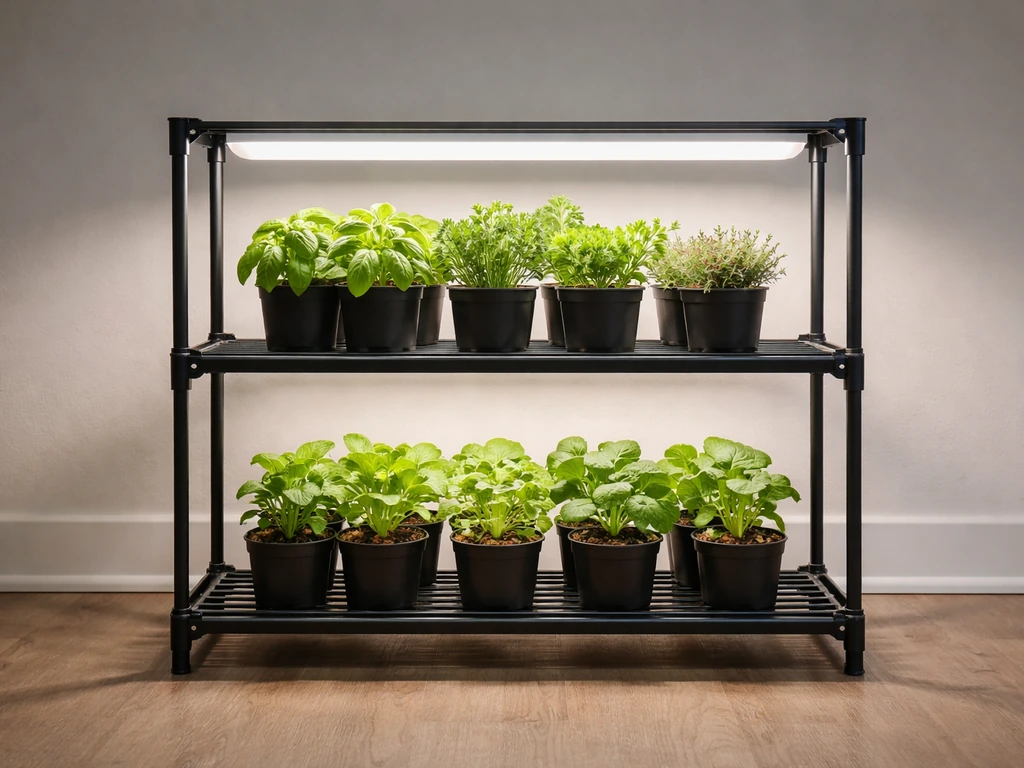
- Vegetative herbs (basil, mint, cilantro) and leafy greens: good fit for a small shelf or countertop garden
- Vegetative stage for larger plants before moving to a dedicated flower light: works well
- Flowering stage for low-demand plants like autoflowers in a 2x2: marginal but workable with careful positioning
- Heavy flower cycles or anything larger than a 2x2 to 2x3 footprint: not the right tool
Coverage and real-world performance
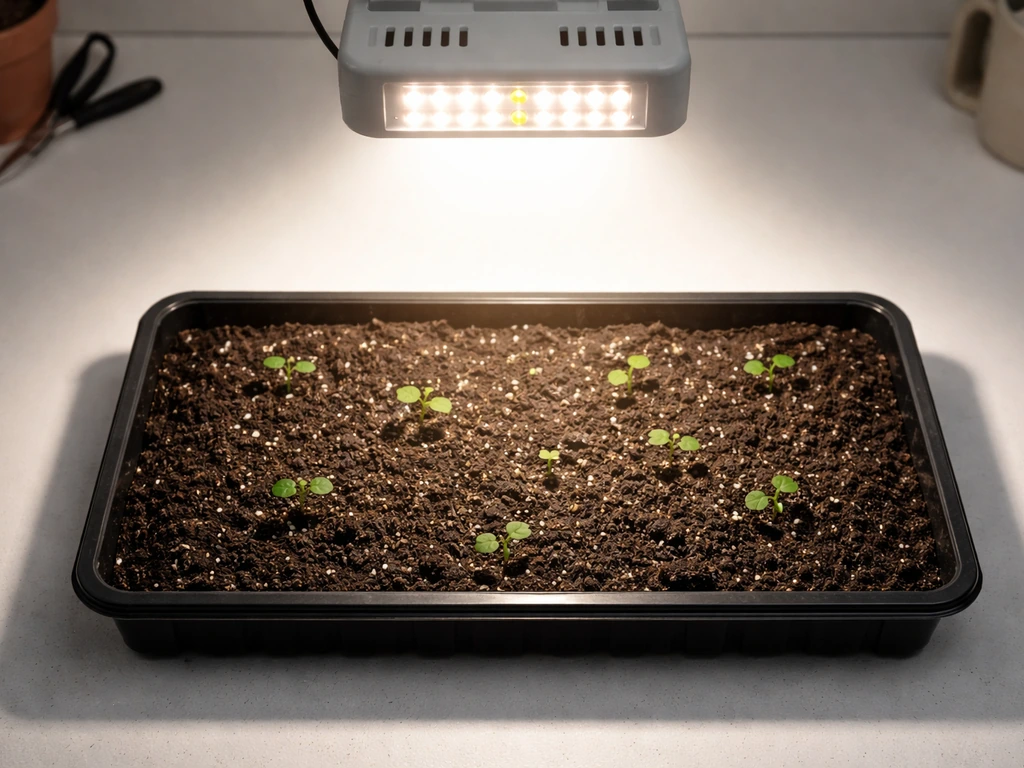
The 120-degree beam angle and the lux figures from the listing suggest a practical coverage footprint of roughly 2x2 to 2x3 feet for vegetative growth, shrinking to a tighter core area for flowering where you want higher intensity. Buyer reports broadly confirm this: users keeping the light about 24 inches from the canopy describe 'great coverage' for compact grows. At 1.5 meters the lux drops about 17 percent from the one-meter reading, which is a normal falloff curve for this form factor.
What the spec sheet does not tell you, and what no independent PPFD measurement has been published for this specific model, is the actual umol/m2/s at canopy level. The claimed 1.60 umol/J efficiency figure is a useful proxy: it is lower than modern quantum board LEDs (which commonly land at 2.5 to 2.9 umol/J), meaning you are getting less photosynthetic output per watt. For seedlings and herbs that threshold is fine. For flowering plants that need 600 to 900 umol/m2/s at the canopy, you are relying on running the light close and accepting uneven distribution at the edges.
The GrowDiaries journal using the 600W variant completed a full White Widow grow from seed to harvest, which is the most meaningful real-world validation available for this brand. No measured yield figures were captured in the research, but the fact that a grower ran it to completion on a notoriously light-hungry strain is at least a proof of concept, even if optimized results would likely require a more powerful fixture.
How to set it up for best results
The manufacturer's recommended hanging distances give you a practical starting framework, and they are reasonable guidelines even if you should tune based on what your plants tell you.
| Plant Stage | Recommended Height | Notes |
|---|---|---|
| Seedling | 24 to 30 inches above canopy | Higher end of range for very young seedlings to avoid stress |
| Vegetative growth | 18 to 24 inches above canopy | Move down as plants establish and show no stress signs |
| Bloom / flowering | 12 to 18 inches above canopy | Lower position maximizes intensity where the light is weakest |
For photoperiod scheduling, the listing provides sensible defaults: 18 hours on / 6 hours off or 20 hours on / 4 hours off for vegetative growth, and 12 hours on / 12 hours off for flowering. Those are standard industry recommendations and a safe place to start. The fixture comes with remote control, so switching between schedules or adjusting on the fly is straightforward.
Coverage planning is simple at this scale. For a 2x2 tent or shelf, one unit centered overhead is adequate for seedlings and veg. If you are running a 2x4 or larger footprint, plan on two units or accept that the outer edges of your canopy will receive less light. Do not try to stretch a single Jhotec 1000W to cover more than about 6 square feet in vegetative mode or 4 square feet in flower mode without expecting diminishing returns toward the edges.
Troubleshooting common setup problems
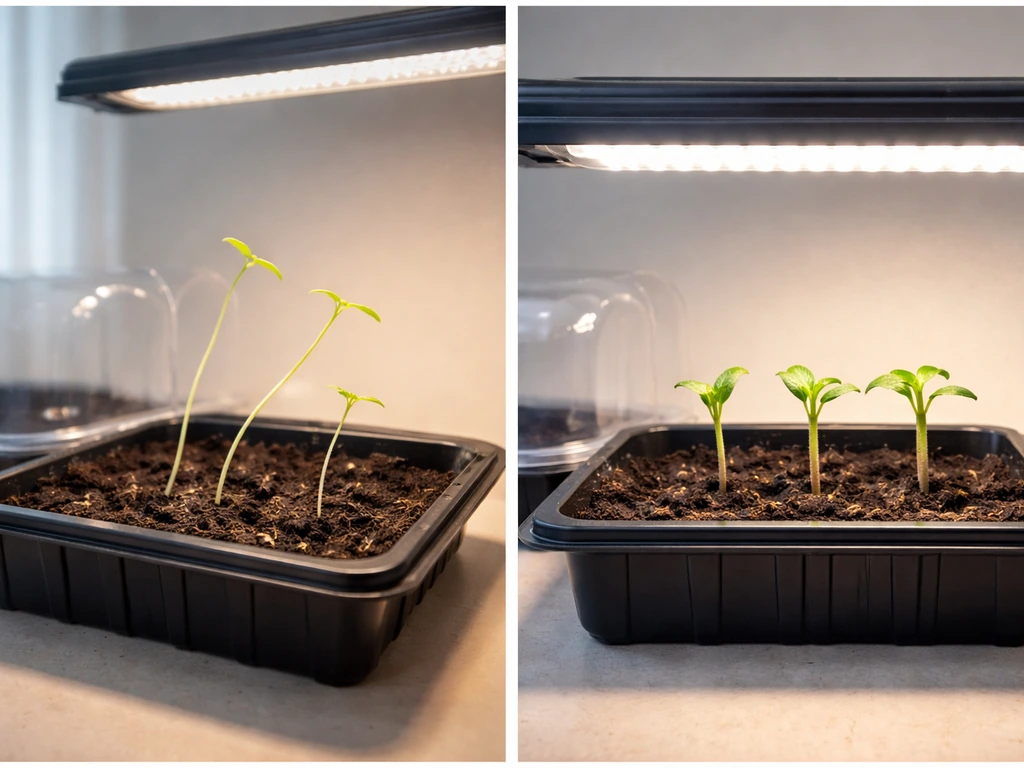
- Stretching or leggy seedlings: light is too far away or schedule is too short. Drop the hanging height to 24 inches and make sure you are running at least 18 hours of light per day during veg
- Leaf bleaching or tip burn: light is too close. Raise it by 4 to 6 inches and monitor for 48 hours before adjusting further
- Slow or weak vegetative growth: check that the fan is running (active cooling failure will throttle output), and confirm you are not running the light at a reduced dimming setting unintentionally
- Uneven canopy: rotate plants every few days or train them to keep the tops at a consistent distance from the light
Build quality, heat, and daily use
The Jhotec uses active fan cooling, which is the standard approach in this price range. The fans are described by buyers as whisper-quiet, and that matches the operating temperature spec: the fixture is rated to run in ambient conditions from -20 to 40 degrees Celsius, which is a reasonable range for most indoor grow environments. Active cooling does mean moving parts that can eventually wear out, but at this price point it is an acceptable trade-off, and the 50,000 to 100,000 hour LED lifespan far exceeds the practical life of the fans.
The remote control is a genuine daily convenience. Being able to adjust settings without reaching into a tent or repositioning a ladder is the kind of small thing that matters when you are checking plants every day. The build itself is typical budget LED construction: a metal housing, nothing exceptional, nothing obviously fragile. It is not going to win awards for fit and finish, but it is solid enough for a home grow environment.
Heat output is modest compared to HID equivalents, which is one of the real advantages of LED even at the budget tier. You are not going to need to redesign your ventilation setup around this light.
Is it worth buying? Value and alternatives
At its typical price point, the Jhotec 1000W is competing with a crowded field of budget LEDs: lights from Mixjoy, Giixer, Juhefa, and similar brands all occupy the same general tier. If you are also considering a Mixjoy LED grow light, it is worth comparing efficiency and canopy coverage against this Jhotec model. The 3.8 out of 5 rating from buyers is honest middleground: people who use it in small spaces for low-demand plants tend to be satisfied. People who push it into flowering or large spaces tend to feel it undershoots.
Compared to the Giixer 1000W and similar wattage-class competitors, the Jhotec holds its own on coverage and spectrum basics. If you are also considering the Giixer 1000W LED grow light, these Giixer 1000W LED grow light reviews are a useful comparison point for flowering expectations. Giixer LED grow light reviews often focus on how their efficiency and canopy coverage compare to budget blurple-style fixtures Giixer 1000W.
The remote control is a feature not every budget light includes, and the quiet fans are a practical advantage. Where Jhotec falls behind is the efficiency figure: 1. 60 umol/J is lower than what some competitors in the same price bracket have started to offer, and that gap matters when you are trying to push flowering plants.
If flowering performance is your primary goal, spending a bit more to step up to a quantum board design (even a basic HLG or Spider Farmer entry model) will get you noticeably better results per dollar over the life of the light.
| Feature | Jhotec 1000W | Typical Budget Competitor (e.g. Giixer 1000W) | Entry QB (e.g. SF-1000) |
|---|---|---|---|
| Claimed wattage | 1000W (marketing) | 1000W (marketing) | 100W actual draw |
| Spectrum | Full spectrum, 450nm + 660nm + UVA | Full spectrum, similar blend | Full spectrum, white + red |
| Efficiency (umol/J) | ~1.60 | ~1.5 to 1.8 (varies by model) | ~2.5 to 2.9 |
| Cooling | Active fan (quiet) | Active fan | Passive heatsink |
| Remote control | Yes | Some models | Sometimes app/timer |
| Best use case | Seedlings, herbs, small veg | Seedlings, herbs, small veg | Seedlings through heavy flower |
| Approximate price tier | Budget | Budget | Mid-range |
If you are deciding between the Jhotec and other budget alternatives like the Mixjoy or Juhefa lights, the differences are marginal enough that availability, price on the day you are buying, and warranty terms are often the deciding factors. None of them are meaningfully better or worse for seedling and herb growing. For flowering, the honest recommendation is to step up to a quantum board if your budget allows it.
The bottom line: pros, cons, and who should buy it
- Pros: affordable entry price, full spectrum with UVA, remote control included, quiet active cooling, solid lux output at short distances, adequate for seedlings and herbs in a 2x2 footprint
- Pros: easy to set up with clear stage-based height guidance, reasonable 50,000+ hour LED lifespan
- Cons: 1.60 umol/J efficiency is below current standards, limiting its usefulness for demanding flower cycles
- Cons: no independently verified PPFD data published, so you are working from proxy lux figures and buyer reports
- Cons: active fans mean moving parts that will eventually need attention, unlike passive-cooled quantum boards
- Cons: 2x2 to 2x3 coverage ceiling limits scalability
Buy the Jhotec 1000W if you are growing seedlings, herbs, or leafy greens in a small space and want a simple, affordable fixture with remote control and a full spectrum. It will do the job without drama. Skip it if flowering performance is your main goal, if your footprint is larger than a 2x3, or if you want the efficiency that justifies the electricity cost over a multi-cycle season. In that case, the modest extra spend on an entry-level quantum board will pay for itself in plant performance and power savings within a few grows.
FAQ
Is the “1000W” on the Jhotec grow light the actual power draw from the wall?
No. Like most budget LEDs, the “1000W” label is marketing. Your electricity cost will be based on the real wattage consumption, which is typically far lower than the label implies. If the listing does not clearly state watt draw, look for an input power rating in the specs before buying.
Does the Jhotec 1000W work for flowering if I keep it closer to the plants?
It can work, but you are trading yield and uniformity for extra intensity. Because the real photosynthetic output at the canopy is not independently measured, the safer approach is to run it for vegetative stages or low-demand flowering, and plan on tighter spacing or supplemental lighting if you want full-canopy consistency.
What canopy size should I target for the best results?
For veg, aim around a 2x2 to 2x3 foot area with the light centered. For flowering, expect diminishing coverage toward the edges, so either reduce your canopy to roughly a 2x2 or use multiple units for larger areas. If you see faster growth in the center than the sides, that is your cue to shrink the usable footprint or add another light.
How high should I hang the Jhotec grow light from my plants?
Start with the manufacturer’s recommended hanging distances, then tune based on plant response. Because you are dealing with lux rather than measured PPFD for this exact model, watch for stress signals like bleached tops (too close or too long) or stretched growth (too far or too weak).
Is the remote control useful, or is it just a gimmick?
It is genuinely practical if you frequently adjust height, schedules, or intensity settings while checking plants daily. That said, the remote cannot fix coverage limits, so it is best used for schedule timing and day-to-day tweaking rather than expecting it to overcome a too-large canopy.
Do I need a separate timer, or can I rely on the light’s built-in scheduling?
Use a basic plug-in timer if the light does not provide reliable schedule memory. Even if the fixture offers on/off timing presets, having an external timer can prevent accidental light-cycle interruptions when you change outlets, power strips, or tent setups.
Will the active fan cooling add maintenance or noise problems over time?
Fans are a normal trade-off at this price. Budget reviews commonly describe the fans as quiet, but the main risk is long-term wear. If the light will run daily for many months, plan for occasional dust cleaning and keep airflow around the fixture unobstructed to prevent fan strain.
What temperature and ventilation conditions should I plan for?
The fixture is rated for a broad ambient range, but indoor grow success still depends on how hot your tent runs overall. Since the heat output is modest for an LED, you can often keep ventilation simpler than HID setups, but you still need stable air exchange and humidity control, especially during flowering.
Does this light’s spectrum actually matter for seedlings versus flowering?
Yes, but in different ways. The blue (around 450 nm) helps keep vegetative growth compact, and the red (around 660 nm) supports growth and flowering transitions. However, spectrum completeness does not guarantee enough canopy intensity, so spectrum is only part of the decision for fruiting or high-demand flower stages.
Is it safe to expect “even” light across the whole tent with one unit?
Not guaranteed. The wide beam angle and budget diodes mean you can get decent coverage in small tents, but flowering often suffers at the edges. If your plants show uneven canopy development, correct it by lowering the light closer, reducing canopy width, rotating plants, or adding a second unit.
How do I estimate whether this Jhotec will cover my plants without PPFD data?
Use lux only as a rough brightness indicator, not a PPFD predictor. A practical method is to measure how quickly your plants recover and grow at your set height, then compare internode stretch, leaf posture, and canopy uniformity against your previous lighting. If growth slows or you see edge lag, assume the light is under-delivering in intensity.
Should I choose the Jhotec 600W or 1000W version for my setup?
Pick based on footprint and stage needs, not the marketing watt number. If your grow area is under roughly 2x2 feet and you mostly do seedlings, herbs, or leafy greens, the 600W can be enough. For flowering or if you want more usable intensity at practical hanging heights, the 1000W variant gives you more headroom, but it still has limitations in larger canopies.
What’s the biggest common mistake when buying a budget grow light like this?
Trying to “oversize” the light for the tent and expecting strong edge-to-edge flowering. Budget LEDs often look fine in photos or small test setups, then fall short when you run a full canopy through a high-demand bloom cycle. Match the light to a realistic footprint, then add a second light if you need uniformity.