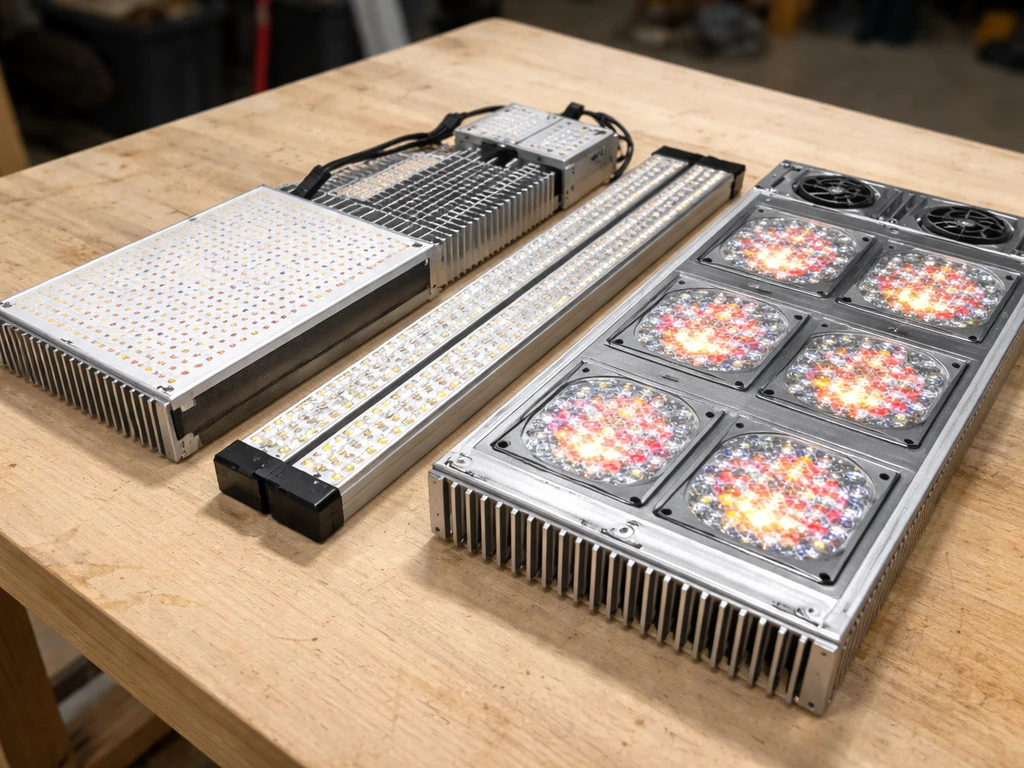
Agrobrite grow lights are fluorescent T5 systems, not the LED quantum-board or bar-style fixtures you might be comparing them against. That single fact shapes almost every buying decision here. They are a Hydrofarm exclusive brand, built around 6400K daylight-balanced T5 tubes in powder-coated steel housings with specular aluminum interiors. If you walked in expecting a modern LED with red/blue spectrum switching and PPFD data sheets, you are looking at a different category of product entirely, and that matters for how you evaluate the price, the coverage, and whether it suits your grow.
Agrobrite Grow Lights Review: PPFD, Coverage, Costs, and Buy vs Skip

Marcus Caldwell
14 Apr 2026
What Agrobrite actually is: models and spectrum
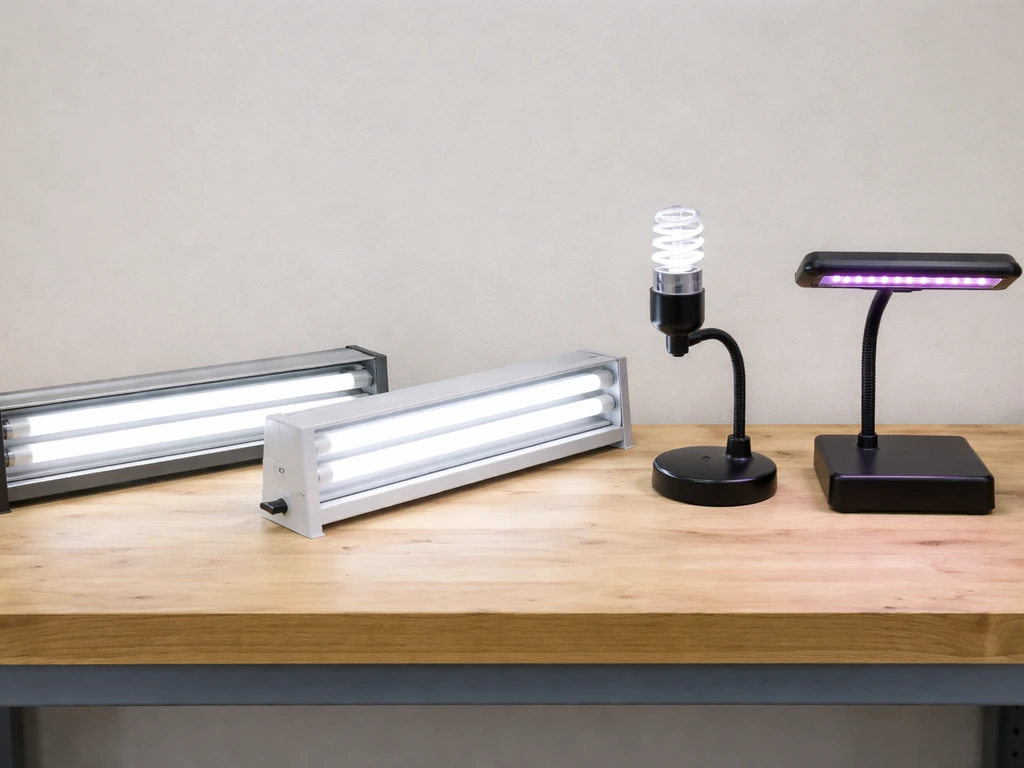
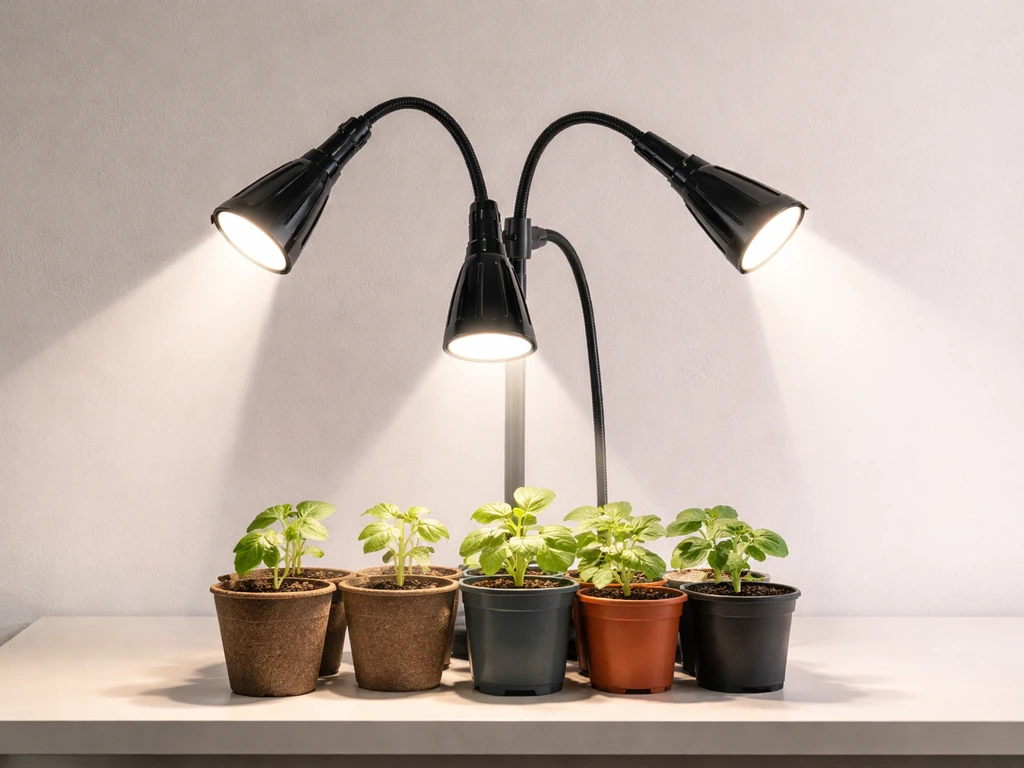
Hydrofarm's current Agrobrite lineup covers several T5 fluorescent fixture sizes, a small CFL desktop/standing lamp family, and a handful of compact desktop LED units. The T5 systems are the heart of the brand. The main SKUs you will encounter are the FLT22 (48W), FLT24 (96W, 2-foot 4-tube), FLT28 (192W 8-tube), FLT44, FLT46, and the larger FLT48. Lumen outputs scale accordingly: the FLT24 is rated up to 8,000 initial lumens, the FLT44 up to roughly 20,000, and the FLT48 up to 40,000. On the smaller end, there is also the Agrobrite Standing CFL Plant Lamp at 27W (SKU FLF27DF) and a 14W desktop LED unit, but those are supplemental lights, not primary grow drivers.
Every T5 model uses 6400K tubes. That is a single, broad daylight spectrum. There is no veg/bloom toggle, no separate red-channel switch, and no customizable spectrum breakdowns. Some fixtures include multiple on/off switches so you can dial down tube count (and therefore intensity and power draw), but the color temperature stays constant at 6400K throughout. Many models hang three ways: overhead, vertical, or horizontal, which gives you flexibility in small tents or shelf setups. The interior reflectors are rated at 86% reflectivity (specular aluminum), which meaningfully improves light delivery compared to bare white interiors.
Worth noting: the FLT24 is listed as "No Longer Stocked" on Hydrofarm's own site as of this writing. If you are shopping for that specific model, check availability carefully before planning your setup around it.
Performance testing: what the numbers actually tell you
Here is the honest situation with Agrobrite performance data: Hydrofarm publishes lumen ratings, not PPFD maps. The FLT24 is rated at 96W and up to 8,000 initial lumens. That is useful for comparing fixtures within the fluorescent category, but it does not directly answer the question most indoor growers care about, which is how many micromoles of photosynthetically active radiation hit your canopy per square meter per second. No manufacturer-provided PPFD charts exist for these units, and I did not find any rigorous third-party PAR mapping for Agrobrite specifically during testing research.
What we can estimate: a well-designed T5 fluorescent fixture produces roughly 50 to 70 μmol/m²/s per tube at 6 inches from the surface, with output dropping off noticeably beyond 12 to 18 inches. A 4-tube 96W system like the FLT24, run close to the canopy, should land somewhere in the 150 to 250 μmol/m²/s range at center at optimal distance. That is a workable number for seedlings and low-light vegetative growth, but it falls short of the 400 to 600 μmol/m²/s most crops want during heavy vegetative growth, and well short of the 600 to 900+ μmol/m²/s that maximizes flowering in fruiting plants. The 86% reflective interior does help, and the 6400K spectrum is genuinely well-matched to chlorophyll absorption peaks for vegetative growth.
Community reports align with this picture. Users running an Agrobrite FLT24 over lettuce in a DWC system kept the fixture about 12 inches above the canopy, which tracks with the general T5 guidance of 12 to 18 inches. Separately, users growing succulents under the same fixture reported consistent etiolation (stretching), which is a textbook sign the light intensity is insufficient for high-light-demand plants even when the fixture is positioned correctly. These are qualitative data points, not controlled trials, but they are consistent with what the lumen and wattage specs predict.
How plants actually respond at each growth stage
Seedlings and cuttings
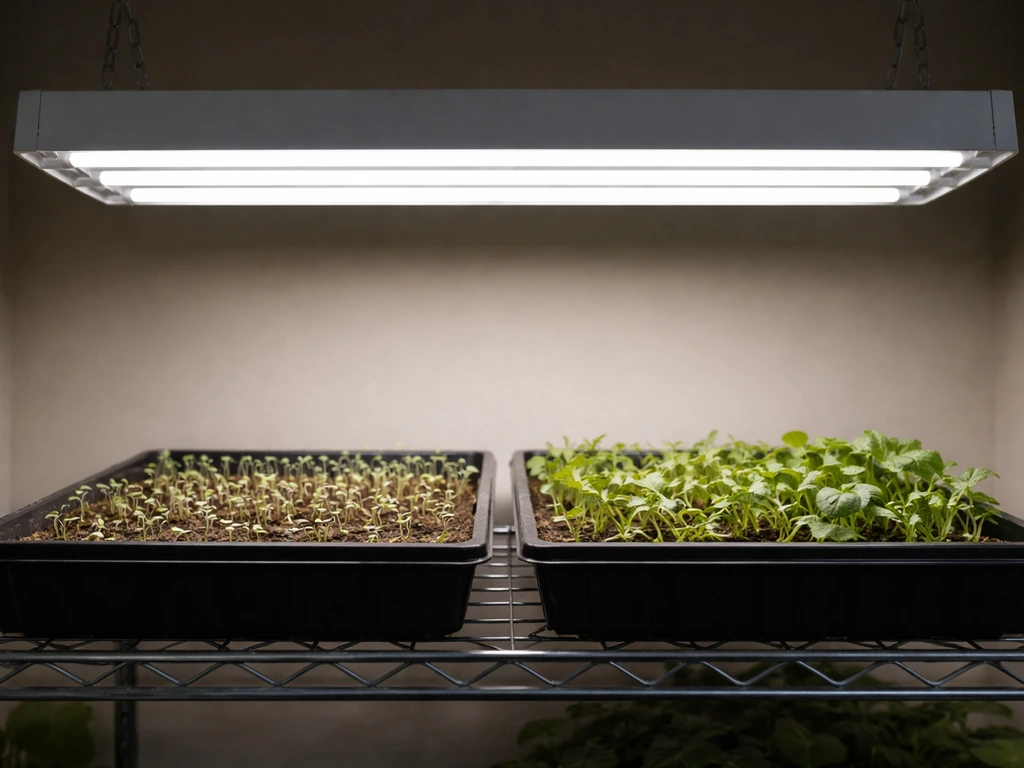
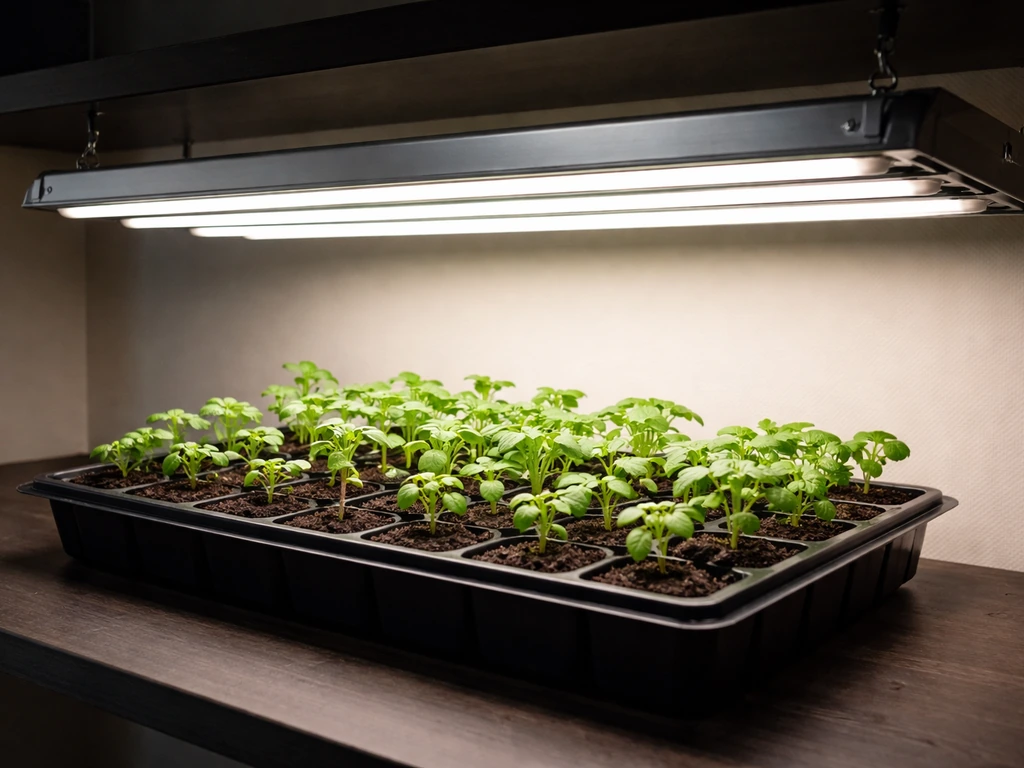
This is where Agrobrite T5s genuinely shine. Seedlings and cuttings want soft, even light with low heat stress, and that is exactly what a 96W fluorescent fixture delivers. The 6400K spectrum encourages compact, bushy early growth. Keep the fixture 4 to 6 inches above your seedling tray and you will get even coverage without heat damage. For propagation trays, cloning domes, and early germination, these lights are a solid, proven tool that professionals have used for decades.
Vegetative growth
For low-to-medium light demand crops (lettuce, herbs, leafy greens, some tropical houseplants), the Agrobrite T5 can carry plants through vegetative growth reasonably well if you keep the fixture close and run all tubes. One r/houseplants thread discussing a Hydrofarm AgroBrite 27W lamp reflects similar first-hand uncertainty about whether it is enough for indoor growing, based on user experience. For higher-demand vegetables and most cannabis cultivars in the vegetative stage, you will likely see slower growth than you would under a modern LED, particularly once your canopy spreads beyond the fixture's footprint. The 6400K spectrum is appropriate for veg (blue-heavy promotes compact structure), but the intensity ceiling limits what you can push.
Flowering and fruiting
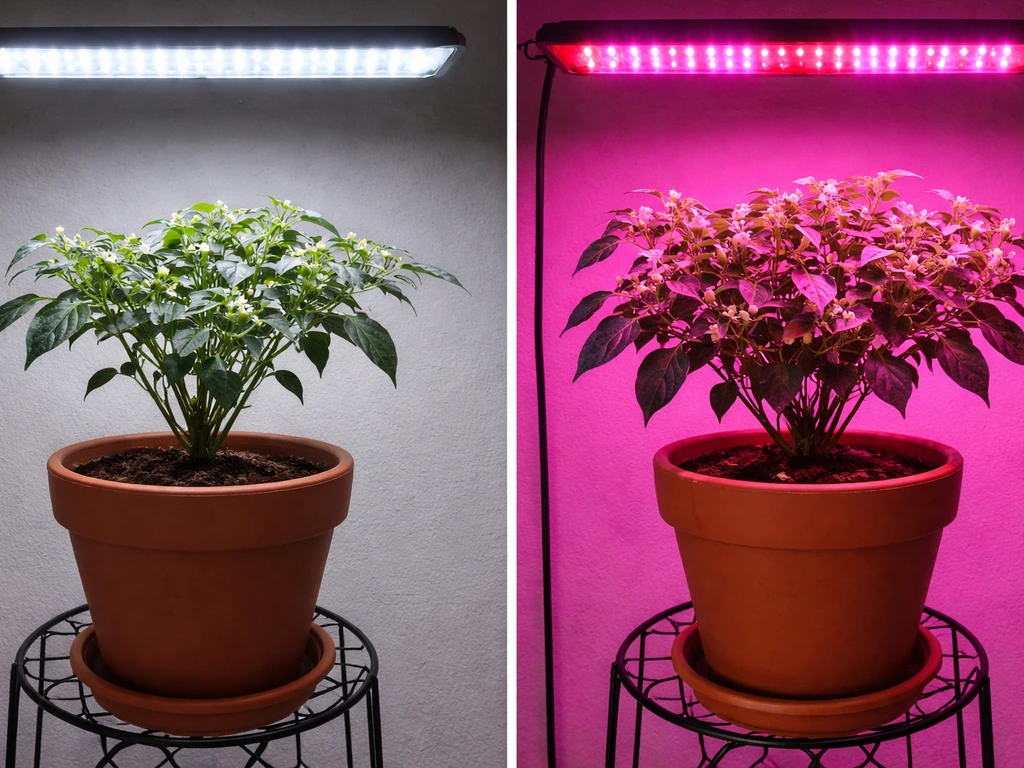
Agrobrite T5s are not flowering lights. The PPFD ceiling is too low for heavy fruiting crops, and the 6400K spectrum lacks the red-heavy wavelengths (around 630 to 660nm) that optimize flowering response and carbohydrate production. If your end goal is tomatoes, peppers, cannabis flower, or any high-light fruiting plant, an Agrobrite T5 either as a sole light or as a primary flower-stage driver will leave you disappointed. You can use them as supplemental side lighting during flowering, but that is a specific, secondary role.
Build quality, safety, and how long they last
The physical build is genuinely solid for the price category. Powder-coated steel housing resists rust and handles humidity reasonably well in a grow tent environment. The specular aluminum interior is durable and maintains reflectivity over time better than painted surfaces. Hydrofarm positions these as "flicker-free fluorescent" systems, which matters for plant stress (high-frequency flicker can affect plant growth) and for your own comfort if you spend time in the grow space.
Safety credentials are straightforward: the FLT24 carries an ETL registration number (4004781) and is rated at 120V, 60Hz. ETL listing means the fixture has been independently tested against relevant electrical safety standards, which is a baseline you should always check on any grow light. Because these are fluorescent systems rather than LED, there is no LED driver to evaluate or fail. Fluorescent ballasts are mature technology; they are reliable over time but do eventually wear out. Tube replacement is straightforward and inexpensive.
Heat output from fluorescent T5s is low compared to older HID systems but still present. A 96W fixture running all four tubes will produce noticeable warmth. In a small enclosed tent, especially in summer, you will want airflow management. That said, the heat output per watt is meaningfully lower than HPS or MH systems and broadly comparable to mid-range LEDs in absolute terms at similar wattages.
Efficiency and real-world running costs
Fluorescent T5 efficiency sits around 80 to 100 lumens per watt, which was impressive a decade ago but trails modern LED efficiency by a meaningful margin. Current full-spectrum LEDs routinely deliver 2.0 to 2.8 μmol/J (photon efficacy), while T5 fluorescents land closer to 1. PPFD is commonly defined as photosynthetic photon flux density, measured in μmol·m−2·s−1, which is the unit your canopy light targets are typically expressed in blank" rel="noopener noreferrer">PPFD (photosynthetic photon flux density) in μmol·m−2·s−1. The California Energy Commission case report explains blank" rel="noopener noreferrer">photosynthetic photon efficacy (PPE) as photosynthetic photon flux divided by input electric power, and it discusses how the unit is tied to ANSI/ASABE S640 framing. 0 to 1.5 μmol/J. In plain terms: a good LED will deliver roughly twice the usable plant light per watt of electricity consumed. For a hobbyist running one or two small fixtures, that gap translates to a modest but real difference in electricity bills over a growing season.
Running a 96W FLT24 for 16 hours a day costs approximately $5 to $7 per month at average US electricity rates (around $0.13 per kWh). That is not a significant expense on its own, and one independent review noted that running an Agrobrite T5 would not meaningfully change your electricity bill at the single-fixture scale. The concern is not the dollar amount per month; it is the efficiency ratio. You are spending that $5 to $7 to deliver less PAR per watt than a modern LED would, so if you scale up, the inefficiency compounds. For one seed starting shelf or one propagation station, it is fine. For a full veg room running eight fixtures, the LED efficiency advantage becomes financially significant.
Hanging height, coverage, and sizing your space
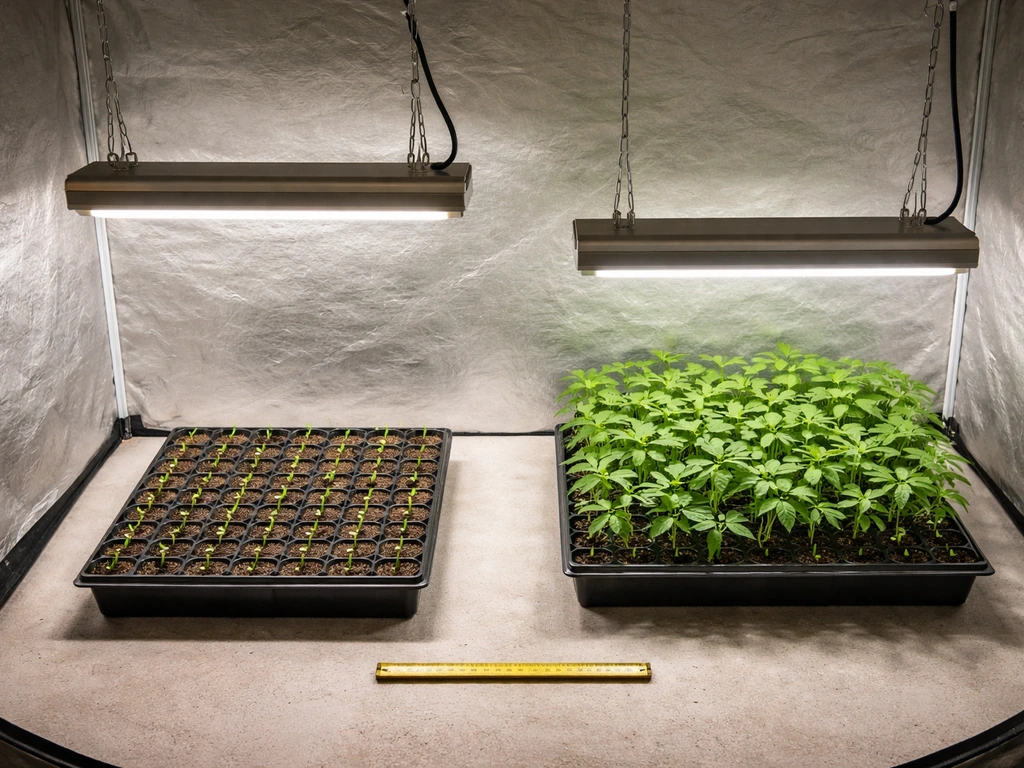
The standard guidance for T5 fluorescent fixtures is to hang them 12 to 18 inches above the canopy for vegetative growth, and closer (4 to 6 inches) for seedlings and cuttings. Unlike LEDs that can maintain usable PPFD at 24 inches or more, T5 output drops off faster with distance due to lower luminous intensity per tube. The practical implication is that your canopy needs to stay relatively close to the fixture, and that limits how tall your plants can grow before the light becomes ineffective at the top of the fixture's range.
Coverage area depends on the fixture size. The FLT24 (2-foot, 4-tube) is realistically effective over roughly a 2×2 foot area for seedlings and a 2×1.5 foot area for vegetative growth where uniformity matters. The FLT48 (8-tube, larger footprint) can cover a 4×2 foot area with reasonable uniformity for veg. To size your room, count the square footage of your canopy and divide by the per-fixture coverage area, then add 10 to 15% overlap at the edges for uniformity. For a standard 3×3 tent in vegetative mode, you would want at minimum two FLT24-equivalent fixtures, ideally three for full uniformity. For a 4×4 tent, a pair of FLT48s would be the minimum. Always measure your hanging height against the light's effective range before committing to a tent size.
Agrobrite vs the alternatives: an honest comparison
To put Agrobrite in context, here is how it stacks up against the main alternatives a typical buyer would consider. Note that direct PPFD-per-dollar comparisons are not fully possible for Agrobrite because no manufacturer PPFD data exists, so this comparison uses lumens, wattage, and photon efficacy estimates alongside practical performance categories.
| Light Type | Spectrum | Efficacy (approx.) | PPFD Range (at canopy) | Best Use Case | Relative Cost per Watt |
|---|---|---|---|---|---|
| Agrobrite T5 (FLT24, 96W) | 6400K fluorescent (single spectrum) | ~1.0–1.3 μmol/J | 150–250 μmol/m²/s at 12" | Seedlings, cuttings, leafy greens | Low |
| Modern full-spectrum LED (mid-range) | White broad-spectrum + red | ~2.0–2.6 μmol/J | 400–900 μmol/m²/s adjustable | All stages, fruiting crops | Medium |
| HPS (250–400W) | Red-heavy (~2100K) | ~1.5–1.8 μmol/J | 500–1000 μmol/m²/s | Flowering, fruiting | Low fixture, high running cost |
| T5 HO competitor (e.g. generic) | 6400K or 3000K | ~1.0–1.4 μmol/J | 140–230 μmol/m²/s at 12" | Seedlings, veg | Low to medium |
Compared to brands like Aglex, which produce modern LED grow lights with published PPFD data and adjustable spectrum channels, Agrobrite T5s occupy a fundamentally different performance category. The LED alternatives will outperform on intensity, efficiency, and spectrum flexibility for most plant stages beyond seedlings. If you are shopping on Amazon and weighing your options, the Amazon LED grow light category has expanded significantly in recent years with better-value options at similar price points to Agrobrite T5 systems.
Where Agrobrite holds its own is in build quality consistency, brand accountability (Hydrofarm is a large, established distributor, not an anonymous drop-shipper), and the specific niche of propagation and seedling development. If you have been burned by generic imports before, there is real value in knowing you are buying from a company with a physical presence and a return policy. For readers who have explored AliExpress grow lights or weighed options from Alibaba LED grow light suppliers, the accountability gap is real and worth factoring into the price comparison.
One smaller brand worth mentioning as a direct alternative for hobbyists is Ankace, which offers compact clip-on and desktop grow lights in a similar price range to the Agrobrite CFL/desktop LED units, though the T5 system comparison is more relevant for growers running a dedicated seedling station or small propagation area.
Should you buy Agrobrite, or skip it?
The answer depends almost entirely on what you are growing and what stage you are lighting. Agrobrite T5s are not all-purpose grow lights for 2026. They are specialized, reliable propagation and seedling tools that have been outpaced by modern LEDs for anything beyond that role. That does not make them bad; it makes them specific.
Buy Agrobrite if you match this profile:
- Your primary use is seed starting, propagation, or cloning, and you want a proven, ETL-listed system from a reputable distributor
- You are growing leafy greens, herbs, or low-light houseplants and do not need the intensity headroom of a full-spectrum LED
- You value build quality and brand accountability over raw performance-per-dollar
- You already own a T5 setup and are replacing tubes or adding fixtures rather than starting from scratch
- You have a shelf-based setup where hanging height is fixed close to the canopy (4 to 12 inches)
Skip Agrobrite (and look at modern LEDs instead) if you match this profile:
- You are growing fruiting or flowering crops at any scale (tomatoes, peppers, cannabis, cucumbers)
- Your canopy needs to be more than 18 inches from the light source
- You want PPFD data and spectrum flexibility to dial in different growth stages
- You are scaling beyond one or two fixtures and running costs matter over a full season
- You want a single light that can carry plants from seedling through harvest without a fixture swap
The honest summary: Agrobrite T5 systems are solid, well-built, ETL-listed fluorescent fixtures that do one part of indoor growing very well. They are not the best value for primary canopy lighting in 2026, but for propagation stations, seed starting shelves, and low-light vegetative crops, they are a reliable choice from a brand that stands behind its products. If your use case fits that description, they are worth the price. If it does not, spend the same money on a mid-range full-spectrum LED and you will get more light, more spectrum control, and better efficiency for the long run.
FAQ
How high can I hang an Agrobrite T5 and still get meaningful results?
If you are using Agrobrite as your main vegetative light, plan around staying close to the canopy and keeping spacing tight. Once your canopy rises beyond the effective range (roughly 12 to 18 inches depending on model and how reflective your tent is), the usable intensity drops quickly because T5 output falls off faster with distance than most modern LEDs.
Can I use Agrobrite T5s for both veg and flowering by compensating with other bulbs or settings?
Switching to a red and blue LED later is usually a better strategy than trying to “spectrally hack” a T5. You cannot change the tube spectrum from the fixture, so for flowering performance you would typically add a dedicated red-heavy light for bloom rather than expecting 6400K T5 to cover both goals equally well.
What should I do if the FLT24 shows as no longer stocked?
For the FLT24 specifically, treat “No Longer Stocked” as a supply-chain risk, not a performance change. Before building your plan, confirm the exact SKU is available at the retailer you intend to buy from, check whether tubes and any replacement parts are still sold separately, and consider having a contingency model size (for example, moving up to a longer multi-tube unit if coverage is your goal).
Will raising the fixture during growth help, or will it reduce performance?
Yes, but do it with intent. If you use the fixture over seedlings and then raise the seedlings later, you may unintentionally starve the upper leaves as the plants expand. A practical approach is to keep hanging height fixed initially, start near the recommended closer distance, and only adjust height gradually so the top growth remains in the fixture’s effective zone.
How can I verify PPFD and coverage if Agrobrite does not provide PPFD charts?
Because Agrobrite does not publish PPFD maps, your best calibration method is measurement-based if you have access to a PAR meter. If you do not, you can still sanity-check with plant response, but be extra cautious with pale new growth, stretching, and slow canopy spread, since lumens alone can mislead you about photon delivery at the leaf level.
What’s the biggest mistake people make when sizing Agrobrite T5 fixtures for a tent?
A common mistake is buying fixtures by wattage or “number of tubes” without matching the real canopy footprint and uniformity needs. Use the tent size as your constraint, then size the number of fixtures to cover edges, adding overlap (about 10 to 15 percent) to reduce hot and cold zones.
How often should I replace T5 tubes, and what signs mean it’s time?
Tube aging can reduce light output over time, so replacement intervals matter more than with LEDs. If you notice slower growth or lighter canopy coloration late in a cycle, inspect tube condition and consider replacing tubes rather than only adjusting hanging height.
Do I need special ventilation considerations because these are fluorescent T5 fixtures?
Fluorescent ballasts are mature, but they still run hot-ish and care about airflow. If you run close to a canopy in a small sealed tent, ensure the ballast can dissipate heat and that intake and exhaust do not just cool the plants, they also keep the fixture enclosure within normal operating conditions.
When should I consider skipping Agrobrite for flowering crops?
Not usually. For fruiting plants, most growers end up wanting higher photon flux and more flowering-friendly wavelengths than 6400K provides. Agrobrite is best treated as a propagation and early veg tool, or as supplemental side lighting, while a dedicated bloom-capable LED handles the main flowering PPFD demand.
Is Agrobrite cost-effective if I’m running many fixtures for a full grow?
Yes for some setups, no for others. If your space is a propagation shelf or a low-light plant station where you can keep plants within the recommended distance, the cost can be reasonable. If your plan is a larger full-time veg room that needs efficient photons over time, the lower photon efficacy of fluorescent compared to modern LEDs becomes the deciding factor.