Quick verdict and who it's for
AGLEX grow lights are a solid mid-tier option for indoor growers who want respectable PPFD numbers and a full-spectrum LED bar design without paying flagship prices. The M-series (M240, M320, M400, M600) is the line most shoppers encounter, and the M400 in particular hits a reasonable sweet spot: it draws around 420W from the wall, claims an average PPFD of 1,238 µmol/m²/s across a 4x5 ft core coverage area, and runs on universal voltage (AC100-277V), so it works in North American and European setups without an adapter. If you're running a 4x4 or 4x5 tent in veg or flower and you want a bar-style fixture under $300, AGLEX deserves a look. If you need lights for a larger space or want proven third-party PAR maps, you'll want to read through the value section before committing.
What you get: specs, spectrum, and build quality
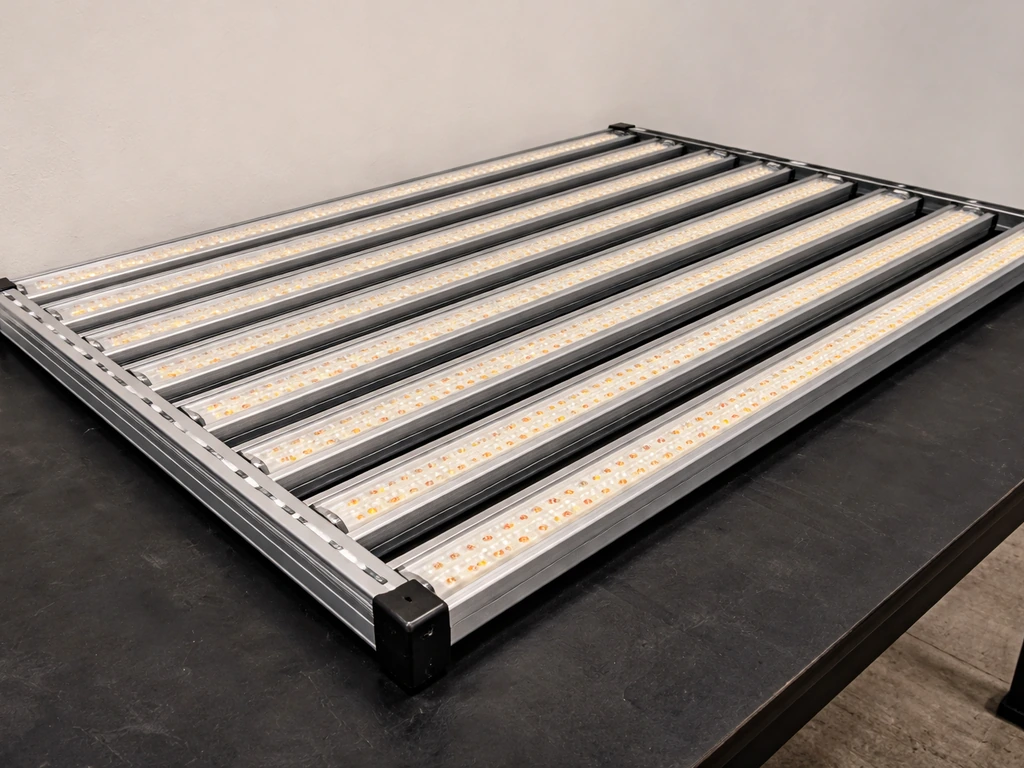
The M-series lineup at a glance
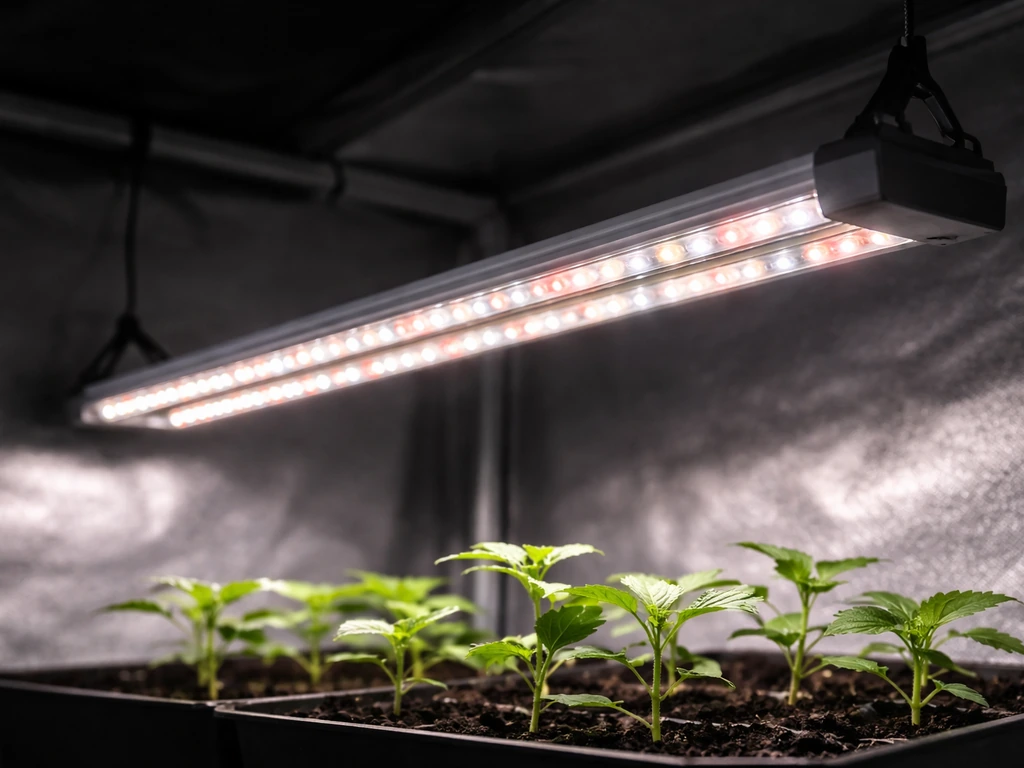
AGLEX markets the M-series as a bar-light system, meaning multiple LED strips mounted across an aluminum frame rather than a single puck or panel. Each model steps up in power, LED count, and claimed coverage. Here's how the four main models compare based on spec sheet data:
| Model | Rated Power | LED Count (per spec PDF) | LED Lumen | PPE | PPFD (avg) | Core Coverage |
|---|
| M240 | ~240W | Not listed separately | Not listed separately | Not listed separately | Not listed | 4.5 x 4 ft |
| M320 | ~320W | Not listed separately | Not listed separately | Not listed separately | Not listed | 5.5 x 4 ft |
| M400 | 420W (wall draw) | 888 LEDs (PDF) / 1,360 chips (manual) | 59,589 LM | 2.8 µmol/J | 1,238 µmol/m²/s | 4 x 5 ft |
| M600 | ~600W | Not listed separately | Not listed separately | Not listed separately | Not listed | 6 x 6.6 ft |
There's a small discrepancy worth flagging right away: the bundled spec PDF for the M400 lists 888 LEDs, while the user manual says 1,360 high-efficiency LED chips. This likely comes down to counting methodology (individual diodes vs. chip packages), but it's the kind of inconsistency that makes independent verification important. The wall-draw figure also shifts slightly depending on the document: the spec PDF says 400W ±5%, and the manual says 420W. At real-world measurement, expect something in the 400-430W range.
Spectrum, build, and what's in the box
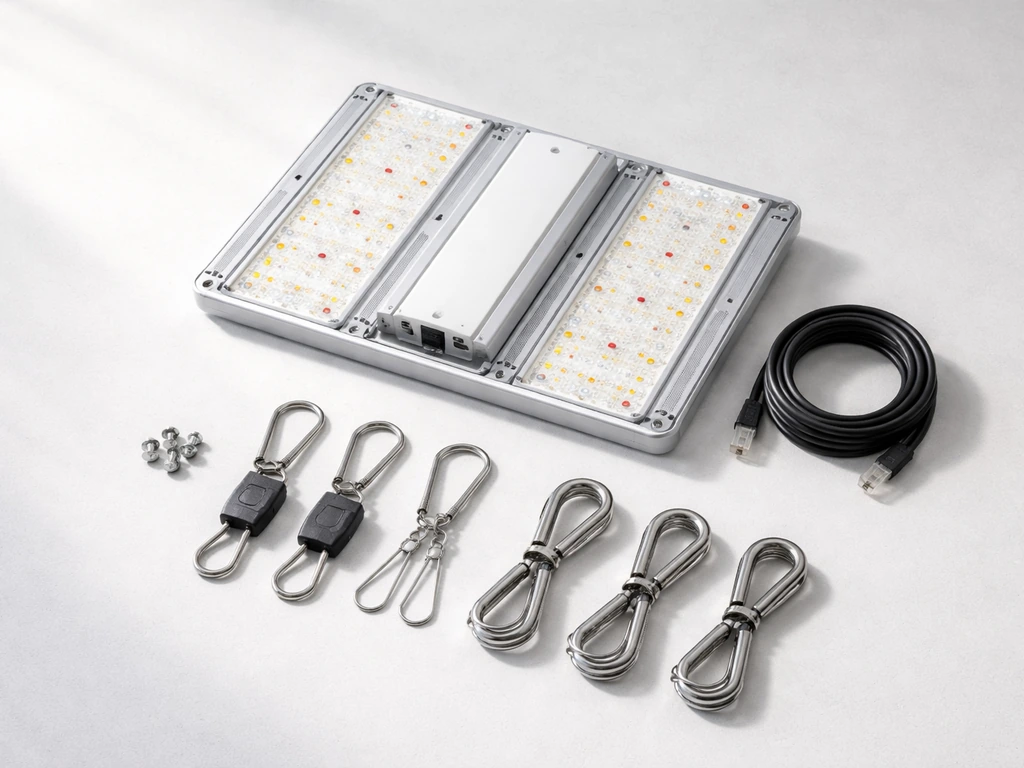
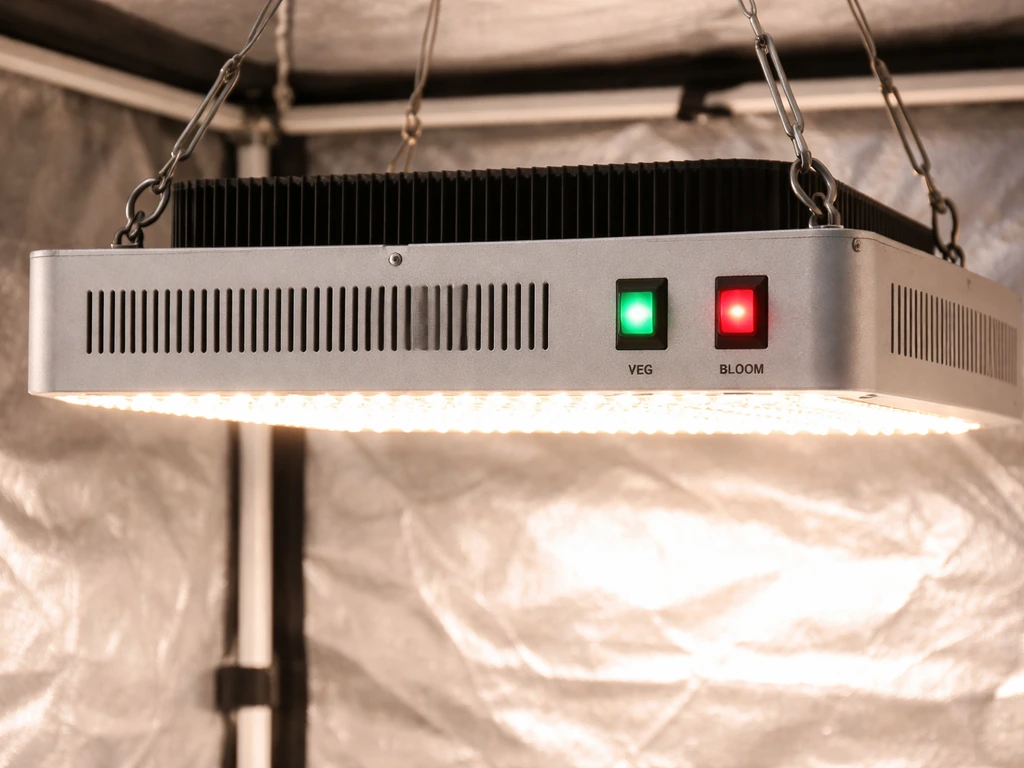
AGLEX M400 uses a full-spectrum LED array designed to cover the photosynthetically active range (400-700 nm) with additional red and far-red wavelengths to support flowering. The aluminum housing (1,040 x 600 x 43 mm) acts as a passive heatsink, which means there are no cooling fans to worry about and no fan noise in your grow tent. AGLEXs M-series product description also states the M240, M320, M400, and M600 are passively cooled no-fan bar lights that run on universal voltage (AC 100V to 277V) passive heatsink, which means there are no cooling fans. The fixture weighs 6.5 kg, so make sure your tent's crossbar or ceiling anchor can handle that load before you hang it.
The package includes the 420W grow light, a 2M RJ12 cable, four screws, hanging kits, and a retractable rope. The RJ12 cable is for daisy-chaining multiple AGLEX units together if you're tiling a larger space, which is a genuinely useful feature if you plan to scale up. The retractable rope ratchets make height adjustment straightforward. There's no built-in dimmer or programmable timer on the base M400, so you'll need a separate outlet timer if you want automated photoperiods.
The M400's claimed average PPFD of 1,238 µmol/m²/s over a 4x5 ft core area is a strong number on paper. For context, most fruiting and flowering crops need somewhere between 600 and 900 µmol/m²/s, and cannabis in late flower can use 800-1,000+ with CO2. At 1,238 µmol/m²/s (average), the M400 is positioned for high-demand flowering if the numbers hold up across the canopy, not just at the center point.
The bar-style form factor helps here. Compared to a single central-chip panel, the distributed bars spread light more evenly side-to-side, reducing the hot center and dark corner problem that plagued older blurple panels. That said, AGLEX's published PPFD maps are manufacturer-supplied, and independent PAR mapping from third parties isn't widely available for this brand. In practice, growers report good canopy penetration and fairly even coverage within the stated 4x5 ft area, with noticeable falloff past those edges. Running the M400 outside its rated footprint (say, in a 5x5 tent) will cost you meaningful intensity at the corners.
Heat management is one area where AGLEX holds up well. The blank" rel="noopener noreferrer">passive aluminum housing stays warm to the touch but doesn't create the thermal spike you'd get from an equivalent HID setup. In a ventilated tent at normal ambient temperatures (68-77°F), the fixture doesn't seem to dramatically elevate canopy temps, though you should still run your inline fan appropriately.
Best use cases and how to set it up right
Seedlings, veg, and flower: expectations by stage
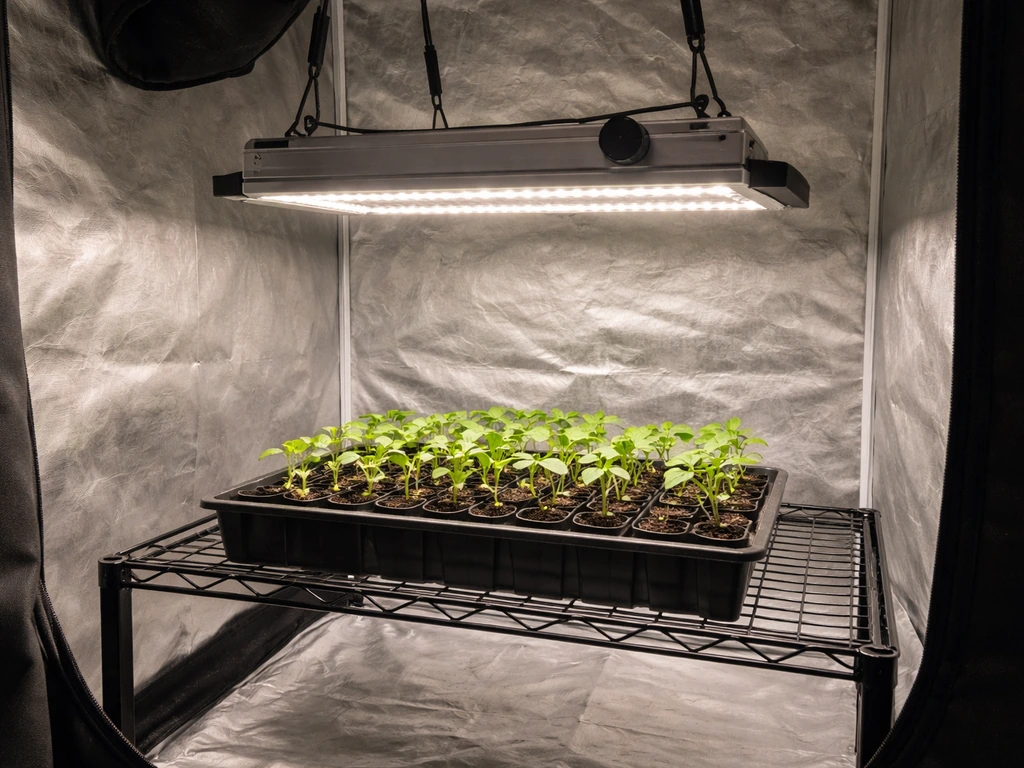
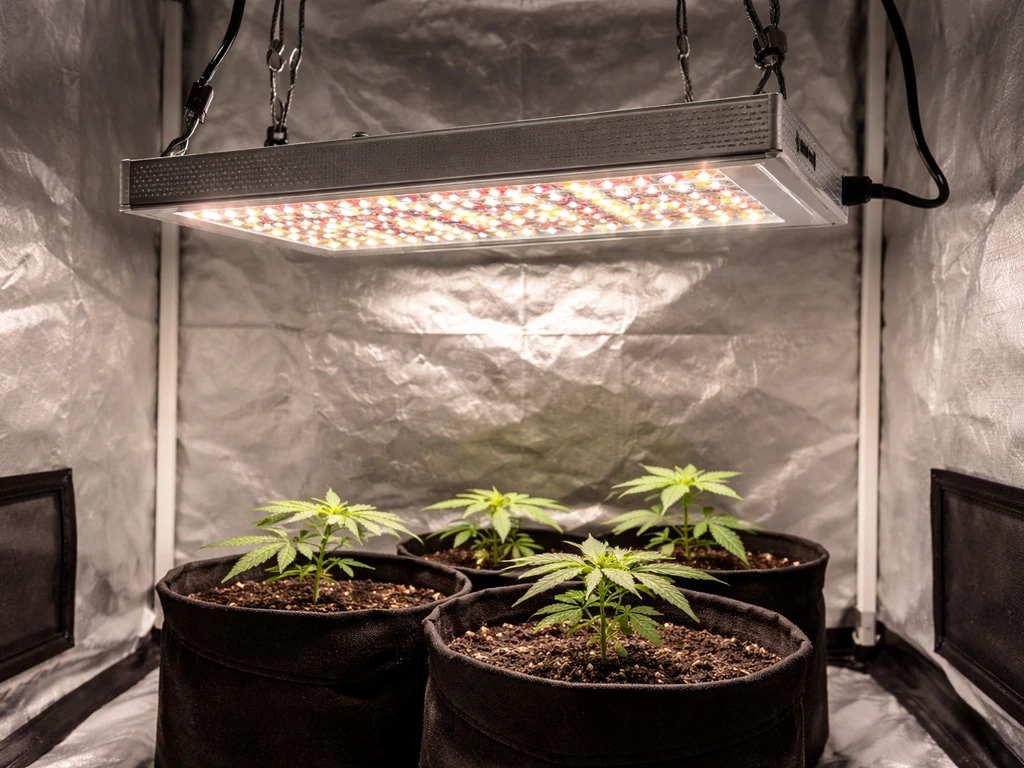
The M400 is probably overkill for a pure seedling setup. For germination and early seedling work in a small tray, you'd be running the light very high or at very low intensity to avoid stress. If you're using AGLEX for the full cycle from seed to harvest, plan on raising the fixture significantly (24-30 inches) for seedlings and dialing back intensity if there's a dimmer option on your specific model. For veg, hanging at 18-24 inches gives you solid canopy coverage without light stress on most crops. For flower, dropping to 12-18 inches (or closer with light-hungry plants) and running a 12/12 photoperiod is the standard approach.
- Seedlings: 28-36 inches above canopy, 18 hours on / 6 hours off, watch for stretching or bleaching as your guide
- Vegetative stage: 18-24 inches above canopy, 18 hours on / 6 hours off for most crops
- Flowering stage: 12-18 inches above canopy, 12 hours on / 12 hours off for photoperiod plants
- Always use an outlet timer since the M400 has no built-in scheduling
- Daisy-chain via the RJ12 cable if covering more than one M400 unit across a wider space
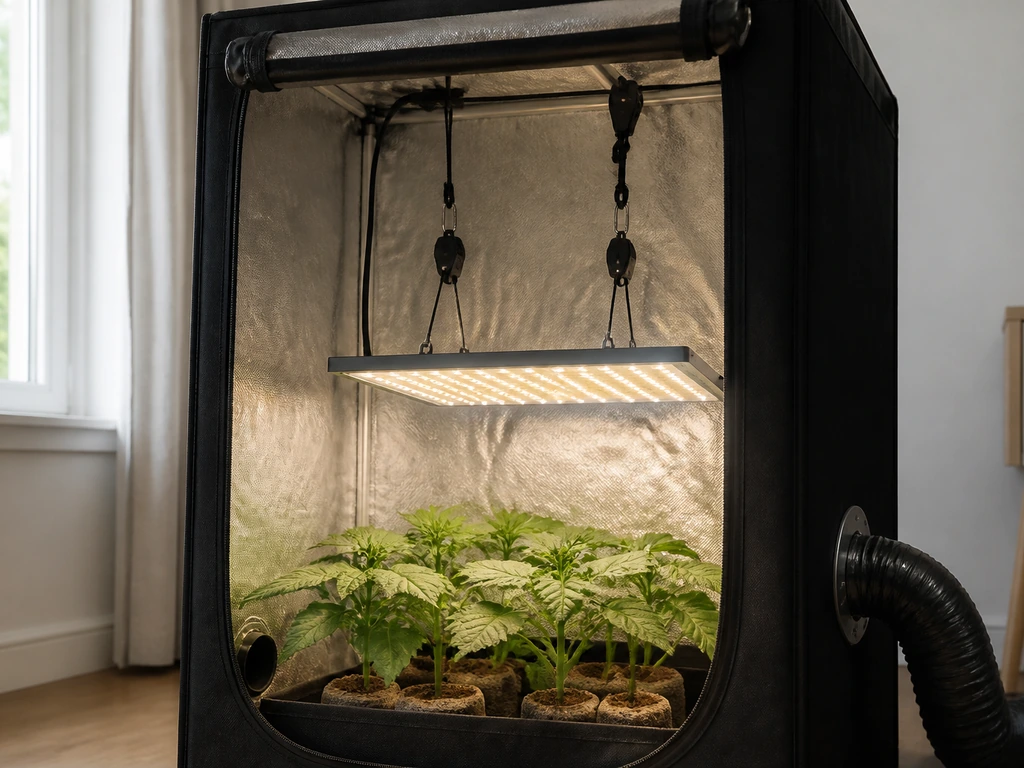
Matching the light to your space
The M400's rated core coverage of 4x5 ft makes it a near-perfect fit for a standard 4x4 tent. You'll have a little extra reach on one axis without losing meaningful intensity at the edges. A 4x5 or 4x6 grow space is also workable if you're not pushing plants hard in flower. Going up to a 5x5 tent with a single M400 will leave corners underlit; in that case, either step up to the M600 or tile two smaller units. The M240 is the better pick for a 2x4 or 3x3 space where the M400 would be overpowered.
Is it worth the money? Price-per-watt and brand comparisons
AGLEX positions itself as a value brand, typically pricing the M400 in the $180-$260 range depending on sales and platform. At 420W actual draw and a mid-point price of $220, that works out to roughly $0.52 per watt, which is competitive for a bar-style LED in this power class. The PPE rating of 2.8 µmol/J is a meaningful efficiency figure: anything above 2.5 µmol/J is considered good for a mid-tier light, and 2.8 puts AGLEX in the same conversation as some brands selling at a 30-40% premium.
For context, brands sourced through wholesale platforms often undercut AGLEX on sticker price but sacrifice consistency and warranty support. If you've been comparing options through channels like an AliExpress grow light review, you'll notice AGLEX is essentially the retail-packaged version of the same Chinese supply chain, but with more predictable QC and at least some customer service infrastructure. Similarly, if you've browsed an Alibaba LED grow light review, you've seen the upstream suppliers that feed brands like AGLEX, which helps explain the aggressive price points.
On the Amazon side, the M400 competes directly with similarly-specced bar lights from brands like Mars Hydro, Spider Farmer, and ViparSpectra. Those brands tend to have more third-party PAR data available, which gives buyers more confidence in the advertised numbers. If you want the reassurance of independent testing, checking an Amazon LED grow light review roundup that includes AGLEX alongside those competitors is worth the extra research time before buying.
It's also worth comparing AGLEX against fluorescent-era alternatives. T5 and T8 bar systems from brands like Agrobrite are still popular for seedlings and clones, and if your needs are confined to propagation rather than full-cycle growing, the cost calculus is very different. A full Agrobrite grow lights review breaks down where that technology still makes sense, and spoiler: for full flowering cycles, an LED like the M400 wins on efficiency handily.
At the lower end of the market, small clip-on and desktop grow lights occasionally come up in comparison threads, but they're not really in the same category. If you've seen an Ankace grow light review pop up in your research, those compact units are designed for herb gardens and small houseplant setups, not the 4x5 ft canopy the M400 targets.
Pros, cons, and things to watch for
What AGLEX does well
- Competitive PPE (2.8 µmol/J) for the price bracket
- Bar-style design gives more even canopy coverage than equivalent panel lights
- Passive cooling means zero fan noise and fewer moving parts to fail
- Universal voltage (AC100-277V) works globally without adapters
- RJ12 daisy-chain support makes tiling multiple units practical
- Reasonably compact at 43 mm depth, easier to manage in tents with limited headroom
Where it falls short or introduces risk
- LED count discrepancy between spec PDF (888) and user manual (1,360) is confusing and undermines transparency
- Power draw listed inconsistently across documents (400W vs. 420W); budget your circuit accordingly at the higher figure
- No built-in timer or dimmer on the base M400, adding a small extra cost and setup step
- Limited independent third-party PAR verification compared to Mars Hydro or Spider Farmer
- Advertised coverage areas are manufacturer claims; real-world intensity drops noticeably outside the stated footprint
- At 6.5 kg, the fixture needs a secure hanging point; check your tent's rated load before install
- Warranty and customer service responsiveness can vary; verify current warranty terms before buying
Before you buy: a practical checklist
Run through these before hitting the order button. They'll either confirm AGLEX is the right call or point you toward a better fit.
- Measure your grow space precisely. The M400 is rated for 4x5 ft core coverage. If your tent is 4x4, it fits well. If it's 5x5, you'll need the M600 or two smaller units.
- Check your circuit capacity. At 420W actual draw, the M400 uses about 3.5A on a 120V circuit. Add other equipment (fans, pumps, heaters) and make sure you're not overloading a 15A or 20A circuit.
- Confirm whether you need a dimmer. The base M400 may not include one. If light intensity control matters for your workflow (seedlings through flower in one tent), verify the specific SKU you're ordering has dimming capability.
- Budget for a timer. Without a built-in scheduler, you need an outlet timer. A mechanical or digital timer costs $10-25 and is non-negotiable for photoperiod accuracy.
- Look at the tent height. At 1,040 x 600 mm footprint and needing 12-24 inches of hang distance, a short 60-inch tent will feel cramped. A 72-inch or 80-inch tent gives you proper working room.
- Factor in the hanging weight. At 6.5 kg (about 14.3 lbs), confirm your tent frame or ceiling mount is rated above that load.
- Check current pricing across platforms. AGLEX M400 pricing fluctuates; compare the seller's current price against the $/watt benchmark and watch for bundles that include the timer or a second unit at a discount.
- Read recent buyer reviews on your chosen platform, specifically for the current production run. LED driver quality can shift between manufacturing batches, and recent reviewers will flag any regressions.
Bottom line: AGLEX is a legitimate grow light brand, not a throwaway novelty. The M400 offers real performance numbers that make sense for a 4x4 to 4x5 flowering space, and the price-per-watt is genuinely competitive. The main caveats are the documentation inconsistencies (worth verifying before you buy) and the relative lack of third-party PAR data compared to the category leaders. If those things bother you, Mars Hydro and Spider Farmer offer similar wattages with more available independent data.
If you're comfortable with the manufacturer specs and the price is right, AGLEX is a reasonable buy that will do the job. AGLEX’s warranty is a limited warranty that covers defects in materials and workmanship during the limited warranty period, with AGLEX offering repair, replacement, or a refund at its option.