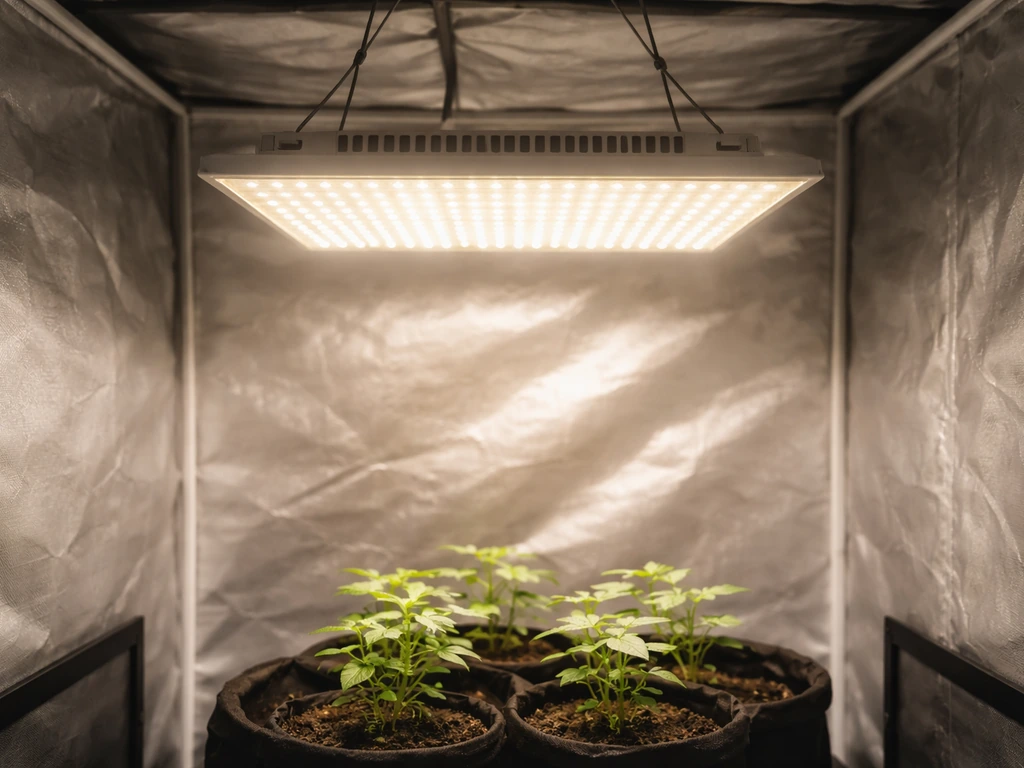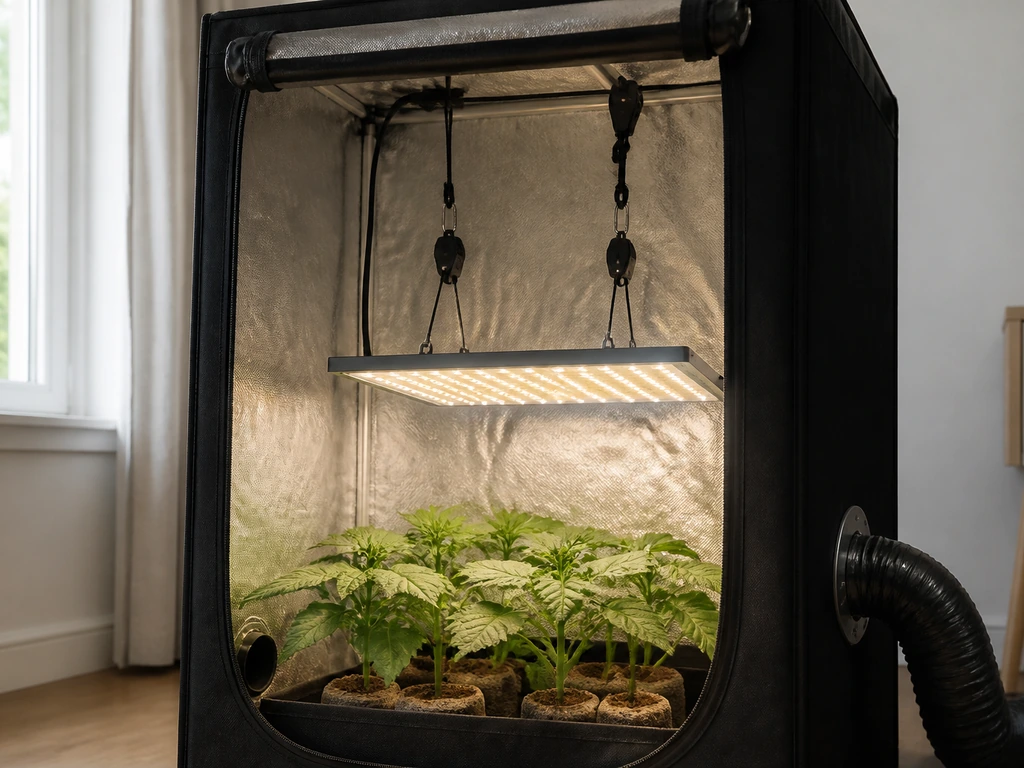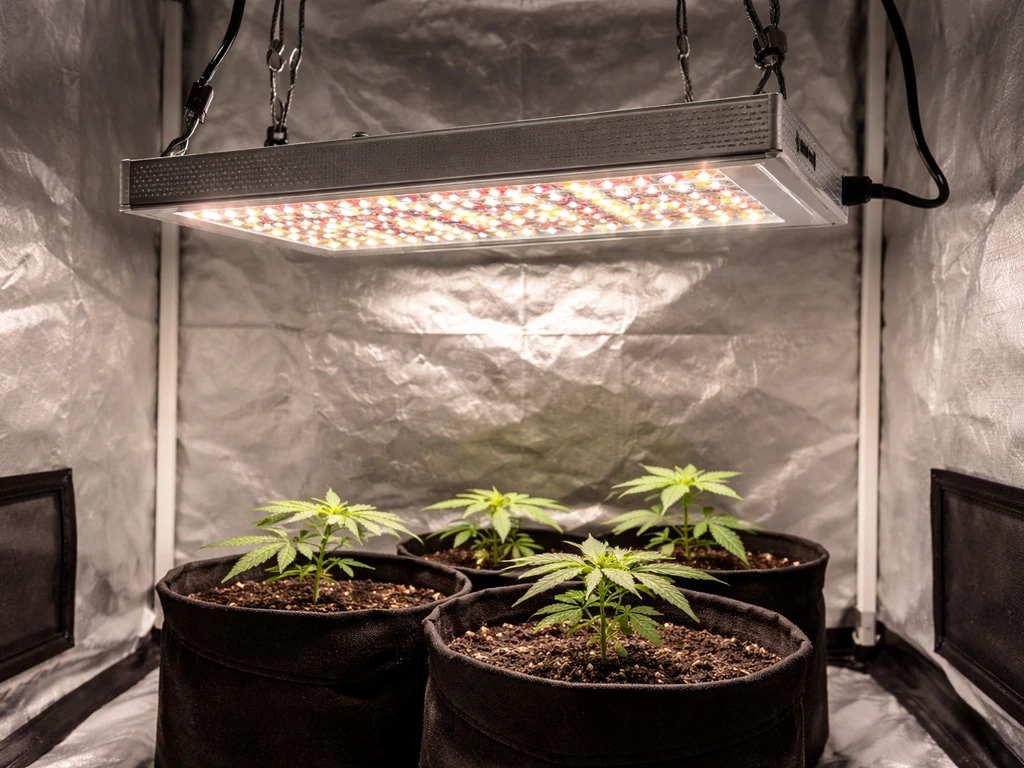
Koscheal makes a small but coherent lineup of LED grow lights, and the two models you're most likely to encounter are the KT600 (a compact 65W panel aimed at single-plant or small-tent growers) and the K6400 (a serious 640W bar-style fixture for 4×4 to 5×5 ft canopies). Both share the same headline efficiency figure of 2.9 µmol/J and both run fanless, but they're built for very different scales. If you're trying to decide which one fits your setup, or whether Koscheal is worth buying at all, here's what you actually need to know.
Koscheal Grow Light Review: Models, Performance, and Value

Marcus Caldwell
17 Apr 2026
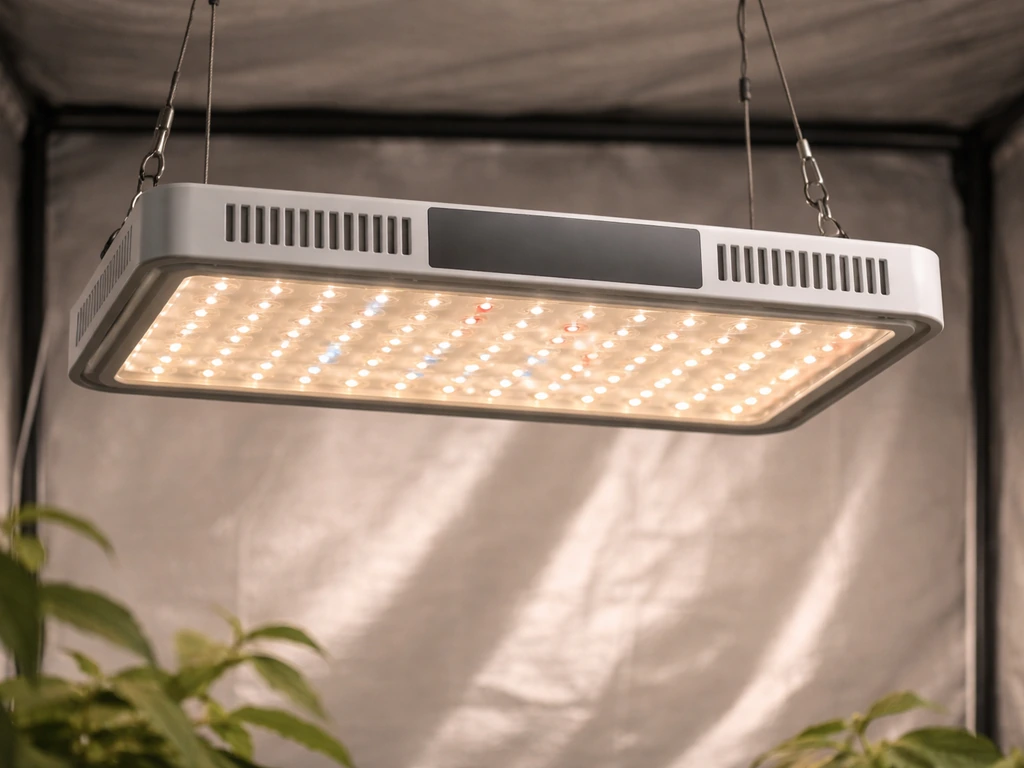
The Koscheal lineup at a glance
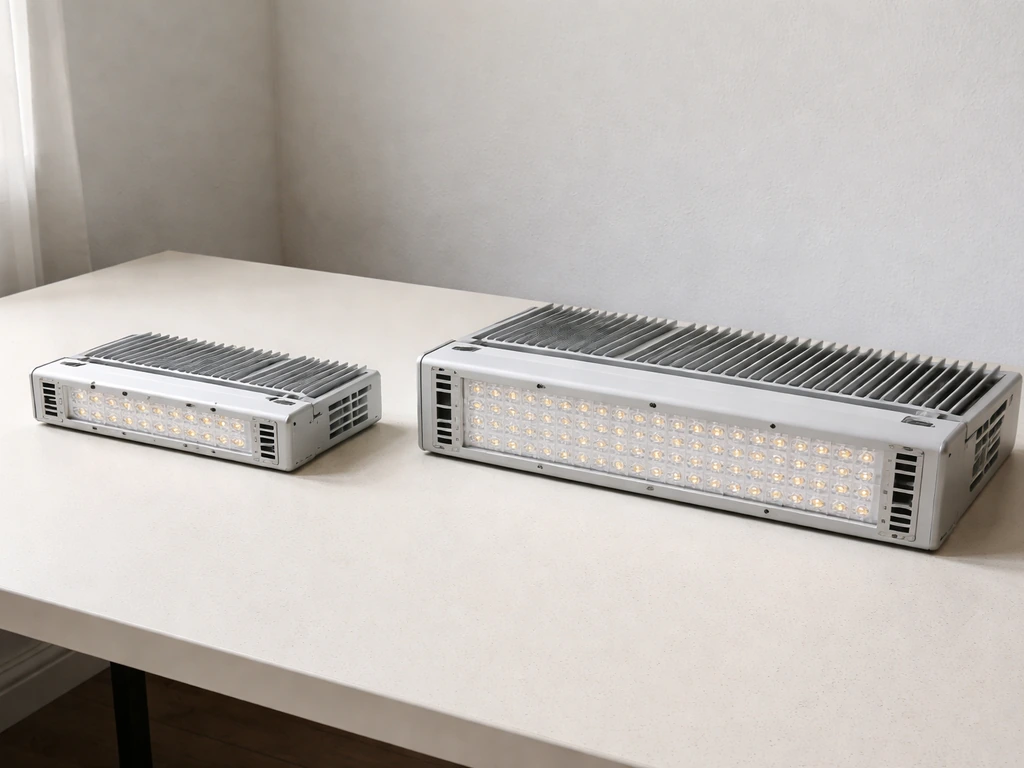
Koscheal's current catalog centers on two distinct product tiers. The KT600 (ASIN B09QMDT21H) is a small panel targeting closet and micro-tent grows. It draws 65W (±5%) at 110V, pulls 0. The KT600 manual lists its 110V power draw as 65W ±5% and specifies coverage footprints of 2×2 ft for veg and 1.
5×1. 5 ft for bloom 65W (±5%) at 110V. 59A, and uses Samsung LM301B diodes in a blend of 3000K, 5000K, 660 nm red, and 730 nm far-red IR.
The K6400 (ASIN B0DFM3ZRGV) is the flagship: a 640W commercial-style bar light built around Samsung LM301H EVO diodes, rated at 1856 µmol/s total PPF and the same 2. 9 µmol/J efficiency. The spectral recipe on the K6400 isn't broken out in as much detail in the manual, but the LM301H EVO diodes are a newer generation than the LM301B and carry a slightly higher efficacy ceiling from Samsung.
In short: KT600 is the budget entry point, K6400 is where you go when the plants outgrow the tent.
| Spec | KT600 | K6400 |
|---|---|---|
| Actual power draw | 65W (±5%) | 640W |
| Diode type | Samsung LM301B | Samsung LM301H EVO |
| Spectrum | 3000K + 5000K + 660 nm + 730 nm IR | Full-spectrum (LM301H EVO blend) |
| PPF | Not stated in manual | 1856 µmol/s |
| Efficiency (PPE) | 2.9 µmol/J | 2.9 µmol/J |
| Coverage (veg) | 2×2 ft | 5×5 ft |
| Coverage (bloom) | 1.5×1.5 ft | 4×4 ft |
| Cooling | Fanless, aluminum body | Fanless, integrated aluminum heat sink |
| Dimming | Switch/inline control | 0–10V, daisy-chain capable |
| Dimensions | Not specified | 41.34 × 40.94 × 2 in |
| Weight | Not specified | 34 lb |
| Warranty | Not specified | 3-year + 30-day returns (US warehouse) |
Build quality, design, and what you're actually holding
Both fixtures are aluminum-bodied and fanless. The KT600 is a compact panel that feels proportionate to its 65W output: the aluminum construction keeps it lightweight, the diode layout is relatively dense for the footprint, and the fanless design means zero audible noise during operation. For a closet grow or a small propagation setup, that silence is genuinely useful. The fixture comes with the standard hanging hardware (adjustable rope ratchets and a power cable) that you'd expect at this price point.
The K6400 is a different animal. At 41. 34 inches wide, 40. 94 inches deep, and weighing 34 lb, this is a bar-array fixture that takes up real space.
The integrated aluminum heat sink runs across the bars and does the thermal work without a fan, which is a meaningful engineering choice at 640W. Passive cooling at that wattage requires a lot of surface area, and Koscheal's bar layout spreads the diode load across enough aluminum to make it work.
The K6400 comes with mounting hardware suited to the weight, and the 0–10V dimming port plus daisy-chain support means you can link multiple units to a single controller, which is practical if you're running more than one fixture in a larger tent or room.
The 3-year warranty and 30-day free return policy (fulfilled from a US warehouse per the manual) are above average for this category and give you a real safety net if a fixture arrives damaged or underperforms early.
Reliability signals worth knowing
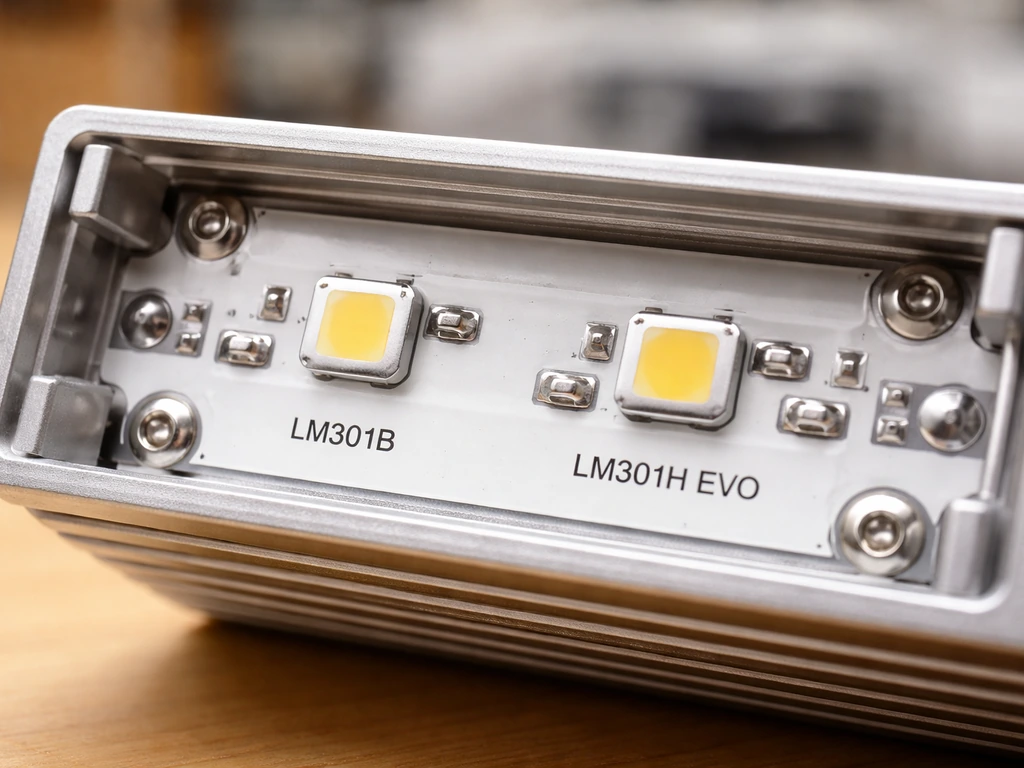
Samsung LM301B and LM301H EVO diodes are established, well-documented components used across dozens of reputable grow light brands. Their presence here is a genuine positive indicator for longevity and consistent output over time. The fanless design removes one of the most common failure points in LED fixtures (fan bearings and motors), but it does mean the aluminum heat sink has to work harder. In a well-ventilated grow tent with reasonable ambient temperatures, passive cooling at these wattages is proven. If you're running the K6400 in a poorly ventilated space in summer heat, expect the fixture to run warmer than spec and watch for any output drop.
Performance numbers and what they mean in practice
The KT600's 2.9 µmol/J efficiency is genuinely competitive for a panel at this wattage. At 65W actual draw, back-of-envelope math puts total PPF somewhere in the 185–190 µmol/s range, which is appropriate for a 2×2 ft veg footprint and a 1.5×1.5 ft bloom footprint. Within those footprints, center-canopy PPFD should be sufficient for most medium-light crops (herbs, leafy greens, some vegetative cannabis). The bloom footprint shrinking to 1.5×1.5 ft is the honest number: at flowering, most crops want 400–600+ µmol/m²/s, and spreading 65W over a larger area won't deliver that. Keep plants within the stated bloom footprint or expect stretched, underpowered results.
The K6400's published figures are more detailed. A 1856 µmol/s PPF at 2. Samsung's LM301H EVO product page reports package-level light output and efficacy example figures at specified drive conditions, which support the LED efficacy basis for this class of performance [2. 9 µmol/J](https://led.
samsung. com/lighting/mid-power-leds/3030-leds/lm301h-evo/). 9 µmol/J over a 4×4 ft bloom footprint works out to roughly 1160 µmol/m²/s average PPFD at canopy level when uniformly distributed, which is squarely in the flowering sweet spot for high-demand crops. Over the larger 5×5 ft veg footprint the intensity drops to around 742 µmol/m²/s average, still more than adequate for aggressive vegetative growth.
The bar-array layout improves intensity uniformity across the footprint compared to older blurple or single-panel designs: bars spread light more evenly, reducing the hot center and dim-corner problem. That said, no fixture is perfectly uniform, and corner-to-center variation of 15–25% is typical even for good bar arrays. Rotating plants occasionally or positioning them toward the center of the footprint during bloom is still good practice.
Plant results by growth stage
Seedlings and clones
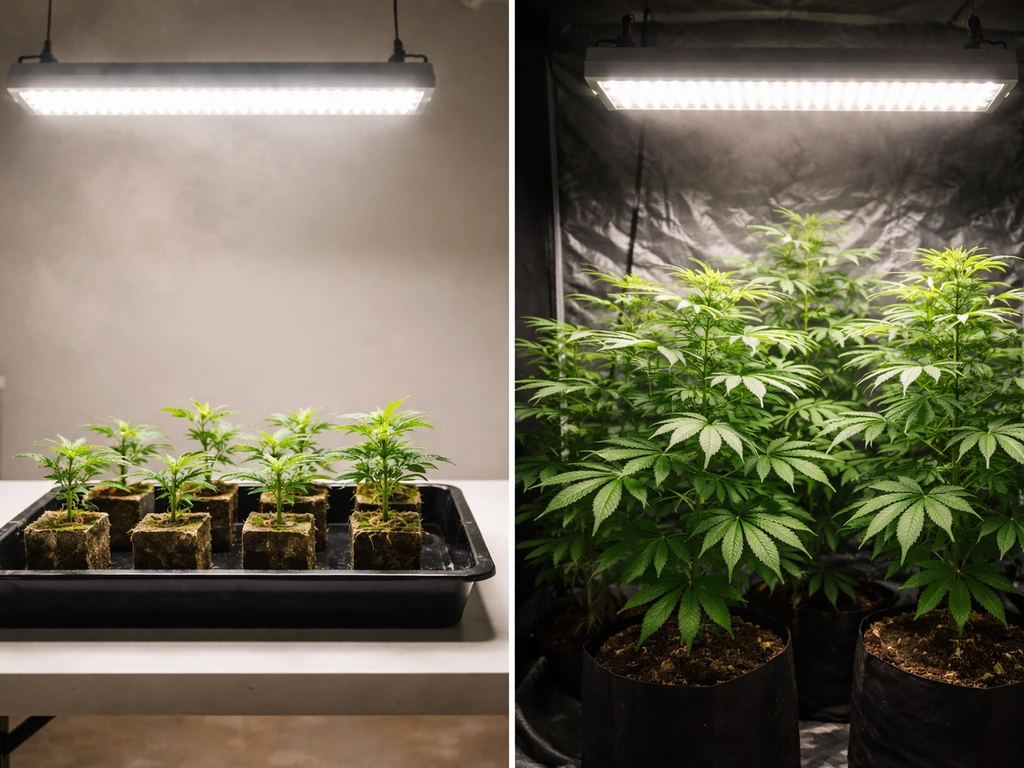
The KT600 is well-suited for seedlings and clones. At 65W, you can hang it closer to the canopy (18–24 inches is a reasonable starting point) and the intensity is gentle enough that you're unlikely to cause light bleaching or heat stress in young plants, especially with the fanless, low-radiant-heat output. For the K6400, seedlings need more distance: start at 36 inches or higher and dim down if you have controller access. A 640W bar light at full power and close range will bleach tender seedlings quickly.
Vegetative growth
Both fixtures perform well in veg within their rated footprints. The KT600 at 18–24 inches over a 2×2 ft area delivers the kind of compact, internodally tight growth you want in vegetative stage. The K6400 at 24–30 inches over a 4×4 to 5×5 ft canopy drives vigorous veg growth with the wattage to push multiple large plants simultaneously. The full-spectrum recipe (3000K/5000K blend plus red and far-red on the KT600, LM301H EVO on the K6400) supports healthy leaf and stem development without the skewed blue-heavy spectrum that older panels sometimes produced.
Flowering and fruiting
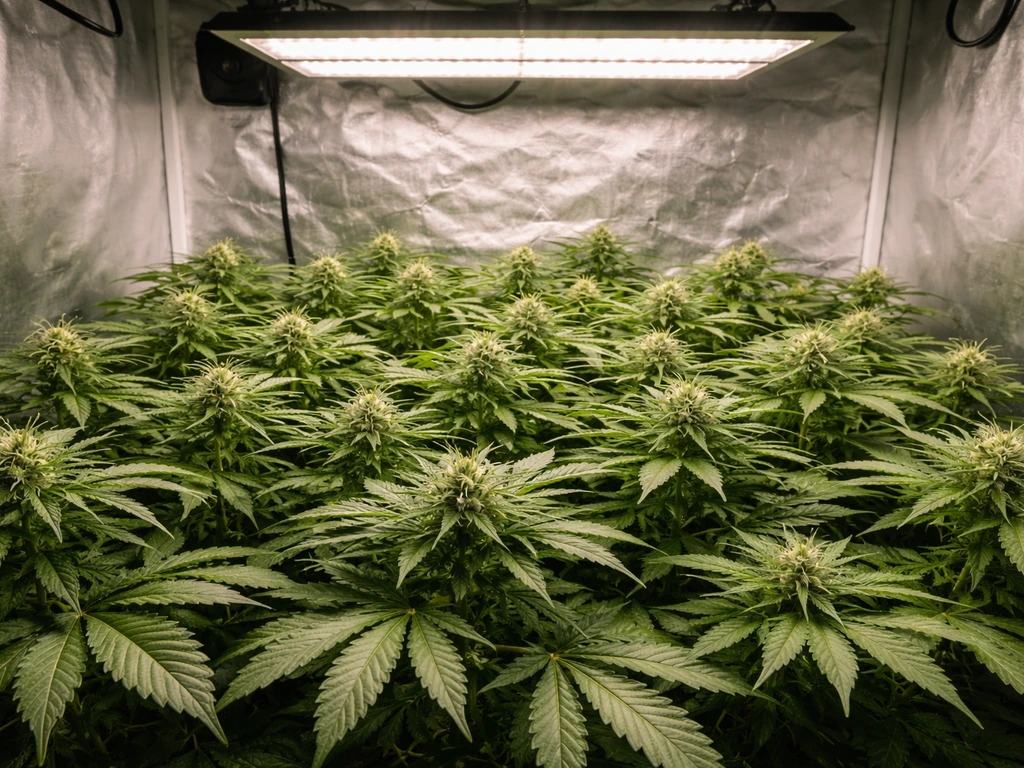
This is where footprint discipline matters most. The K6400 at a 4×4 ft bloom footprint is genuinely capable of supporting high-demand flowering crops: the 660 nm and 730 nm far-red components in the spectrum support flowering initiation and bud density, and the raw intensity is there. The KT600's 1.5×1.5 ft bloom footprint is honest and tight; push it beyond that and you'll see the outer plants lose density and stretch toward center. Heat stress from the K6400 is manageable with adequate tent ventilation, but watch for any leaf curling or bleaching on the top cola closest to the bars in small tents where you can't get the mounting height high enough.
Setup, hanging, and day-to-day usability
Setup for the KT600 is straightforward. The included ratchet hangers let you adjust height easily, and the inline switch handles on/off without needing a separate controller. The manual suggests adjusting intensity by changing hanging height rather than a dial, which is the simplest possible dimming approach. It works, but it's less precise than a knob. For basic timer compatibility, any standard outlet timer will work fine since you're just switching mains power.
The K6400 is more involved to hang (34 lb requires solid anchor points in your tent frame or overhead structure) but the 0–10V dimming interface opens up proper controller compatibility. You can connect a compatible 0–10V controller to ramp intensity up or down smoothly, which is useful for sunrise/sunset simulation or for dialing back intensity in early veg or late propagation. The daisy-chain port means you can run two or more K6400s off a single controller signal, which simplifies wiring in a multi-fixture room. Standard outlet timers work for basic on/off; a smart controller with 0–10V output gives you full ramp control.
Power draw, efficiency, and whether the price makes sense
At 2.9 µmol/J, both Koscheal fixtures sit at the upper end of what's widely available in the consumer market right now. That's the same efficiency figure claimed by many well-regarded fixtures in the $200–$400 range for mid-tier panels. Whether that figure holds up under third-party measurement is something Koscheal hasn't published independently, but the Samsung LM301B and LM301H EVO substrates have known efficiency curves that make the 2.9 µmol/J claim plausible for a well-designed driver and circuit board.
On operating cost: the KT600 at 65W running 18 hours/day in veg costs roughly $4.20/month at $0.12/kWh, or about $2.80/month at 12 hours in flower. The K6400 at 640W over 12 hours/day runs approximately $27.60/month at the same rate. For a 4×4 ft canopy, that's a reasonable operating cost compared to equivalent HID lighting, which would draw more watts for similar output with added cooling load. The value question is really about whether you trust the brand's efficiency claims enough to invest in the hardware cost. The 3-year warranty on the K6400 helps justify that bet.
Who should actually buy a Koscheal
The KT600 is a solid pick for anyone growing in a small closet, propagation chamber, or single-plant setup where simplicity and low noise matter more than scalability. It's not a light you'll outgrow upward; if your goals expand to a full tent, you'll replace it. Think of it as a purpose-built starter light with good diode quality for the price.
The K6400 makes sense for growers who are already committed to a 4×4 or 5×5 ft tent and want a single-fixture solution with proper dimming and controller support. At 640W with LM301H EVO diodes and a fanless design, it competes credibly with other bar-array fixtures in its class. The 34 lb weight and physical size mean this isn't an impulse buy; you need a tent or structure that can support it and enough overhead clearance to get mounting height right.
- Buy the KT600 if: you're growing 1–2 plants in a 2×2 ft space, want zero noise, and need a low-cost, low-complexity setup.
- Buy the K6400 if: you're running a 4×4 to 5×5 ft tent, want 0–10V dimming and daisy-chain capability, and value passive cooling at high wattage.
- Skip the KT600 if: you're planning to scale up within a year. Buy up once rather than twice.
- Skip the K6400 if: your tent is smaller than 4×4 ft. The light will be overpowered and you'll have no room to hang it high enough to avoid intensity problems.
- Think twice on either if: you're in a hot climate with poor tent ventilation. Fanless lights at 640W need ambient air movement to stay in spec.
How Koscheal stacks up against other brands
Koscheal isn't the only brand in this efficiency bracket, and it's worth knowing where it sits relative to the competition before you commit. If you're looking at other budget-to-mid-tier panels using Samsung diodes, the Missyee grow lights cover similar small-tent territory and are worth a direct comparison if the KT600's small footprint is a concern for your space.
For growers comparing higher-output options, the Yehsence grow lights lineup is a natural reference point in the same efficiency and price tier. If you're specifically considering the 1500W-class fixtures, the Yehsence 1500W LED grow light is one of the more tested options in that range and gives you a sense of what the price-per-watt looks like from an established competitor.
At the budget end of the spectrum, the Sayhon grow light is another small-panel option that competes with the KT600 on price; it's worth checking if you're prioritizing cost above everything else. For growers who want to understand the premium end of the market and how a purpose-built specialist fixture compares to bar-array value lights, the Kessil grow light review covers what you give up and gain by spending more.
One other brand that competes directly with Koscheal on the small-panel, single-plant segment is covered in the Honorsen grow light review, which is useful reading if you want a side-by-side sense of build quality differences at a similar price point.
| Brand/Model | Best For | Key Differentiator | Compared to Koscheal |
|---|---|---|---|
| Koscheal KT600 | Closet / 2×2 ft grows | Fanless, LM301B, 2.9 µmol/J | Reference point |
| Koscheal K6400 | 4×4 to 5×5 ft tents | Bar array, 640W, 0–10V dimming | Reference point |
| Missyee (similar panel class) | Small tents | Comparable diode quality | Similar efficiency, check footprint |
| Yehsence (mid-tier) | Mid-size tents | Established brand, tested at 1500W class | Competitive on PPE, broader model range |
| Sayhon (budget panels) | Budget-first grows | Lower price | May trade efficiency for cost |
| Kessil (premium) | Precision/aquatic/specialty grows | Point-source optics, build premium | Higher cost, different use case |
The honest summary is that Koscheal earns its place in the market on the strength of its diode selection and efficiency rating. The KT600 is a competent small-space light with no major red flags, and the K6400 is a legitimate option for a 4×4 or 5×5 ft tent if you want a fanless bar array with proper dimming control. Neither fixture does anything unusual or proprietary, and that's mostly a compliment: they're straightforward, well-specced lights using proven components, backed by a warranty that's better than the category average. If your grow space fits the stated coverage footprints, you're unlikely to be disappointed.
FAQ
Is the koscheal grow light review claim of 2.9 µmol/J realistic, and how should I verify it before buying?
You cannot confirm efficiency without independent testing, so use the published watt draw and PPF to sanity-check the math. For example, 640W at 2.9 µmol/J implies roughly 1856 µmol/s PPF (which matches the listing for the K6400), while the KT600 should yield a much smaller total PPF consistent with its 65W draw. If a seller’s stated PPF and claimed efficiency do not align with the wattage, treat the efficiency claim as unreliable.
Which one should I choose if I’m growing seedlings and then flowering under the same tent?
If you must use one fixture through the full cycle, the K6400 is the safer bet because its bloom footprint is realistic for flowering intensity (not just veg). The KT600 can work for seedlings and clones, but its 1.5×1.5 ft bloom limit means flowering plants typically lose bud density and stretch unless you keep your canopy tight within that smaller area.
What is the biggest setup mistake people make with the KT600 and K6400?
Most common error is ignoring the stated bloom footprint. If you place the KT600 over a larger flowering area than its 1.5×1.5 ft target, you will likely see thin outer growth and slower development. For the K6400, using the full 5×5 ft space at full power can also reduce edge performance, because even well-designed bar arrays have normal corner-to-center variation.
Do I need a fan if the koscheal grow lights are fanless?
Yes, you still need airflow in the tent, just not inside the fixture. Fanless lights rely on the heat sink and ambient ventilation, so ensure the grow space has active circulation (oscillating fan for canopy movement and exhaust for removing hot air). In stale or hot rooms, the fixture can run warmer than ideal, increasing the chance of output drop.
How high should I hang the K6400 near seedlings or clones, and what should I watch for?
Start higher than full-bloom height. A practical approach is 36 inches or more for tender starts, then lower gradually while monitoring leaf color and tip stress. If you see bleaching, very light leaf color, or curling near the top, raise the light again or reduce intensity if your controller supports it.
Can I daisy-chain multiple K6400 units safely, or is it just a wiring convenience?
It is both convenience and a limitation, because daisy-chaining depends on your controller’s output capacity and the wiring method specified for the 0–10V signal. Before chaining, confirm your controller can supply the correct voltage signal for all fixtures combined, and keep cable routing stable and insulated to prevent intermittent dimming behavior.
Does the 0–10V dimming on the K6400 work with smart controllers and sunrise timers?
It can, as long as your controller provides a true 0–10V output (not just an on/off relay). Many smart systems are compatible only if they specifically support 0–10V analog dimming. If your controller only switches power, it will not give you smooth ramping and will instead hard-cycle the fixture.
What kind of warranty coverage should I expect on the K6400 and how does it help?
The K6400’s 3-year warranty is meaningful because it reduces the downside if efficiency or thermal behavior is not what you expect after the first few months. Still, keep installation within the intended mounting and ventilation conditions, because extreme heat or blocked airflow can be grounds for disputing performance claims.
How do I calculate operating cost for my exact schedule using the wattage from the review?
Use the fixture wattage times hours per day, then multiply by your electricity rate. For quick math: (watts ÷ 1000) × hours/day × 30 × rate (per kWh). For example, if you run the K6400 at 640W for 14 hours/day at $0.12/kWh, monthly cost is about 640/1000 × 14 × 30 × 0.12.
Will the KT600 be quiet in practice, or can there be other noise sources?
The fixture itself is fanless, so it should be silent mechanically, but you can still hear noise from nearby components like clip-on oscillating fans, exhaust fans, or a vibrating power strip. If you are noise-sensitive, place the fixture so the heat-sink area is unobstructed and keep fans off low shelves that transmit vibration into the tent frame.
Do these fixtures require special dimming or driver settings beyond hanging height for the KT600?
For the KT600, the practical method is height-based dimming, because the review notes you adjust output by changing hanging height rather than using a control port. If you need precision, a better fit is the K6400 because it supports 0–10V control, which lets you fine-tune intensity without constantly re-hanging the light.
How do I position plants on a bar-array like the K6400 to minimize unevenness?
Treat the center as your production zone. Place the densest or highest-value plants toward the middle of the 4×4 bloom footprint, and consider rotating plants every week so any corner-to-center variation has time to average out. If you cannot center plants due to space, keep the canopy flatter and avoid tall plants directly under any potential hot-spot region.