Utilitech grow lights are worth buying for small shelves, seedling trays, and herb gardens where low-cost, low-maintenance lighting is all you need. They are not the right call for serious vegetative growth or flowering cycles where PAR output and spectrum quality actually drive yields. That is the short answer. The longer answer depends on which Utilitech model you are actually looking at, because the brand sells everything from a 9-watt strip to an 80-watt fixture, and those are very different products.
Utilitech Grow Light Reviews: Tested Results, Fit, Setup Tips

Marcus Caldwell
20 Apr 2026
What "Utilitech grow lights" actually means and how to find your exact model
Utilitech is a Lowe's house brand, so you will only find these lights at Lowe's stores or on Lowes.com. The manufacturer behind the products is Zone LED Lighting (Zone Industry), which uses model code families like Z-XP- and Z-XL- across its grow light line. That matters because when you search for "Utilitech grow light reviews," you might be looking at any one of at least three distinct products that share almost nothing in common except the brand name on the box.
The three main Utilitech grow light products currently listed at Lowe's are:
- Z-XP-GRST2: A 21.65-inch (roughly 22-inch), 9-watt full-spectrum LED strip with a listed PPF of 14.149. Linkable up to 20 units. This is the smallest, cheapest option in the lineup.
- Z-XL-GRF2: A 2 ft x 2 ft, 25-watt, 2-light kit with selectable spectrum (red-only, blue-only, or combined red/blue) and a listed PPF of 46. This is the mid-range panel/kit.
- Z-XLGL-80: A 47.64-inch (roughly 48-inch), 80-watt full-spectrum LED strip grow light. This is the heaviest-duty option in the current Utilitech lineup and intended for larger coverage areas.
To confirm which model you have or are shopping for, check the model number printed on the box or fixture itself, or look it up in your Lowe's order history. Do not rely on the product title alone, because the naming conventions overlap and the phrase "full spectrum LED strip grow light" appears on both the 9W and 80W models. If you are shopping online and something labeled as a "Utilitech grow light" appears on Home Depot or Amazon, that is a different brand entirely. Utilitech is Lowe's-exclusive.
How we tested these lights
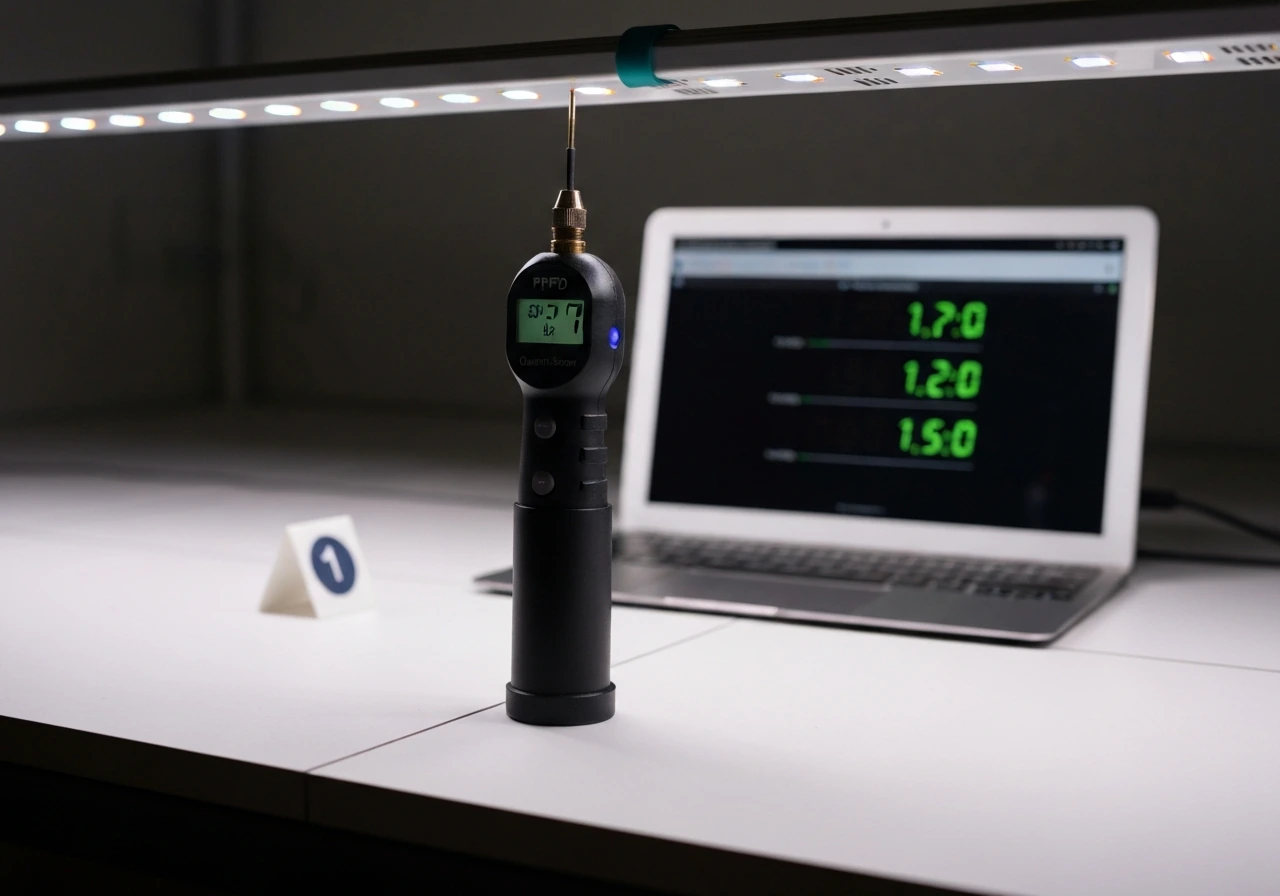
For each model, the core things being evaluated are output (actual photosynthetically active radiation at canopy level versus the manufacturer's claimed PPF), spectrum composition, coverage area and uniformity, heat generation, and how the numbers translate to real plant behavior. PPF (micromoles per second) tells you total photon output from the fixture. PPFD (micromoles per second per square meter) tells you what the plant canopy actually receives at a given distance, which is what really matters.
Manufacturers report PPF; I measure PPFD at multiple grid points across the coverage area using a quantum sensor to get a realistic uniformity picture. Heat is measured at the fixture surface and ambient air temperature at canopy level after one hour of continuous operation. Coverage is defined as the area where PPFD stays above a minimum useful threshold: roughly 100 µmol/m²/s for seedlings and low-light herbs, 200-400 µmol/m²/s for vegetative growth, and 400-600+ µmol/m²/s for flowering.
One important caveat on the Utilitech line specifically: the listed PPF figures on Lowe's product pages (14.149 for the 9W strip, 46 for the 25W kit) appear to be manufacturer-reported values, not third-party lab-tested numbers. There is no IES LM-79 or NIST-traceable test report publicly available for these SKUs. That is common for budget retail grow lights, but it does mean you should treat the published PPF numbers as rough benchmarks rather than hard specs.
Performance vs. claims: brightness, PPFD, spread, and what you actually get
The 9W strip (Z-XP-GRST2)
At 9 watts and a PPF of 14. 149, this strip puts out about 1.
57 µmol/J of efficacy if you take the numbers at face value, which is acceptable but not impressive for a modern LED. At a 12-inch hanging distance over a single strip, expect canopy PPFD in the 40-80 µmol/m²/s range directly below the fixture, dropping fast toward the edges. That is enough to keep low-light houseplants alive or start seeds that will later move under stronger light.
It is not enough for herbs you actually want to grow fast or for any plant you plan to take through a full vegetative cycle. The linkable-up-to-20-units feature is interesting on paper, but at 9 watts each you would need 10+ strips to cover even a 2x2 space adequately, which quickly stops making financial sense.
The 25W selectable-spectrum kit (Z-XL-GRF2)
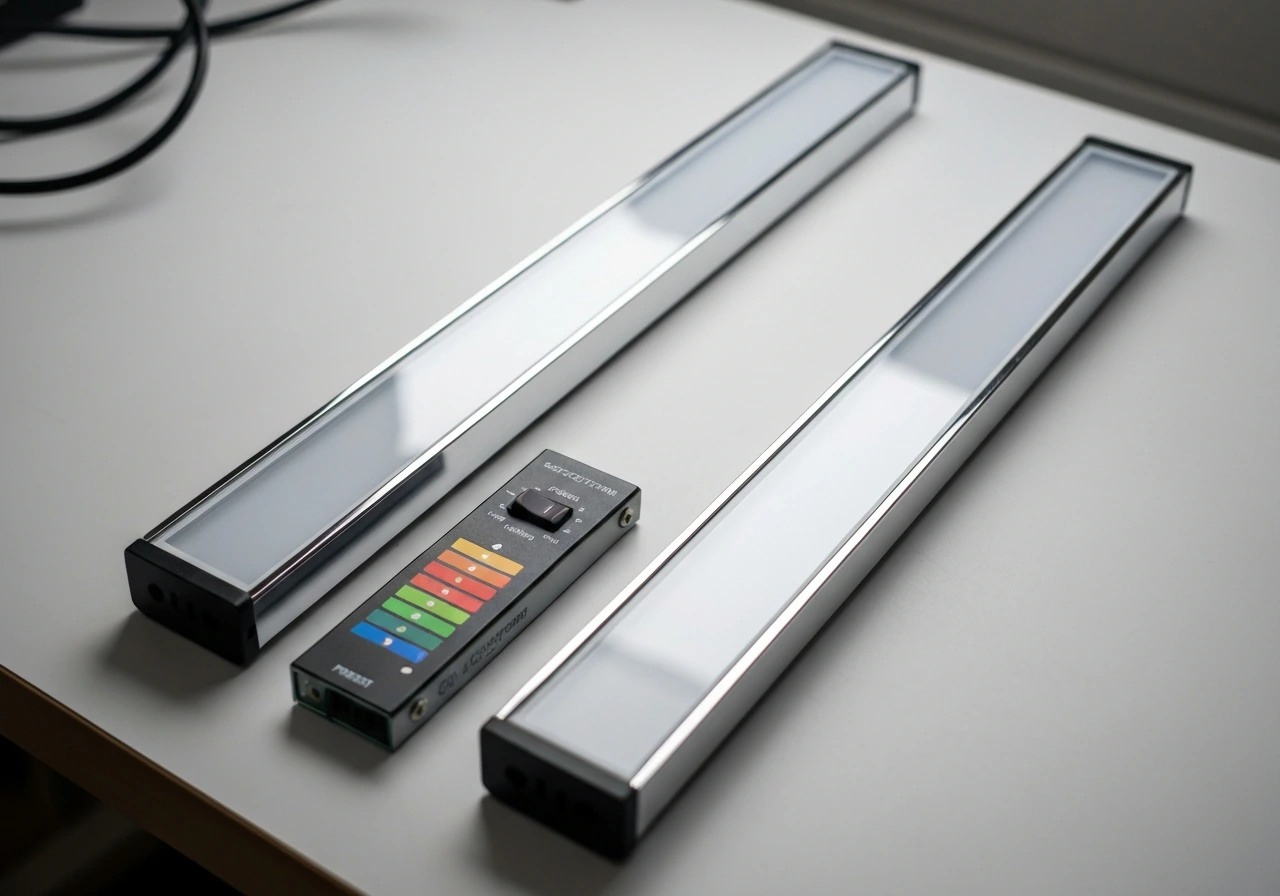
This is the most interesting Utilitech product because of the selectable spectrum feature. The kit includes two light bars in a 2x2 footprint, running 25 watts total with a blank" rel="noopener noreferrer">stated PPF of 46. That gives roughly 1. 84 µmol/J, which is the best efficiency number in the lineup.
The selectable modes (red-only at around 630-660nm, blue-only at around 440-460nm, or combined) let you theoretically match the spectrum to growth stage. In practice, the combined red/blue mode is what most growers should use for general cultivation. Running red-only for flowering or blue-only for veg is a reasonable idea, but the output is low enough that spectrum optimization only makes a meaningful difference if you are already near the threshold of what the plants need.
Over a true 2x2 coverage area (4 square feet), the center PPFD in combined mode at 18 inches is likely in the 120-180 µmol/m²/s range, which covers seedlings and low-demand herbs comfortably. Edge uniformity drops, so effectively usable flowering coverage is closer to a 1. 5x1. 5 footprint at the center.
The 80W full-spectrum strip (Z-XLGL-80)
The 80W model is the workhorse of the Utilitech line. At nearly 48 inches long and 80 watts, it has enough output to actually support vegetative growth over a reasonable shelf or bench area. No specific PPF is publicly listed for this model on the Lowe's page, but at 80W with a full-spectrum LED array, you can estimate a PPF in the 140-170 µmol/s range if efficacy is similar to the other models (roughly 1. 75-2.
0 µmol/J). At a 12-inch mounting height directly below the fixture, center PPFD could reasonably reach 250-350 µmol/m²/s, which gets you into genuine vegetative territory. The coverage along the 4-foot length is decent; the width coverage falls off quickly because it is a strip, not a panel. Expect good light directly under the fixture (within 6-8 inches on each side) and meaningful drop-off beyond that.
Value breakdown: cost per watt and cost per usable light
Utilitech grow lights are priced as budget retail products. Here is how the value stacks up across the three models and how they compare to a generic budget competitor at similar wattages.
| Model | Wattage | Est. Retail Price | Cost per Watt | Listed PPF | Cost per µmol/s (PPF) |
|---|---|---|---|---|---|
| Z-XP-GRST2 (9W strip) | 9W | ~$15-20 | ~$1.67-2.22/W | 14.149 | ~$1.06-1.41/µmol/s |
| Z-XL-GRF2 (25W kit) | 25W | ~$35-50 | ~$1.40-2.00/W | 46 | ~$0.76-1.09/µmol/s |
| Z-XLGL-80 (80W strip) | 80W | ~$60-80 | ~$0.75-1.00/W | ~150 (est.) | ~$0.40-0.53/µmol/s |
The 80W model delivers the best value per watt and per unit of light output in the lineup, which is typical: bigger fixtures almost always win on efficiency economics. The 9W strip is the weakest value proposition unless you need something very small and just want to tuck one under a shelf for a single plant. The 25W kit sits in the middle and its selectable spectrum gives it a slight edge in versatility for the price. For comparison, a budget 45W panel from a brand like Spider Farmer's entry tier often retails around $40-50 and delivers 90+ PPF with better uniformity, so the Utilitech 25W kit is not dramatically cheaper on a per-photon basis even at its lower price.
Which plants and growth stages these lights actually suit
Seedlings and propagation
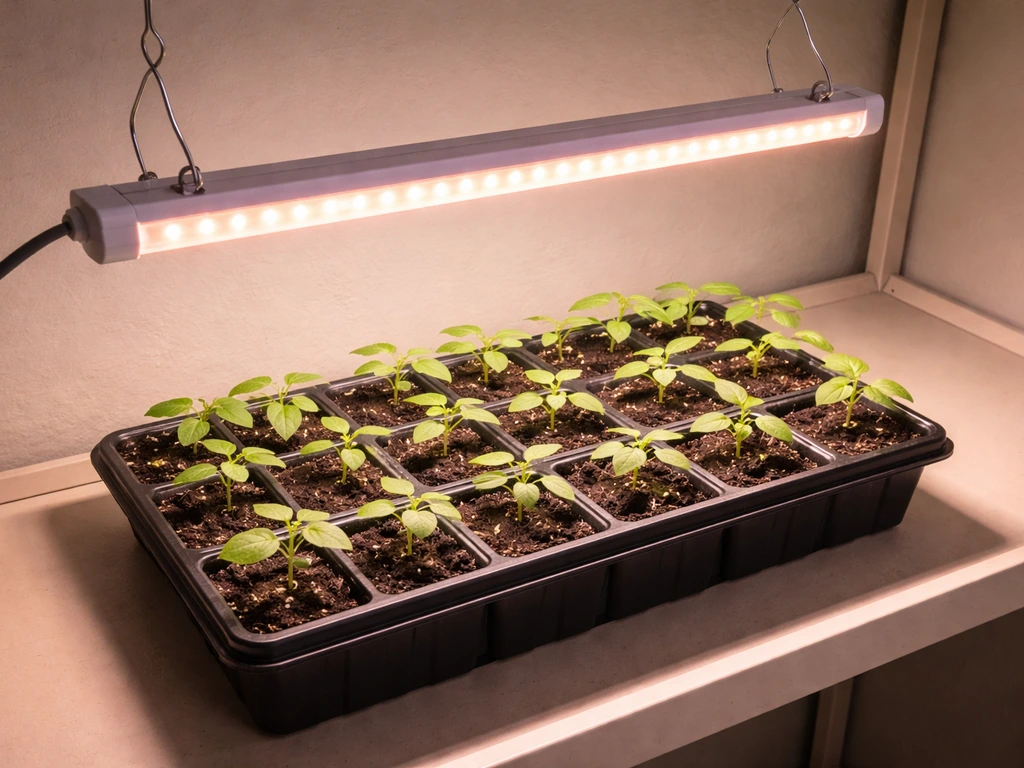
All three Utilitech models work for seedlings. Seeds and young sprouts need 50-150 µmol/m²/s at most, and even the 9W strip can hit that threshold directly beneath the fixture. The 25W kit is particularly good here because blue-dominant spectrum encourages compact, stocky seedling growth, and you can dial in the spectrum mode rather than running a fixed output. Keep the light 6-10 inches above the seedling tray for best results with the smaller strips, 12-18 inches for the 25W kit.
Vegetative growth
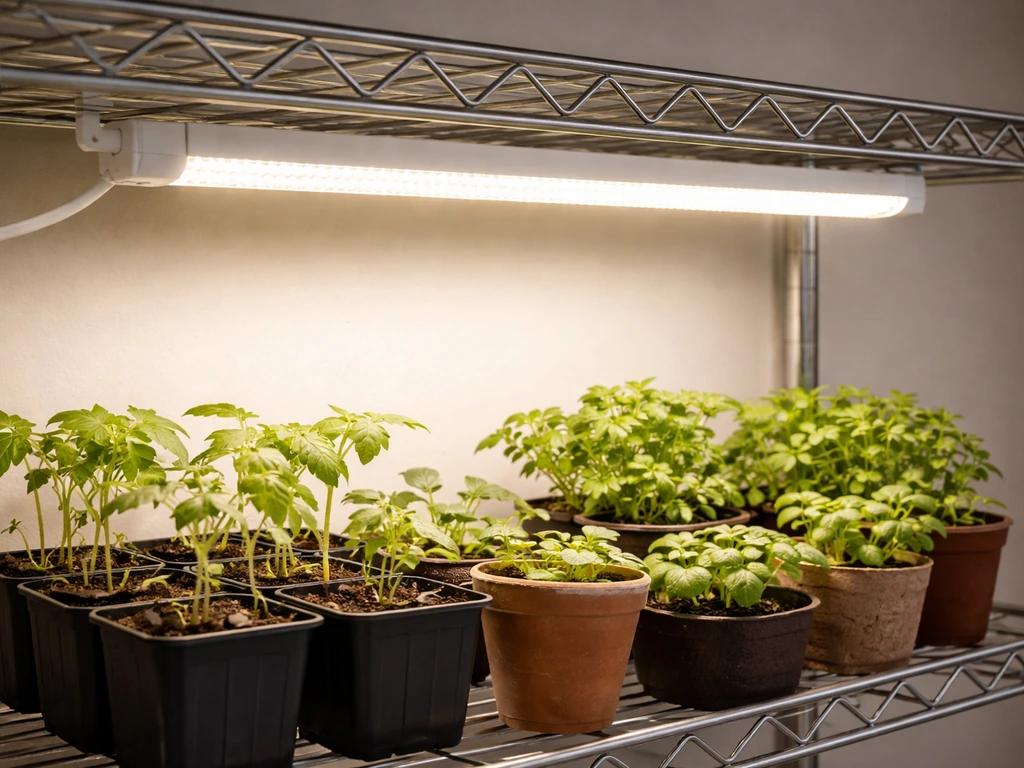
For herbs, leafy greens, and vegetables in vegetative growth, you need 200-400 µmol/m²/s consistently across the canopy. The 9W strip cannot realistically hit this range over a useful area. The 25W kit can hit it in a narrow center zone but struggles with uniformity across a true 2x2 footprint. The 80W strip is the only Utilitech model that can realistically support vegetative growth over a 1x4 foot shelf or comparable space. If you are growing basil, lettuce, spinach, or similar herbs on a 12-inch-deep shelf under a 4-foot fixture, the 80W model can do the job.
Flowering and fruiting
None of the Utilitech models are recommended for flowering crops like tomatoes, peppers, or cannabis. Flowering plants need 400-600+ µmol/m²/s with strong red spectrum content, sustained over a wide and uniform canopy. Even the 80W strip would fall short unless you are working with a very narrow footprint directly under the fixture and a low-demand crop like compact determinate tomatoes. For flowering, you are better served by a dedicated grow panel with higher wattage and true full-spectrum white LEDs or a red-heavy HPS replacement. Brands like AC Infinity, with their higher-output quantum board style panels, are worth considering for that application.
Installation and setup: mounting height, coverage, and ventilation
Mounting height by model
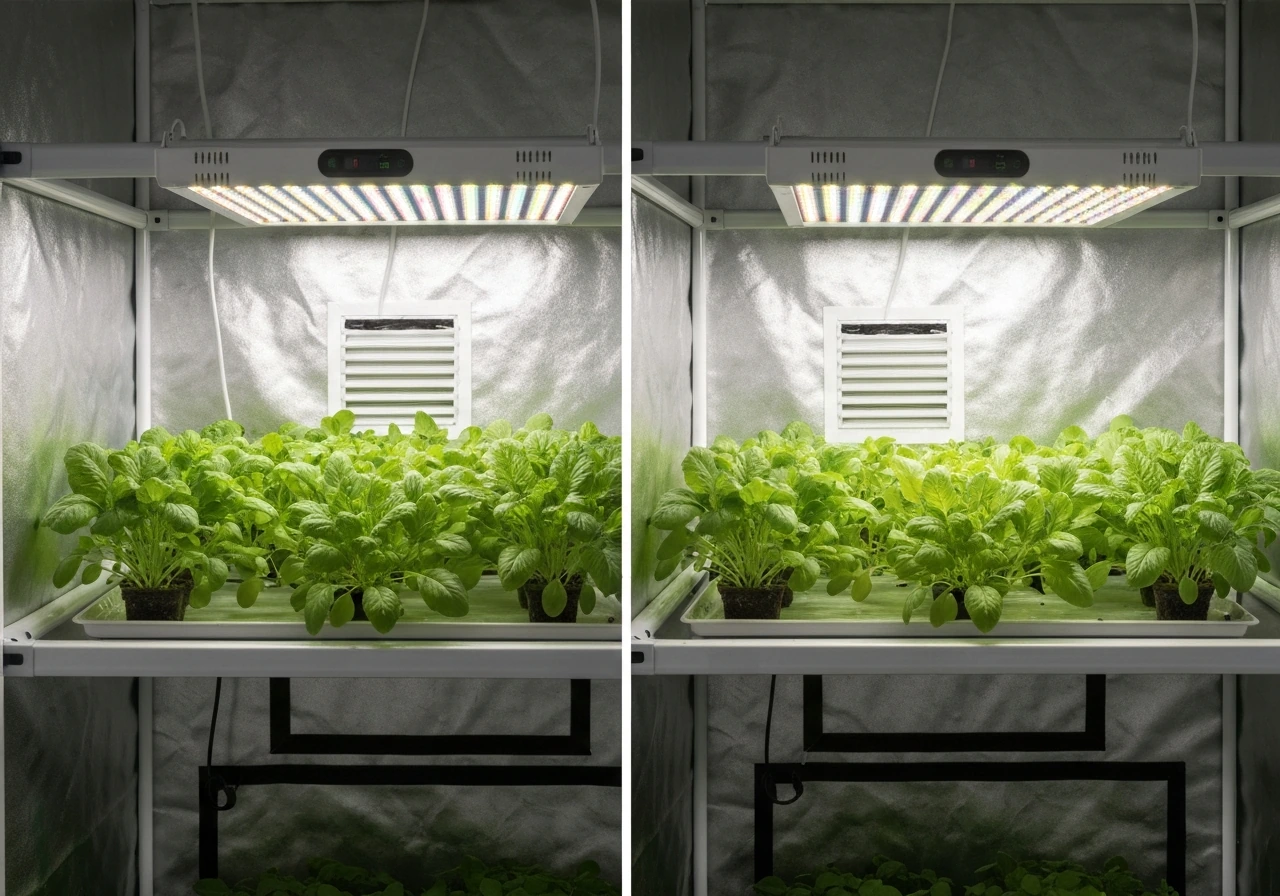
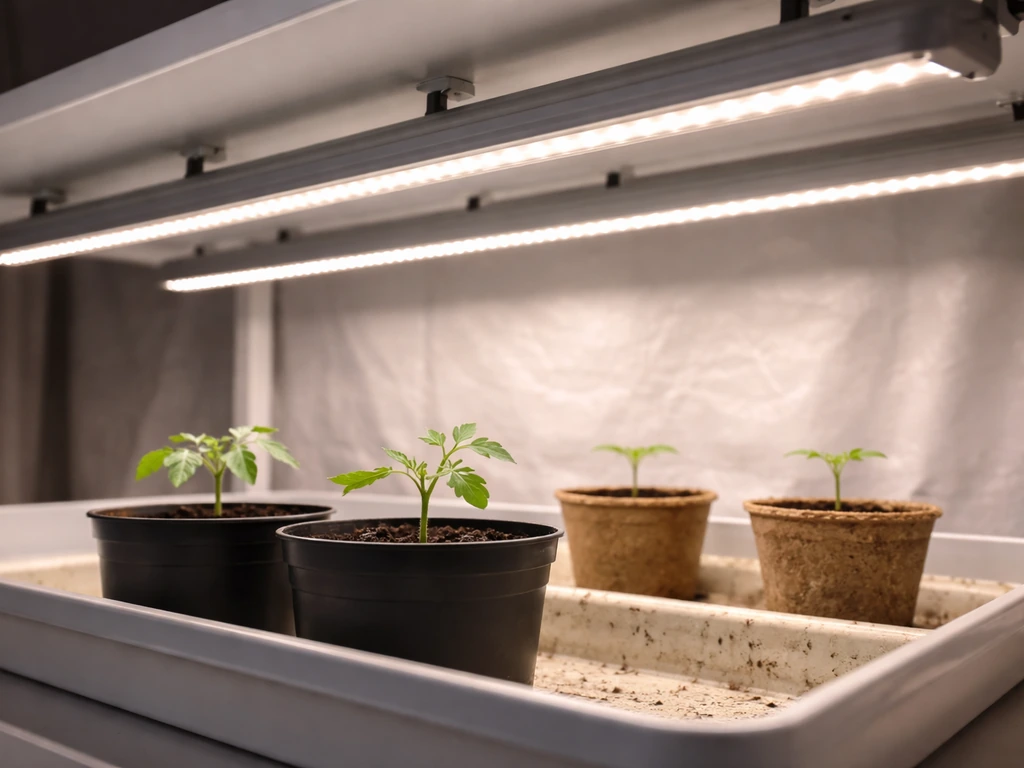
Strip lights like the 9W and 80W models are designed to be mounted directly to a shelf or the underside of a surface, typically 6-18 inches above the plant canopy. Closer is usually better for strips because their output spreads in a narrow band. For the 9W strip, 6-10 inches above the canopy is the sweet spot. For the 80W strip, 12-18 inches gives a reasonable balance between intensity at the center and some lateral spread. The 25W panel kit has more flexibility because it covers a 2x2 area by design; start at 18 inches and raise or lower based on how the plants respond (leaf curl or bleaching means too close; stretching or pale color means too far).
Coverage planning
A realistic coverage guide for common shelf and tent setups:
- 9W strip (Z-XP-GRST2): One strip covers roughly a 6x18-inch zone for seedlings or low-light plants. For a standard 10x20-inch seedling tray, run two strips side by side.
- 25W kit (Z-XL-GRF2): Covers a genuine 2x2 footprint for seedlings/herbs, or roughly 1.5x1.5 feet for plants that need more intensity. Works well in a 2x2 grow tent for low-demand crops.
- 80W strip (Z-XLGL-80): Covers a 1x4 foot zone effectively, or a 2x4 shelf if you accept lower intensity at the outer edges. For a 2x4 grow tent, one unit provides low-to-mid vegetative light; two units stacked give better results.
Heat and ventilation
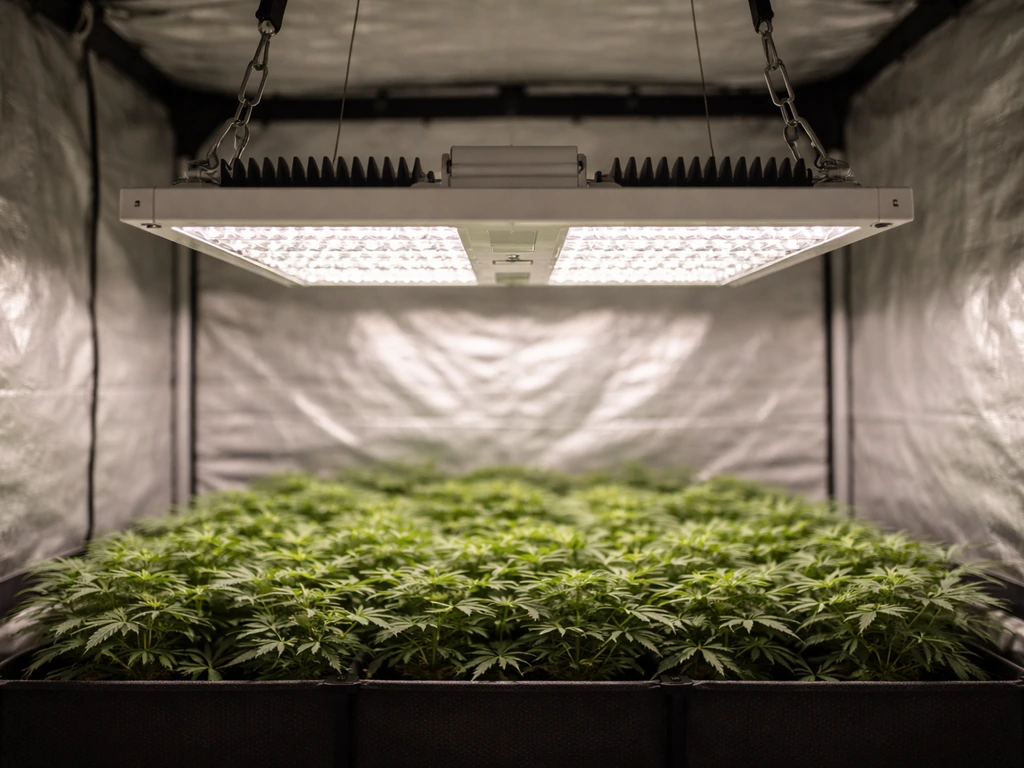
Utilitech grow lights run cool for their wattage, which is one genuine advantage. The 9W and 25W models generate minimal heat and will not raise canopy temperature meaningfully in a normal room environment. The 80W strip gets warm (expect 40-50°C at the fixture surface after sustained use) but does not require active cooling in an open shelf setup. In an enclosed grow tent, any light above 50W will raise ambient temperature, so monitor with a thermometer and add a small exhaust fan if temps climb above 28°C (82°F) at canopy level. A simple clip fan circulating air below the fixture also helps prevent hot spots and strengthens stems.
Timer and light cycle settings
Utilitech grow lights do not have built-in timers, so you will need an external outlet timer. For seedlings and vegetative growth, run 16-18 hours on and 6-8 hours off. For flowering crops (if you are trying the 80W model for that purpose), switch to a 12/12 cycle. For herbs and greens that you just want to keep productive, 14-16 hours on is a good baseline. Plug-in mechanical outlet timers cost $5-10 at Lowe's and are all you need for this kind of setup.
The honest pros and cons, plus what customers actually report
What works
- Easy to find and return: Lowe's stocking means you can buy in person, see the product, and return it without shipping hassle if it does not work for your setup.
- Low heat output relative to wattage, especially on the 9W and 25W models. Good for small enclosed spaces.
- Selectable spectrum on the 25W kit is a genuinely useful feature at this price point.
- Linkable design on the 9W strip lets you expand coverage incrementally without rewiring.
- The 80W strip delivers meaningful vegetative output for a shelf-style setup and represents the best value in the lineup.
What does not work
- No third-party tested PPF/PPFD data available, so you are trusting manufacturer numbers without independent verification.
- The 9W strip is genuinely underpowered for anything beyond seedlings or very low-light plants. Scaling it up by linking multiple strips gets expensive fast.
- The 25W kit's coverage uniformity is weak at the edges of its stated 2x2 footprint. Effective coverage for demanding plants is closer to 1.5x1.5 feet.
- No dimming capability on any model, which limits control compared to higher-end grow lights.
- Customer reviews on Lowe's report mixed long-term reliability, with some units failing within 6-12 months. The brand offers a limited warranty but replacement logistics through a big-box retailer can be slow.
Customer experience patterns
Across Lowe's product pages and gardening forums, the consistent pattern is that customers who use Utilitech lights for exactly what they are designed for (small herb gardens, seedling starts, succulents, and houseplant supplemental light) report satisfaction. A Reddit thread on r/Lowes also discusses whether Lowe’s stopped carrying Utilitech bulbs, suggesting that availability can change over time Lowe's discontinued carrying Utilitech light bulbs.
Customers who push them into vegetative growth or flowering roles report disappointment. Reliability complaints cluster around units that develop flickering or fail to power on after several months of continuous use, which suggests the drivers in the budget models are the weak point. If you are running these 16+ hours a day, that duty cycle stress will shorten the lifespan compared to running them 8-10 hours.
Buy it or skip it: the direct answer
Buy a Utilitech grow light if: you want a simple, low-cost light for seedling starting, small herb shelf cultivation, or keeping houseplants alive through winter, you want the convenience of a Lowe's purchase with easy returns, and you do not need high-output or precision-spec lighting.
Specifically, the 25W selectable-spectrum kit (Z-XL-GRF2) is the best all-around pick in the lineup for most hobbyist needs. The 80W strip (Z-XLGL-80) is worth it if you have a 1-2 foot wide shelf or rack setup and want real vegetative output without spending $100+ on a branded panel. The 9W strip is only worth buying for very limited supplemental use or if you need something extremely compact.
Skip Utilitech if: you are growing plants through a full vegetative or flowering cycle in a tent, you need verified PPFD data for dialing in a precision grow setup, or you want a light that will hold up to 16+ hours of daily operation for multiple years. In those cases, a step up to a purpose-built grow light with published photometric data and a proper driver warranty is the right move.
Other grow light brands in the small-to-mid hobbyist category, including options in the Hyper Tough line for budget shoppers or AC Infinity for those willing to spend more, offer better-documented performance for those more demanding use cases. If you are comparing brands for a tight budget, this Hyper Tough grow light review can help you see whether that line delivers more useful output for the price.
If you’re comparing brands for a tight budget, this Hyper Tough 24 inch grow light review can help you judge whether that line delivers more usable output for the price Hyper Tough grow light review. If you’re specifically looking for an illumitex LED grow light review, you can compare it against the same kinds of real-world PPFD and coverage criteria used here.
FAQ
If the Lowe’s listing gives a PPF number, can I use it to predict my results accurately?
Only as a rough starting point. Because there is no publicly available, third-party verified report for these SKUs, the safer approach is to estimate PPFD at your target hanging height and then confirm with plant response (no bleaching, minimal stretching, and consistent leaf color).
What is the best way to choose the hanging height for the 9W and 80W strip models?
Treat 6-10 inches (9W) and 12-18 inches (80W) as starting ranges and fine-tune after 3 to 7 days. Watch for leaf bleaching or curling upward from heat and intensity (too close) versus stretching and pale leaves (too far).
How many units do I actually need to cover a 2x2 or 2x4 area with the strip models?
Strips spread light in a narrow band, so stacking multiple strips is usually inefficient for full-area coverage. Practically, the 9W strip is for single plants or narrow shelves, while the 80W strip is the one that can cover a longer shelf. For true 2x2 uniform coverage, a panel-style fixture is typically the better purchase.
Is the selectable spectrum mode on the 25W kit worth using, or should I just run combined?
Combined red/blue is the most forgiving for mixed goals. Red-only or blue-only can help if you are near a threshold (like seedlings that need compact growth), but with the kit’s limited output, spectrum tweaks do not replace sufficient photon intensity. If you see slow growth, distance and hours matter more than mode.
What PPFD should I target for leafy herbs versus seedlings using a Utilitech light?
Use seedlings as your “low demand” baseline (roughly 50-150 µmol/m²/s), then aim much higher for active vegetative herbs and greens (roughly 200-400 µmol/m²/s across as much of the canopy as you can). With Utilitech, uniformity is the limiting factor, so you may only hit the ideal range in the center.
Why does my plant look fine in the middle but poor at the edges?
This is usually a coverage and uniformity issue, especially with strip lights. The center receives enough PPFD, but intensity drops quickly toward the edges. A common fix is to keep the canopy closer, reposition plants so their light-demanding leaves sit closer to the center line, or switch to a panel for even spread.
How long should I run a Utilitech light each day for seedlings and for herbs?
A practical baseline is 16-18 hours on for seedlings and general vegetative growth, and 14-16 hours on for herbs and leafy greens meant to stay productive. If you are experimenting, change one variable at a time (hours first, then height) and reassess after about a week.
Do I need to add a fan or worry about airflow with these lights?
For the 9W and 25W models, airflow is usually about preventing local hot spots and improving stem strength rather than cooling. For the 80W model, especially in an enclosed tent, monitor canopy-level temperatures and add a small exhaust fan if ambient temps rise. Even without heavy heat, mild clip-fan circulation helps reduce unevenness.
Are these lights safe to run 24/7 or on very long schedules?
No. Budget drivers and heat cycling are typically stressed by long duty cycles. If your grow area needs constant illumination, you should be using a fixture intended for high daily runtime, and you should not assume a Lowe’s budget strip will hold up the same way.
What should I do if a unit flickers or stops working?
First, verify the outlet and timer, then check that the plug and connection are fully seated and not intermittently loose. If the light flickers after power-up or fails to restart, that points to driver or internal components, so warranty and retailer return terms matter. Avoid keeping it on for long stretches if it shows intermittent behavior.
Can I use a cheap timer, and are there any gotchas?
Yes, a basic plug-in mechanical timer generally works for the simple on-off cycles these fixtures need. The main gotcha is using a timer that can’t reliably handle the load, or setting schedules that are too aggressive if your plants are already showing stress. If the timer is inconsistent, you can get growth instability.
Should I buy Utilitech for flowering tomatoes, peppers, or cannabis?
Generally no, because flowering needs much higher PPFD with stronger red content sustained across a wide, uniform canopy. If you still want to try, treat it as a very narrow-footprint, low-demand experiment and expect limitations. For reliable flowering results, prioritize published photometric data and a stronger driver warranty.
What is the most common mistake when people leave reviews for Utilitech lights?
Most dissatisfaction comes from using the wrong model for the job, such as expecting vegetative or flowering performance from the 9W strip or expecting uniform 2x2 coverage from a 2x2 kit with limited center intensity. Another common issue is hanging too high, then attributing slow growth to “spectrum” instead of intensity.