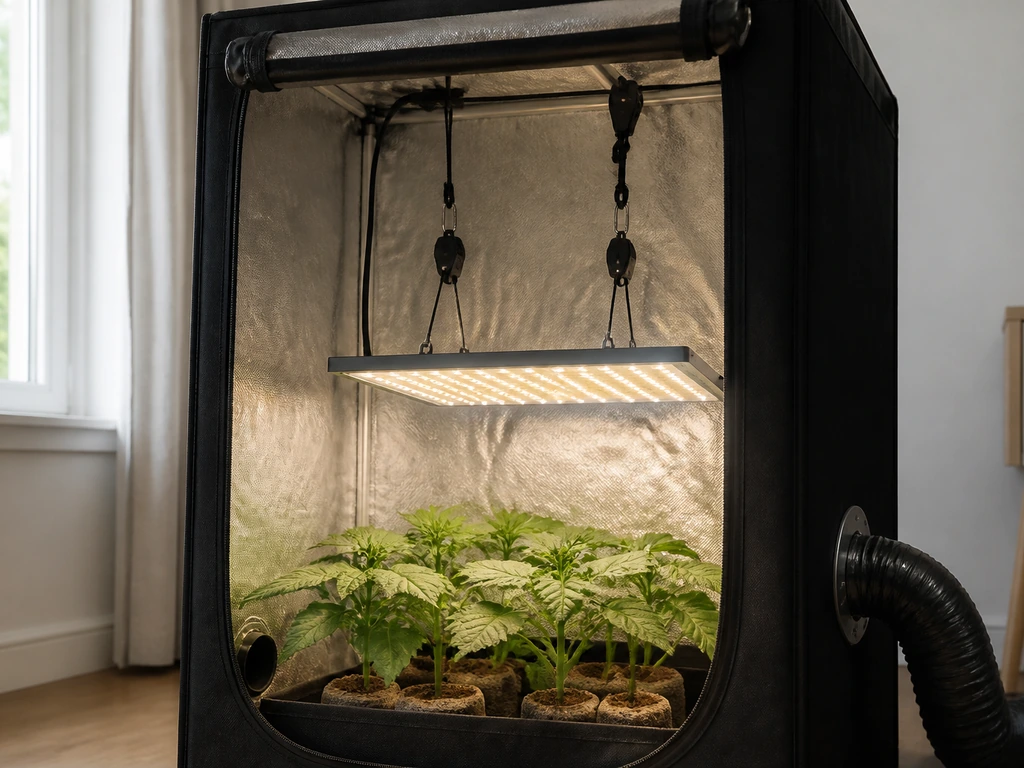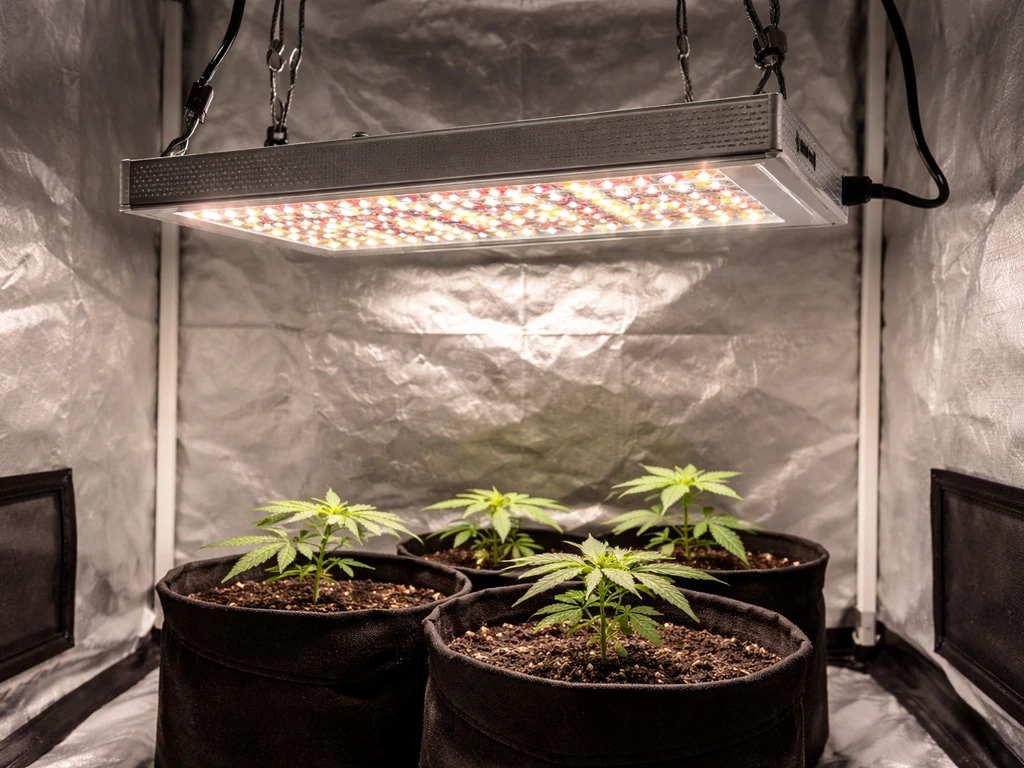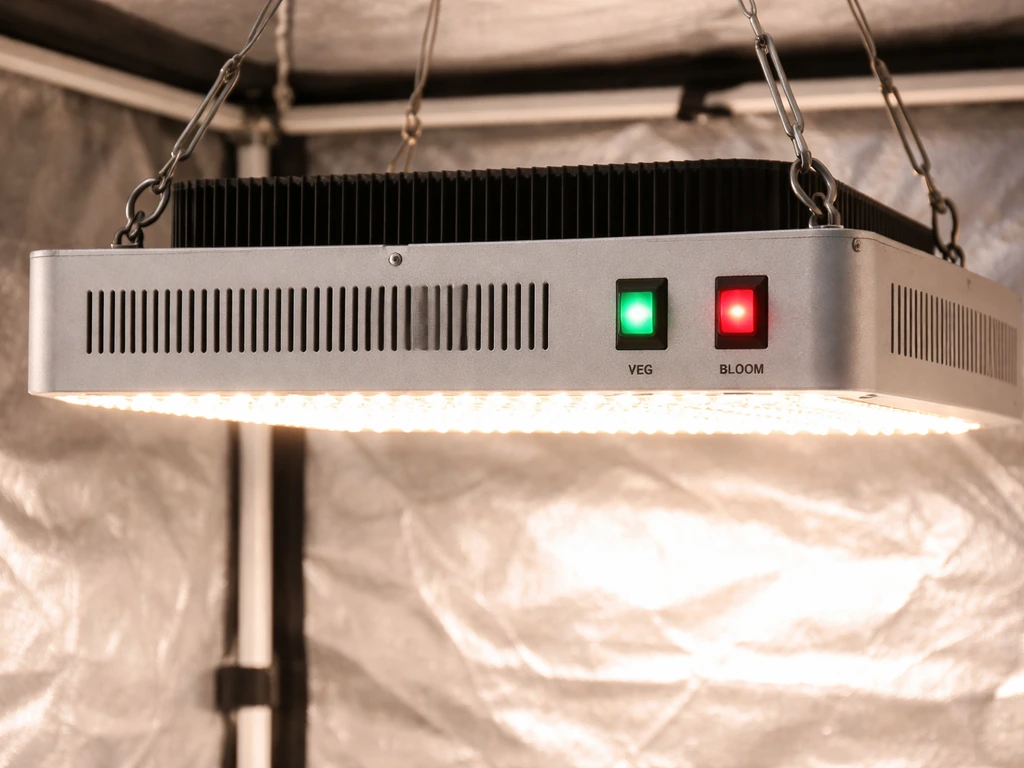
The short answer: Farmlite makes decent budget-to-mid-range grow lights that work well for small tents when you understand their limits. The 240W bar model is the one most hobbyists are shopping, and it can genuinely cover a 4x4ft canopy if you dial in the hanging height and don't expect spider-farmer-tier PPFD uniformity at every corner. If you've been searching around and keep hitting results for 'Eco Farm' and 'Unit Farm' alongside Farmlite, that's not a coincidence. All three names orbit the same product ecosystem, and sorting out what's actually different between them is half the battle before you buy.
Farmlite Grow Light Review Eco Farm and Unit Farm Options

Marcus Caldwell
5 Apr 2026
What Farmlite is and who it's actually for
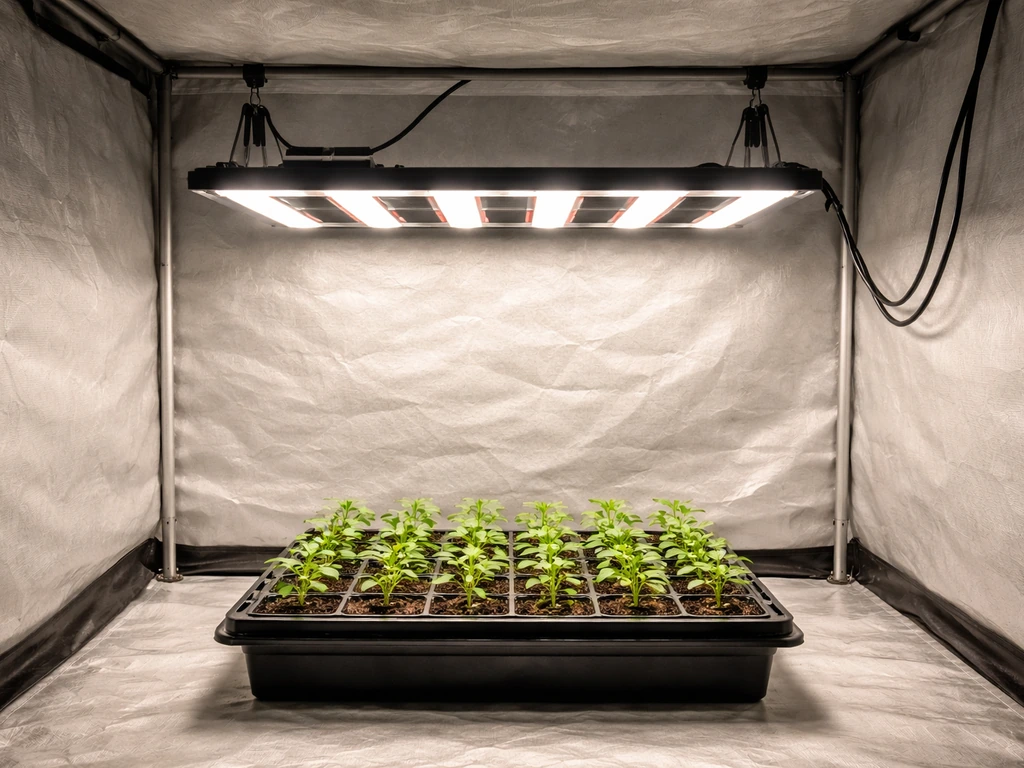
Farmlite is a Chinese LED grow light brand (official site: farmlite.cn) that sells direct and through third-party retailers. Their lineup centers on full-spectrum bar-style and quantum board fixtures aimed at small-scale indoor growers who want Samsung-diode performance without paying Samsung LM301B brand-premium prices. If you're running a 2x4ft or 4x4ft tent and you're not trying to push commercial-grade PPFD, Farmlite sits in a reasonable price bracket.
The audience this light is built for is pretty specific: hobbyist gardeners, small-tent cannabis cultivators, and anyone growing leafy greens or herbs who wants a plug-and-play fixture with some dimming flexibility. It's not a commercial fixture, and it's not designed for growers stacking multiple lights for deep canopy penetration. If you want something with tighter manufacturing tolerances and more independently verified PPFD data, you'd be looking at a different price tier entirely.
One thing worth clearing up before we go further: ECO Farm and Unit Farm are not Farmlite sub-models. They are separate brands, though they're sold through overlapping channels (notably GrowPackage, which operates under ECO Farm Canada Inc). You'll find all three names in the same search results because they compete in the same price range and are often reviewed together. I'll compare the key models directly later in this article.
Specs that actually decide results
Farmlite's headline product is the 240W full-spectrum bar light (Model QS-BAR4, SKU WBLSDB0B81Z28HB), listed at around $193 USD through retail channels. It runs 1,056 Samsung diodes across a bar-array design, covers a claimed 4x4ft footprint, and supports daisy-chain wiring and 0-100% dimming. Those are the marketing numbers. Here's what they mean in practice:
| Spec | Farmlite 240W QS-BAR4 | Unit Farm UF-4000 | ECO Farm 240W LM301B |
|---|---|---|---|
| Actual power draw | 240W | 360W (@ AC120V) | 240W |
| Diode brand | Samsung | OSRAM | Samsung 301B + 660nm/IR/UV |
| Driver | Not specified (dimmable) | Not specified | Meanwell |
| Stated PPFD (18") | Not published by brand | 747.5 μmol/m²/s | 1100 μmol/s |
| Photon efficiency | Not published | 2.7 μmol/J | Not published separately |
| Coverage area | 4x4ft | 4x4ft | 4x4ft |
| Dimming/daisy-chain | Yes | Not listed | Yes |
| Price range | ~$194 | Higher tier | Mid tier |
A few things to flag on that table. The ECO Farm '1100 μmol/s' figure is a PPF (total photon flux) number, not a PPFD (per square meter) number, even though the product page labels it 'PPFD.' That's a common and frustrating mislabeling in this market segment. PPF of 1100 μmol/s across a 4x4ft (roughly 1.5 m²) space would average out to around 733 μmol/m²/s at center, assuming no losses, which aligns reasonably with the Unit Farm UF-4000's stated 747.5 μmol/m²/s at 18 inches. Farmlite doesn't publish a PPFD map at all on the QS-BAR4 page, which is a transparency gap you should factor in.
Real-world performance: brightness, spread, and uniformity
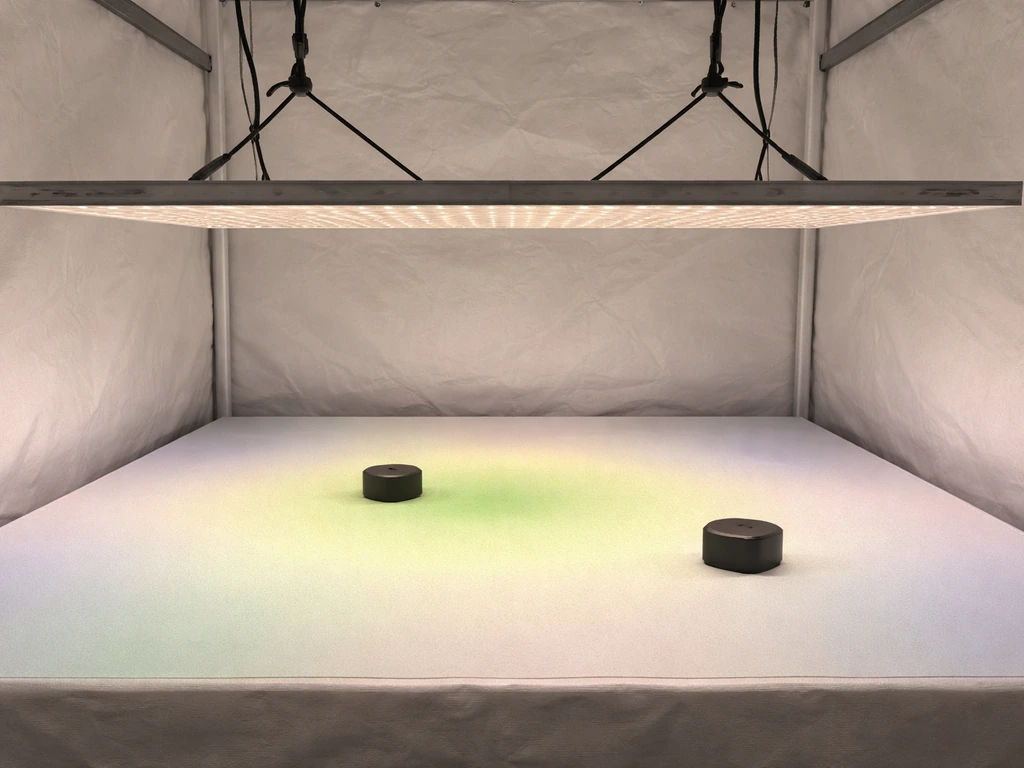
Running the Farmlite 240W at 100% power with the canopy at 24 inches, community users measuring with the Photon app report PPFD in the 600-750 μmol/m²/s range at center. That's consistent with what you'd expect from a 240W Samsung-diode bar array without a Meanwell driver pushing peak efficiency. At 18 inches, center readings climb closer to 800-900 μmol/m²/s, which puts you comfortably in veg range and into low-end flower territory.
The spread is where bar arrays earn their keep over blurple panels. The QS-BAR4 distributes light across multiple parallel bars, which improves uniformity compared to a single central puck. Edge falloff on a true 4x4 canopy is real though. Expect corner PPFD to drop 30-40% below center readings. That's not unusual for any 240W light trying to cover 16 square feet, but it means the 4x4ft coverage claim is generous. For consistent flowering results, treating this as a 3x3ft primary zone with 4x4ft secondary reach is more honest.
One user documented leaf tip yellowing when running at 100% from 24 inches during early veg, which is a light stress symptom rather than a heat burn. At that intensity and height, you're probably pushing 800+ μmol/m²/s on seedlings that want 200-400 μmol/m²/s. The dimmer exists for a reason. Start seedlings at 40-50% output, raise the light to 30+ inches, and ramp up gradually. This isn't a Farmlite-specific issue; it's how any competent grow light should be managed.
Build quality, heat, noise, and efficiency
The QS-BAR4 chassis is aluminum with passive cooling fins along each bar. There's no active fan, which means zero noise. That's a genuine plus in a home environment. The tradeoff is that bar surface temperatures run warmer than fanless quantum boards of equivalent wattage because the heat dissipation area is more concentrated. In a well-ventilated tent with a dedicated exhaust fan, this isn't a problem. In a sealed or poorly ventilated space, you'll notice the ambient temperature climb faster than with a fanless board light that has wider aluminum coverage.
Build quality at the $194 price point is acceptable but not impressive. Connectors feel adequate rather than confidence-inspiring, and the daisy-chain ports are functional. The hanging hardware is basic, though the light is light enough (under 4kg typically for bar arrays this size) that standard tent ratchet hangers handle it fine. The cord length is serviceable for most tent setups. Nothing about the physical construction screams 'this will fail,' but nothing screams 'built to last a decade' either.
On efficiency: the ECO Farm 300W board from the same channel ecosystem posts a PPF efficiency of 1.21 μmol/J, which is reasonable but not exceptional. For context, the Unit Farm UF-4000 claims 2.7 μmol/J, which is a top-tier number that would put it ahead of most premium fixtures. In a Reddit thread discussing Unit Farm UF-4000 efficiency, a user relay states a “Claims 2.7 umol/joule” figure, which is higher than the 2.7 vs 2.17 discussion elsewhere in the thread. I'd treat that claim skeptically without independent verification. Farmlite doesn't publish an efficiency rating for the QS-BAR4. Given the Samsung diode spec and the absence of a confirmed Meanwell driver, a realistic estimate is 2.0-2.3 μmol/J, which is competitive for the price.
Setup, hanging height, and planning your coverage
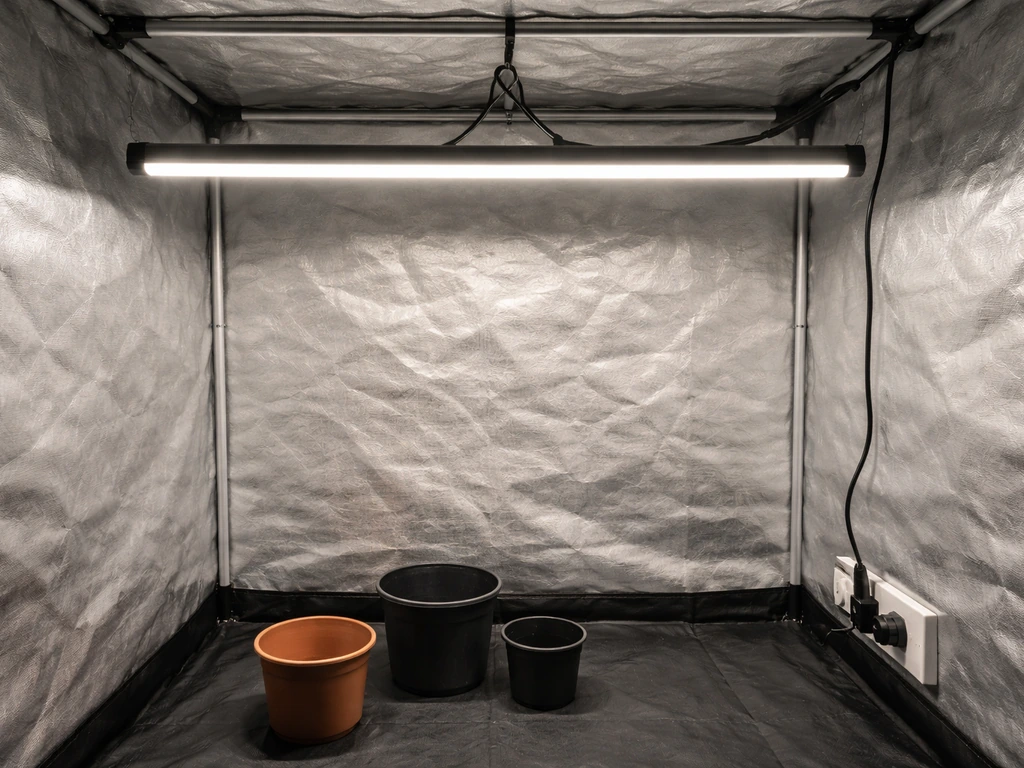
Setup is straightforward. The QS-BAR4 ships assembled; you're hanging it, plugging in the daisy-chain or single power cable, and running the dimmer. For a first-time grower, the only real variable is hanging height, and here's a simple framework based on the UF-4000 guidance (which applies broadly to any 240-360W full-spectrum fixture in this class):
| Growth Stage | Recommended Hanging Height | Target PPFD Range | Dimmer Setting |
|---|---|---|---|
| Seedling / clone | 28–34 inches | 150–300 μmol/m²/s | 30–50% |
| Vegetative | 20–26 inches | 400–600 μmol/m²/s | 60–80% |
| Early flower | 16–22 inches | 600–900 μmol/m²/s | 80–100% |
| Peak flower | 14–18 inches | 800–1000 μmol/m²/s | 100% |
If you're working without a PAR meter, use the UF-4000's published height data as a rough calibration reference and adjust based on plant response. Leaf cupping or bleaching means the light is too close or too intense. Stretchy, pale internodes mean it's too far. For coverage planning: if your tent is 4x4ft, position the light centered and accept that corner plants may need rotation every week or so. For a 3x3ft tent, the QS-BAR4 at 18-22 inches will cover it very evenly and give you excellent veg and flower results.
If you want to cross-reference your setup against another well-documented fixture before committing, reading a lee valley grow light review gives useful context on how bar-style lights in a similar output class handle comparable tent sizes. The hanging height logic transfers directly.
Eco Farm vs Unit Farm vs Farmlite: which model do you actually want
These three brands overlap in search results constantly, and understanding the real differences saves you from buying the wrong thing. Here's the honest breakdown:
Farmlite (QS-BAR4, 240W) is the budget-friendly bar array. Samsung diodes, no published PPFD map, no confirmed Meanwell driver, passive cooling, daisy-chain support. Best for: hobbyists who want a clean bar-array setup for a 3x3 to 4x4 tent without paying premium prices. Its lack of published specs is the main liability.
ECO Farm (240W LM301B Quantum Board) steps up with confirmed Samsung 301B diodes, a Meanwell driver, plus 660nm, IR, and UV supplemental channels. The Meanwell driver matters because it means better efficiency and longer lifespan under sustained loads. The stated PPF of ~1100 μmol/s is competitive. Best for: growers who want the reliability of a name-brand driver and a broader diode spectrum in the same power class.
Unit Farm (UF-4000, 360W) is a different category entirely. At 360W draw with OSRAM diodes and a claimed 2.7 μmol/J efficiency, it's targeting growers who want higher PPFD at the cost of higher power consumption. The UFO-120 sits at the other end of the Unit Farm lineup as a compact option for very small spaces. Best for: growers who need maximum PPFD per square foot in a 4x4 and are willing to pay more per month in electricity. If the 2.7 μmol/J efficiency claim holds, the power cost premium is partly offset by efficiency.
| Brand/Model | Power | Key Diode | Driver | Best Tent Size | Who Should Buy It |
|---|---|---|---|---|---|
| Farmlite QS-BAR4 | 240W | Samsung | Unspecified | 3x3 to 4x4ft | Budget bar-array buyers, hobbyists |
| ECO Farm 240W LM301B | 240W | Samsung 301B + IR/UV | Meanwell | 3x3 to 4x4ft | Growers wanting driver reliability + full spectrum |
| Unit Farm UF-4000 | 360W | OSRAM | Not listed | 4x4ft | High-PPFD flower growers |
| Unit Farm UFO-120 | 120W (approx) | OSRAM/CREE | Not listed | 2x2 to 2x4ft | Small-space / propagation use |
My honest recommendation: if you're on a strict budget and running a 3x3 tent, the Farmlite 240W delivers. If you can spend a bit more and want a more transparent spec sheet with a quality driver, the ECO Farm 240W LM301B board is the better long-term buy. GrowPackage’s ECO Farm warranty page lays out the warranty policy details for the ECO Farm products they sell, which can matter for your purchase decision blank" rel="noopener noreferrer">ECO Farm 240W LM301B board is the better long-term buy. If you're committed to maximizing flower yield in a 4x4 and will run the light hard for multiple cycles, the Unit Farm UF-4000's higher wattage and claimed efficiency make it worth evaluating. A thorough relassy grow light review is worth a read alongside this one if you want another data point in the same budget tier before deciding.
Best crops and stages, plus the mistakes that kill yields
Where the Farmlite 240W performs best
- Leafy greens and herbs: excellent. These crops have low PPFD ceilings (200-400 μmol/m²/s), so even at 50% dimmer and 24-inch height you're in the perfect range.
- Vegetative cannabis or tomatoes in a 3x3: very good. At 70-80% power from 20-24 inches, you're hitting target DLI without stress.
- Flowering cannabis in a true 4x4: marginal. Center plants will be fine; edge plants need rotation to compensate for the 30-40% PPFD drop at corners.
- Propagation and seedling trays: ideal when dimmed down and raised. The bar distribution pattern is actually better for seedling trays than a center-point puck.
Common buying mistakes to avoid
- Taking the 4x4ft coverage claim literally for flowering. Coverage specs almost always describe the maximum light footprint, not the optimal flowering zone. Plan on 3x3ft for dense, even flower canopy.
- Running at 100% from day one. Start at 40-50% and ramp up over two weeks. Light stress in seedlings looks like nutrient deficiency and sends growers chasing the wrong problem.
- Ignoring the tent's temperature when evaluating the light's heat. The QS-BAR4 is passive cooling, so if your tent runs warm from ambient heat plus inadequate exhaust, the light surface will run hotter than it should. Fix your airflow first.
- Assuming Eco Farm = Farmlite = Unit Farm. They share retail channels but are different products with different specs. Read the driver spec before buying anything in this ecosystem.
- Not verifying PPFD claims independently. The ECO Farm label of '1100 PPFD' on the product page is likely a PPF total, not a PPFD density. Use a free Photon app measurement or cross-reference against a known fixture's PAR map to calibrate your own readings.
- Daisy-chaining past the rated limit. The Farmlite daisy-chain feature is useful but has a maximum load. Check the documentation before linking multiple units.
If you're comparing this light against hydroponics-store branded options, it's worth checking out a root farm grow light review to see how retail-branded fixtures stack up on the efficiency and spectrum front, especially if you're growing in a hydro setup where DLI consistency matters more than raw wattage.
For growers looking at alternatives in the same price tier that publish more transparent data, a loriflux grow light comparison is useful, particularly for quantum board formats where diode density and driver quality are easier to evaluate side by side. And if you're considering a stripped-down bar fixture from a less-known brand, reading the rousseau grow light review will give you a realistic baseline for what 'no-frills' build quality looks like at this price range so you can judge Farmlite's construction in context.
The bottom line
The Farmlite 240W QS-BAR4 is a functional, value-priced bar light that does what it claims as long as you're realistic about the coverage zone and manage it properly from the first week. Its weak points are the lack of published PPFD data, an unspecified driver, and the predictable corner falloff of any 240W fixture trying to fill a 4x4. Its strong points are passive (silent) cooling, Samsung diodes at a competitive price, dimming and daisy-chain support, and a build quality that will hold up for several grow cycles if you're not running it at the thermal edge.
If you're choosing between Farmlite, ECO Farm, and Unit Farm: match the fixture to your actual tent size and growth stage needs, not the maximum coverage number on the box. The ECO Farm 240W LM301B is the better specified buy if the price difference is small. The Unit Farm UF-4000 is the choice if you need higher PPFD and have the wattage budget. For a clean, low-noise, budget bar light in a 3x3 tent, the Farmlite earns its place.
FAQ
How should I set the hanging height and dimmer for seedlings versus veg and early flower with the Farmlite 240W QS-BAR4?
Use the light output settings to match your stage, not just the height. Seedlings usually do better starting around 40 to 50% dimming and 30+ inches, then ramp output weekly while watching for leaf tacoing (too much intensity) or thin, stretchy growth (too little).
Will the Farmlite QS-BAR4 really cover a 4x4 evenly, or do I need to plan around edge falloff?
Expect corner plants to underperform if you rely on the full 4x4 claim. A practical approach is to rotate the outer pots every week (or every 5 to 7 days) and keep the canopy level, since uneven leaf height amplifies uniformity issues.
Does the fanless design mean I must run different ventilation compared to fan-cooled grow lights?
Because the bar array has no fan, you should confirm you have enough exhaust and airflow before treating it as a “set it and forget it” light. In a cramped or poorly ventilated tent, ambient temperature can rise faster than with some quantum board setups, which can reduce performance consistency across long runs.
Can I daisy-chain multiple Farmlite bar lights, and what’s the main mistake to avoid when using one timer?
Yes, but do it intentionally. If you plan to daisy-chain multiple lights, make sure you stay within the manufacturer’s electrical limits and use a single timer and dimmer strategy per string (not per light) to keep your canopy at a consistent total photon input.
What are the early signs that the Farmlite is too strong, and what should I change first?
Running a higher-output light at the wrong canopy distance often shows up first as leaf tip yellowing, clawing, bleaching, or sudden slowing of growth. If you see stress symptoms, reduce intensity or raise the light immediately rather than waiting for a full week.
Why does the “unspecified driver” matter, and how can I sanity-check it before I buy?
Look for driver information in the product listing or packaging, because the QS-BAR4 writeups do not provide the same level of clarity as some competing boards. If you cannot confirm the driver brand and model, treat efficiency and lifespan claims as estimates, not guarantees.
If I do not own a PAR meter, how do I still dial in uniform results across the tent?
If you are not using a PAR meter, you can still control for uniformity by keeping plants on a single trellis height and using a top-down canopy plan (for example, one layer in veg, one managed canopy plane in flower). Without that, the corners and taller plants will receive different effective intensity.
When choosing between Farmlite’s claimed footprint and real performance, what’s a better way to plan my grow space?
The biggest coverage planning mistake is assuming the stated footprint equals equal PPFD everywhere. A more reliable method is to plan the light as your primary zone for 3x3 operation, then treat the 4x4 as a secondary reach that may require rotation and tighter canopy management.
Is dimming enough to solve uneven growth, or are there canopy factors I should handle first?
Dimming helps, but it does not fix a poor canopy setup. If leaves are not level, some plants will experience peaks and others will be underlit, so uniform dimming can still lead to uneven flowering. Level the canopy first, then use the dimmer and height to fine-tune.
How do I prevent heat-related issues with a passive-cooled bar light in a sealed tent?
Yes. Bar lights can have warmer bar surfaces than some fanless quantum boards because the heat dissipation area is more concentrated. Make sure the tent exhaust is active and avoid enclosing the fixture in a way that blocks airflow around the fins.