If you need real photon output for a 2x2 or 2x4 ft tent, the VIVOSUN AeroLight A100 system at $189. 99 (single light plus GrowHub E42 controller) is the most capable option you'll find on Walmart's shelves right now, though it's priced more like a specialty horticulture purchase than a casual impulse buy. Everything else in between needs to be evaluated on output per dollar, not wattage claims, which this article walks you through in detail.
What to look for: spectrum, brightness, coverage, and build quality
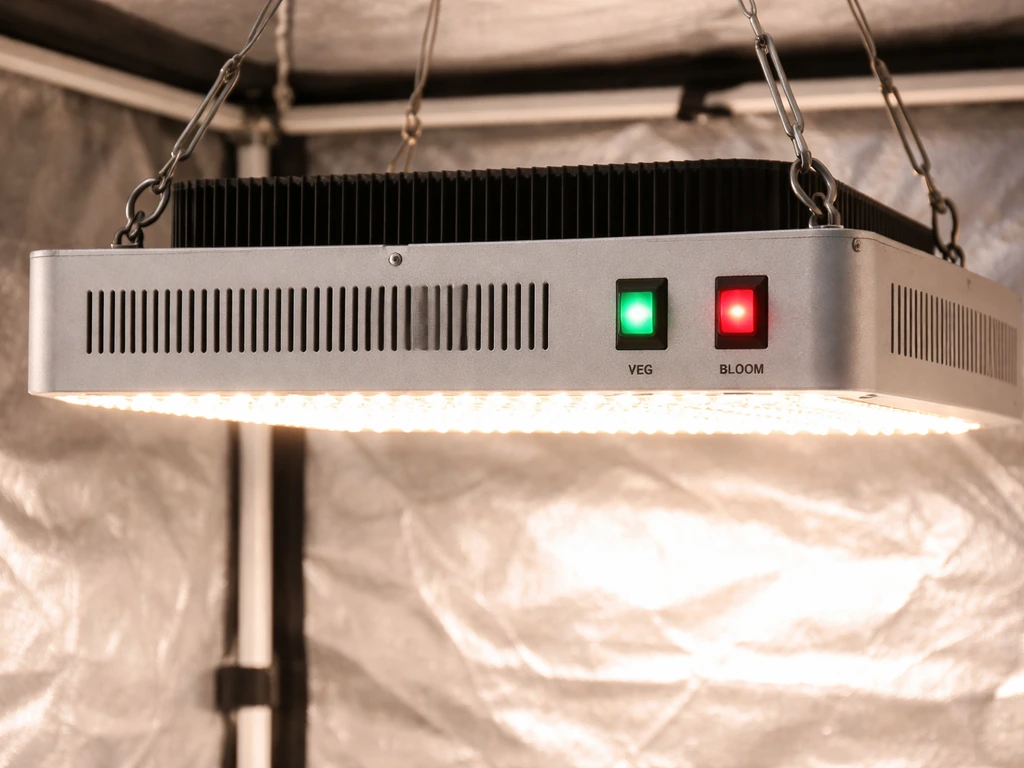
Spectrum matters more than most Walmart listings let on. A light labeled "full spectrum" should cover roughly 400–700 nm of visible light, ideally with strong peaks in the blue range (440–470 nm) for vegetative growth and red (620–680 nm) for flowering and fruiting. Many cheap Walmart panels use a purple/blurple LED mix of just red and blue diodes, which works but gives you poor visibility into plant health and generally lower efficiency per watt compared to white-phosphor full spectrum LEDs. If the listing shows a photo of the light emitting a purple glow, that's a blurple panel. Not a dealbreaker for seedlings or herbs, but it limits versatility.
Brightness on grow light packaging is routinely misrepresented. Ignore "equivalent wattage" claims like "replaces 600W HPS" on a 45W panel. What you actually want is the actual draw wattage (measured at the wall, not peak LED wattage) and, ideally, a PPF (photosynthetic photon flux) value in micromoles per second. A well-built 100W quantum board-style LED typically delivers around 200–230 µmol/s. A cheap 45W blurple panel might deliver only 60–80 µmol/s. Those numbers tell you far more than any marketing claim.
Coverage footprint is another area where specs get inflated. A light rated for a "4x4 ft coverage area" at low intensity may only deliver adequate PPFD (250+ µmol/m²/s for seedlings, 400–600 for herbs and veg) across a 2x2 or 2x3 ft area when you actually measure it. For real coverage planning, look at the PPFD map at your intended hanging height, not the maximum coverage claim. Build quality signals to look for include a metal housing (aluminum dissipates heat far better than plastic), a meanwell or similarly reputable driver brand, and a fan if the unit exceeds 50W. Fanless designs are fine at lower wattages and eliminate noise, but passive cooling only works if the heatsink is properly sized.
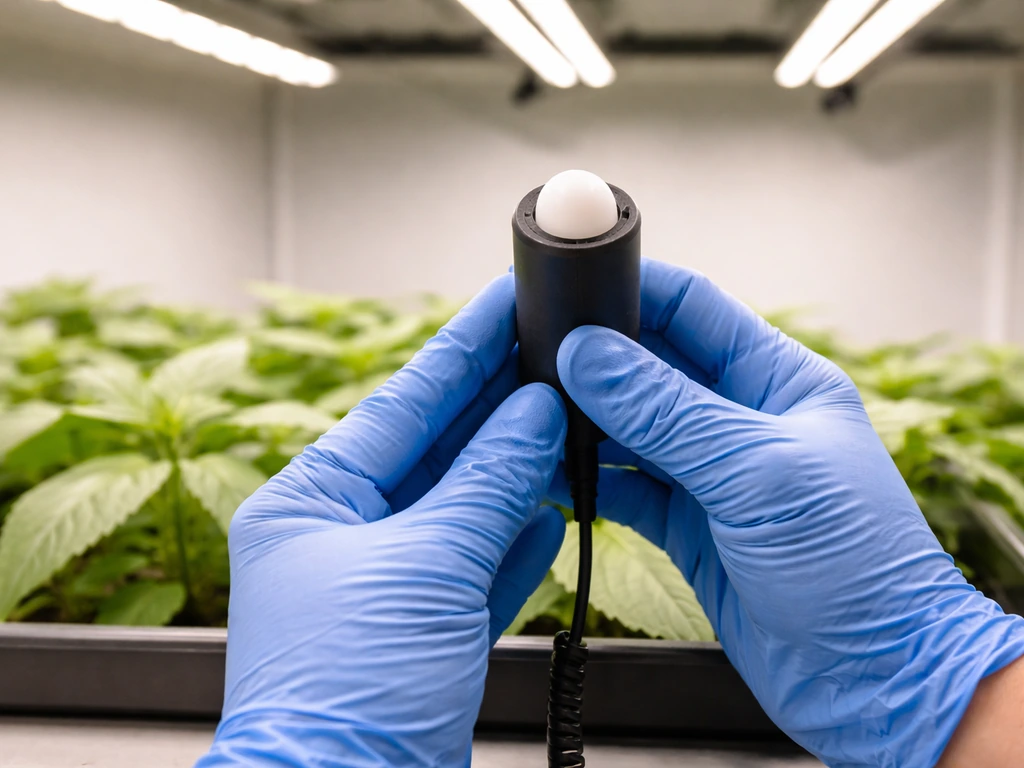
PPFD (photosynthetic photon flux density) is the most useful single number for evaluating grow light performance. It measures the number of photons in the 400–700 nm range hitting one square meter per second, expressed in µmol/m²/s. PPFD is defined as incident photon flux per unit area, reported as μmol·m⁻²·s⁻¹, and PAR refers to wavelengths from 400 to 700 nm, also expressed in μmol·m⁻²·s⁻¹ [PPFD and PAR are defined using photon flux per area with 400–700 nm wavelengths](https://pmc. ncbi.
nlm. nih. gov/articles/PMC4567830/). For reference: seedlings and clones want 100–300 µmol/m²/s, leafy herbs and vegetables in vegetative growth need 400–600 µmol/m²/s, and fruiting plants at peak flowering can benefit from 600–900 µmol/m²/s or higher.
When testing Walmart grow lights, I measure PPFD at the center point and at four corner points of the target coverage area, then average them to get a uniformity score. A good light delivers corner readings at 70% or more of the center reading. Budget panels often drop to 40–50% at the edges, meaning plants at the perimeter are significantly underlit.
In practical testing, a well-known budget outcome with cheap Walmart LED panels (the kind under $40) is a strong center reading of 300–400 µmol/m²/s at 18 inches but edge readings as low as 120–150 µmol/m²/s at the same height across a 2x2 ft area. That means you're only reliably hitting seedling-appropriate levels at the edges, and plants in the corners show it: slower growth, lighter green color, and more stretching compared to center plants.
The VIVOSUN AeroLight A100, by contrast, uses a more optimized beam angle and is designed to be deployed in multi-unit arrays (hence the "100W Light x2" and "100W Light x4" bundle options at $322. 99 and $599. 99 respectively), which improves both total coverage and uniformity across larger footprints.
One other metric worth checking before you buy: flicker. Cheaper drivers operating at lower frequencies produce light that flickers invisibly to the eye but measurably stresses plants over long photoperiods. You can test this by pointing your phone camera at the light and looking for banding in the video. High-quality constant-current drivers (Meanwell is the benchmark) produce essentially flicker-free output. Most budget Walmart LEDs use generic drivers that pass this test inconsistently. It's not a guaranteed problem, but it's worth the 10-second camera check after purchase.
Value analysis: cost per watt and cost per useful light
Cost per watt is an easy calculation but a limited one. A $30 panel drawing 45W costs $0. 67 per watt. The VIVOSUN A100 at $189.
99 for 100W costs $1. 90 per watt. On that metric alone, the budget panel wins. But cost per watt ignores efficiency, which is where the real value story lives.
A better metric is cost per µmol/s of PPF output, sometimes called cost per useful light. If the budget 45W panel delivers 70 µmol/s of PPF, you're paying about $0. 43 per µmol/s. If the A100 delivers 220 µmol/s, you're paying $0.
86 per µmol/s. The budget panel still wins on this metric, but the gap is much smaller than the watt-price comparison suggests, and the quality of light (spectrum coverage, uniformity, driver reliability) is genuinely better on the higher-end unit.
| Light Type | Approx. Price | Actual Draw (W) | Est. PPF (µmol/s) | Cost/Watt | Cost/µmol/s |
|---|
| Budget blurple panel (generic) | $25–$35 | 25–45W | 40–70 µmol/s | $0.60–$0.90 | $0.40–$0.65 |
| Mid-range full spectrum panel (generic) | $45–$80 | 45–65W | 80–130 µmol/s | $0.80–$1.20 | $0.45–$0.65 |
| VIVOSUN AeroLight A100 (single + hub) | $189.99 | 100W | ~200–220 µmol/s | $1.90 | $0.86–$0.95 |
| VIVOSUN AeroLight A100 x2 bundle | $322.99 | 200W total | ~400–440 µmol/s | $1.61 | $0.73–0.81 |
The two-unit bundle at $322.99 actually improves the per-photon cost compared to the single unit because you're spreading the hub/controller cost across more output. If you're planning a 2x2 or 2x4 tent build from the start, the bundle math works more in your favor. For comparison, what Costco sells in the grow light space tends to follow a similar bundle-value pattern, where the per-unit cost drops when buying multi-light kits. One thing to watch: Walmart's listings show "Free 30-day returns" on the VIVOSUN hydroponic system, which is meaningful if you want to test actual PPFD output at home and return it if the numbers don't match what you need.
Best options by grow type and grow space
Seedlings and clones
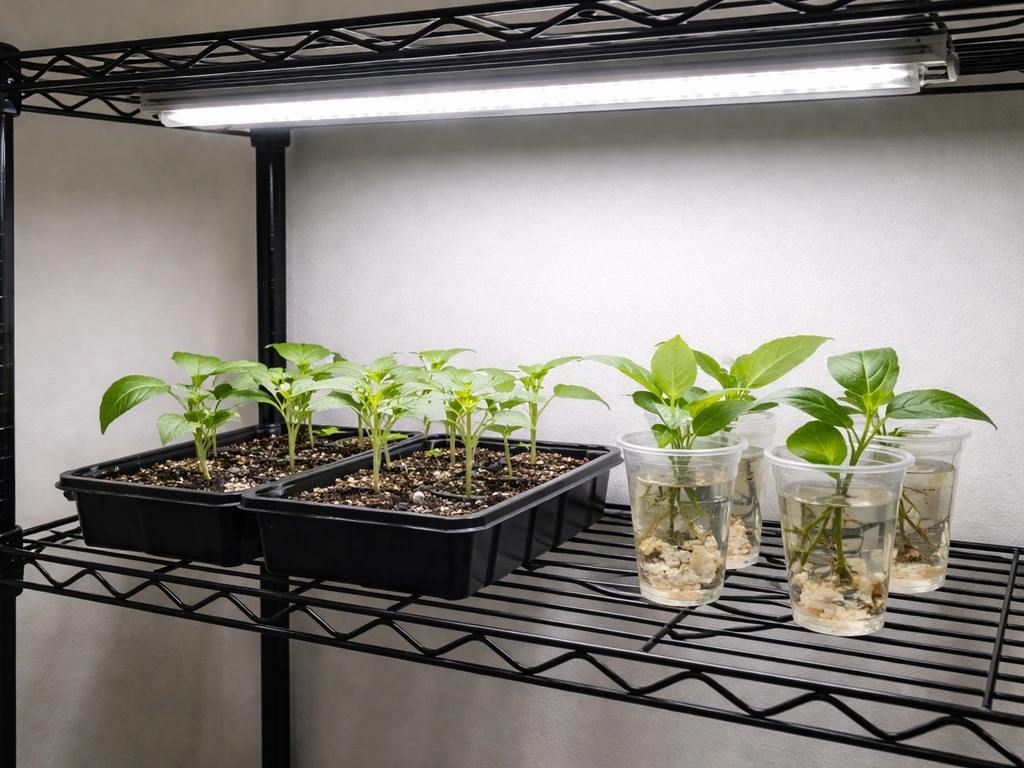
For seedlings and cuttings, you need low-to-moderate PPFD (150–300 µmol/m²/s) and a spectrum heavy in blue wavelengths to keep plants compact and well-rooted. A $25–$40 full spectrum panel from Walmart works well here. You don't need 100W of output for a seedling tray. Keep a 30–45W panel at 20–24 inches above the canopy and you'll hit the right intensity range without stressing young plants. The blurple panels actually work fine at this stage, though a white full spectrum LED gives you better visibility. If you're already considering a more capable light and want a brand comparison, the Wakyme grow light lineup offers some seedling-friendly options worth stacking up against what Walmart stocks.
Herbs and leafy greens on a shelf
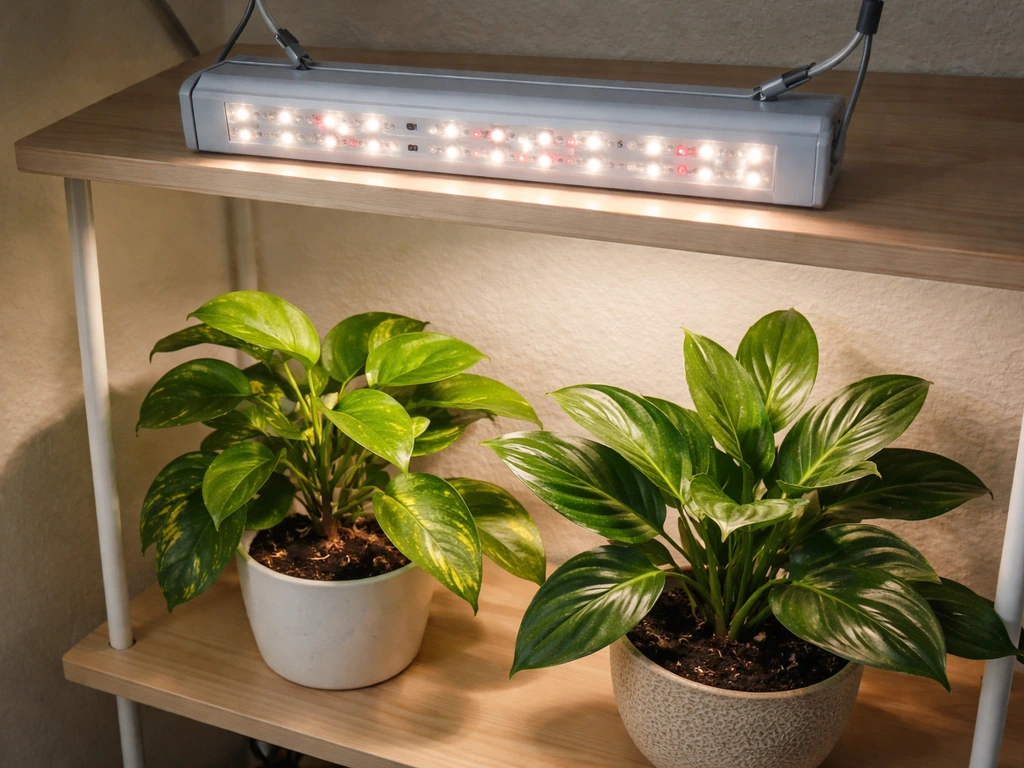
Herbs like basil, mint, and cilantro, plus leafy greens like lettuce and spinach, need a moderate 300–500 µmol/m²/s across a consistent footprint. A $45–$70 full spectrum strip light or panel with good uniformity works well here. For a single shelf around 12x24 inches, a 40–50W bar-style LED mounted 12–16 inches above the plants is typically enough. Strip lights also tend to have better edge uniformity than single-point panels for rectangular shelf footprints. Ikea actually has a comparable product category here, and the IKEA grow light lineup is worth checking if you prioritize aesthetics alongside performance for a kitchen or living space setup.
Vegetative growth in a small tent (2x2 ft)
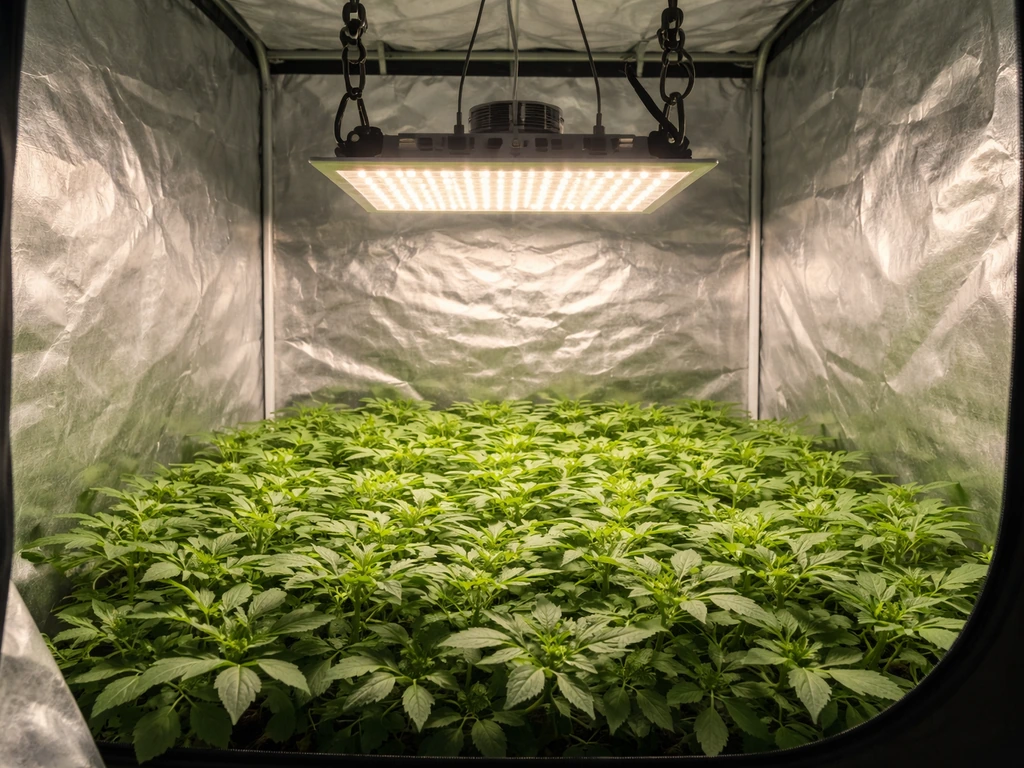
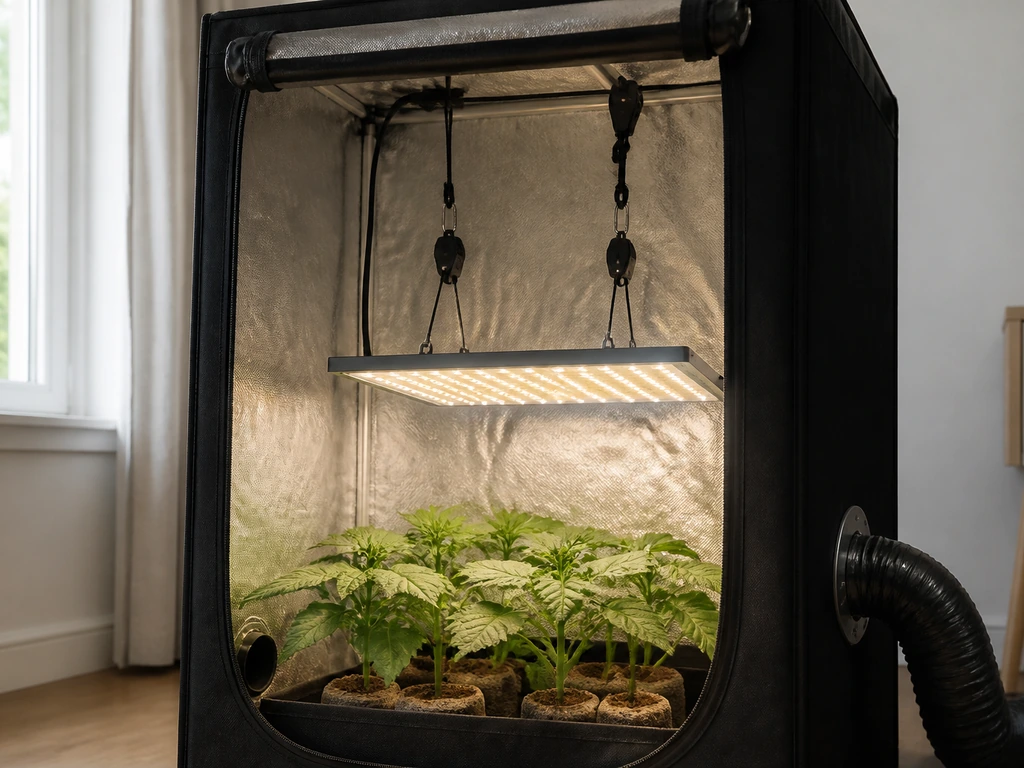
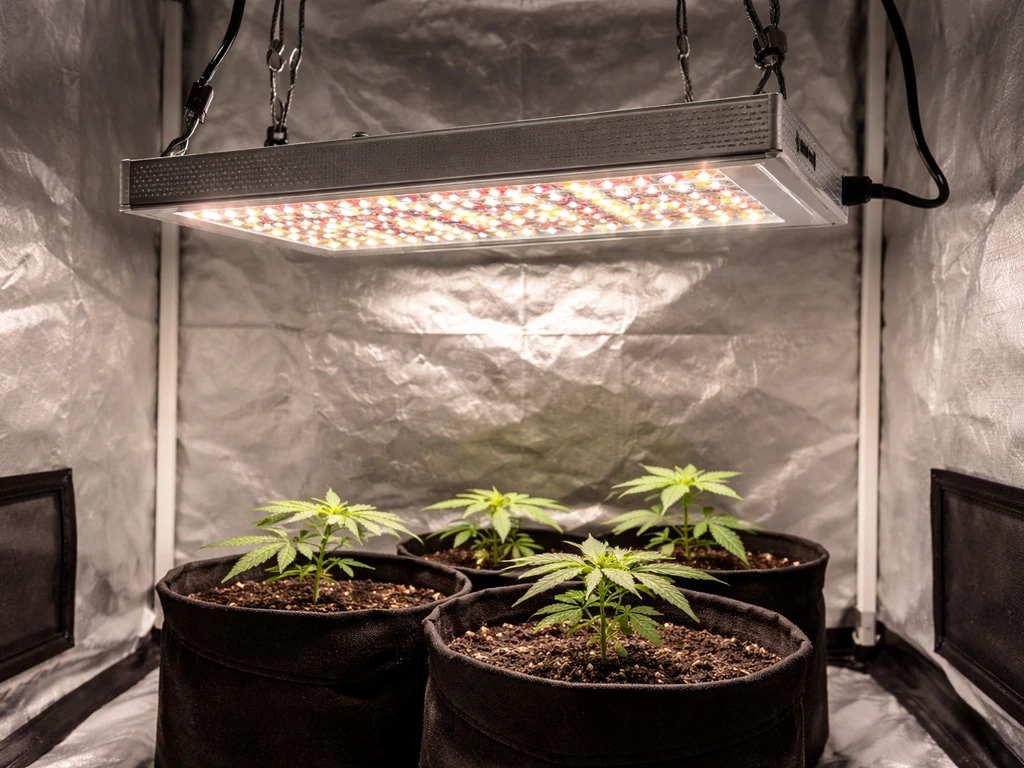
A 2x2 ft tent in vegetative mode needs roughly 400–600 µmol/m²/s across the entire footprint. A single 100W quality LED at the right hanging height (typically 18–24 inches above canopy) hits this comfortably. The VIVOSUN AeroLight A100 is the most capable single unit Walmart currently carries for this purpose. It's a genuine 100W draw, and the GrowHub E42 controller adds dimming and scheduling, which matters for matching the light intensity to your plant stage without buying a separate timer. The integrated circulation fan also helps manage the canopy microclimate, which is underrated for dense veg growth in a sealed tent.
Flowering and fruiting (2x2 to 2x4 ft)
Fruiting plants in flower want 600–900+ µmol/m²/s at the canopy. A single 100W unit will cover a 2x2 ft space in this range if hung properly, but for a 2x4 ft footprint you need either two 100W units or a single higher-wattage fixture. The 2x AeroLight A100 bundle at $322. 99 is designed exactly for this, and the VIVOSUN listing describes the system as covering a 2x2 ft hydroponic footprint with two units.
For a standard 2x4 ft tent in flower, you'd want either four A100 units (the $599. 99 bundle) or a different higher-wattage fixture. At that price point, you're edging into territory where purpose-built grow light brands like those covered in the Wolezek grow light review or the Apelila grow light review might offer better raw output per dollar for flowering applications.
Setup, hanging height, and coverage planning
Hanging height is the simplest lever you have for tuning light intensity without buying anything new. Moving a light 6 inches closer roughly doubles the intensity (following the inverse square law), and moving it 6 inches farther roughly halves it. For practical planning, start with the manufacturer's recommended hanging height (usually 18–24 inches for a 100W panel), take a PPFD reading at the canopy center if you have a meter, and adjust from there. If you don't have a PAR meter, most modern LED driver-controlled lights with a dimmer let you dial down intensity instead of raising height, which is more precise.
For coverage footprint planning, the most common mistake is trusting the "maximum coverage" spec on the box. Use this rule instead: for vegetative light levels (400–600 µmol/m²/s), assume a quality 100W LED covers a reliable 2x2 ft area. For seedling levels (150–300 µmol/m²/s), the same light can cover a 3x3 ft area at a higher hanging height. For flowering intensity (700+ µmol/m²/s), shrink your target area to roughly 1.
5x1. 5 ft per 100W fixture, or use the light closer to the canopy. If your grow space is a shelf rather than a tent, also account for light spill: tents reflect wasted photons back into the canopy, while open shelves lose that benefit, so you may need 20–30% more intensity at the source to hit the same canopy PPFD.
For multi-light arrays like the VIVOSUN two-unit or four-unit bundles, spacing the lights evenly and using the app-controlled dimming (via the GrowHub E42 hub) to synchronize intensity across units is important for uniform coverage. Uneven dimming between units creates light and dark zones that slow growth in the shadowed areas. The GrowHub system handles this automatically if you set all units to the same schedule, which is one of the practical advantages of buying a coordinated kit over two separate lights from different brands.
Common issues and FAQs
Heat output
Modern LED grow lights run far cooler than HID or fluorescent fixtures, but they still generate heat, and cheap aluminum heatsinks on budget panels can run warm enough to affect the driver lifespan over time. As a general rule, if the light housing feels uncomfortably hot to touch after two hours of operation (above roughly 60°C), the thermal design is marginal. For a small tent, even a well-cooled 100W LED adds some heat load, so factor that into your ventilation planning. The AeroLight A100's integrated circulation fan helps move air past the LEDs and slightly reduces ambient temperature buildup in the canopy zone.
Lifespan and driver reliability
LED diodes themselves rarely fail. What fails is usually the driver. Budget fixtures from generic brands use low-cost drivers rated for 20,000–30,000 hours but often performing significantly less in real use, especially if the operating temperature runs high. A Meanwell or comparable quality driver in a mid-range fixture is rated for 50,000+ hours under normal conditions and has a much better track record. If you're buying a budget Walmart panel, check whether the brand has any driver replacement policy or warranty. Most don't, and a dead driver means replacing the whole unit. The VIVOSUN products carry a more structured warranty and have a larger support infrastructure than the generic brands on Walmart's marketplace listings.
Flicker
As mentioned in the performance section, the camera test is your quickest flicker check. Point your phone camera at the light, record a short video, and look for horizontal banding or strobing in the footage. No banding means the driver frequency is high enough to avoid visible or camera-detectable flicker. If you see heavy banding, the driver frequency is low. This isn't proven to harm plants in short grow cycles, but it's a quality indicator. If flicker is a concern, lights from brands with documented constant-current driver specs, including some of those covered in the Wills grow light review, show how driver spec transparency varies significantly between brands.
Dimming behavior
Not all grow lights with a dimmer knob are actually dimming correctly. Some cheap implementations simply reduce voltage rather than use PWM (pulse width modulation) or constant-current reduction, which can affect spectrum balance as you dim. On quality drivers, dimming is linear and doesn't change the color temperature or relative spectrum distribution. On cheap drivers, you may notice the light looking noticeably redder or cooler at lower dim settings. If you plan to use dimming as a key feature (for seedling vs veg vs flower intensity adjustments), this matters and is worth checking in reviews or testing at home during the return window.
Warranty and returns
Walmart's 30-day free return policy on items like the VIVOSUN hydroponic system is worth using as a test window. Buy it, set it up, measure or observe plant response, and return it within 30 days if the output doesn't match your needs. For generic third-party marketplace listings on Walmart.com, check whether the return goes through Walmart or the third-party seller, as policies differ. Items fulfilled by Walmart directly are generally easier to return in-store. Marketplace-only sellers may require mail returns or have more restrictive windows. Always check the "seller" field on the listing before purchase.
Deciding between Walmart and purpose-built grow light brands
Walmart is a convenient source for entry-level grow lights and basic setups, but for anything beyond herbs and seedlings, it's worth comparing against brands that specialize exclusively in horticulture lighting. The Wills grow light lineup, for instance, and brands reviewed across this site are often available online at similar or lower prices with better output specs and longer warranties. The convenience factor of a Walmart pickup is real, but if you're spending $200 or more on a grow light, spending 20 minutes comparing against purpose-built alternatives online usually pays off in better performance per dollar.